AMD借MEXT以半数DRAM保住95%服务器性能
今年 6 月,AMD 接手了名为 MEXT 的预测性内存引擎。该技术宣称,在仅使用低至 25% 物理 DIMM 的情况下,就能提供满配 DRAM 容量系统 99% 以上的性能。这项技术将冷内存页卸载到闪存存储,并利用 AI 模型在页面被需要之前就将其调入。AMD 表示,计划明年将该技术推广到其 IT 基础设施的广泛领域。
MEXT 背后的说法好得令人难以置信。据 AMD 和 MEXT 创始人 Gary Smerdon 称,该技术可将服务器所需的物理 DRAM 减少 20% 至 75%,具体取决于应用和性能目标。那些“缺失的”内存对操作系统而言仍显示为已安装的 DRAM。然而,MEXT 并不使用 DRAM,而是用相对廉价的闪存来卸载冷页面,并在需要时借助 AI 模型将其快速调回。AMD 表示,在其部分内部工作负载中,例如 Synopsys PrimeTime,借助 MEXT 在 50% DRAM 容量下运行时,能够达到满配服务器 95% 的性能。
AMD 已在内部 145 台服务器上部署了 MEXT,并称明年将扩展到 2,000 台服务器。此外,该公司宣布与 HPE 建立合作,将 MEXT 带给客户。目前我们正处于推广的第一阶段,部分 EPYC Venice 服务器带有“MEXT Ready”标识,并配备用于卸载的专用 NVMe 硬盘或盘位。第二阶段将为这些服务器提供 MEXT 许可证,以及 RAM View 应用。AMD 尚未说明第二阶段何时开始。
AI 驱动的 DRAM 涨价潮影响的不只是游戏 PC,企业同样承受着价格上涨的冲击,即便它们并未运行 AI 工作负载。如果 MEXT 能够实现 AMD 所宣称的效果,考虑到当前的市场状况,它可能带来变革性的影响。正因如此,有必要弄清楚 MEXT 究竟是什么,以及 AMD 声称它能做什么。
尽管 MEXT 在概念上令人兴奋,但显然 AMD 在推广上采取了保守的做法。毕竟,非凡的主张需要非凡的证据。MEXT 目前的应用范围较窄,不过 AMD 表示正在扩大 MEXT 所适用的工作负载,并已取得初步的积极成果。
MEXT 的基本思路在概念上很简单:冷页面写入闪存,AI 在需要时把这些页面调回来,就仿佛内存从未缺失过一样。主要问题显而易见。闪存的速度比 DRAM 慢几个数量级,因此按需从闪存把页面流式传回内存并不可行。MEXT 的诀窍在于用 AI 模型预测你将会用到的页面。只要模型能够提前预判的时间至少达到 SSD 的传输延迟,就仿佛物理 DRAM 一直安装在那里一样。
考虑到 MEXT 所使用的基于 Transformer 的 LLM 的工作原理,这一概念并不疯狂。如果你不熟悉其内部机制,这个开源可视化清晰地拆解了 Transformer AI 模型的概念。其基础概念是下一 Token 预测,这也是现代 LLM 设计的根基。给定一组 Token,LLM 判断接下来最可能出现的是哪个 Token(单词、词的一部分等)。它做出一次预测。就 MEXT 而言,它预测的是下一步需要哪个页面,而不是下一个词是什么。
将内存卸载到闪存并非新概念,但 MEXT 创始人 Gary Smerdon 表示,AI 才是这项技术的关键差异所在。MEXT 本身以 Linux 内核模块的形式部署,可兼容任何 Linux 发行版。它使用“AI 模型集成”,其中起主导作用的是基于 Transformer 的 LLM。而关键在于,它并非预先训练好的。
相反,AMD 表示 MEXT 在首次部署时可在不到一秒内完成训练,无需 GPU,仅运行在一个 EPYC 核心上,并随着工作负载的推进持续训练。考虑到 MEXT 可能适用的工作负载多种多样,这种做法是合理的。其思路是让它学习应用程序的访问模式,从而驱动那个预测引擎。
MEXT 并不完美,但它不需要在每种情况下都完美。例如,所存储页面的顺序并不重要。对于文本,LLM 需要按正确顺序预测正确的文本,但对 MEXT 而言,顺序无关紧要。只要在需要时该页面位于 DRAM 中,就没问题。
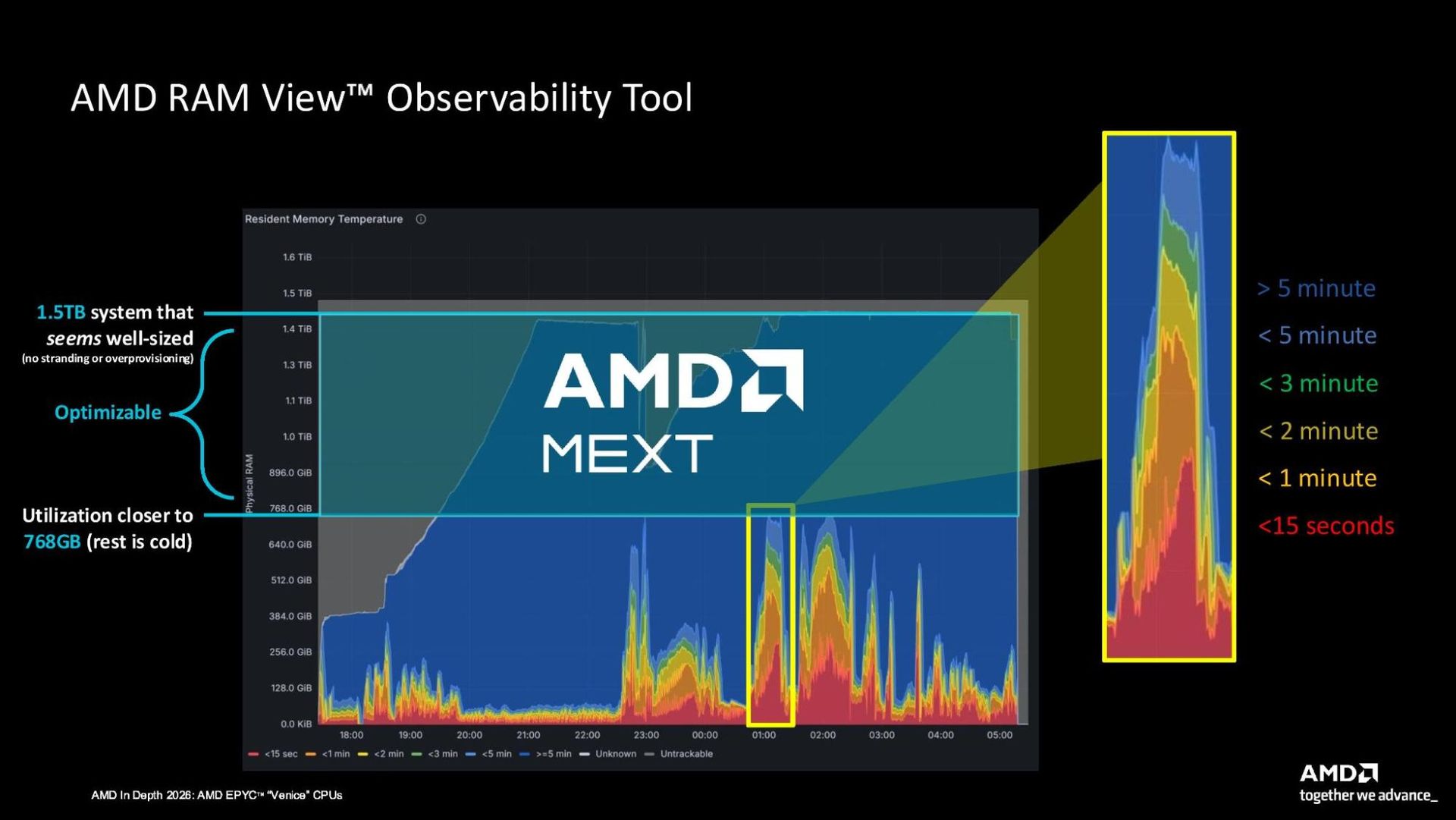
为了解 MEXT 在不同工作负载中的应用情况,AMD 开发了与之配套的 RAM View。这是一款内存利用率工具,可显示哪些页面是热页面、哪些已经变冷。如上方示例所示,一个拥有 1.5 TB 内存的系统在整个工作负载中内存利用率接近满载,但任意时刻,存储在内存中的页面里约有半数在五分钟或更长时间内未被访问过。
AMD 给出的这个示例是泛化的,并未说明测试的是哪种工作负载。这一点非常重要,因为根据服务器上运行的应用不同,利用率构成会大相径庭。起初,AMD 将 MEXT 应用于其内部使用的关键 EDA 应用,例如 Synopsys PrimeTime,但该公司表示,它同时也在着力优化智能体式 AI、数据库以及媒体和娱乐类工作负载。
这一点之所以重要,不仅因为不同应用的内存访问模式不同,还因为当系统内存不足时,这些应用的性能反应也各不相同。AMD 所称的“内存墙”应该是一个并不陌生的概念,无论你是否接触过服务器。AMD 表示,借助 MEXT,它试图拓展这道内存墙,而不同应用所面对的内存墙可能并不相同。
例如,该公司确信许多工作负载可以将容量减少约 20% 到 25%。但随着削减幅度加大,应用会变得更加专用化,性能差异也会随之扩大。
AMD 分享了一些内部的 MEXT 测试结果,看起来相当亮眼,不过照例,对这类第一方基准测试保持怀疑总是明智的。先从 PrimeTime 说起——到目前为止,AMD 对 MEXT 的关注重点主要集中于此。该公司称,以 50% 容量运行的服务器可保留完整服务器 95% 的性能,即便降到 25% 容量,仍能维持该应用 80% 的性能。
对于大型设计,PrimeTime 需要大量内存。AMD 表示,有些应用的性能几乎完全相同。在一个运行于 Azure、采用第五代 EPYC CPU 的 3 节点集群中,AMD 称,在运行 TPC-DS 基准测试中的 Spark SQL 工作负载时,MEXT 以 50% 的 DRAM 容量实现了完整集群 99% 的性能。SQL 数据库会尽可能多地把数据缓存在内存中以避免 I/O 瓶颈,这为像 MEXT 这样想要释放冷页面的技术创造了绝佳机会。
不过,目前最适合的工作负载或许是智能体式 AI,AMD 表示 MEXT 在这方面也有类似的应用。在五个智能体并发的几何平均值下,AMD 声称以 50% 的内存容量可达到完整服务器 99% 的性能,以 25% 的容量可达到 85% 的性能。对于“内存饥渴型”智能体,AMD 声称在 50% 和 25% 容量下分别可达到 90% 和 88% 的性能。
你上面看到的这张幻灯片带有脚注标记。不过,AMD 尚未向我们提供这些脚注,因此我们无法了解这些测试是如何运行的。自然,我们推测 AMD 至少是以尽可能有利的方式呈现了 MEXT 的性能。但在不知道测试如何运行的情况下,我们无法进行全面分析。
有意思的是 AMD 在推出 MEXT 上的谨慎态度。它目前是 EPYC 独占功能,不过 AMD 为很久以后在未来的产品(如 Strix Halo 等消费级设备)上提供支持留了余地。它将作为许可证销售,与 RAM View 软件捆绑,但我们还不知道这一举措的时间表。而且,尽管 AMD 与 HPE 建立了合作以推出“MEXT Ready”服务器,我们仍不知道 MEXT 本身何时才能走出 AMD 内部、可供部署。
考虑到这种保守的做法,MEXT 很可能还存在我们尚未看到的隐患,而且很难想象它能广泛适用于每一台服务器,至少在 AMD 用基准测试展示的 50% 和 25% DRAM 容量水平上是这样。
不过,在当前供应受限的环境下,即便只是削减服务器 25% 的 DRAM 容量,也意味着大幅节省成本。如果某些工作负载能把这一比例推到 50% 容量,那就更好了。当然,我们还需要看 MEXT 在广泛可用后的表现如何,但如果 AMD 的说法站得住脚,它可能会成为那些似乎总也拿不到足够内存的数据中心的标志性技术。
译文由英文原文机器翻译,术语按行业惯例统一,可在文末展开原文核对。
查看英文原文(AMD shares how it can retain 95% of server performance with just half the DRAM, sidestepping memory shortages with MEXT)
In June, AMD overtook the predictive memory engine known as MEXT, which claims to offer upwards of 99% of the performance of a system with full DRAM capacity while running with as little as 25% of the physical DIMMs. The technology offloads cold memory pages to flash storage and uses an AI model to serve pages before they’re needed, and AMD says it plans to extend the tech across a wide swath of its IT infrastructure next year.
The pitch behind MEXT seems too good to be true. According to AMD and MEXT founder Gary Smerdon, the technology can cut the physical DRAM required in a server by 20% to 75% depending on the application and performance target. That missing memory still registers as installed DRAM to the OS. Instead of DRAM, however, MEXT uses relatively inexpensive flash storage to offload cold pages, flying them back in as they’re needed with an AI model. In some of AMD’s internal workloads, such as Synopsys PrimeTime, the company says it’s able to achieve 95% of the performance of a full server while running at 50% DRAM capacity with MEXT.
AMD has deployed MEXT internally on 145 servers, which it says will expand to 2,000 servers next year. In addition, the company has announced a partnership with HPE to bring MEXT to customers. Currently, we’re in phase 1 of the rollout, with some EPYC Venice servers carrying a “MEXT Ready” badge and a dedicated NVMe drive or bay for the offload. Phase 2 brings MEXT licenses out to these servers, as well as the RAM View application. AMD hasn’t said when Phase 2 will begin.
The AI-driven DRAM pricing surge impacts more than just gaming PCs, with enterprises also feeling the brunt of price increases, even if they aren’t running AI workloads. If MEXT is able to achieve what AMD claims, it could be transformative given the current market. Because of that, it’s worth understanding what exactly MEXT is, as well as what AMD claims it can do.
Although MEXT is exciting in concept, it’s obvious that AMD is taking a conservative approach to the rollout. Extraordinary claims require extraordinary evidence, after all. The applications of MEXT are currently narrow, though AMD says it’s expanding the workloads it’s using MEXT on with promising early results.
DRAM, Flash and an LLM
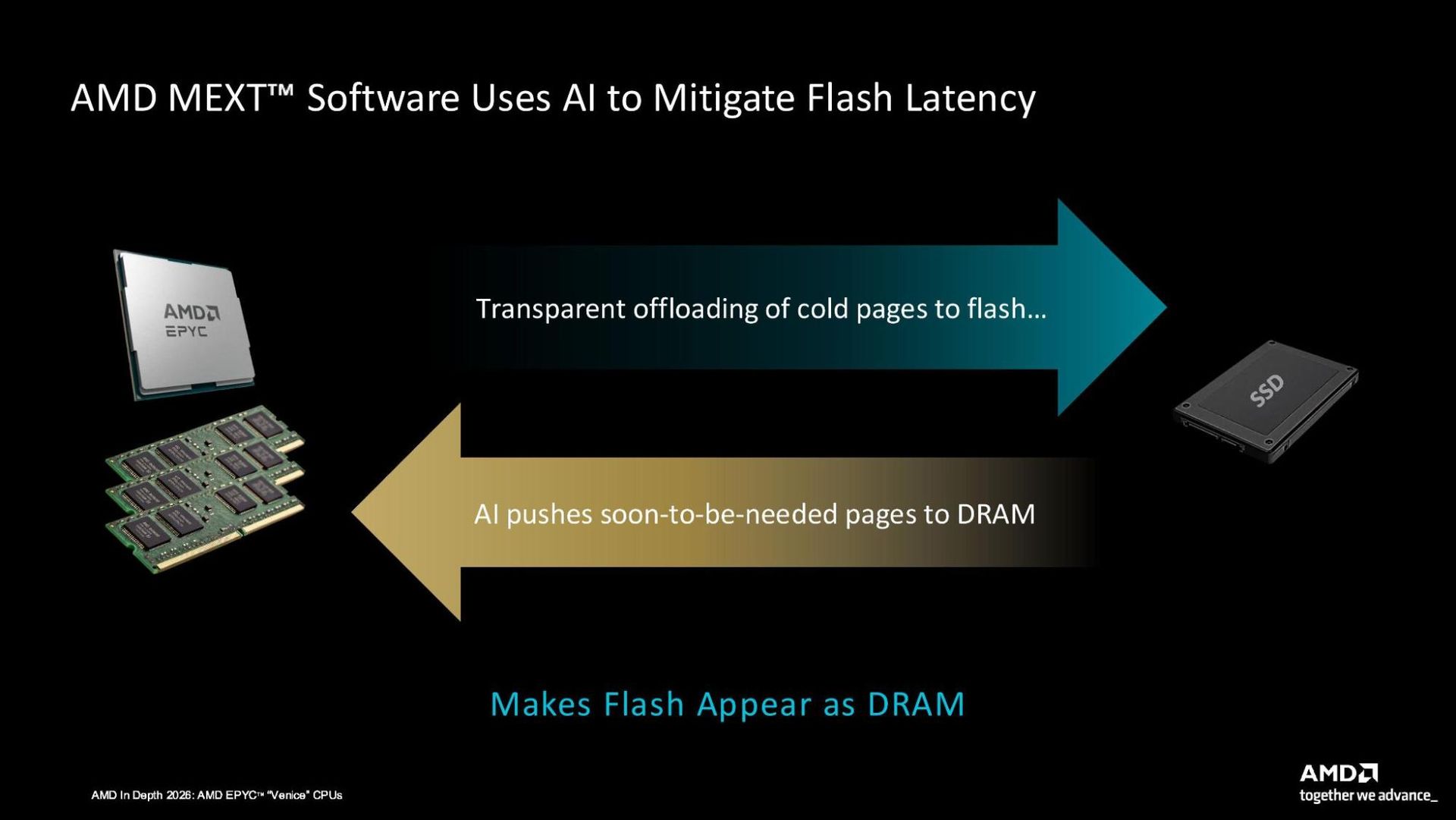
The basic setup of MEXT is simple in concept: cold pages go to flash, AI brings those pages back as needed, and it’s as if the memory was never missing in the first place. The main problem should be obvious. Flash is orders of magnitude slower than DRAM, so streaming pages back into memory from flash as they’re needed isn’t feasible. MEXT’s trick is using an AI model to predict the pages you’ll need. And, as long as the model is able to stay ahead by at least the transfer latency from the SSD, it’s as if the physical DRAM was installed the whole time.
This isn’t a crazy concept considering how a transformer-based LLM, which MEXT uses, operates. If you’re unfamiliar with the inner workings, this open-source visualization breaks down the concept of a transformer AI model cleanly. The foundational concept is next token prediction, which underpins the design of modern LLMs. Given a set of tokens, the LLM determines which token (word, portion of a word, etc.) is most likely to come next. It makes a prediction. In the case of MEXT, it’s predicting what page is needed next, not what word comes next.
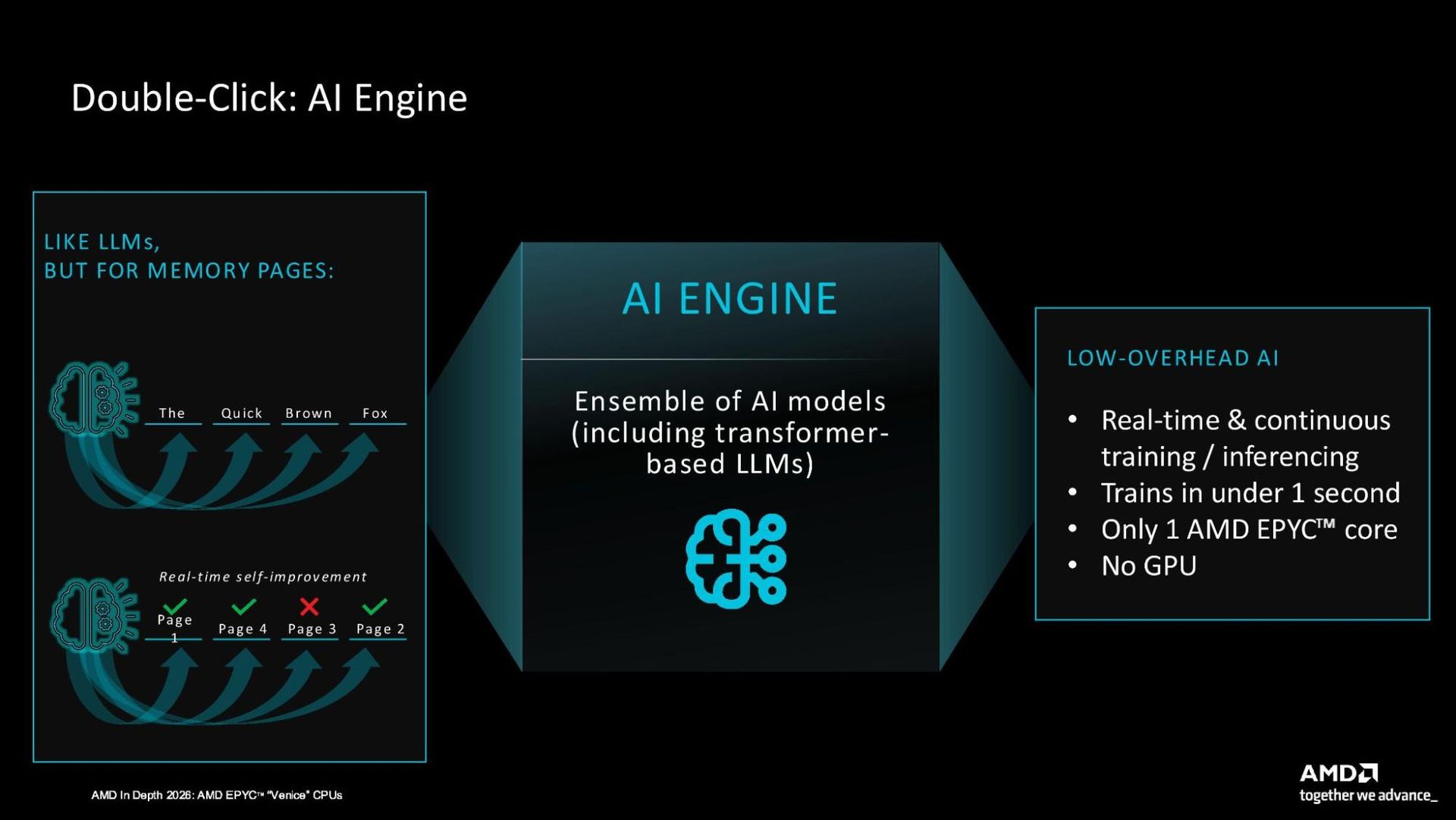
Memory offloading to flash isn’t a new concept, but MEXT founder Gary Smerdon says that AI is the critical difference in this technology. MEXT itself is deployed as a Linux kernel module that works with any Linux distro. It uses an “ensemble of AI models,” with the primary transformer-based LLM driving the technology. And critically, it doesn’t come pre-trained.
Instead, AMD says that MEXT trains in under a second when first deployed, operates on one EPYC core without a GPU, and continually trains as the workload progresses. This approach makes sense given the varied workloads that MEXT may apply to. The idea is that it would learn the access patterns of the application in order to drive that prediction engine.
MEXT isn’t perfect, but it doesn’t need to be perfect in every situation. For instance, the order of stored pages isn’t important. With text, an LLM needs to predict the correct text in the correct order, but with MEXT, the order doesn’t matter. As long as the page is in DRAM when it’s needed, that’s fine.
In order to understand the application of MEXT to different workloads, AMD has developed RAM View to go alongside the tech. It’s a memory utilization tool that shows which pages are hot and which have gone cold. As you can see from the example above, a system with 1.5 TB of memory shows near-full utilization across the full workload, but around half of the pages stored in memory haven’t been touched in five minutes or more at any given time.
AMD provided this generalized example and didn’t clarify what workload it was testing. That’s very important, as the utilization breakdown will look vastly different depending on the application(s) running on the server. Initially, AMD is applying MEXT to critical EDA applications it uses internally, such as Synopsys PrimeTime, but the company says it has focused on optimizing agentic AI, database, and media and entertainment workloads as well.
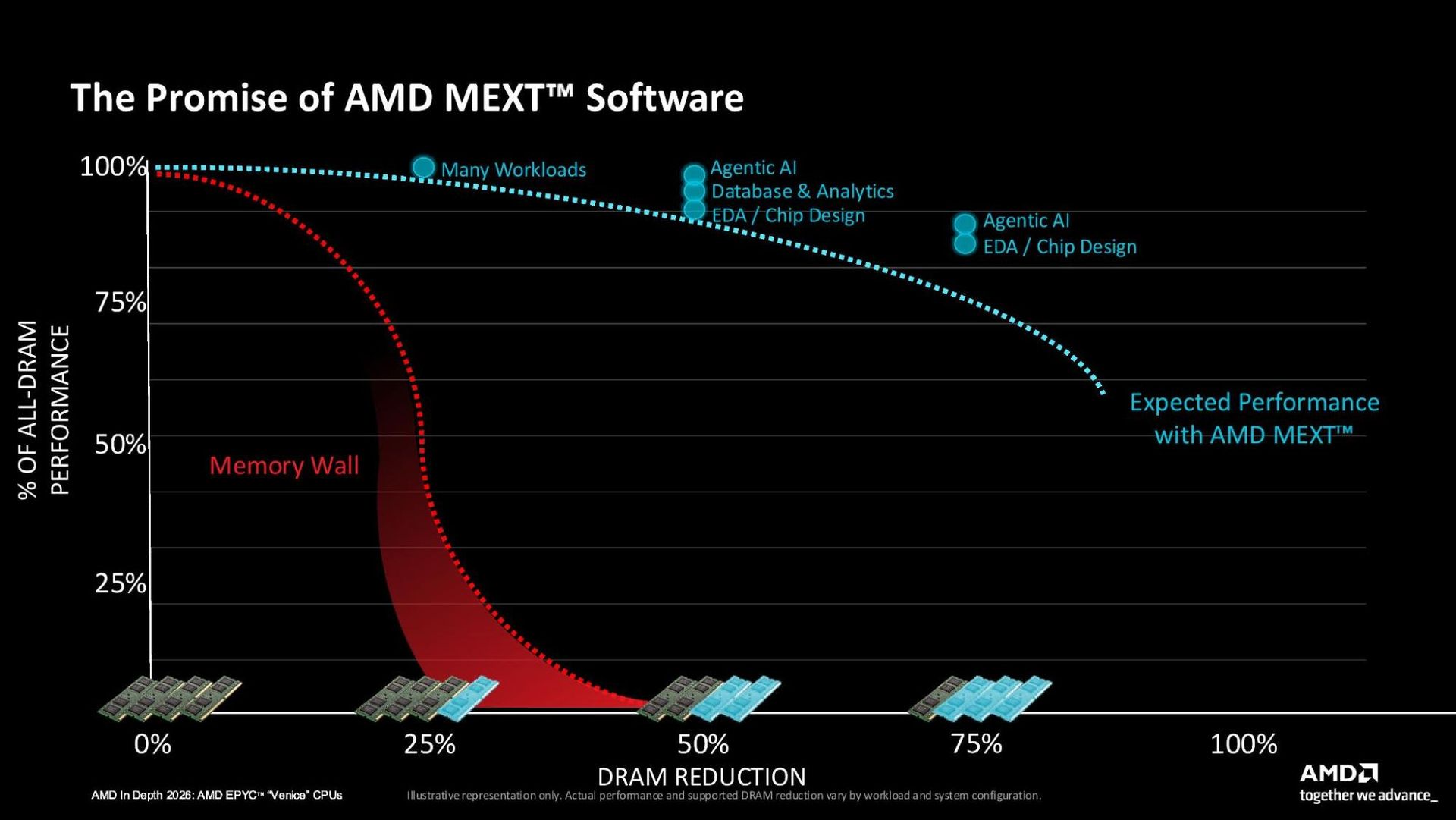
This is important not only because memory access patterns change between applications, but also because performance in those applications reacts differently when a system doesn’t have enough memory. The “memory wall,” as AMD calls it, should be a familiar concept regardless of whether you’ve ever touched a server. With MEXT, AMD says it’s trying to extend this memory wall, which may look different for different applications.
For instance, the company is confident that many workloads can reduce capacity by around 20% to 25%. As the reduction increases, however, the applications become more specialized, and the performance delta becomes greater.
AMD’s internal MEXT results
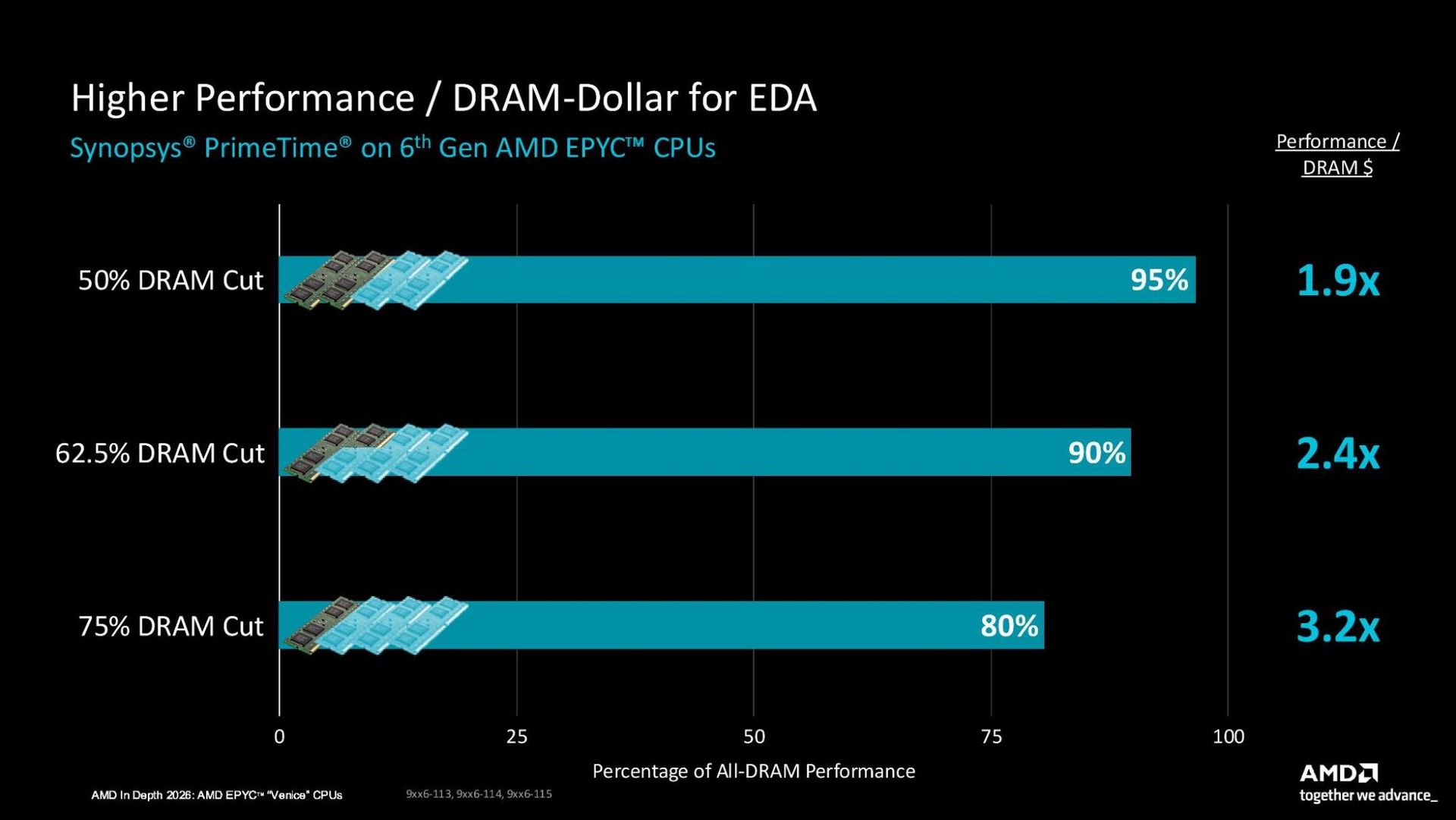
AMD has shared some internal MEXT results, which look impressive, though as usual, it’s always smart to handle first-party benchmarks like this with skepticism. Starting with PrimeTime, where AMD has focused much of its attention on MEXT up to this point, it says servers running at 50% capacity retain 95% of the performance of a full server, and going down to as little as 25% capacity still maintains 80% of the application’s performance.
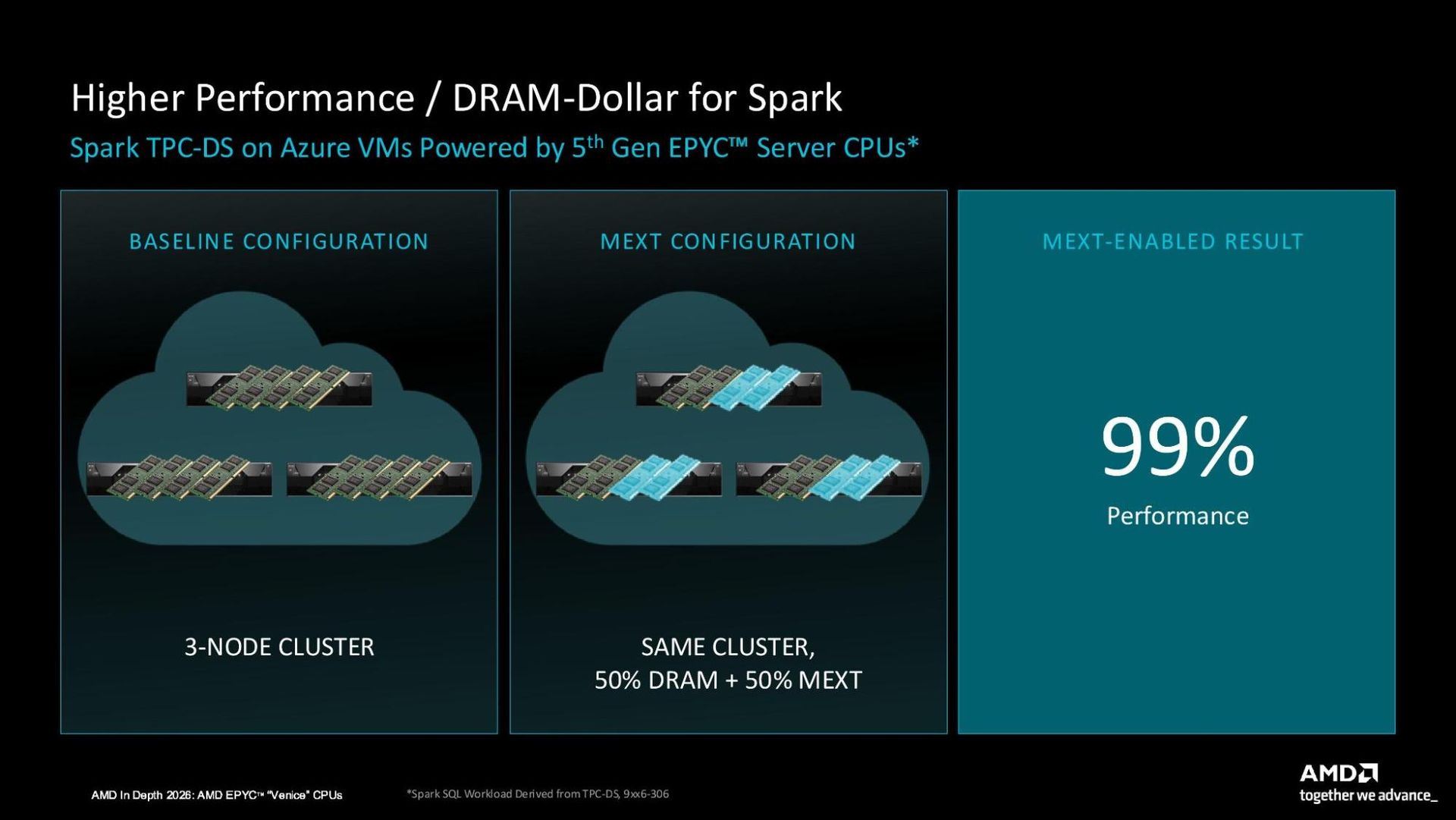
PrimeTime demands a lot of memory for large designs. There are some applications where performance is nearly identical, according to AMD. In a 3-node cluster running in Azure with 5th-gen EPYC CPUs, AMD says MEXT offers 99% of the performance of the full cluster while running at 50% DRAM capacity with the Spark SQL workload from the TPC-DS benchmark. SQL databases try to cache as much data as possible in memory to prevent I/O bottlenecks, creating a golden opportunity for tech like MEXT that wants to free cold pages.
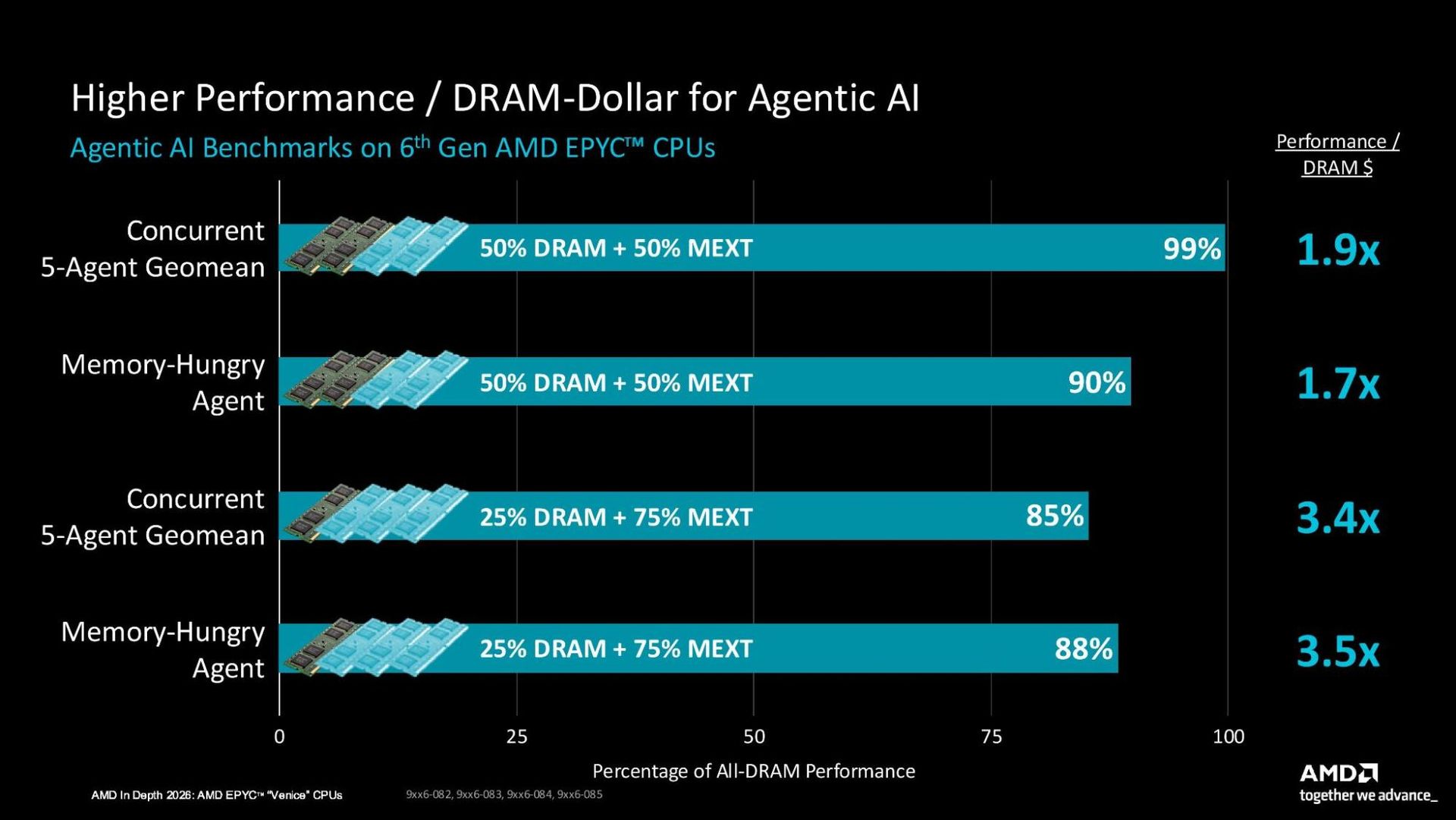
Perhaps the most applicable workload at the current moment, however, is agentic AI, and AMD says MEXT has similar applications there. Across a five-agent concurrent geomean, AMD claims 99% of the performance of a full server with 50% memory capacity, and 85% of the performance with 25% capacity. With a “memory-hungry” agent, AMD claims 90% and 88% performance for 50% and 25% capacity, respectively.
The slide you can see above has footnote tags. However, AMD has not shared the footnotes with us yet, so we don’t have a view into how these tests were run. Naturally, we assume AMD has, at minimum, represented the performance of MEXT in the best light possible. We can’t do a full analysis without knowing how the tests were run, however.
What is interesting is AMD’s cautious approach to rolling out MEXT. It’s an EPYC-exclusive feature right now, though AMD left the door open for support on future products (consumer devices, such as Strix Halo) far down the road. It will be sold as a license, bundled with the RAM View software, but we don’t have a timeline on when that will happen. And, despite a partnership with HPE to push out “MEXT Ready” servers, we still don’t know when MEXT itself will be ready for deployment beyond AMD’s walls.
Given that conservative approach, there are likely pitfalls to MEXT that we’re not seeing yet, and it’s hard to imagine it will be broadly applicable to every server, at least at the 50% and 25% DRAM capacity levels that AMD showed off with its benchmarks.
However, even being able to trim 25% of a server’s DRAM capacity represents a massive cost savings in the current supply-constrained environment. If some workloads can push that to 50% capacity, that’s even better. Of course, we’ll need to see how MEXT holds up once it’s available broadly, but if AMD’s claims hold water, it could become a defining technology in data centers that can’t seem to get enough memory.
正文保留英文原文,标题与摘要由机器翻译。
原文发布于 Tom's Hardware(AMD shares how it can retain 95% of server performance with just half the DRAM, sidestepping memory shortages with MEXT),标题、摘要与正文由机器翻译,术语按行业惯例统一,未经人工逐句校订。