不花大钱微调 LLM 的 5 种技术
作者:Shittu Olumide,技术内容专家,2026 年 11 月 10 日,语言模型栏目
一个团队从供应商那里拿到报价:五万美元,为他们构建一个基于其支持工单训练的「定制 AI 模型」。团队里有人心存怀疑,花了一个周末测试这份报价所依据的实际技术。真实的 GPU 账单不到十美元。
这个差距不是四舍五入的误差,也并不罕见。微调大语言模型(LLM)一直背负着「只有研究实验室才做得起」的名声,而对于从零开始全量微调一个前沿模型来说,这个名声是名副其实的:那种规模的训练确实要花费数千万甚至数亿美元。但如今,把现有的开放权重模型适配到特定任务,已经完全是另一个成本量级,而大多数解释这一差距的指南要么只讲到某一种技术就戛然而止,要么从不给出真实可运行的代码。
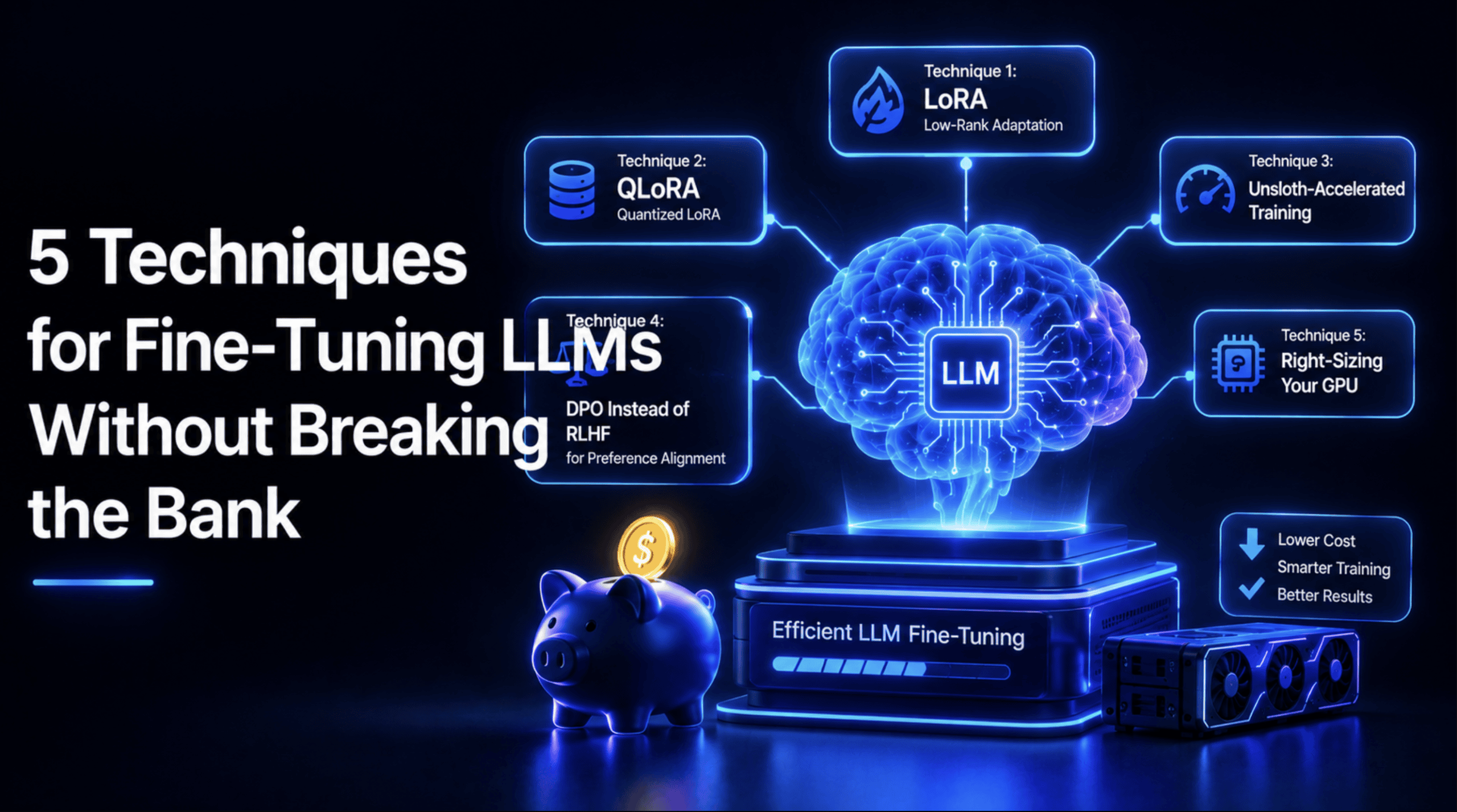
本文两者都做到了。它涵盖五种低成本微调 LLM 的不同技术——从低秩适配(LoRA)和量化低秩适配(QLoRA)这类参数高效方法,到更快的训练工具、更廉价的对齐目标,以及那些悄无声息地把大多数人账单翻倍的基础设施决策——每一种都配有真实用例和可运行的代码。
微调大语言模型究竟意味着什么
微调是指取一个已在广泛、通用的语料上完成预训练的模型,再在一个更窄、面向特定任务的数据集上继续训练,使其行为可测量地向你真正需要的样子偏移——某种特定格式、某个特定领域、一致的语气——而不是从零开始。
值得把它与其他塑造模型行为的方式放在一起比较,因为微调是若干选项中的一个真实选择,而非默认做法。按照 Let's Data Science 2026 年这一领域的指南所给的框架,提示工程、少样本示例和检索增强生成(RAG)都能在不改动任何一个权重的前提下塑造模型的产出,这正是它们尝试起来更快、更新起来更容易的原因。微调则是真正改变模型本身的那个选项。这比编辑一段提示词是明显更大的投入,因此值得审慎判断它何时才真正是正确选择。
团队为何真的会微调
这里值得说得具体些,而不是含糊带过,因为“微调能让模型更好”这一说法经不起推敲:一个提示得当的前沿模型往往已经足够出色。有三种真实情形会让天平倒向微调。
第一是规模化下的行为一致性:需要模型在数千次调用中可靠地保持某种行为方式,而不是指望系统提示在每一次调用中都能顶住压力
第二是精确的输出模式或格式,无论提示词如何措辞,通用模型都无法可靠地稳定做到
第三是狭窄的领域词汇或特定的品牌语气,否则每次提示都要重新解释一遍,从而在每一次调用中悄悄抬高 Token 成本
同样重要的是,要诚实地判断什么时候它并不是正确的选择。根据 hjLabs 的 2026 最佳实践指南,大约 80% 以「我们需要微调一个模型」为名义提出的需求,实际上通过更好的检索就能解决。当上述三种情况确实成立时,微调是一种真实且持久的能力升级;而当情况并非如此时,它只是一种代价高昂的方式来修补提示词或检索问题。
哪些大语言模型实际上可以被微调
在动手使用任何技术之前,先了解有哪些选项真正可用会有所帮助。有几个开放权重模型系列直接支持微调,背后有成熟的工具链和活跃的社区:Llama 3.x、Qwen 2.5 和 3、Mistral、Gemma 2 到 4,以及 Phi。本文中的五种技术都可以直接应用于上述任何一个模型。
对于完全不想接触训练基础设施的团队来说,托管式微调 API 是当下一个真实可行的选择。OpenAI 和 Google 都在各自的平台上针对部分模型提供微调服务,而 Together AI 和 Fireworks 等供应商直接提供按 Token 计费的 LoRA 微调,代价是略高的每 Token 训练成本,换来的是无需管理任何基础设施。
有一个关于扩展性的坦率提醒值得尽早指出,因为它会显著改变这笔账:本文中的一切都假设是约 2B 到 13B 区间的稠密模型,在这些模型上,上述技术可以在单块 GPU 上轻松运行。一旦超过约 70B 参数,尤其是当模型是稀疏的混合专家架构而非稠密架构时,即便是 QLoRA 也需要一个真正的多 GPU 节点,才能把量化后的权重装进内存。
微调大语言模型的真实成本
截至 2026 年年中,这些数字实际落在什么区间,值得先看完整范围,再假设某一个数字具有代表性。在 2 到 8B 的小模型上,参数高效方法通常的纯 GPU 时间成本低于 $10,而在高端基础设施上对更大模型进行全量微调,成本可能超过 $10,000。更具体地说,Stratagem Systems 于 2026 年 7 月核实的费率显示,对 7 到 8B 模型进行 LoRA 或 QLoRA 微调,GPU 时间成本为 $3 到 $10(在租用的 A100 上运行两到四小时),或在租用的 RTX 4090 上低于 $3,而 70B QLoRA 运行的成本约为 $15 到 $30。
不过,对于规划真实项目而言,真正最重要的细节是:GPU 小时数如今已是整个流程中最小的一项支出。真正的开支在于数据集创建、多次迭代运行和评估——这些工作每次基础模型更新时都会重复发生。正因如此,即便计算本身只花费个位数美元,完整的真实项目成本仍落在 $5,000 到 $15,000 区间。
五种技术速览
在深入介绍每一种技术之前,先看这张图。其中两种是算法层面的,一种是工具优化,一种改变训练目标,还有一种属于基础设施决策。它们设计为可叠加使用,而非相互竞争。
可训练参数量
与全量微调相比,大幅削减计算量和存储需求
一块拥有足够 VRAM、能以 16-bit 精度容纳完整模型的 GPU
彻底消除 GPU 预算这一限制因素
单块消费级 GPU,通常为 8 至 24GB
训练速度与内存
在 LoRA/QLoRA 已有节省的基础上,进一步缩短实际租用时间
与 LoRA/QLoRA 相同,通常更少
直接偏好优化(DPO)
对齐训练流程
省去了基于人类反馈的强化学习(RLHF)所需的奖励模型与强化学习基础设施
与所搭配的任一适配器方法相同
往往在五项中是单项节省最大的一项
没有特别指定;这是一项采购决策
技术一:低秩适配(LoRA)
LoRA 是本文其余内容所依托的基础技术,因此值得理解其实际机制,而不是把它当作黑箱。LoRA 在训练中不更新模型中的每一个权重,而是冻结整个基础模型,并在既有权重矩阵旁注入小型、可训练的低秩矩阵。这一思路来自 Hu 及其同事 2021 年的原始论文,其所基于的假设是:让模型适配新任务所需的权重变化具有较低的内在秩,也就是说,一组小得多的参数就能捕捉到几乎所有有用的适配。在实践中,这意味着只训练模型总参数中极小的一部分,通常不到 1%,而原始权重则完全不被改动。
下面是一个真实、可运行的例子:在 Databricks Dolly 15k 数据集上微调 Llama 3.1 8B Instruct,这是一个真正公开、由人类编写的指令数据集,涵盖开放式问答、摘要和分类等任务。
原文较长,译文为节选;译文由英文原文机器翻译,术语按行业惯例统一,可在文末展开原文核对。
查看英文原文(5 Techniques for Fine-Tuning LLMs Without Breaking the Bank)
By Shittu Olumide, Technical Content Specialist on November 10, 2026 in Language Models
A team gets a quote from a vendor: fifty thousand dollars to build them a "custom AI model" trained on their support tickets. Someone on the team, skeptical, spends a weekend testing the actual technique that quote was based on. The real GPU bill comes out under ten dollars.
That gap isn't a rounding error, and it isn't unusual. Fine-tuning large language models (LLMs) has a reputation as a research-lab-only activity, and for full fine-tuning of a frontier model from scratch, that reputation is earned: training runs at that scale really do cost tens or hundreds of millions of dollars. But adapting an existing open-weight model to a specific task is a completely different cost category now, and most of the guides explaining that gap either stop at one technique or never show real, runnable code.
This article does both. It covers five distinct techniques for fine-tuning LLMs cheaply — from parameter-efficient methods like low-rank adaptation (LoRA) and quantized low-rank adaptation (QLoRA) to faster training tooling, cheaper alignment objectives, and the infrastructure decisions that quietly double most people's bills — each with a real use case and working code.
What Fine-Tuning a Large Language Model Actually Means
Fine-tuning takes a model that's already been pretrained on a broad, general corpus and trains it further on a narrower, task-specific dataset, so its behavior shifts measurably toward what you actually need — a particular format, a specific domain, a consistent tone — without starting from nothing.
It's worth placing that next to the other ways to shape a model's behavior, since fine-tuning is a genuine choice among several, not the default. Prompt engineering, few-shot examples, and retrieval-augmented generation all shape what a model produces without touching a single weight, which is exactly why they're faster to try and easier to update, per the framing in Let's Data Science's 2026 guide to the space. Fine-tuning is the option that actually changes the model itself. That's a meaningfully bigger commitment than editing a prompt, which is why it's worth being deliberate about when it's genuinely the right call.
Why Teams Actually Fine-Tune
It's worth being specific here rather than hand-wavy, since "fine-tuning makes the model better" doesn't hold up under scrutiny: a frontier model prompted well is often already excellent. Three real situations tip the scales toward fine-tuning specifically.
The first is behavioral consistency at scale: needing a model to reliably behave a certain way across thousands of calls rather than hoping a system prompt holds under pressure every single time
The second is an exact output schema or format that a general-purpose model won't commit to reliably, no matter how the prompt is worded
The third is narrow domain vocabulary or a specific brand voice that would otherwise need re-explaining in every single prompt, quietly inflating token cost on every call forever
It's just as important to be honest about when it isn't the right call. According to hjLabs' 2026 best-practices guide, roughly 80% of requests that arrive framed as "we need to fine-tune a model" turn out to be solvable with better retrieval instead. Fine-tuning is a real, durable capability upgrade when one of the three situations above genuinely applies. It's an expensive way to patch a prompting or retrieval problem when it doesn't.
Which Large Language Models Can Actually Be Fine-Tuned
Before touching any technique, it helps to know what's actually on the table. Several open-weight model families support fine-tuning directly, with mature tooling and active communities behind them: Llama 3.x, Qwen 2.5 and 3, Mistral, Gemma 2 through 4, and Phi. All five techniques in this article apply cleanly to any of these.
For teams that don't want to touch training infrastructure at all, managed fine-tuning APIs are a real, current option. OpenAI and Google both offer fine-tuning on select models through their own platforms, and pay-per-token LoRA fine-tuning is available directly through providers like Together AI and Fireworks, trading a slightly higher per-token training cost for zero infrastructure to manage.
One honest scaling caveat is worth flagging early, since it changes the math significantly: everything in this article assumes a dense model in the roughly 2B to 13B range, where these techniques run comfortably on a single GPU. Past around 70B parameters, and especially once a model is a sparse mixture-of-experts rather than a dense architecture, even QLoRA needs a genuine multi-GPU node just to hold the quantized weights in memory.
The Real Cost of Fine-Tuning a Large Language Model
Here's where the numbers actually land as of mid-2026, and it's worth seeing the full range before assuming any one figure is representative. Parameter-efficient methods on a small 2 to 8B model routinely run under \$10 in raw GPU time, while full fine-tuning of a larger model on premium infrastructure can exceed \$10,000. Getting more specific, Stratagem Systems' rates verified in July 2026 put a LoRA or QLoRA fine-tune of a 7 to 8B model at \$3 to \$10 in GPU time (two to four hours on a rented A100), or under \$3 on a rented RTX 4090, with a 70B QLoRA run landing around \$15 to \$30.
Here's the detail that actually matters most for planning a real project, though: GPU hours are now the smallest line item in the whole process. The real spend is dataset creation, multiple iteration runs, and evaluation — work that recurs every time the base model updates. That's precisely why complete, real-world projects still land in the \$5,000 to \$15,000 range even when the compute itself costs single-digit dollars.
The Five Techniques at a Glance
Before going deep on each one, here's the map. Two are algorithmic, one is a tooling optimization, one changes the training objective, and one is an infrastructure decision. They're designed to stack rather than compete.
Trainable parameter count
Cuts compute and storage sharply vs. full fine-tuning
A GPU with enough VRAM to hold the full model at 16-bit
Removes GPU budget as the limiting factor entirely
A single consumer GPU, often 8 to 24GB
Training speed and memory
Cuts wall-clock rental time on top of LoRA/QLoRA savings
Same as LoRA/QLoRA, often less
Direct preference optimization (DPO)
Alignment training pipeline
Skips the reward-model and reinforcement learning infrastructure that reinforcement learning from human feedback (RLHF) needs
Same as whichever adapter method it's paired with
Often the single biggest line-item saving of the five
None specifically; it's a procurement decision
Technique 1: Low-Rank Adaptation
LoRA is the foundational technique the rest of this article builds on, so it's worth understanding the actual mechanism rather than treating it as a black box. Instead of updating every weight in a model during training, LoRA freezes the entire base model and injects small, trainable low-rank matrices alongside the existing weight matrices. The idea, from Hu and colleagues' original 2021 paper, rests on the hypothesis that the weight changes needed to adapt a model to a new task have a low intrinsic rank, meaning a much smaller set of parameters can capture nearly all of the useful adaptation. In practice, that means training a tiny fraction of the model's total parameters, often under 1%, while leaving the original weights completely untouched.
Here's a real, working example: fine-tuning Llama 3.1 8B Instruct on the Databricks Dolly 15k dataset, a genuinely public, human-written instruction dataset covering tasks like open Q&A, summarization, and classification.
import torch
from datasets import load_dataset
from transformers import AutoModelForCausalLM, AutoTokenizer
from peft import LoraConfig, get_peft_model
from trl import SFTTrainer, SFTConfig

model_id = "meta-llama/Llama-3.1-8B-Instruct"

tokenizer = AutoTokenizer.from_pretrained(model_id)
tokenizer.pad_token = tokenizer.eos_token

model = AutoModelForCausalLM.from_pretrained(
 model_id,
 torch_dtype=torch.bfloat16,
 device_map="auto",
)

# A real, public instruction dataset, 15,011 human-written examples
dataset = load_dataset("databricks/databricks-dolly-15k", split="train")

def format_example(example):
 if example["context"]:
 text = (
 f"### Instruction:\n{example['instruction']}\n\n"
 f"### Context:\n{example['context']}\n\n"
 f"### Response:\n{example['response']}"
 )
 else:
 text = f"### Instruction:\n{example['instruction']}\n\n### Response:\n{example['response']}"
 return {"text": text}

dataset = dataset.map(format_example)

# LoRA config: r controls adapter capacity, all-linear targets every
# linear layer rather than hand-picking attention modules
lora_config = LoraConfig(
 r=16,
 lora_alpha=32,
 target_modules="all-linear",
 lora_dropout=0.05,
 bias="none",
 task_type="CAUSAL_LM",
)

model = get_peft_model(model, lora_config)
model.print_trainable_parameters() # confirms how few parameters actually train

training_args = SFTConfig(
 output_dir="./llama-3.1-8b-dolly-lora",
 per_device_train_batch_size=4,
 gradient_accumulation_steps=4,
 num_train_epochs=3,
 learning_rate=2e-4,
 logging_steps=10,
 save_strategy="epoch",
 bf16=True,
 dataset_text_field="text",
 max_length=1024,
)

trainer = SFTTrainer(model=model, args=training_args, train_dataset=dataset)
trainer.train()
trainer.save_model("./llama-3.1-8b-dolly-lora-final")
A few lines here matter more than they look. r=16 sets the rank of the adapter matrices, which is the actual dial controlling how much capacity the adapter has: low enough to stay cheap, high enough to capture the pattern in a dataset this size. target_modules="all-linear" is the current, simpler alternative to manually listing attention projection layers; it applies the adapter to every linear layer in the model rather than a hand-picked subset. model.print_trainable_parameters() is worth actually running and reading, since seeing the real percentage (typically well under 1% of the model's total weights) is what makes the "parameter-efficient" claim concrete rather than theoretical. And note what's absent from this script: no quantization at all. This still requires enough VRAM to hold the full 8B model at 16-bit precision, which is where the next technique comes in.
Technique 2: Quantized Low-Rank Adaptation
QLoRA takes LoRA's core idea and removes its remaining hardware requirement. The technique, introduced by Dettmers and colleagues in 2023, quantizes the frozen base model down to 4-bit NormalFloat precision while keeping the trainable LoRA adapters themselves in higher precision, cutting memory use by roughly a factor of four with close to negligible quality loss on most tasks. This is the change that took an 8B fine-tune from "needs a 24GB professional card" to "runs on a \$200-a-month laptop GPU."
Here's the exact same task from Technique 1 (Llama 3.1 8B on the Dolly dataset), now genuinely runnable on a single consumer GPU:
import torch
from datasets import load_dataset
from transformers import AutoModelForCausalLM, AutoTokenizer, BitsAndBytesConfig
from peft import LoraConfig, get_peft_model, prepare_model_for_kbit_training
from trl import SFTTrainer, SFTConfig

model_id = "meta-llama/Llama-3.1-8B-Instruct"

# 4-bit NormalFloat quantization of the frozen base model
bnb_config = BitsAndBytesConfig(
 load_in_4bit=True,
 bnb_4bit_quant_type="nf4",
 bnb_4bit_compute_dtype=torch.bfloat16,
 bnb_4bit_use_double_quant=True, # quantizes the quantization constants too
)

tokenizer = AutoTokenizer.from_pretrained(model_id)
tokenizer.pad_token = tokenizer.eos_token

model = AutoModelForCausalLM.from_pretrained(
 model_id,
 quantization_config=bnb_config,
 device_map="auto",
)

# Preps the quantized model for stable gradient flow through
# the LoRA adapters during training
model = prepare_model_for_kbit_training(model)

dataset = load_dataset("databricks/databricks-dolly-15k", split="train")
dataset = dataset.map(format_example) # same formatting function as Technique 1

lora_config = LoraConfig(
 r=16,
 lora_alpha=32,
 target_modules="all-linear",
 lora_dropout=0.05,
 bias="none",
 task_type="CAUSAL_LM",
)
model = get_peft_model(model, lora_config)

training_args = SFTConfig(
 output_dir="./llama-3.1-8b-dolly-qlora",
 per_device_train_batch_size=4,
 gradient_accumulation_steps=4,
 num_train_epochs=3,
 learning_rate=2e-4,
 logging_steps=10,
 save_strategy="epoch",
 bf16=True,
 dataset_text_field="text",
 max_length=1024,
 optim="paged_adamw_8bit", # memory-efficient optimizer built for quantized training
)

trainer = SFTTrainer(model=model, args=training_args, train_dataset=dataset)
trainer.train()
trainer.save_model("./llama-3.1-8b-dolly-qlora-final")
Compare this against Technique 1 and exactly three things changed: a BitsAndBytesConfig quantizing the base model, a call to prepare_model_for_kbit_training that stabilizes gradients flowing through quantized weights, and optim="paged_adamw_8bit", an optimizer variant built specifically to keep memory use low when the underlying model is quantized. Everything else — the LoRA config, the dataset, the training loop — stays identical. That's the whole point: QLoRA is not a different technique from LoRA; it's LoRA with the memory bottleneck engineered away.
Technique 3: Unsloth-Accelerated Training
The first two techniques save money on the algorithm side: fewer trainable parameters, less memory per parameter. Unsloth saves money on the tooling side instead, by replacing slower default GPU operations with hand-optimized kernels, which cuts both training time and memory use for the exact same LoRA or QLoRA setup underneath. Less wall-clock time renting a GPU is a direct, first-order cost saving, independent of anything covered so far.
Here's the identical fine-tuning task run through Unsloth instead:
from unsloth import FastLanguageModel
from datasets import load_dataset
from trl import SFTTrainer, SFTConfig

# Unsloth ships pre-quantized versions of popular models,
# which skips a separate quantization step at load time
model, tokenizer = FastLanguageModel.from_pretrained(
 model_name="unsloth/Meta-Llama-3.1-8B-Instruct-bnb-4bit",
 max_seq_length=1024,
 load_in_4bit=True,
)

model = FastLanguageModel.get_peft_model(
 model,
 r=16,
 lora_alpha=32,
 target_modules=["q_proj", "k_proj", "v_proj", "o_proj", "gate_proj", "up_proj", "down_proj"],
 lora_dropout=0.05,
 bias="none",
 use_gradient_checkpointing="unsloth", # Unsloth's own memory-saving checkpointing
)

dataset = load_dataset("databricks/databricks-dolly-15k", split="train")
dataset = dataset.map(format_example) # same formatting function as Technique 1

training_args = SFTConfig(
 output_dir="./llama-3.1-8b-dolly-unsloth",
 per_device_train_batch_size=4,
 gradient_accumulation_steps=4,
 num_train_epochs=3,
 learning_rate=2e-4,
 logging_steps=10,
 bf16=True,
 dataset_text_field="text",
 max_length=1024,
)

trainer = SFTTrainer(model=model, args=training_args, train_dataset=dataset)
trainer.train()
model.save_pretrained("./llama-3.1-8b-dolly-unsloth-final")
FastLanguageModel.from_pretrained replaces the standard AutoModelForCausalLM loading call and pulls in Unsloth's pre-optimized, pre-quantized model weights directly, skipping a separate quantization step. use_gradient_checkpointing="unsloth" swaps in Unsloth's own checkpointing implementation, which trades a small amount of recomputation for a further memory reduction beyond what standard checkpointing achieves. Nothing about the LoRA configuration or the training loop itself is unfamiliar; the entire value of this technique is that the same training run finishes faster and with lower peak memory, which translates directly into fewer billed GPU-hours for the exact same result.
Technique 4: Direct Preference Optimization Instead of Reinforcement Learning from Human Feedback for Preference Alignment
The first three techniques all address the same kind of fine-tuning: supervised fine-tuning (SFT), which teaches a model to reproduce example outputs. Alignment, which means teaching a model to prefer one style of response over another, has traditionally used a much more expensive pipeline: RLHF, which requires training a separate reward model from pairwise human preferences first, then running reinforcement learning (classically proximal policy optimization) against that reward model. That's genuine additional infrastructure and genuine training instability on top of the base fine-tuning cost.
DPO, introduced by Rafailov and colleagues in 2023, skips the reward model entirely. It trains directly on ranked preference pairs — a prompt with a "chosen" response and a "rejected" one — using a comparatively simple classification-style loss that pushes the model toward the chosen response and away from the rejected one, without ever needing a second model in the loop.
import torch
from datasets import load_dataset
from transformers import AutoModelForCausalLM, AutoTokenizer, BitsAndBytesConfig
from peft import LoraConfig
from trl import DPOTrainer, DPOConfig

# Starting from the QLoRA checkpoint trained in Technique 2, adding
# a preference-alignment pass on top of the instruction-tuned model
model_id = "./llama-3.1-8b-dolly-qlora-final"

bnb_config = BitsAndBytesConfig(
 load_in_4bit=True,
 bnb_4bit_quant_type="nf4",
 bnb_4bit_compute_dtype=torch.bfloat16,
)

tokenizer = AutoTokenizer.from_pretrained(model_id)
tokenizer.pad_token = tokenizer.eos_token

model = AutoModelForCausalLM.from_pretrained(
 model_id,
 quantization_config=bnb_config,
 device_map="auto",
)

# A real, public preference dataset: prompts with a chosen and
# a rejected response, ranked by human or model judgment
dataset = load_dataset("Intel/orca_dpo_pairs", split="train").select(range(2000))

def format_dpo_example(example):
 return {
 "prompt": example["question"],
 "chosen": example["chosen"],
 "rejected": example["rejected"],
 }

dataset = dataset.map(format_dpo_example)

lora_config = LoraConfig(
 r=16,
 lora_alpha=32,
 target_modules="all-linear",
 lora_dropout=0.05,
 bias="none",
 task_type="CAUSAL_LM",
)

training_args = DPOConfig(
 output_dir="./llama-3.1-8b-dolly-dpo",
 per_device_train_batch_size=2,
 gradient_accumulation_steps=8,
 num_train_epochs=1,
 learning_rate=5e-5,
 beta=0.1, # controls how strongly the model is pulled toward chosen responses
 logging_steps=10,
 bf16=True,
)

trainer = DPOTrainer(
 model=model,
 args=training_args,
 train_dataset=dataset,
 processing_class=tokenizer,
 peft_config=lora_config,
)

trainer.train()
trainer.save_model("./llama-3.1-8b-dolly-dpo-final")
Two details are worth understanding directly. beta=0.1 is DPO's single most important hyperparameter: it controls how strongly the loss penalizes the model for straying from its original behavior while still preferring the chosen response. A lower value allows more aggressive alignment; a higher value keeps the model closer to its starting point. And loading model_id from the QLoRA checkpoint saved in Technique 2, rather than the original base model, is deliberate: it shows DPO as a second stage stacked on top of SFT, which is exactly how it's used in real pipelines — teach the model the task first, then align its preferences on top of that.
Technique 5: Right-Sizing Your GPU
The first four techniques all reduce cost within a training run. This one is a procurement decision made before any training starts, and it addresses the single most common and most avoidable cost mistake in this entire space: renting frontier hardware like an H100 for adapter training that a \$0.31-an-hour consumer card handles just as well.
LoRA or QLoRA on 7 to 8B models
Larger batch sizes, faster iteration, up to 13B comfortably
Genuinely needed for 30B+ dense models or heavy multi-GPU work
Before renting anything, it's worth actually estimating the job rather than guessing. A short script makes this concrete:
def estimate_finetune_cost(
 num_examples: int,
 epochs: int,
 tokens_per_example: int = 512,
 tokens_per_second: int = 3000, # rough throughput for an 8B QLoRA run
 hourly_rate: float = 0.34, # adjust to the GPU and provider you're using
) -> dict:
 """A rough planning estimate, not a precise quote. Useful for
 deciding which GPU tier a job actually needs before renting one."""
 total_tokens = num_examples * tokens_per_example * epochs
 training_hours = (total_tokens / tokens_per_second) / 3600
 estimated_cost = training_hours * hourly_rate

 return {
 "total_tokens": total_tokens,
 "estimated_hours": round(training_hours, 2),
 "estimated_cost_usd": round(estimated_cost, 2),
 }

# Full Dolly dataset, 3 epochs, on an RTX 4090
print(estimate_finetune_cost(num_examples=15011, epochs=3))
Running that estimate before provisioning anything is what turns "which GPU should I rent?" from a guess into a decision. If the estimate comes back well under an hour of training time, an RTX 4090 is almost always the right call, and paying H100 rates for that same job is close to pure waste. If the estimate points to many hours across a much larger dataset, that's when stepping up to an A100 for faster iteration starts to pay for itself in saved wall-clock time, not just raw compute capability.
Stacking These Techniques Together
None of the five techniques above are exclusive alternatives, and the real budget wins come specifically from stacking them. A genuinely tight, real pipeline looks like this: QLoRA to fit training on a single rented consumer GPU, Unsloth wrapped around that same training run to cut the billed hours further, an RTX 4090 rented instead of an A100 because the estimate script above says the job doesn't need more, and a DPO pass stacked on top of the resulting checkpoint for a final alignment step.
Choosing the Right Technique for Your Situation
If you're memory-constrained on a single consumer GPU, QLoRA is the default starting point. If comfortable VRAM is already available and faster iteration matters more than squeezing onto smaller hardware, plain LoRA trains slightly faster without the quantization overhead. If training wall-clock time itself is the bottleneck, layer Unsloth on top of whichever of those two is already the choice; it isn't a replacement for either. If the task is about tone, safety, or preference rather than teaching genuinely new knowledge or format, DPO is the objective to reach for, likely stacked on top of an SFT pass. And regardless of which of the above applies, check current GPU pricing and actually estimate the job before renting anything larger than the task needs, since that single check is consistently where the biggest avoidable cost sits.
Fine-tuning stopped being a research-lab-only capability once these five techniques matured into stable, well-documented tooling, and the actual skill left to build today isn't finding a way to afford it. It's knowing which lever — the adapter method, the training tooling, the alignment objective, or the hardware choice — actually matches the constraint sitting in front of a given project, and having the discipline to check the estimate before reaching for the biggest GPU on the list.
Shittu Olumide is a software engineer and technical writer passionate about leveraging cutting-edge technologies to craft compelling narratives, with a keen eye for detail and a knack for simplifying complex concepts. You can also find Shittu on Twitter.
原文为英文,正文由自动抓取并保留原文。
原文发布于 KDnuggets(5 Techniques for Fine-Tuning LLMs Without Breaking the Bank),标题、摘要与正文由机器翻译,术语按行业惯例统一,未经人工逐句校订。
