让 AI 完善你的想法,而非替你发明

AI 头脑风暴如何减少想法多样性
想象一个房间里有一百个人,被要求解决同一个问题。每个人都打开同一个 AI 助手,让它提供想法。每个人离开时得到的答案都比他们独自写出的更好,而整个房间离开时,却带着几乎相同的答案一百遍。
那个房间里没有人做错任何事。每个人都为自己做出了合理的选择。真正失去的东西——答案的多样性——只有当你审视整个房间时才会显现出来。
本文是一篇关于这种损失的评论。我经常向 AI 征求想法,所以这并非对他人的担忧。我的担忧在于,人们评判 AI 时,过于看重它能为单个人做什么,而太少关注它对一个群体想法多样性的影响。
实验发现了什么
我参考了几项研究。
2024 年,Science Advances 发表了一项针对这一担忧的研究。人们借助或不借助 AI 提供的想法来写短篇故事。借助 AI 想法写出的故事被评为更具创意、写得更好、更令人愉悦,而且对于一开始创造力较低的作者,提升最大。
这些故事彼此之间也更加相似。论文标题点明了这种权衡:AI 提升了个人创造力,却降低了集体多样性。直白地说,每位作者都写得更好,而作为一组故事,它们变得不那么多样了。
那是一项关于短篇故事的在线实验,所以它只是一个信号,而非定论。尽管如此,它展示了这个问题可能呈现的样子。对你而言更好的想法,与对我们所有人而言更狭窄的想法集合,可能同时出现。
一个关乎我们、而不只是关乎模型的问题
人们倾向于孤立地评判一个想法。一个更好的想法感觉像是一种收获,对拥有它的人来说确实如此。而损失则是那些从未存在过的想法,因此没人能指出它们。
我认为这正是这个问题容易被忽视的原因。在我看来,一个存在分歧的群体会探索更广阔的地带,即便其中有些想法很薄弱。如果每个人都从同一个打磨完善的起点出发,这个群体可能会失去那个古怪、未完成的想法——而别人本可以把它带向新的地方。
这样看,想法是一种共享资源。每个先问 AI 的人都会消耗掉一点这种多样性,并获得了实实在在的东西。这些微小而合理的选择加总起来,就是一个我们谁都没有选择的结果。
你提问的时机可能很重要
2026 年 7 月的一篇预印本论文为“何时提问”增添了新的转折。预印本是在其他科学家评审之前就公开分享的论文,所以我把它当作线索而非事实。
在一项预注册实验中——也就是说,研究计划在数据收集之前就已公布,因此作者无法事后挑选结果——写作者通过三种方式创作创意隐喻。他们独自创作、向 AI 索要想法,或者先写下自己的想法再让 AI 打磨。
作者报告称,向 AI 索取创意会降低所有人汇总创意的多样性。而用 AI 来完善人们已有的创意,则能保持这种多样性。向 AI 索取创意还提高了每位写作者自身作品的评分,作者将这种现象描述为与集体利益相冲突的私人激励。
有一个细节让我印象深刻。母语不是英语的写作者,为群体创意带来的多样性比母语为英语的人更多。而向 AI 索取创意后,这种差异变得小到无法察觉。
2025 年发布的第二篇预印本论文涉及 486 名参与者,结论指向同一方向。当 AI 主导并改写人们的创意时,质量上升了,但多样性和对创意的拥有感却下降了。
当由人来主导、用 AI 来做反思时,质量上升,多样性和拥有感也得以保持。
图 1。由作者绘制的示意图,并非实测数据。每个点代表一个创意。位置越高表示创意越好,点分布得越分散,说明创意之间的差异越大。
反对我这一担忧的论据
证据并非只有一面。一项大型实验发现,看到大量 AI 创意的人自己并没有写出更具创造性的创意,但群体整体的多样性上升了。该实验涉及来自 40 多个国家的 800 多人。
作者将其总结为:AI 让创意变得不同,而非变得更好。
我不知道为什么这一结果与2024年的研究不同。任务、人们接触AI想法的方式以及衡量指标都不一样,我无法判断哪一差异最为关键。这是一个合理的理由,让我对自己的论点保持不那么笃定。
还有一个显而易见的益处需要权衡。我认为AI可以帮助人们把一个他们独自写不出来的想法用文字表达出来。一个能扩大创意工作参与人群的工具值得保留,因为在2024年的研究中,收益最大的是那些创造力较弱的作者。
我在自己使用中的所见
我经常向AI征求想法。我曾让它提供赚钱的商业点子,也让它为一个应用出主意。
有一次我用AI帮助构建一个应用,结果它看起来和其他应用非常相似,设计也是千篇一律。这只是一个例子,并不是一次测量。
第一个答案很少是我最终采用的那个。大多数时候,我必须完善想法并追问许多后续问题,它才会变得有用。我认为很多人会在第一个答案处停下,然后很多人最终会得到同样的想法。
我会如何应对
我会把以下内容视为需要测试的事项,而不是规则。研究指向它们,但没有一项研究表明它们有效。
在向 AI 索取任何想法之前,先写下自己的想法,然后再用它来完善、挑战或扩展这些想法,因为在预注册研究中,正是「完善」这一做法保住了想法的多样性。在团队里,要在任何人打开工具之前先收集每个人的想法,这样每个人的原创想法都会在 AI 塑造它们之前先行存在。当你评判一组想法时,既要看每个想法本身有多好,也要看它们彼此之间差异有多大。
如果你在构建或测试帮助人们头脑风暴的工具,请衡量整组想法的多样性。平均评分可能上升,而多样性却在收缩,单一分数无法体现这一点。
[1] Doshi and Hauser, Generative AI enhances individual creativity but reduces the collective diversity of novel content, 2024, PubMed Central.
[2] Dong and Yakura, Human diversity fuels collective creativity that large language models cannot simulate or sustain, 2026, arXiv.
[3] Maier, Schneider and Feuerriegel, Partnering with Generative AI, 2025, arXiv.
[4] Ashkinaze, Mendelsohn, Li, Budak and Gilbert, How AI Ideas Affect the Creativity, Diversity, and Evolution of Human Ideas, 2024, arXiv.
在 LLM 应用中构建鲁棒性与确定性
如何从零成为 LLM 科学家或工程师
关于公开工作、追求内在动机,以及在写作中承担风险
面向非专家使用场景的一行式建模查询
以及弱 grounding 与强 grounding 之间的区别
一个 Python 内置装饰器即可降低代码的复杂度与长度
“有时,我会出去散散步,去理解自己所处的环境,并试着发现其中的模式。”
你将不再考虑使用正则表达式。
NumPy 构成了数据科学领域众多 Python 库的基础。
译文由英文原文机器翻译,术语按行业惯例统一,可在文末展开原文核对。
查看英文原文(Ask AI to Refine Your Ideas, Not Invent Them)
How AI Brainstorming Can Reduce Idea Diversity
Imagine a room of one hundred people asked to solve the same problem. Each of them opens the same AI assistant and asks for ideas. Every person leaves with a better answer than they would have written alone, and the room leaves with nearly the same answer one hundred times.
Nobody in that room did anything wrong. Each person made a sensible choice for themselves. What is lost, the variety of answers, only shows up when you look at the whole room.
This article is an opinion about that loss. I ask AI for ideas often, so this is not a worry about other people. My worry is that AI is judged too much on what it does for one person and too little on what it does to a group's variety of ideas.
What the experiments found
I lean on a few studies.
A study of this worry came out in Science Advances in 2024. People wrote short stories with or without ideas from an AI. Stories written with AI ideas were rated as more creative, better written and more enjoyable, and the gain was largest for writers who started out less creative.
The stories were also more similar to one another. The title of the paper states the trade-off, that AI enhances individual creativity but reduces collective diversity. In plain words, each writer did better, and the stories as a set became less varied.
That was an online experiment about short stories, so it is a signal and not a verdict. Still, it shows what the problem could look like. A better idea for you and a narrower set of ideas for all of us can arrive together.
A question about us, not only about models
People tend to judge an idea by itself. A better idea feels like a gain, and for the person who has it, it is one. The loss is an idea that never existed, so nobody can point at it.
I think this is why the problem is easy to miss. In my view a group that disagrees explores more ground, even when some of its ideas are weak. If everyone begins from the same polished starting point, the group may lose the odd, unfinished idea that someone else would have taken somewhere new.
Seen this way, ideas are a shared resource. Each person who asks AI first uses up a little of that variety and gains something real. The sum of those small, sensible choices is an outcome none of us chose.
The moment you ask may matter
A July 2026 preprint adds a twist about when you ask. A preprint is a paper shared before other scientists have reviewed it, so I treat it as a lead and not a fact.
In a preregistered experiment, meaning the plan was published before the data came in so the authors could not pick results afterwards, writers made creative metaphors in three ways. They worked alone, they asked AI for ideas, or they wrote their own ideas and asked AI to refine them.
The authors report that asking AI for ideas reduced the variety of all the ideas put together, for everyone. Using AI to refine ideas people already had kept that variety. Asking AI for ideas also raised each writer's own ratings, which the authors describe as private incentives set against the collective good.
One detail stayed with me. Writers whose first language was not English added more variety to the group's ideas than native speakers did. Asking AI for ideas made that difference too small to detect.
A second preprint, from 2025 with 486 participants, points the same way. When the AI took the lead and rewrote people's ideas, quality rose but variety and the sense of owning the idea fell.
When people led and used the AI to reflect, quality rose and variety and ownership held.
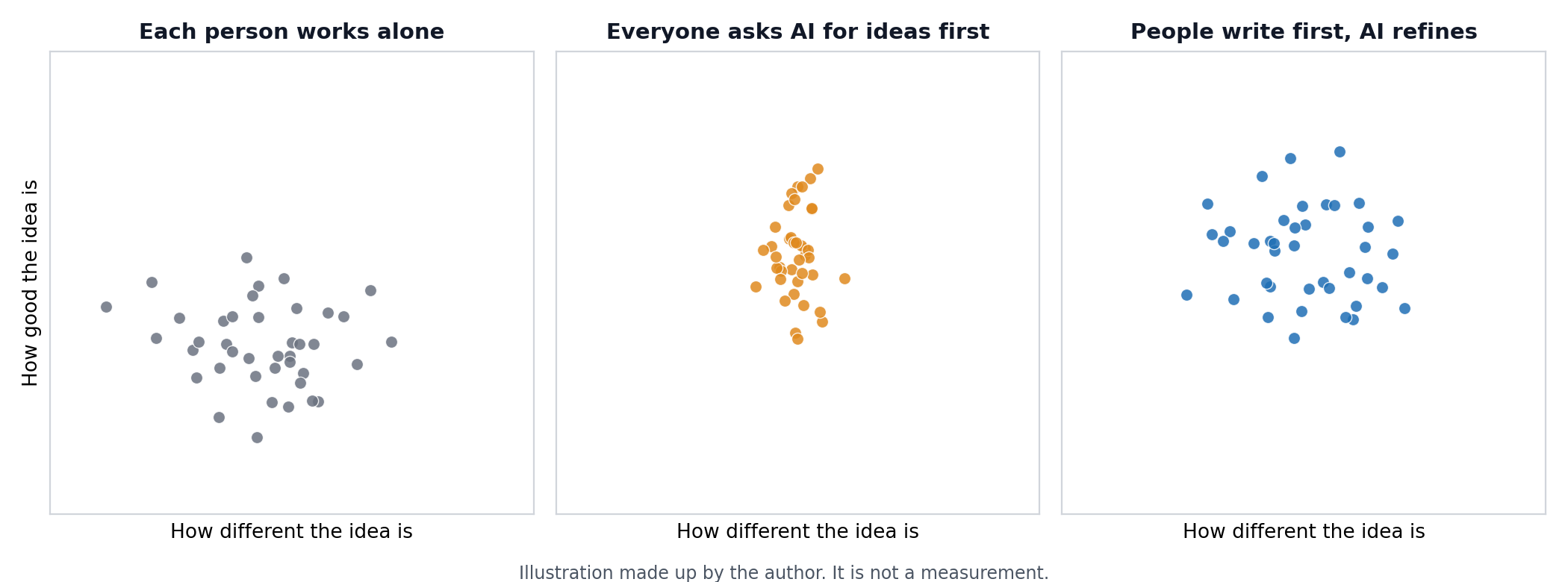
Figure 1. An illustration made by the author, not a measurement. Each dot is one idea. Higher means a better idea, and the more spread out the dots are, the more different the ideas are.
The case against my worry
The evidence is not one sided. A large experiment found that people who saw many AI ideas did not write more creative ideas themselves, but the variety across the group went up. It involved more than 800 people from over 40 countries.
The authors sum it up as AI making ideas different and not better.
I do not know why this result differs from the 2024 study. The tasks, the way people met the AI ideas and the measures were not the same, and I cannot tell which difference matters most. It is a fair reason to hold my argument loosely.
There is also a plain benefit to weigh. I think AI can help people put into words an idea they could not have written alone. A tool that widens who can take part in creative work is worth keeping, since the largest gains in the 2024 study went to less creative writers.
What I see in my own use
I ask AI for ideas often. I have asked it for business ideas to earn money, and for ideas for an app.
Once I used AI to help build an app, and it came out looking very similar to other apps, with the same generic designs. That is one example and not a measurement.
The first answer was rarely the one I used. Most times I had to refine the idea and ask many follow-up questions before it became useful. I think many people would stop at the first answer, and then many people would end up with the same idea.
What I would do about it
I would treat the following as things to test, not as rules. The studies point toward them, but none of them shows that they work.
Write your own ideas before you ask AI for any, then use it to refine, challenge or extend them, because in the preregistered study refining kept the variety of ideas. In a team, collect each person's ideas before anyone opens the tool, so that every person's own ideas exist before AI shapes them. When you judge a set of ideas, look at how different they are from one another as well as how good each one is.
If you build or test tools that help people brainstorm, measure the variety of the whole set. An average rating can go up while the variety shrinks, and a single score will not show it.
[1] Doshi and Hauser, Generative AI enhances individual creativity but reduces the collective diversity of novel content, 2024, PubMed Central.
[2] Dong and Yakura, Human diversity fuels collective creativity that large language models cannot simulate or sustain, 2026, arXiv.
[3] Maier, Schneider and Feuerriegel, Partnering with Generative AI, 2025, arXiv.
[4] Ashkinaze, Mendelsohn, Li, Budak and Gilbert, How AI Ideas Affect the Creativity, Diversity, and Evolution of Human Ideas, 2024, arXiv.
Building robustness and determinism in LLM applications
August 9, 20245 min read
How to become an LLM Scientist or Engineer from scratch
January 16, 202518 min read
On working in public, chasing intrinsic motivation, and taking risks in writing
One-liner modeling query for non-expert usage
July 31, 20204 min read
And the difference between weak vs strong grounding
September 22, 20247 min read
A Python built-in decorator reduces the complexity and length of your code
"Sometimes, I just take a walk to understand the environment I am in and try to uncover patterns."
You will not think about using Regular Expressions anymore.
July 25, 202415 min read
NumPy forms the basis of many Python libraries in the data science domain.
August 29, 20205 min read
原文为英文,正文由自动抓取并保留原文。
原文发布于 Towards Data Science(Ask AI to Refine Your Ideas, Not Invent Them),标题、摘要与正文由机器翻译,术语按行业惯例统一,未经人工逐句校订。