单一 AI 模型可模拟从沙粒滑动到蛋白质折叠的多种物质行为
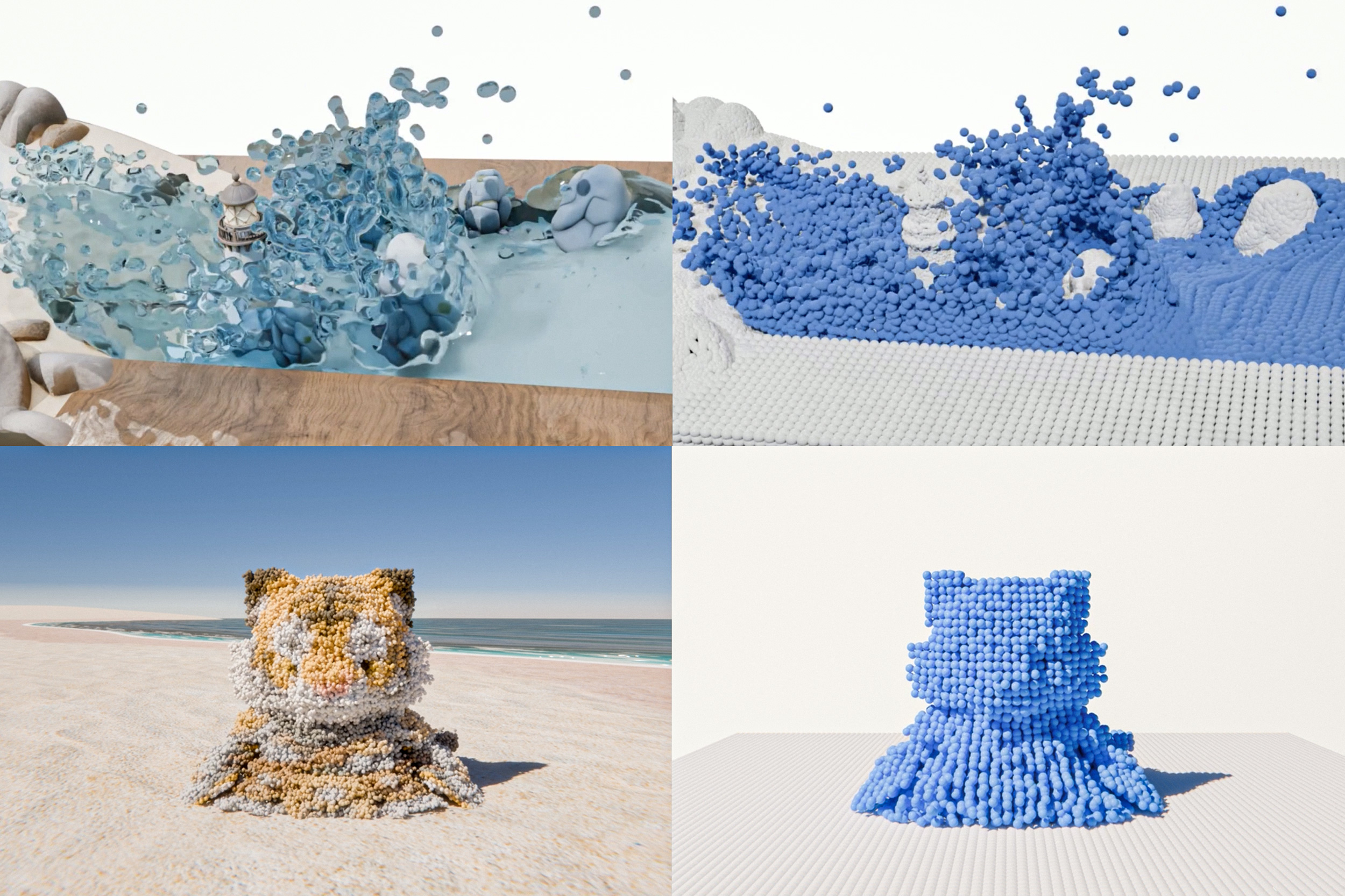
如今,科学家若要模拟某一物理过程,必须为这一项任务挑选合适的工具,比如为水流体打造的求解器,或是为模拟蛋白质折叠方式而设计的另一款求解器。每一个求解器都是围绕支配该过程行为的具体方程手工编写而成的。
MIT、不列颠哥伦比亚大学(UBC)等机构的研究人员如今用一套名为 WorldParticle 的单一深度学习系统取代了这种拼接式做法,它可以帮助工程师借助一个统一的人工智能架构,模拟从沙子滑移到蛋白质折叠等不同的物理现象。
科学家和工程师可以用这套系统来模拟那些通常需要多个独立模拟器的过程,例如流体对可变形固体的晃荡冲击。举例来说,这可以提供一种更快、更准确的方式,来模拟储罐中晃荡的油会如何冲击弹性阀门。它还能帮助工程师研究沙土等颗粒材料在软体机器人接触时会向何处移动、如何移动。
该系统把它所模拟的每一种材料——从一座沙丘到一个蛋白质分子——都表示为微小粒子,并一次一步地预测这些粒子将移动到何处。由于它是学习底层的动力学规律,而不是通过方程进行编程,该模型能够适应训练中从未遇到过的材料、作用力和环境。
从长远来看,研究人员希望这项工作能帮助科学家发现新材料,并探索那些用现有模拟方法无法有效研究的物理过程。
“我们希望为模拟领域带来一个 GPT 时刻,”Peter Yichen Chen 说。他曾是 MIT 的博士后,现为 UBC 助理教授,也是这项技术一篇开放获取论文的共同通讯作者。“每当人们想为某种特定的物理现象构建模拟器时,都需要从头编写代码。我们的愿景是拥有一个基础模型,开箱即用,适用于你想模拟的任何场景。这是朝着这个方向迈出的第一步。”
与 Chen 合作的还有共同通讯作者、共同第一作者、MIT 博士后 Minghao Guo;共同第一作者、UBC 研究生 Caoliwen Wang 和 Siyuan Chen;MIT 电气工程与计算机科学教授、计算机科学与人工智能实验室(CSAIL)计算设计与制造小组负责人 Wojciech Matusik;以及来自 UBC、Georgia Tech、Inria、Meta、宾夕法尼亚大学、犹他大学、加州大学洛杉矶分校和香港大学的其他人员。该研究将在 ACM SIGGRAPH 亚洲计算机图形与交互技术大会暨展览会上展示。
统一模拟
在这项工作中,研究人员从世界模型中汲取了灵感。这些强大的 AI 系统学习支配物理世界的规律,从而能够预测物体或环境在特定动作或条件作用下随时间推移将如何变化。
研究人员将这些概念应用于开发一种统一的 AI 架构,能够模拟多种类型的物理现象。
“如果你研究可变形物体和流体,你就需要两个模拟器——每种物理机制各一个。但如果你把它们统一到一个模型中,也许就能把这两种过程的物理耦合起来,从而对新问题获得洞见?”Guo 说。
WorldParticle 采用所谓的拉格朗日表示法,把一个物体分解为成千上万个乃至数百万个微小的三维点,即粒子。它追踪这些粒子在空间和时间上的运动与速度,从而模拟材料的动力学。
通常,科学家使用拉格朗日粒子对材料和物理过程建模时,会采用一个控制方程,该方程定义了支配该材料随时间和空间变化行为的基本定律。他们必须把这个复杂的方程转换成数值求解器能够处理的公式,并对他们想要建模的每一种材料和过程重复这些步骤。
相反,研究人员设计了一个神经网络,让它学会通用地求解控制方程,从而无需为每一个方程设计新的模型和求解器。
一旦 WorldParticle 把物体转换为粒子,神经网络就会以粒子的三维位置和物理属性作为输入。它输出这些粒子在模拟下一帧中的位置和属性,以 1 秒为增量预测材料随时间和空间的运动。
“它的架构与 ChatGPT 类似。但不同的是,我们不是一次预测一个词来写出一段文本,而是预测这些粒子将如何移动,一步一步地预测,”Chen 说。
在每个模拟步骤之前,WorldParticle 会分离出影响该物理系统的外力,比如海浪拍击海堤时作用于海浪的冲力。
在预测粒子的初始状态之后,WorldParticle 会将外力重新纳入仿真,并根据这些外力如何影响物体行为来修正其粒子预测。通过这种方式,该系统可以泛化到未见过的材料、变化的环境条件以及各种不同的作用力。
一个通用、可扩展的框架
但由于一个复杂物体可能被拆分为数百万个粒子,这个问题很快就会变得计算量过大,超出模型的处理能力。
为简化处理,研究人员采用了一种合并技术来组合和压缩粒子,同时仍能让 WorldParticle 捕捉其行为的细粒度细节。
“我们需要做大量精细的工程工作,并对架构进行许多调整,才能让它真正具备泛化性和可扩展性,”Guo 说。
他们通过对六种不同的物理现象进行建模来展示 WorldParticle,包括可变形物体、颗粒材料和蛋白质,其准确率高于数值仿真方法。
例如,WorldParticle 有效捕捉到了一个颗粒状物体如何塌落成一堆,而一些基线方法则让沙粒悬浮在空中。Guo 补充说,他们的方法对蛋白质结构随时间变化的建模速度也比数值仿真器快约 100 倍。
研究人员表示,这一通用框架可应用于许多材料和过程,包括软体机器人操作任务、RNA 演化,以及星系合并等天体物理现象。
展望未来,他们希望调整 WorldParticle,使其能够模拟这些以及其他物理系统。他们还希望在这项工作的基础上,进一步开发一套面向科学发现的完整、通用仿真流水线。
“我们看到计算与科学的融合为我们带来了新的洞见和工具,用以发现物理现象,或解释某些无法解释的物理现象,”Guo 表示。“借助统一模型,我们有望解锁许多我们甚至无法想象的发现。”
译文由英文原文机器翻译,术语按行业惯例统一,可在文末展开原文核对。
查看英文原文(A single AI model simulates the behavior of many substances, from sliding sand to folding proteins)
Today, a scientist who wants to simulate a physical process must pick the right tool for that one job, such as a solver built for flowing water or another designed to model the way a protein folds. Each one is hand-coded around the specific equations that dictate how that process behaves.
Researchers at MIT, the University of British Columbia (UBC), and elsewhere have now replaced that patchwork with a single deep-learning system, called WorldParticle, that could help engineers model different physical phenomena, from sliding sand to folding proteins, with one unified artificial intelligence architecture.
Scientists and engineers could use this system to model processes that typically require separate simulators, such as a fluid sloshing against a deformable solid. This could offer a faster, more accurate way to simulate how sloshing oil might impact an elastic valve in a storage tank, for instance. It could also help engineers study where and how granular materials, like sand or soil, could move when a soft robot touches them.


The system represents every material it simulates, from a dune of sand to a protein molecule, as tiny particles and predicts where those particles will move one step at a time. Because it learns the underlying dynamics rather than being programmed with an equation, the model can adapt to materials, forces, and environments it never encountered during training.
In the long term, the researchers hope this work helps scientists discover new materials and explore physical processes they would be unable to effectively study with existing simulation methods.
“We want to have a GPT moment for simulation,” says Peter Yichen Chen, a former MIT postdoc who is now an assistant professor at UBC, and is a co-corresponding author of an open-access paper on this technique. “Every time people want to build a simulator for a particular physical phenomenon, they need to code it up from scratch. Our vision is to have a foundation model that works out of the box for any scenario you want to simulate. This is a first step in that direction.”
Chen is joined by co-corresponding and co-lead author Minghao Guo, an MIT postdoc; co-lead authors Caoliwen Wang and Siyuan Chen, UBC graduate students; Wojciech Matusik, an MIT professor of electrical engineering and computer science who leads the Computational Design and Fabrication Group within the Computer Science and Artificial Intelligence Laboratory (CSAIL); and others at UBC, Georgia Tech, Inria, Meta, the University of Pennsylvania, the University of Utah, the University of California at Los Angeles, and the University of Hong Kong. The research will be presented at the ACM SIGGRAPH Conference and Exhibition on Computer Graphics and Interactive Techniques in Asia.
Unified simulation
For this work, the researchers drew inspiration from world models. These powerful AI systems learn the rules that govern the physical world so they can predict how objects or environments will change over time in response to certain actions or conditions.
The researchers applied these concepts to develop a unified AI architecture that can simulate multiple types of physical phenomena.
“If you study deformable objects and fluids, you would need two simulators — one for each physical regime. But if you unify them into one model, maybe you could couple the physics of these two processes and gain insights into new problems?” Guo says.
WorldParticle breaks an object into thousands or millions of tiny, three-dimensional dots, or particles, using what is known as a Lagrangian representation. It tracks the movement and velocity of the particles over space and time to simulate the material’s dynamics.
Typically, when scientists model materials and physical processes using Lagrangian particles, they use a governing equation that defines the fundamental laws which control how that material behaves over time and space. They must convert that complex equation into a formula a numerical solver can handle, repeating these steps for each material and process they want to model.
Instead, the researchers designed a neural network that learns to solve governing equations in general, eliminating the need to design a new model and solver to handle each one.
Once WorldParticle converts an object into particles, a neural network takes the 3D positions and physical properties of the particles as inputs. It outputs their positions and properties for the next frame of the simulation, predicting the material’s motion over time and space in one-second increments.
“It is a similar architecture to ChatGPT. But instead of predicting one word at a time to write a piece of text, we are predicting how these particles will move, one step at a time,” Chen says.
Before each simulation step, WorldParticle separates the external forces that affect the physical system, like impulse forces that affect an ocean wave when it slams into a seawall.
After predicting the initial states of the particles, WorldParticle integrates the external forces back into the simulation, correcting its particle predictions based on how those forces affect the object’s behavior. In this way, the system can generalize to unseen materials, changing environmental conditions, and varied forces.
A general, scalable framework
But because a complex object could be broken into millions of particles, the problem quickly becomes too computationally intensive for the model to handle.
To streamline processing, the researchers employed a merging technique to combine and compress particles while still allowing WorldParticle to capture fine-grained details of their behavior.
“We needed to do a lot of detailed engineering and employ many tweaks to the architecture for it to be truly generalizable and scalable,” Guo says.
They demonstrated WorldParticle by modeling six different physical phenomena, including deformable objects, granular materials, and proteins, with higher accuracy than numerical simulation methods.
For instance, WorldParticle effectively captured how a granular object would collapse into a pile while some baseline methods left sand particles floating in the air. Their method also modeled how protein structures change over time about 100 times faster than numerical simulators, Guo adds.
The general-purpose framework could be applied to many materials and processes, including soft robot manipulation tasks, RNA evolution, and astrophysical phenomena like the merging of galaxies, the researchers say.
Moving forward, they want to adapt WorldParticle to simulate these and other physical systems. They also want to build on this work toward the development of a full, general-purpose simulation pipeline for scientific discovery.
“We see the unification of computation and science giving us new insights and tools to discover physical phenomena or explain some unexplainable physical phenomena,” Guo says. “With a unified model, we could unlock many discoveries that we can’t even imagine.”
正文保留英文原文,标题与摘要由机器翻译。
原文发布于 MIT News AI(A single AI model simulates the behavior of many substances, from sliding sand to folding proteins),标题、摘要与正文由机器翻译,术语按行业惯例统一,未经人工逐句校订。