为 AI 智能体数据湖访问构建无服务器 MCP 服务器
构建由人工智能(AI)驱动的应用的组织面临着一个反复出现的挑战:让大语言模型(LLM)智能体访问企业数据湖,同时又不必在每个智能体和应用之间重复集成逻辑。大多数团队起初都是把智能体直接接到数据库和 API 上,中间没有诸如 Model Context Protocol(MCP)服务器这样的共享网关。每新增一个数据集都需要定制代码,每个智能体都要重新实现自己的访问控制。随着数据集或智能体数量增长,权限管控逐渐走样,接入一个新的数据源也变成需要数天工作量的工程任务。
我们的团队为 Amazon 北美分拣中心(NASC)网络提供支持,那里的规划团队依赖运营数据来管理产能、人力和包裹流转。为了让这些团队能以对话方式访问这些数据,我们在 Amazon Elastic Container Service(Amazon ECS)上结合 AWS Fargate 构建了一个无服务器 Model Context Protocol(MCP)服务器,为 NASC 的规划团队解决这一问题。该服务器充当 AI 智能体与企业数据湖之间的集中式、与具体智能体无关的网关。要开放一个新的数据集,只需提供一个 JSON 元数据文件,服务器会在下一次管道同步时自动发现它。
在本文中,我们介绍该架构,展示元数据驱动的方式如何免去针对每个数据集编写集成代码的需要,并解释这套无服务器基础设施如何在多租户环境中支持多个智能体和应用。
两个相互关联的挑战塑造了我们设计这套系统的方式:碎片化的数据访问模式,以及不可持续的接入模式。
我们的数据湖包含数千个数据集,涵盖运营指标、业务分析和领域特定数据。多个团队都希望拥有能以对话方式查询这些数据的 AI 助手,但每个团队都从零开始构建自己的集成。每个智能体都内嵌了自己的 SQL 生成逻辑、schema 知识和连接处理,因此一次 schema 变更就意味着要逐个修补每个智能体。访问控制支离破碎,数据访问决策没有统一的审计点。接入一个新数据集需要定制工具代码、查询验证和重新部署,通常每张表要耗费数天时间。
我们确立了四项需求:
该架构将关注点分离为四层(客户端、MCP 服务器、工具和知识库刷新),每一层都可独立扩展和部署。元数据目录支撑着工具层,存储 schema 描述、列级语义和表关系,供 AI 智能体在生成 SQL 时参考。由于智能体在查询时从目录中获取 schema 知识,因此无需硬编码表结构,schema 变更时也无需重新部署。知识库刷新层则让该目录保持最新,在新数据集元数据到达时对其进行索引。以下各节将详细描述每一层。
下图展示了从用户查询到数据层、贯穿全部四层的请求流转过程。用户从客户端应用(网页聊天、Slack、IDE 插件或外部智能体)提交查询。请求通过 Amazon Route 53 进行 DNS 解析,抵达公有子网中配置了 HTTPS 和 AWS WAF 的 Application Load Balancer。负载均衡器将请求路由至 Amazon Cognito,由其对用户进行身份验证并对请求进行增强。通过验证的流量随后进入私有子网,客户端层在此运行于 Amazon ECS Fargate 上。该层在 Amazon DynamoDB 中处理会话状态,并通过内部 Application Load Balancer 将请求转发至同样运行在 Amazon ECS Fargate 上的 MCP 服务器层。在 MCP 服务器层中,由 Amazon Bedrock 驱动的 AI 智能体负责编排使用 FastMCP(一个用于构建 MCP 服务器的 Python 框架)构建的工具。每一次模型交互都会应用 Amazon Bedrock Guardrails。右侧的数据层承载着各工具的后端。Amazon Athena 和 Amazon Redshift 针对数据湖运行 SQL 查询,而 Amazon Bedrock Knowledge Bases 这一全托管的检索增强生成(RAG)能力则负责语义搜索。写入 Amazon Simple Storage Service(Amazon S3)和知识库的数据摄取由 AWS Lambda 处理。后续各节将详细描述每一层。
图 1:请求流经无服务器 MCP 服务器的过程,从客户端应用到数据层
译文由英文原文机器翻译,术语按行业惯例统一,可在文末展开原文核对。
查看英文原文(Serverless MCP server for AI agent data lake access on Amazon ECS Fargate)
Organizations building applications powered by artificial intelligence (AI) face a recurring challenge: giving large language model (LLM) agents access to enterprise data lakes without duplicating integration logic across every agent and application. Most teams begin by wiring agents directly to databases and APIs, with no shared gateway such as a Model Context Protocol (MCP) server in between. Each new dataset demands custom code, and each agent reimplements its own access control. As the number of datasets or agents grows, permission enforcement drifts, and onboarding a new data source becomes a multi-day engineering effort.
Our team supports Amazon’s North America Sort Center (NASC) network, where planning teams rely on operational data to manage capacity, labor, and package flow. To give those teams conversational access to that data, we built a serverless Model Context Protocol (MCP) server on Amazon Elastic Container Service (Amazon ECS) with AWS Fargate to address this problem for planning teams in NASC. The server acts as a centralized, agent-agnostic gateway between AI agents and our enterprise data lake. Exposing a new dataset requires only a JSON metadata file that the server discovers automatically on the next pipeline sync.
In this post, we describe the architecture, show how a metadata-driven approach removes the need for per-dataset integration code, and explain how the serverless infrastructure supports multiple agents and applications in a multi-tenant environment.
Problem statement and design goals
Two interrelated challenges shaped how we designed this system: fragmented data access patterns and an unsustainable onboarding model.
Integration challenge at scale
Our data lake contains thousands of datasets spanning operational metrics, business analytics, and domain-specific data. Multiple teams wanted AI assistants that could query this data conversationally, but each built its own integration from scratch. Each agent embedded its own SQL generation logic, schema knowledge, and connection handling, so a schema change meant patching every agent individually. Access control was fragmented, with no single audit point for data access decisions. Onboarding a new dataset required custom tool code, query validation, and redeployment, typically a multi-day effort per table.
Design goals
We established four requirements:
- Configuration-driven data lake access. Adding a dataset requires only a metadata file, not code.
- Agent-agnostic tool interfaces. Any MCP-compatible client can invoke the same tools.
- Centralized permission enforcement. Access control is enforced at the MCP server layer.
- Elastic infrastructure. The system scales with bursty AI workload patterns.
Solution overview
The architecture separates concerns into four layers (client, MCP server, tools, and knowledge-base refresh), each independently scalable and deployable. A metadata catalog underpins the tools layer, storing schema descriptions, column-level semantics, and table relationships that the AI agent references when generating SQL. Because the agent derives schema knowledge from the catalog at query time, there is no need to hardcode table structures or redeploy when schemas change. The knowledge-base refresh layer keeps that catalog current, indexing new dataset metadata as it arrives. The following sections describe each layer in detail.
Architecture walkthrough
The following diagram shows the request flow from user query to data layer across all four layers. A user submits a query from a client application (web chat, Slack, an IDE plugin, or an external agent). The request resolves through Amazon Route 53 for DNS and reaches an Application Load Balancer in a public subnet, configured with HTTPS and AWS WAF. The load balancer routes to Amazon Cognito, which authenticates the user and enriches the request. Authenticated traffic then enters the private subnet, where the client layer runs on Amazon ECS Fargate. This layer handles session state in Amazon DynamoDB and forwards requests through an internal Application Load Balancer to the MCP server layer, also on Amazon ECS Fargate. In the MCP server layer, an AI agent powered by Amazon Bedrock orchestrates tools built with FastMCP (a Python framework for building MCP servers). Amazon Bedrock Guardrails is applied to every model interaction. On the right, the data layer holds the tool backends. Amazon Athena and Amazon Redshift run SQL queries against the data lake, and Amazon Bedrock Knowledge Bases, the fully managed Retrieval Augmented Generation (RAG) capability, handles semantic search. Data ingestion into Amazon Simple Storage Service (Amazon S3) and the knowledge bases is handled by AWS Lambda. Each layer is described in detail in the sections that follow.
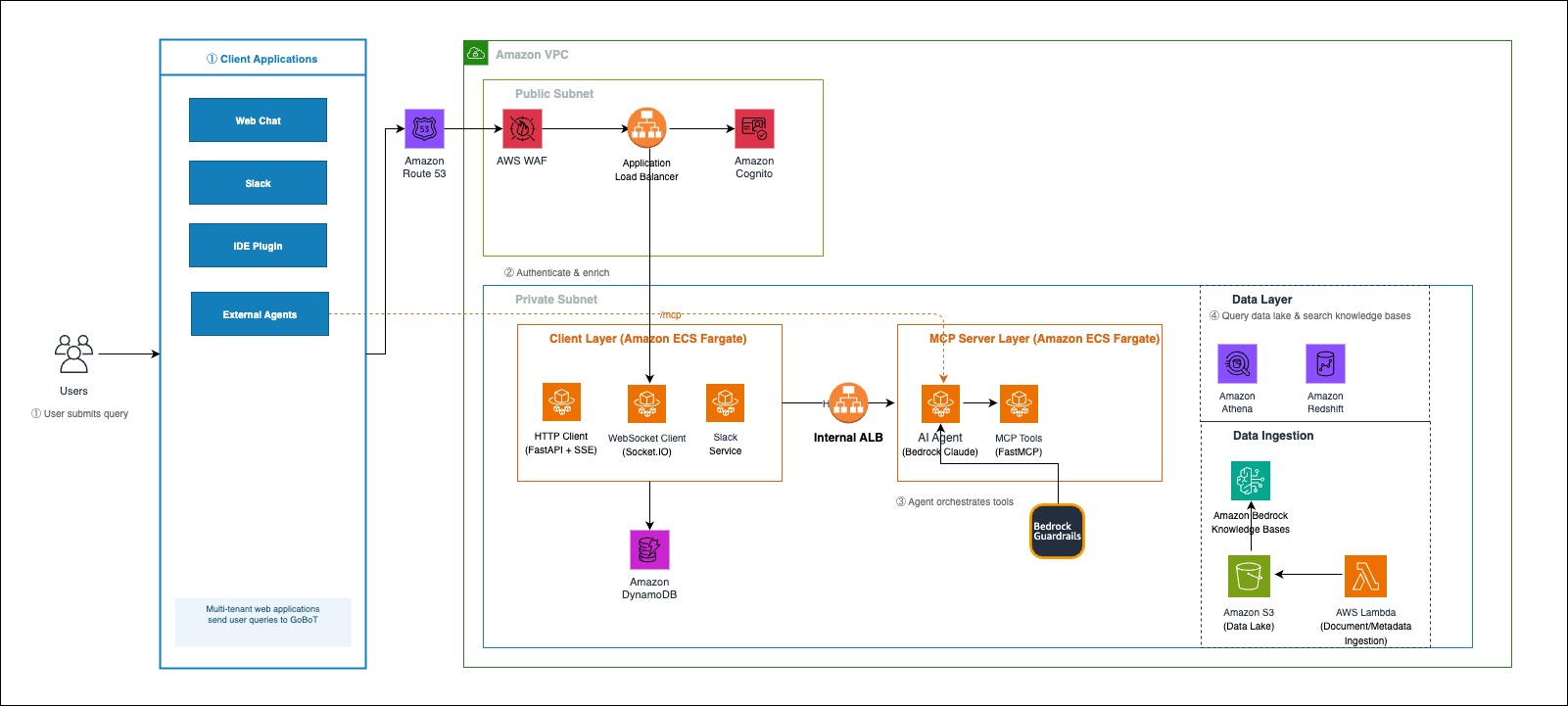
Figure 1: Request flow through the serverless MCP server, from client applications to the data layer
MCP client layer: Authentication and session management
A request flows from the client application through Amazon Route 53 for DNS resolution to an Application Load Balancer configured with HTTPS and AWS WAF. The load balancer forwards traffic to the Amazon ECS Fargate client service, which integrates with Amazon Cognito for JSON Web Token (JWT) authentication and Amazon DynamoDB for session storage.
A context mapping configuration drives this enrichment, scoping each query to only the relevant tables. In our testing, this scoping keeps end-to-end interaction latency in the 15–20 second range. The following example shows a context mapping configuration:
{
  "package_data": {
    "description": "Package tracking and delivery information",
    "tables": ["analytics_db.regional_order_summary", "operations_gold.load_summary"],
    "sources": {"wiki": [], "quip": []}
  },
  "labor_planning": {
    "description": "Workforce management and capacity planning",
    "tables": ["workforce.capacity_details"],
    "sources": {"wiki": [], "quip": []}
  }
}
When a context specifies tables, the MCP server narrows its search of the metadata catalog to those tables, reducing noise and improving SQL generation accuracy. Adding a new business domain requires only adding an entry to this mapping.
MCP server layer: Stateless execution with conversation state
The MCP server runs on its own ECS Fargate cluster, isolated from the client layer. Requests reach it through Amazon Route 53 and an internal Application Load Balancer in a private subnet. The server handles full orchestration including query analysis, tool selection, execution, and response generation. Through the MCP protocol endpoint (/mcp), a FastMCP-powered JSON-RPC interface, external MCP-compatible clients such as Amazon Q Developer or IDE extensions can discover and invoke tools directly.
Fargate tasks are stateless with conversation state persisted in DynamoDB, so tasks can be replaced or scaled without data loss. When a request arrives, the agent retrieves session history, analyzes user intent using Amazon Bedrock, discovers and invokes appropriate tools, and streams results back to the user.
Tools layer and metadata-driven data lake access
Each tool is registered with FastMCP and discoverable at runtime:
| Sr.no | Tool | Backend | Purpose |
| 1 | SQL query tools | Amazon Athena Amazon Redshift |
SQL queries against any configured dataset in the data lake and Redshift |
| 2 | Document and metadata search | Amazon Bedrock Knowledge Bases | Semantic search over internal documentation, table metadata and team wikis |
| 3 | Policy search | Amazon Bedrock Knowledge Bases | Search operational policies and standard procedures |
The Athena query tools are the primary interface to the data lake. The agent first queries the metadata catalog to understand available schemas, generates an optimized SQL query through Amazon Bedrock, validates and auto-corrects the SQL for Athena compatibility, then executes it. Results flow back to the orchestrating agent for natural language synthesis.
Responsible AI controls
Amazon Bedrock Guardrails is applied to all LLM interactions and is designed to filter harmful content, enforce grounding checks, and help block prompt injection attempts. These guardrails operate as production controls at the MCP server layer, so every connected agent benefits from the same content safety policies regardless of how it connects. The Athena query tools enforce SELECT-only queries, rejecting write operations at the tool level before they reach the data lake.
Knowledge base refresh layer: Dataset onboarding with a single JSON file
The entire system is built around configuration-driven extensibility. Adding a new dataset requires a metadata JSON file describing the table and an optional context mapping entry. The file captures the table’s schema, business context, and column-level semantics. It serves as the single source of truth that the AI agent uses to understand and query the dataset:
{
  "database_service_name": "athena",
  "database_name": "analytics_db",
  "table_name": "regional_order_summary",
  "business_description_for_the_table": "Regional order history with shipping status and delivery performance. Contains completed orders with delivery data. Refreshes daily. In Athena SQL, always use date() to wrap string literals when comparing against timestamp columns.",
  "column_details": {
    "order_id [varchar]": {
      "description": "Unique order identifier assigned at checkout.",
      "sample_values": ["ORD-20250115-001234", "ORD-20250116-005678"]
    },
    "order_date [timestamp(3)]": {
      "description": "Date and time the order was placed. Use this column for time-range filtering.",
      "sample_values": ["2025-01-15 08:00:00.000", "2025-01-16 12:30:00.000"]
    },
    "warehouse_id [varchar]": {
      "description": "Fulfillment center that processed the order.",
      "sample_values": ["FC-EAST-07", "FC-WEST-03", "FC-SOUTH-12"]
    }
  },
  "load_type": "Incremental (refreshes last 7 days)",
  "refresh_frequency": "Daily at 6:00 AM UTC",
  "table_size": "~2.1B rows",
  "creation_time": "2024-03-15",
  "last_refresh_time": "2025-05-20T06:00:00Z"
}
The business_description_for_the_table field carries engine-specific query hints, such as “always use date() to wrap string literals,” that reduce SQL validation failures. The column_details field pairs each column_name [type] with a natural language description and sample values, giving the agent both schema awareness and business semantics. The sample_values field matters for accurate WHERE clause generation because the agent learns real data patterns, for instance that warehouse_id holds codes like FC-EAST-07 rather than spelled-out names like “East region facility.”
The pipeline picks up metadata files, generates vector embeddings with Amazon Titan Text Embeddings, and indexes them into Amazon Bedrock Knowledge Bases. Once indexed, the table is discoverable by all connected agents without manual re-indexing or server restarts.
To improve accuracy for specific applications, an engineer can optionally associate the dataset with a business context. This narrows the search scope, so the agent prioritizes the right tables. The following example shows a context mapping entry:
{
  "delivery_metrics": {
    "description": "Delivery accuracy and defect attribution data",
    "tables": ["analytics_db.customer_orders_summary"],
    "sources": {"wiki": [], "quip": []}
  }
}
If no context is specified, the agent searches across all indexed tables. The context mapping reduces latency and improves SQL accuracy by limiting the search space. This scoping is optional and can be added at any time without modifying the metadata files themselves.
Putting it together: A query in action
When a user asks, “What were our top 10 highest-value orders last month?”, the client enriches the request with business context to narrow scope. The agent converts the question into a vector embedding, searches the metadata catalog for matching schemas, and selects the most relevant table via a lightweight LLM call.
Using the selected schema, column descriptions, and engine-specific query hints, the agent generates a SQL statement such as:
SELECT order_id, customer_id, total_amount, order_date
FROM analytics_db.regional_order_summary
WHERE order_date >= date_add('month', -1, current_date)
ORDER BY total_amount DESC
LIMIT 10
The SQL is validated and auto-corrected for engine compatibility, then executed against Amazon Athena. The agent formats the results into a natural language response and streams it back to the user. In our testing, this end-to-end flow completes within 15–20 seconds.
The same orchestration extends beyond pure SQL. Because document search is registered as another tool on the same server, the agent can answer questions that span structured and unstructured sources in a single turn, such as “What was our return rate for Q4, and what does the product team’s analysis say about the root causes?” For that request, the agent runs an Athena query for the return-rate figure and a Knowledge Bases document search for the analysis, then combines both into one response.
Security and multi-tenant access
That single-turn orchestration works only because every tool call passes through the same controlled gateway. The architecture uses layered security rather than a single enforcement point. The MCP server runs in private subnets behind an internal Application Load Balancer and is not reachable from the internet. Only the client layer, which sits behind a public-facing Application Load Balancer with AWS WAF, can route requests to it. Amazon Cognito validates user identity at the client layer, and only authenticated, token-bearing requests are forwarded downstream. At the tool level, the Athena query tools enforce SELECT-only queries, rejecting write operations before they reach the data lake. All tool invocations are logged to Amazon CloudWatch with structured JSON, which gives security teams a single audit point for data access across every agent and application. This architecture is available in the AWS Regions where Amazon Bedrock and Amazon Bedrock Knowledge Bases are available.
This centralized design is also what makes the server multi-tenant. Because the standardized /mcp endpoint accepts any MCP-compatible client regardless of which LLM or orchestration framework it uses, multiple agents share the same tools and the same access controls. Adding a new agent requires only pointing it at the server endpoint, so onboarding another team extends the system without weakening or duplicating the security model.
Serverless infrastructure and scaling
Each layer scales through a mechanism suited to its workload pattern:
| Layer | Scaling mechanism | Trigger |
| Client (ECS Fargate) | ECS Service Auto Scaling | CPU utilization (50% threshold) |
| MCP Server (ECS Fargate) | ECS Service Auto Scaling | CPU/Memory utilization |
| Athena | Serverless (automatic) | Query concurrency |
| Amazon Bedrock | Managed service scaling | Inference requests |
Amazon ECS Fargate provides serverless compute with no EC2 instances to manage. Downstream services (Athena, Bedrock) scale automatically, so the system handles a single query or hundreds of concurrent queries without configuration changes.
Use cases and extensions
This architecture supports several patterns beyond basic question-answering. Enterprise knowledge assistants can combine data lake queries with document search to answer complex questions spanning both structured data and unstructured knowledge, such as “What’s our return rate for Q4, and what does the product team’s analysis say about the root causes?” Internal analytics copilots let business users query the data lake conversationally without writing SQL, relying on the metadata descriptions and query hints to guide the agent toward accurate, performant query patterns.
The standardized /mcp endpoint also supports multi-agent workflows. Multiple specialized agents for data analysis, document retrieval, and operational alerting can share the same MCP server, each accessing the full tool suite through a common protocol. Onboarding a new team’s data follows the same configuration-driven pattern. They add a metadata JSON file, and within one pipeline sync cycle their dataset is discoverable by every connected agent and application.
Conclusion
A centralized MCP server on Amazon ECS Fargate provides a scalable, secure gateway between AI agents and enterprise data lakes. The metadata-driven approach removes the need for per-dataset integration code, and the Model Context Protocol standard means any MCP-compatible client can connect without custom adapters.
The key architectural decision is separating the tool layer from the agent layer. Agents evolve rapidly, but data access patterns should outlive any single agent implementation. Treating extensibility as a configuration problem rather than a code problem accelerates onboarding.
To learn more, see Amazon ECS on AWS Fargate, Amazon Bedrock, the Amazon Bedrock Knowledge Bases user guide, Amazon Athena, and the Model Context Protocol specification.
Next steps
We are extending this architecture in two directions. First, finer-grained access control where table owners can mark sensitive columns as restricted per permission group, and the agent automatically excludes those columns from generated SQL without prompt-level changes.
Second, closing the feedback loop so that when queries fail or produce low-confidence results, the system captures the failure pattern and surfaces targeted suggestions for improving column descriptions, adding query hints.
About the authors

Aishwarya Pawar
Aishwarya is a Senior Data Engineer at Amazon who works at the convergence of generative AI and enterprise data. She specializes in bringing large language models into the data workflow, creating intelligent systems that automate complex analysis and let teams interact with their data in natural language. Her work focuses on making powerful AI capabilities approachable and dependable, so that insight is no longer limited to those who can write code. She champions a future where data is open, intuitive, and ready to drive decisions for everyone across the organization.

Sairam Vangapally
Sairam is a Senior Data Engineer at Amazon with extensive experience architecting real-time, large-scale data platforms that power critical logistics operations across North America. He has led the design and deployment of end-to-end data pipelines, enabling high-throughput ingestion, transformation, and analytics at scale. He is passionate about building resilient data infrastructure and driving cross-functional collaboration to deliver solutions that accelerate operational insights and business impact.

Nitin Goyal
Nitin serves as a Data Engineering Manager in Amazon’s Sort Center organization, where he leads initiatives to optimize operational efficiency across North American facilities. With over 10+ years of tenure at Amazon spanning multiple teams, he specializes in architecting high-performance data systems, with particular emphasis on real-time streaming pipelines, artificial intelligence, and low-latency solutions. His expertise drives the development of sophisticated operational workflows that enhance sort center productivity and effectiveness.
正文保留英文原文,标题与摘要由机器翻译。
原文发布于 AWS Machine Learning(Serverless MCP server for AI agent data lake access on Amazon ECS Fargate),标题、摘要与正文由机器翻译,术语按行业惯例统一,未经人工逐句校订。