如何用 12 项 KPI 衡量 AI 采用、性能与 ROI

如今,企业正在 AI 上大举投入。谈到 AI 转型,许多企业的起点是推出更多 AI 工具和解决方案、鼓励员工使用,并把 AI 采用率和生产力提升作为衡量成功的标准。但即便员工更多地使用 AI、更快地完成日常工作,端到端的业务流程仍然可能需要很长时间才能走完。
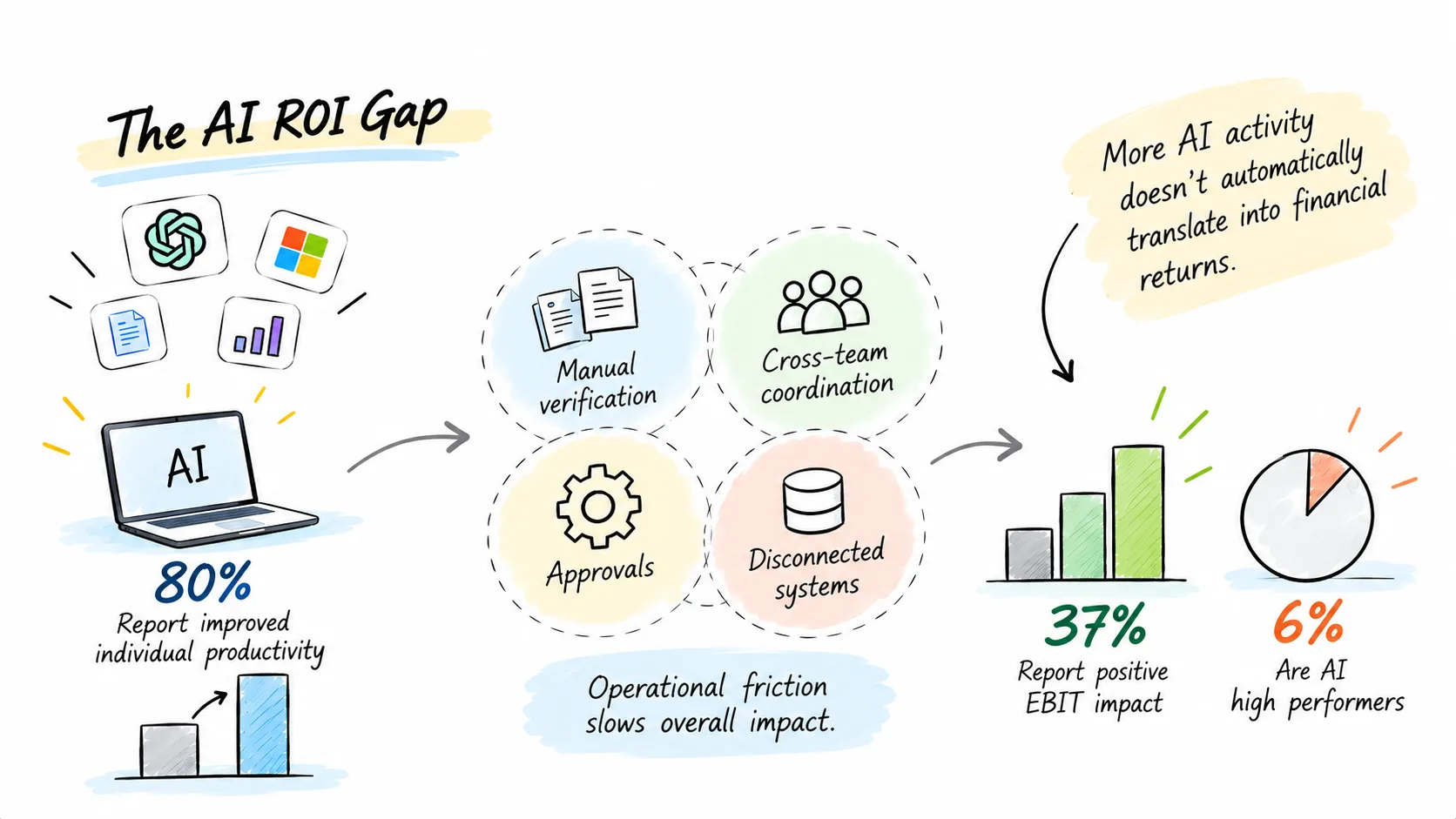
麦肯锡的《2026 年 AI 现状:迈向 ROI 之路》揭示了这一落差。虽然 80% 的受访者表示 AI 提升了他们的个人生产力,但只有 37% 的受访者报告 AI 对所在组织的息税前利润(EBIT)产生了积极影响,仅有 6% 的企业堪称 AI 高绩效者。
《哈佛商业评论》另一项针对 300 名员工和一线管理者的研究发现,人们大约把 37% 的时间花在协调工作上,而用于实际工作的时间占 44%。
这些发现引出一个重要问题:我们如何判断哪些 AI 投入正在改善业务表现、并带来有意义的财务回报?
没有可量化的 KPI,就很难判断什么在奏效、什么在创造价值,以及下一步该往哪里投。
2. 一套衡量 AI 影响的实用 KPI 框架
在为大型企业从事 AI 转型战略与业务运营工作的过程中,我学到的一点是:衡量 AI 的成功,不能只看技术本身能做什么。无论我们是帮助员工在日常工作中使用 AI,还是在业务流程与工作流中部署 AI,都需要弄清楚哪些环节得到了改善,以及这些改善是否转化为财务结果(参见麦肯锡《Rewired》第二版)。
因此,我建议在你的 AI 投资组合中采用以下三个层级的 AI 绩效衡量方式:
AI 采用与使用:你的员工是否在持续使用 AI?
AI 驱动的运营绩效:AI 是否正在改善业务的运营方式?
AI 商业价值与 ROI:这些改善是否产生了可衡量的财务回报?
AI 采用情况反映的是人们如何主动使用 AI 工具,并找到将其应用于工作的有效方式。我会重点关注四项关键指标:
采用率:符合条件的员工中主动使用 AI 的百分比。
活跃使用:每周或每月使用 AI 的员工数量。
使用频率:员工在工作中持续使用 AI 的程度。
成功案例与用例:记录在案的将 AI 应用于实际工作的实例数量,并附有产生有用结果的证据。
在其中一项 AI 学习计划中,随着我们从引入 AI 工具逐步转向动手解决实际问题,并在各团队之间分享成功用例,我们的采用率逐步提升。
我们通过积极参与、实际应用和持续使用来衡量这一进展,然后评估生产力提升是否带来业务流程的改善。最终,我们的 AI 采用率达到 95%,自报的每周生产力提升超过 9 小时。
2.2 AI 驱动的运营表现
AI 是否改善了企业的运营方式?在一个项目中,一名数据分析师使用 Databricks Genie Code,把通常需要 2-4 小时的分析工作缩短到 5 分钟以内。这比原来快 24 倍以上。AI 帮助探索数据、验证假设、调查意外发现,并产出一份包含分析与建议的可复现 notebook。
然而,HBR 的研究表明,AI 可以在单个任务上节省数小时,但整体流程仍然耗时,因为涉及多个团队之间的协调、人工验证和审批。
以下是我会重点关注的四个运营 KPI:
端到端完成时间(速度):企业完成一个流程的速度有多快。
人工工作量减少与员工生产力提升(效率):所需的人力投入、节省的工时,以及在同等资源下额外完成的工作量。
错误与返工减少(质量):工作完成的准确程度。
决策及时性与质量(有效性):决策制定的速度与可靠程度。
这四项运营指标共同衡量速度、效率、质量和决策有效性。这正是我认为 AI 价值日益凸显之处:让团队有更多时间去理解不同的客户痛点和业务挑战,验证结果,并将洞察转化为行动。
2.3 AI 商业价值与 ROI
这些运营改善是否带来了可衡量的财务回报?
我会重点关注以下四项财务 KPI:
已实现的成本节约:你实际削减了哪些支出?
可归因的增量毛利:你能将多少额外利润可信地归因于 AI?
AI 总成本:你在实施和运营 AI 上花了多少钱?在相关情况下,还要衡量每验证节省一小时所对应的 AI 成本,以了解我们每获得一小时员工产能需要花多少钱。
经核验的 ROI:在计入这些成本后,你产生了多少财务回报?
我会谨慎对待如何衡量 AI 的财务价值。节省员工时间并不自动意味着省钱。只有当你能证明已实现的财务收益时,我才会把它算作成本节约。
收入与利润率改善也是如此。很难确切知道 AI 贡献了多少,所以我会考察在采用 AI 的同时财务结果如何改善,利用其他业务证据来估算 AI 的贡献,并对这些假设保持透明。
3. 如何计算 AI ROI
以下是我如何估算 AI 投资第一年财务回报的示例。你也可以使用自己的假设,试试交互式 AI ROI 计算器。
每位员工每周节省的小时数
估计的价值实现率
首年 AI 总成本
第 1 步:计算年度 AI 产能价值
50 × 5 × 48 × $65 = $780,000
第 2 步:计算估算的 AI 财务收益
$780,000 × 50% = $390,000
第 3 步:计算 AI 净收益
$390,000 − $110,000 = $280,000
第 4 步:计算估算的首年 AI ROI
$280,000 ÷ $110,000 × 100 = 255%
第5步:计算 AI 投资回收期,假设 $50,000 为前期实施成本,$60,000 为年度运营成本
$50,000 ÷ ($390,000 - $60,000) × 12 = 1.82 个月
在这些假设下,AI 投资可能在不到两个月内收回成本。此后,这意味着累计的 AI 净收益将覆盖最初 $50,000 的投资。
请注意,这是一个假设 AI 收益立即开始产生的假设性预测。实际的 AI 投资回报率(ROI)取决于 AI 释放出的人力产能有多少能转化为可衡量的财务收益。如果采用速度缓慢,或预期收益未能完全实现,AI 投资回收期也可能更长。
AI 采用情况告诉我们员工是否在积极使用这项技术。AI 运营表现表明 AI 是否改善了业务工作流和流程。业务价值和投资回报率(ROI)决定这些由 AI 带来的改进是否能产生有意义的财务回报。
将 AI 影响转化为投资决策
对于每一项 AI 计划,我建议遵循一致的成功衡量流程。
建立基线。在引入 AI 之前,记录当前流程及其表现。纳入与业务问题相关的衡量指标,例如完成时间、人工投入、质量或运营成本。
设定可衡量的目标。就预期改进幅度以及评估周期达成一致。目标应当把 AI 举措与业务成果关联起来。
明确责任人。确定业务负责人、技术合作伙伴和 AI 负责人。业务负责人对结果负责,技术和 AI 团队则支持实施落地、性能表现和效果衡量。
跟踪 AI 表现。衡量采用率、运营改善和财务价值。区分经过验证的成果与估算的财务贡献。参见 AI Performance Dashboard 示意图,其中对比了实际值与计划值。
依据一线证据做出投资决策。决定哪些举措应扩大规模、哪些需要干预,以及在哪里调整投向或撤回投资。
在下次 AI 投资组合评估中,我会提出的一个关键问题是:贵公司已部署的 AI 举措中,有多少能够证明带来了可衡量的运营改善和财务价值?
* 作者注:本文所有图片均由作者使用 AI 工具生成。
如何将音频转换为图像并用 ResNeSt 进行分析
AI 自食其尾:生成式系统中的模型崩溃风险
增强大语言模型:一段穿越图推理与指令微调的旅程
提示工程如何演变:一次科学审视,以及对对话式 AI 工具未来的启示
缓存、懒加载、路由、压缩整理,以及更多
以及我转而开始做的事。
在 MLOps 1 级中,机器学习流水线是自动化的。这样做可以实现……
从一块没有价签的巧克力到 PyMC 中的营销组合模型,以及横亘其间的那个已有 200 年历史的积分。
一份简单而实用的指南
译文由英文原文机器翻译,术语按行业惯例统一,可在文末展开原文核对。
查看英文原文(How to Measure AI Adoption, Performance, and ROI With 12 KPIs)
Companies are investing heavily in AI today. When it comes to AI transformation, many start by rolling out more AI tools and solutions, encouraging employees to use them, and focusing on AI adoption and productivity improvement as measures of success. But even when employees use AI more and complete their day-to-day tasks faster, the end-to-end business process can still take a long time to complete.
McKinsey's The State of AI in 2026: On the Road to ROI highlights this gap. While 80% of respondents said AI improved their individual productivity, 37% reported a positive impact on their organization's EBIT, and only 6% qualified as AI high performers.
Another HBR study of 300 employees and frontline managers found people spent about 37% of their time coordinating work, compared with 44% doing the actual work.
These findings raise an important question: How do we know which AI investments are improving business performance and delivering meaningful financial returns?
Without measurable KPIs, it's difficult to determine what's working, what's delivering value, and where to invest next.
2. A Practical KPI Framework for AI Impact
One thing I've learned from working across AI transformation strategy and business operations for large enterprises is that measuring AI success requires looking beyond what the technology can do. Whether we're helping employees use AI in their daily work or deploying AI across business workflows and processes, we need to understand what improves and if those improvements translate into financial results (see McKinsey's Rewired, 2nd ed.).
So I'd recommend adopting the following three levels of AI performance measurement across your AI portfolio:
AI Adoption & Usage: Are your employees using AI consistently?
AI-Driven Operational Performance: Is AI improving how the business operates?
AI Business Value & ROI: Are those improvements generating measurable financial returns?
AI adoption reflects how people actively use AI tools and find useful ways to apply it to their work. There are four key measures I would focus on:
Adoption Rate: Percentage of eligible employees actively using AI.
Active Usage: Number of employees using AI weekly or monthly.
Usage Frequency: How consistently employees use AI in their work.
Success Stories & Use Cases: Number of documented examples of AI applied to real work, with evidence of useful results.
In one of the AI learning initiatives, our adoption grew gradually as we moved from introducing AI tools to hands-on practical problem-solving, and sharing successful use cases across teams.
We measure this progress through active participation, practical application, and continued usage, then evaluate whether the productivity gains lead to business process improvements. As a result, our AI adoption rate reached 95%, with more than nine hours of self-reported productivity lift per week.
2.2 AI-Driven Operational Performance
Does AI improve how the business operates? In one project, a data analyst used Databricks Genie Code to reduce the analytics work that typically took 2-4 hours to under 5 minutes. This is more than 24× faster. AI helped explore data, test hypotheses, investigate unexpected findings, and produce a reproducible notebook with analysis and recommendations.
However, the HBR study showed AI can save hours on individual tasks while the overall process still takes time because of coordination, manual verification, and approvals across multiple teams.
These are the four operational KPIs I would focus on:
End-to-End Completion Time (Speed): How quickly the business completes a process.
Manual Work Reduction & Employee Productivity Lift (Efficiency): Human effort required, hours saved, and additional work completed with the same resources.
Error and Rework Reduction (Quality): How accurately work is completed.
Decision Timeliness and Quality (Effectiveness): How quickly and reliably decisions are made.
Together, these four operational metrics measure Speed, Efficiency, Quality, and Decision Effectiveness. This is where I see the growing value of AI: enabling teams to spend more time understanding different customer pain points and business challenges, validating results, and connecting insights to actions.
2.3 AI Business Value & ROI
Do the operational improvements create measurable financial returns?
These are the four financial KPIs I would focus on:
Realized Cost Savings: What expenses have you actually reduced?
Attributable Incremental Gross Profit: What additional profit can you credibly link to AI?
Total AI Cost: What did you spend to implement and operate AI? Where relevant, also measure AI cost per verified hour saved to understand how much we're spending for each hour of employee capacity gained.
Verified ROI: What financial return did you generate after accounting for those costs?
I would be careful about how you measure the financial value of AI. Saving employees time doesn't automatically mean saving money. I would only count it as cost savings when you can demonstrate realized financial benefits.
The same goes for revenue and margin improvements. It's hard to know exactly how much AI contributed, so I would look at how financial results improved alongside AI adoption, use other business evidence to estimate AI's contribution, and be transparent about these assumptions.
3. How to Calculate AI ROI
Here's an example of how I would estimate the first-year financial return on an AI investment. You can also try the interactive AI ROI Calculator using your own assumptions.
Hours saved per employee per week
Estimated value realization rate
Total first-year AI cost
Step 1: Calculate annual AI capacity value
50 × 5 × 48 × $65 = $780,000
Step 2:Calculate estimated AI financial benefit
$780,000 × 50% = $390,000
Step 3: Calculate net AI benefit
$390,000 − $110,000 = $280,000
Step 4: Calculate estimated first-year AI ROI
$280,000 ÷ $110,000 × 100 = 255%
Step 5: Calculate AI payback period, assuming $50,000 is the upfront implementation cost and $60,000 is the annual operating cost
$50,000 ÷ ($390,000 - $60,000) × 12 = 1.82 months
Under these assumptions, the AI investment could pay for itself in less than two months. After that, it means the accumulated net AI benefits will cover the initial $50,000 investment.
Please note that this is a hypothetical projection assuming AI benefits start immediately. The actual AI ROI depends on how much of the human capacity released by AI generates measurable financial benefits. AI payback may also take longer if adoption is slow or the expected benefits are not fully realized.
AI adoption tells us whether your employees are actively using the technology. AI operational performance shows whether AI improves business workflows and processes. Business value and ROI determine whether these AI-generated improvements deliver meaningful financial returns.
Turn AI Impact to Investment Decisions
For every AI initiative, I'd suggest following a consistent success measurement process.
Establish a baseline. Document the current process and its performance before introducing AI. Include the measures that are relevant to the business problem, such as completion time, manual effort, quality, or operating costs.
Set a measurable target. Align on the expected improvement and the period over which it will be evaluated. The target should connect the AI initiative to a business outcome.
Assign ownership. Identify a business owner, technology partner, and AI lead. The business owner is accountable for the outcome, while the technology and AI teams support implementation, performance, and measurement.
Track AI performance. Measure adoption, operational improvements, and financial value. Distinguish verified results from estimated financial contributions. See the AI Performance Dashboard mockup comparing actuals vs. plans.
Use the field evidence to make investment decisions. Decide which initiatives to scale, which need intervention, and where to redirect or pull back the investment.
A key question I would bring into the next AI portfolio review is: Of the AI initiatives your company has deployed, how many can demonstrate measurable operational improvements and financial value?
* Author's Note: All images in this article were created by the author using AI tools.
How to convert audio to images and analyze it with ResNeSt
December 16, 20205 min read
AI eating its own tail: the risk of model collapse in generative systems
July 30, 20248 min read
Enhancing large language models: A journey through graph reasoning and instruction-tuning
September 12, 20249 min read
How prompt engineering has evolved, examined scientifically; and implications for the future of conversational AI tools
January 23, 20267 min read
Caching, lazy-loading, routing, compaction, and more
April 29, 202621 min read
And what I started to do instead.
August 26, 20204 min read
In MLOps level 1 the machine learning pipeline is automated. By doing so you achieve...
From a chocolate bar with no price tag to a marketing mix model in PyMC, and the 200-year-old integral that stood in between.
September 17, 202622 min read
A simple yet practical guide
April 19, 20224 min read
原文为英文,正文由自动抓取并保留原文。
原文发布于 Towards Data Science(How to Measure AI Adoption, Performance, and ROI With 12 KPIs),标题、摘要与正文由机器翻译,术语按行业惯例统一,未经人工逐句校订。