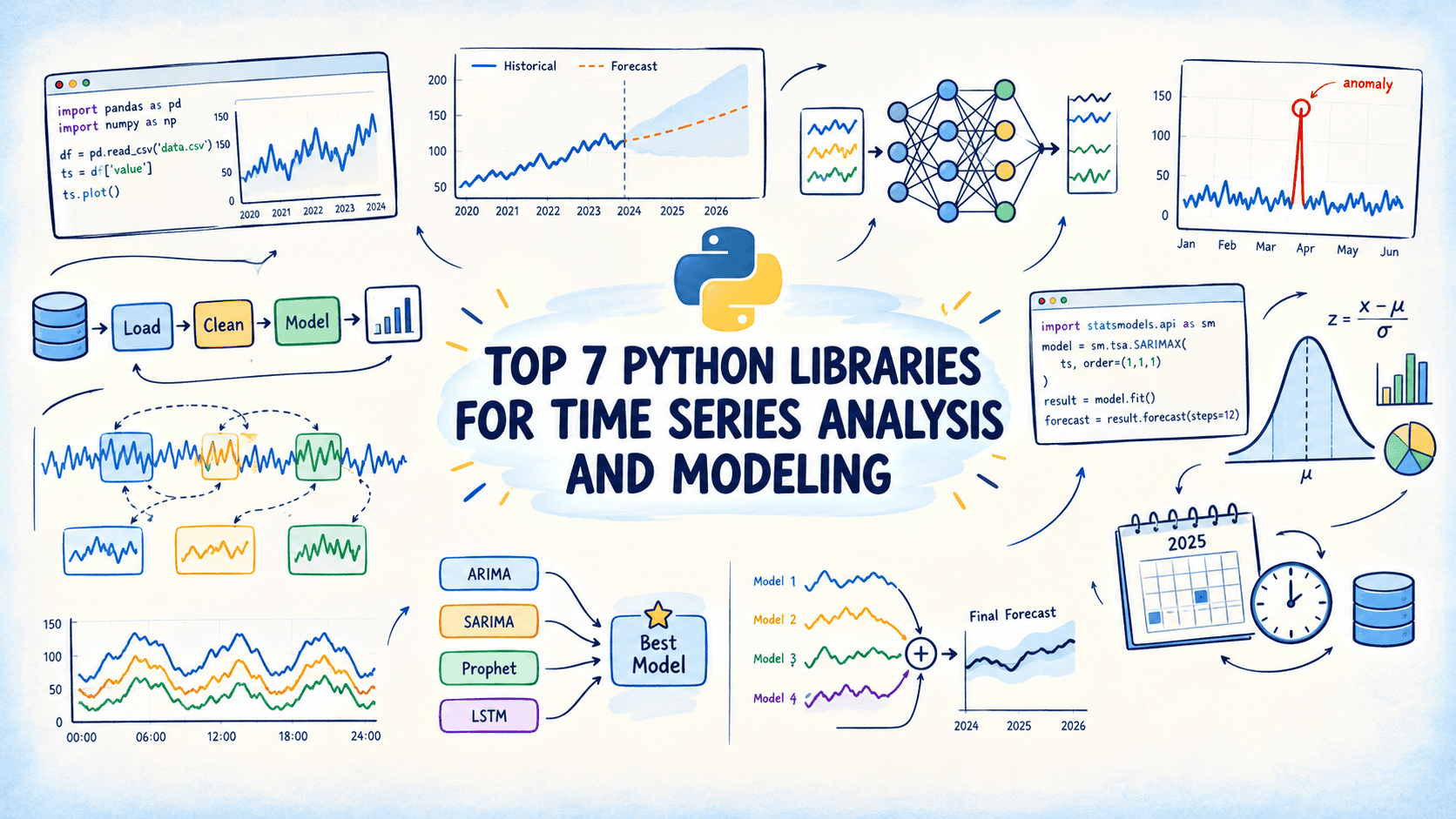
时间序列分析与建模的7大Python库
作者:Bala Priya C,KDnuggets 特约编辑兼技术内容专家,2026年11月6日,Python 分类
时间序列分析拥有 Python 中最碎片化的库生态之一。根据你是需要统计预测、机器学习流水线、深度学习模型还是异常检测,你会选用不同的工具——而每种工具都有自己的 API、对数据格式的预期,以及对你要解决问题的前提假设。
本文介绍七个实用的 Python 库,它们共同覆盖了时间序列工作的完整谱系,包括:
经典与自动化统计预测
可扩展的机器学习流水线与模型选择
深度学习与基于集成的预测
异常检测、离群值分析与模式发现
1. 使用 statsmodels 构建统计预测模型
当可解释性与预测能力同等重要时,statsmodels 是首先应该使用的库。它是 Python 中经典时间序列分析的基础,实现了数十年来在经济学、金融学和运筹学领域一直作为主力工具的统计模型。
statsmodels 的实用之处在于:
实现了完整的 ARIMA 家族,包括适用于季节性数据和外生回归变量的 ARIMA 和 SARIMAX,输出中包含置信区间、赤池信息准则(AIC)和贝叶斯信息准则(BIC)评分以及诊断图
通过 ETSModel 提供指数平滑模型,涵盖加法和乘法趋势及季节性成分
包含用于建模前诊断的统计检验:用于平稳性检验的增广迪基-富勒(ADF)检验和 KPSS 检验,以及用于残差自相关检验的 Ljung-Box 检验
2. 用 pmdarima 实现模型选择自动化
找到合适的 ARIMA 阶数——即 (p, d, q) 参数——是经典预测中最繁琐的步骤之一。pmdarima 通过将 R 的 auto.arima 功能引入 Python 解决了这一问题,它在底层封装了 statsmodels,并自动化了模型选择过程。
以下是 pmdarima 的关键特性:
auto_arima 会在候选 ARIMA 阶数上进行逐步搜索,以 AIC 或 BIC 作为评分标准,无需人工解读自相关图和偏自相关图
遵循 scikit-learn 的 fit/predict 接口,因此可以无缝接入现有的 scikit-learn 流水线
在加入 SARIMA 项之前自动检验季节性,从而降低强行套用并不存在的季节性结构的风险
注意:pmdarima 适合用于快速建立统计基线,或对大量序列进行自动化预测。其 GitHub 仓库显示,近几个版本的开发速度已经放缓,因此在将其固定进新的生产流水线之前,请先查看变更日志。
3. 用 sktime 构建统一的机器学习流水线
sktime 为各类时间序列学习任务——预测、分类、回归、聚类和标注——提供统一接口,涵盖经典统计学、机器学习和深度学习。因此,它解决的正是我们在本文开头提到的 Python 时间序列生态碎片化问题。
为什么 sktime 值得在你的时间序列工具箱中占有一席之地:
所有估计器采用统一的接口,因此在 ARIMA 模型、梯度提升回归器和神经网络之间切换只需改动少量代码
复合模型构建——流水线化、集成、调优、归约——用于将预处理和预测串联成一个可复现的工作流
时间序列感知的交叉验证,尊重时间顺序,避免通用交叉验证器在序列数据上引入的泄漏
提供与相关库的直接接口,包括 scikit-learn、statsmodels、tsfresh 和 PyOD
当工作流需要系统化、可复现,并且易于跨模型家族进行比较时,sktime 就是应该使用的库。阅读 Building Time-Series Machine Learning Models with sktime in Python,获取 sktime 的实用介绍。
4. 用 Darts 进行规模化预测
Darts 采用了比 sktime 更宽泛的工具包式方法。它并非统一访问其他库的算法,而是直接实现经典、机器学习和深度学习模型,并侧重于概率预测和多序列规模化。
Darts 的亮点:
在大多数模型上生成概率预测,返回预测区间而非单点估计
一次性在大量相关序列的集合上训练单个全局模型,而不是为每个序列各训练一个模型
包含回测工作流,可在多个预测跨度上模拟历史预测
内置异常检测模块,可将预测或滤波模型封装为检测器,也可把 PyOD 风格的评分器直接应用于时间序列
Darts 还在同一个包中提供了广泛的模型目录,涵盖指数平滑、ARIMA、梯度提升回归以及多种深度学习架构。
5. 使用 stumpy 检测时间模式
大多数时间序列库专注于预测。而 stumpy 计算的是矩阵剖面(matrix profile),这一结构记录了序列中每个子序列与其最近邻之间的距离。该结构支持模体发现、discord 检测和模式发现,且无需标注数据。
stumpy 为何有助于时间序列中的模式发现:
模体发现能找出重复出现最频繁的子序列——这对传感器数据、用户活动日志或设备周期都很有用,且无需标注
Discord 检测找出与其余部分最不相似的子序列,这是一种参数轻量的异常事件标记方式
通过 CPU 并行化和 GPU 加速实现扩展,适用于高频或长时间运行的数据
在 matrix profile 之上支持额外任务,包括 shapelet 发现、流式更新和时间序列链
当问题在于「这批数据中存在哪些模式」而非「接下来会发生什么」时,stumpy 往往是合适的工具。在生产监控中,它与预测库形成互补。
6. 用 PyOD 扩展异常检测
对于表格型和多变量特征矩阵上的异常检测,PyOD 是现有最全面的库。其当前主版本在一个接口下实现了 60 多种检测算法,并已从表格数据扩展到时间序列、图、文本和图像数据。
PyOD 在离群点检测方面之所以实用:
在一个包中涵盖完整谱系,包括基于邻近度、线性、集成和深度学习的方法
跨检测器提供一致的接口,输出连续异常分数,而不仅是二分类标签
提供用于并行训练和评估的实用工具,减少构建异常检测实验所涉及的样板代码
近期版本在现有编程 API 之上新增了智能体式工作流,可用自然语言描述检测任务
PyOD 仍最常用于工程化特征矩阵——滚动统计量、滞后特征、频率分量——而不是直接用于原始序列。
7. 使用 NeuralForecast 进行深度学习预测
当经典模型和基于机器学习的模型达到瓶颈时,深度学习可以弥合差距。Nixtla 的 NeuralForecast 将大量神经预测架构引入 Python,打包成便于生产使用的软件包。
NeuralForecast 的功能包括以下内容:
在同一个库中实现了 30 多种预测架构,涵盖从循环网络到基于 Transformer 和基于大语言模型的模型,如 PatchTST、TimesNet 和 TimeLLM
支持外生变量和静态协变量,并提供针对趋势、季节性和特征贡献的可解释性方法
包含自动超参数调优和内置的时间序列交叉验证
专为多序列预测而构建,接受带有序列标识符列的长格式数据,从而一个全局模型可以覆盖数千个相关序列
NeuralForecast 是更广泛的 Nixtla 生态系统的一部分,与用于快速经典模型的 StatsForecast 和用于梯度提升的 MLForecast 并列。
这七个库覆盖了完整的时间序列技术栈,从可解释的统计模型到可扩展的深度学习和无监督异常检测。以下是一个概览:
完整的 ARIMA/SARIMAX 系列,具备严格的诊断功能
可解释、可直接面向利益相关者的预测
自动化模型选择
通过 auto_arima 自动搜索 ARIMA 阶数
快速统计基线
统一的机器学习流水线
一套接口覆盖预测、分类与聚类
可复现、可比较的机器学习工作流
概率化的多序列全局模型,外加异常检测
在多条序列上以不确定性进行规模化预测
用矩阵轮廓实现重复模式与异常子序列发现
无需标签即可发现模式或异常
一个 API 下提供 60+ 算法,现已支持多模态
大规模表格/多变量异常检测
深度学习预测
30+ 种神经架构,支持全局训练
在复杂、大规模序列上提升准确率
原文较长,译文为节选;译文由英文原文机器翻译,术语按行业惯例统一,可在文末展开原文核对。
查看英文原文(Top 7 Python Libraries for Time Series Analysis and Modeling)
By Bala Priya C, KDnuggets Contributing Editor & Technical Content Specialist on November 6, 2026 in Python
Time series analysis has one of the most fragmented library ecosystems in Python. Depending on whether you need statistical forecasting, machine learning pipelines, deep learning models, or anomaly detection, you'll reach for different tools — each with its own API, data format expectations, and assumptions about your problem.
This article covers seven useful Python libraries that collectively span the full spectrum of time series work, including:
Classical and automated statistical forecasting
Scalable machine learning pipelines and model selection
Deep learning and ensemble-based forecasting
Anomaly detection, outlier analysis, and motif discovery
1. Building Statistical Forecasting Models with statsmodels
When interpretability is just as important as predictive power, statsmodels is the first library to reach for. It is the foundation of classical time series analysis in Python, implementing the statistical models that have been workhorses in economics, finance, and operations research for decades.
What makes statsmodels useful:
Implements the full ARIMA family, including ARIMA and SARIMAX for seasonal data and exogenous regressors, with confidence intervals, Akaike information criterion (AIC) and Bayesian information criterion (BIC) scores, and diagnostic plots included in the output
Provides exponential smoothing models through ETSModel, covering additive and multiplicative trend and seasonal components
Includes statistical tests for pre-modeling diagnostics: the Augmented Dickey-Fuller test and KPSS test for stationarity, and the Ljung-Box test for residual autocorrelation
2. Automating Model Selection with pmdarima
Finding the right ARIMA order — the (p, d, q) parameters — is one of the most tedious steps in classical forecasting. pmdarima solves this by bringing R's auto.arima functionality to Python, wrapping statsmodels under the hood and automating the model selection process.
The following are the key features of pmdarima:
auto_arima runs a stepwise search over candidate ARIMA orders, scoring by AIC or BIC, without manual interpretation of autocorrelation and partial autocorrelation plots
Follows scikit-learn's fit/predict interface, so it slots into existing scikit-learn pipelines
Tests for seasonality automatically before adding SARIMA terms, reducing the risk of forcing seasonal structure that isn't there
Note: pmdarima is the right tool for a fast statistical baseline, or for automated forecasting across many series. Its GitHub repository shows development has slowed in recent releases, so check the changelog before pinning it into a new production pipeline.
3. Building Unified Machine Learning Pipelines with sktime
sktime provides a unified interface for time series learning tasks — forecasting, classification, regression, clustering, and annotation — spanning classical statistics, machine learning, and deep learning. It therefore tackles the fragmentation problem in Python's time series ecosystem that we started this article with.
Why sktime should find a place in your time series toolkit:
One consistent interface across estimators, so switching between an ARIMA model, a gradient boosting regressor, and a neural network is a small code change
Composite model building — pipelining, ensembling, tuning, reduction — for chaining preprocessing and forecasting into a single reproducible workflow
Time-series-aware cross-validation that respects temporal order, avoiding the leakage generic cross-validators introduce on sequential data
Direct interfaces to related libraries, including scikit-learn, statsmodels, tsfresh, and PyOD
sktime is the library to use when a workflow needs to be systematic, reproducible, and easy to compare across model families. Read Building Time-Series Machine Learning Models with sktime in Python for a practical introduction to sktime.
4. Forecasting at Scale with Darts
Darts takes a broader-toolkit approach than sktime. Instead of unifying access to other libraries' algorithms, it implements classical, machine learning, and deep learning models directly, with an emphasis on probabilistic forecasting and multi-series scale.
What makes Darts interesting:
Produces probabilistic forecasts across most models, returning prediction intervals rather than single-point estimates
Trains a single global model across large collections of related series at once, rather than one model per series
Includes a backtesting workflow for simulating historical forecasts across multiple horizons
Ships an anomaly detection module that wraps forecasting or filtering models into detectors, or applies PyOD-style scorers directly to time series
Darts also covers a broad model catalog in one package, spanning exponential smoothing, ARIMA, gradient-boosted regression, and several deep learning architectures.
5. Detecting Temporal Patterns with stumpy
Most time series libraries focus on forecasting. stumpy, however, computes the matrix profile, a structure recording the distance between every subsequence in a series and its nearest neighbor. That structure supports motif discovery, discord detection, and pattern discovery without labeled data.
What makes stumpy helpful for pattern discovery in time series:
Motif discovery surfaces the most frequently recurring subsequences — useful for sensor data, user activity logs, or equipment cycles, without labeling
Discord detection finds the subsequences most unlike everything else, a parameter-light way to flag unusual events
Scales through CPU parallelization and GPU acceleration for high-frequency or long-running data
Supports additional tasks on top of the matrix profile, including shapelet discovery, streaming updates, and time series chains
stumpy is often the right tool when the question is "what patterns exist in this data" rather than "what happens next." It complements forecasting libraries in production monitoring.
6. Scaling Anomaly Detection with PyOD
For anomaly detection on tabular and multivariate feature matrices, PyOD is the most comprehensive library available. Its current major version implements more than 60 detection algorithms under one interface and has expanded beyond tabular data to also cover time series, graph, text, and image data.
What makes PyOD useful for outlier detection:
Covers the full spectrum in one package, including proximity-based, linear, ensemble, and deep learning methods
One consistent interface across detectors, with continuous anomaly scores rather than only binary labels
Utilities for parallel training and evaluation, cutting the boilerplate involved in building anomaly detection experiments
Recent releases add agentic workflows for describing a detection task in plain language, on top of the existing programmatic API
PyOD is still most often used on engineered feature matrices — rolling statistics, lag features, frequency components — rather than on raw sequences directly.
7. Forecasting with Deep Learning Using NeuralForecast
When classical and machine learning-based models plateau, deep learning can close the gap. NeuralForecast by Nixtla brings a large collection of neural forecasting architectures to Python in a production-friendly package.
The features of NeuralForecast include the following:
Implements more than 30 forecasting architectures in one library, from recurrent networks to transformer-based and large language model-based models like PatchTST, TimesNet, and TimeLLM
Supports exogenous variables and static covariates, plus interpretability methods for trend, seasonality, and feature contributions
Includes automatic hyperparameter tuning and built-in temporal cross-validation
Built for multi-series forecasting, accepting long-format data with a series identifier column so one global model can cover thousands of related series
NeuralForecast is part of the broader Nixtla ecosystem, alongside StatsForecast for fast classical models and MLForecast for gradient boosting.
These seven libraries cover the full time series stack, from interpretable statistical models to scalable deep learning and unsupervised anomaly detection. Here's an overview:
Full ARIMA/SARIMAX family with rigorous diagnostics
Interpretable, stakeholder-ready forecasts
Automated model selection
Automates ARIMA order search via auto_arima
Fast statistical baselines
Unified machine learning pipelines
One interface across forecasting, classification, and clustering
Reproducible, comparable machine learning workflows
Probabilistic, multi-series global models plus anomaly detection
Scaling forecasts with uncertainty across many series
Matrix profile for motif and discord discovery
Finding patterns or anomalies without labels
60+ algorithms under one API, now multimodal
Tabular/multivariate anomaly detection at scale
Deep learning forecasting
30+ neural architectures with global training
Pushing accuracy on complex, large-scale series
The best way to get comfortable with any of these libraries is to apply them to the same dataset and compare results. Understanding why models work the way they do for the given problem teaches you more about your data than any benchmark table can.
Bala Priya is a developer, educator, and technical writer based in India. She writes about programming, data science, machine learning, and AI, with a focus on making complex technical ideas practical and approachable. She creates tutorials, how-to guides, and deep dives that help developers build, solve problems, and understand complex technical concepts. Her technical interests include LLM applications, agentic AI, graph algorithms, computer vision, explainable AI, and ML systems. When she’s not writing or coding, Bala is usually reading classic literature, epic fantasy, or speculative fiction. She also enjoys talking about books, learning new things, and sharing what she learns with the developer community.
原文为英文,正文由自动抓取并保留原文。
原文发布于 KDnuggets(Top 7 Python Libraries for Time Series Analysis and Modeling),标题、摘要与正文由机器翻译,术语按行业惯例统一,未经人工逐句校订。