Intel下一代Nova Lake需换新主板:Nova Point与Z990、Z970、B960芯片组前瞻
英特尔新的 Nova Lake-S CPU 据传有望在 2026 年第四季度开始量产,预计 2027 年第一季度发布。与此前的发布不同,我们据称将先在第一季度看到中端 SKU,据说是未锁频的 28 核产品,随后在 2027 年晚些时候推出旗舰级型号,据称其采用两个计算模块并最高可达 52 核。
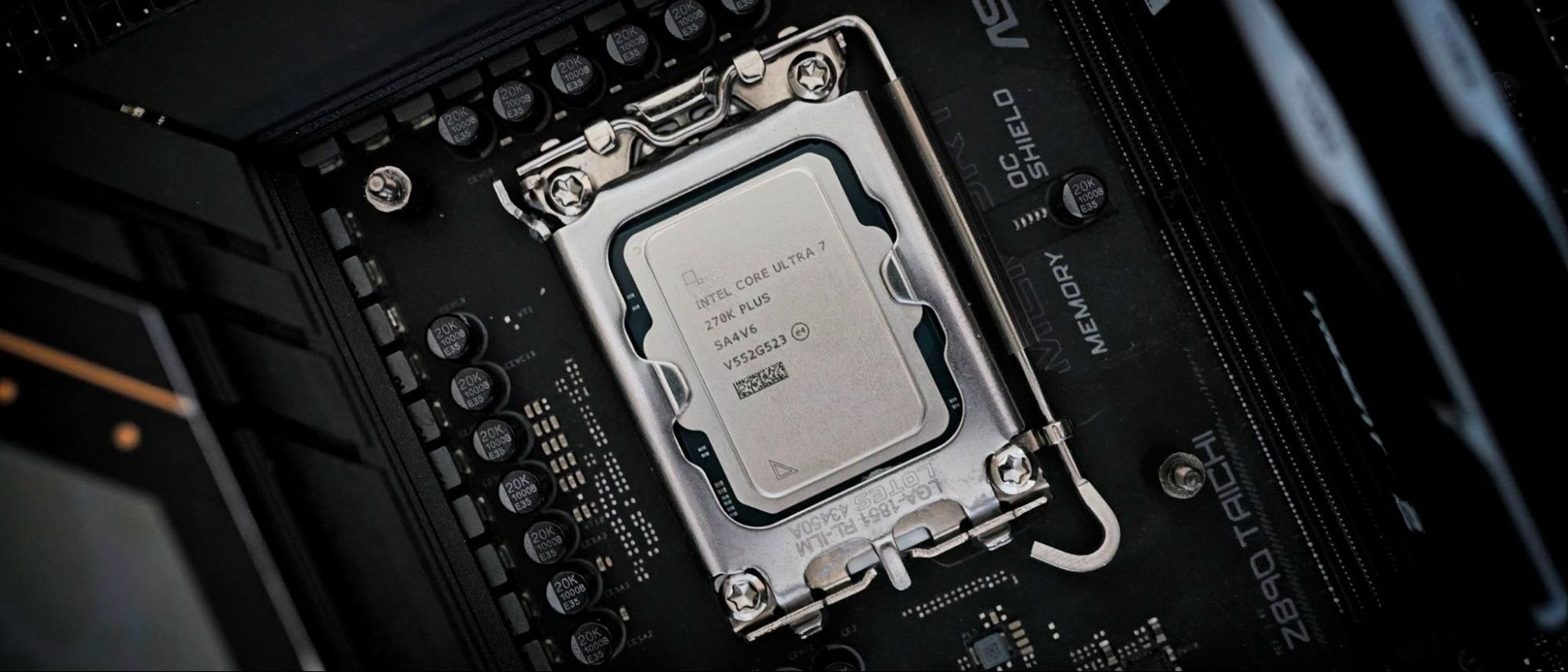
英特尔 CEO 陈立武(Lip-Bu Tan)今年早些时候表示,Nova Lake 将在“2026 年底推出”。尽管传闻和声明越来越多,我们仍没有具体日期,但预计很快就能看到这些 CPU,以及随之而来的全新插槽和主板芯片组。无论它们有多少核心或何时上市,你都需要为 Nova Lake 换新主板。随着 2026 年早些时候发布的 Core Ultra 7 270K Plus 等 Core Ultra Series 2 处理器推出,LGA 1851 插槽已走到生命周期尽头;这意味着不会再有新处理器,已是死路。新插槽 LGA 1954 是必要的,因为 Nova Lake CPU 的 I/O 和功耗需求大幅增加。这也是英特尔首款 bLLC(大末级缓存),旨在对抗 AMD 的 X3D CPU。
我们尚未看到关于这些主板本身的许多细节,比如定价、官方配置或产品线,而且我们只在 Computex 上瞥见了一两款早期型号。不过,我们还是看到了一些有趣的平台细节和传闻。为此,我们整理了一张表格,汇总目前已知的规格信息。有些内容尚未官方确认,并用波浪号(~)标注。我们还列出了上一代对应产品以供参考。
900 系列芯片组,“最高”
B960(主流)
B860(主流)
Z990(发烧级)
Z890(发烧级)
Z970(发烧级)
PCIe 通道总数
处理器 TB4/USB4
1(TB5,80Gbps)
2(TB5,80Gbps)
1(TB5,80Gbps)
DMI Gen5 通道
芯片组 PCIe 5.0 通道
芯片组 PCIe 4.0 通道
SATA 3.0(6G 通道)
USB3.2(20G)端口
USB3.2(10G)端口
USB3.2(5G)端口
无(由主板决定)
处理器 PCIe 5.0 插槽通道配置
1x16 或 1x8 + 2x4 或 2x8 或 4x4
1x16 + 1x4 或 2x8 + 1x4 或 1x8 或 3x4
处理器 PCIE 5.0 存储通道配置
支持的同步显示器数量
支持 PCIE RAID 0/1/5/10
支持 SATA RAID 0/1/5/10
Intel vPro + 标准可管理性
译文由英文原文机器翻译,术语按行业惯例统一,可在文末展开原文核对。
查看英文原文(Intel’s next-gen Nova Lake needs new motherboards — what we expect from Nova Point and Z990, Z970, and B960 chipsets)
Intel’s new Nova Lake-S CPUs are rumored to be on track to start mass production in Q4 2026, with a launch expected in Q1 2027. Unlike previous launches, we’re supposed to see mid-range SKU(s), supposedly an unlocked 28-core product(s), first in Q1, followed later in 2027 by flagship-class models that allegedly use two compute tiles and feature up to 52 cores.
Lip-Bu Tan, Intel CEO, said earlier this year that Nova Lake is “coming at the end of 2026.” Despite the growing number of rumors and statements, we still don’t have a concrete date, but we can expect to see the CPUs soon, and with them, a brand-new socket and motherboard chipsets.
Regardless of how many cores they have or when they arrive, you will need a new motherboard for Nova Lake. The LGA 1851 socket is at the end of its life with the release of Core Ultra Series 2 processors like the Core Ultra 7 270K Plus, released earlier in 2026; that means no more new processors and a dead end. A new socket, LGA 1954, is necessary because Nova Lake CPUs have a significant increase in I/O and power needs. It’s also Intel’s first bLLC (big last-level cache) intended to take on AMD’s X3D CPUs.
We haven’t seen many details about the boards themselves, like pricing, official configurations, or product stacks, and we've only caught glimpses of one or two early models at Computex. Still, we have seen a few interesting platform details and rumors. To that end, we’ve put together a table of what we know so far about the specifications. Some things aren’t official yet and are noted by the tilde (~). We’ve also listed last-gen equivalents for reference.
900 Series Chipset, “up to” | B960 | B860 | Z990 | Z890 | Z970 |
Total PCIe Lanes | 34 | 34 | 48 | 48 | 34 |
Processor TB4/USB4 | 1 | 1 | 2 | 2 | 1 (TB5, 80Gbps) |
DMI Gen5 Lanes | 2 | 0 (4x G4) | 4 | 0 (8x G4) | 2 |
Chipset PCIE 5.0 Lanes | 0 | 0 | 12 | 0 | 0 |
Chipset PCIe 4.0 Lanes | 14 | 14 | 12 | 24 | 14 |
SATA 3.0 (6G Lanes) | 4 | 4 | 8 | 8 | 4 |
USB2 Ports | 12 | 12 | 14 | 14 | 12 |
USB3.2 (20G) Ports | ~2 | 2 | ~5 | 5 | ~2 |
USB3.2 (10G) Ports | ~2 | 4 | ~10 | 10 | ~4 |
USB3.2 (5G) Ports | ~6 | 6 | ~10 | 10 | ~6 |
IA OC | No | No | Yes | Yes | Yes |
BCLK OC | No | No (board discretion) | Yes | Yes | No |
Memory OC | Yes | Yes | Yes | Yes | Yes |
Processor PCIE 5.0 Slot Lane Config | 1x16 | 1x16 + 1x4 | 1x16 or 1x8 + 2x4 or 2x8 or 4x4 | 1x16 + 1x4 or 2x8 + 1x4 or 1x8 or 3x4 | 1x16 |
Processor PCIE 5.0 Storage Lane Config | 1x4 | 1x4 | 1x8 or 2x4 | 1x4 | 1x4 |
ECC | No | No | No | No | No |
Simultaneous Displays Supported | 4 | 4 | 4 | 4 | 4 |
PCIE RAID 0/1/5/10 Support | No | No | Yes | Yes | No |
SATA RAID 0/1/5/10 Support | Yes | Yes | Yes | Yes | Yes |
Intel vPro + Standard Manageability | No | No | No | Yes | No |
The new lineup consists of five different chipsets. You get Z990 and Z970 for the enthusiast class, B960 for the Mainstream, W980 for workstations, and Q970. You may notice it’s missing the ‘H910’ platform for entry-level PCs, and now we see a second enthusiast-class platform, the Z970, wedged between the B960 and Z990. Z990 is still the flagship, offering more PCIe lanes, a DMI Gen5 x4 link, and 12 Gen5 lanes from the chipset. Z970 is the less expensive enthusiast option and is reportedly built on the same silicon as B960. You get CPU multiplier overclocking, but no BCLK adjustment, and of course fewer ports and lanes than the flagship.
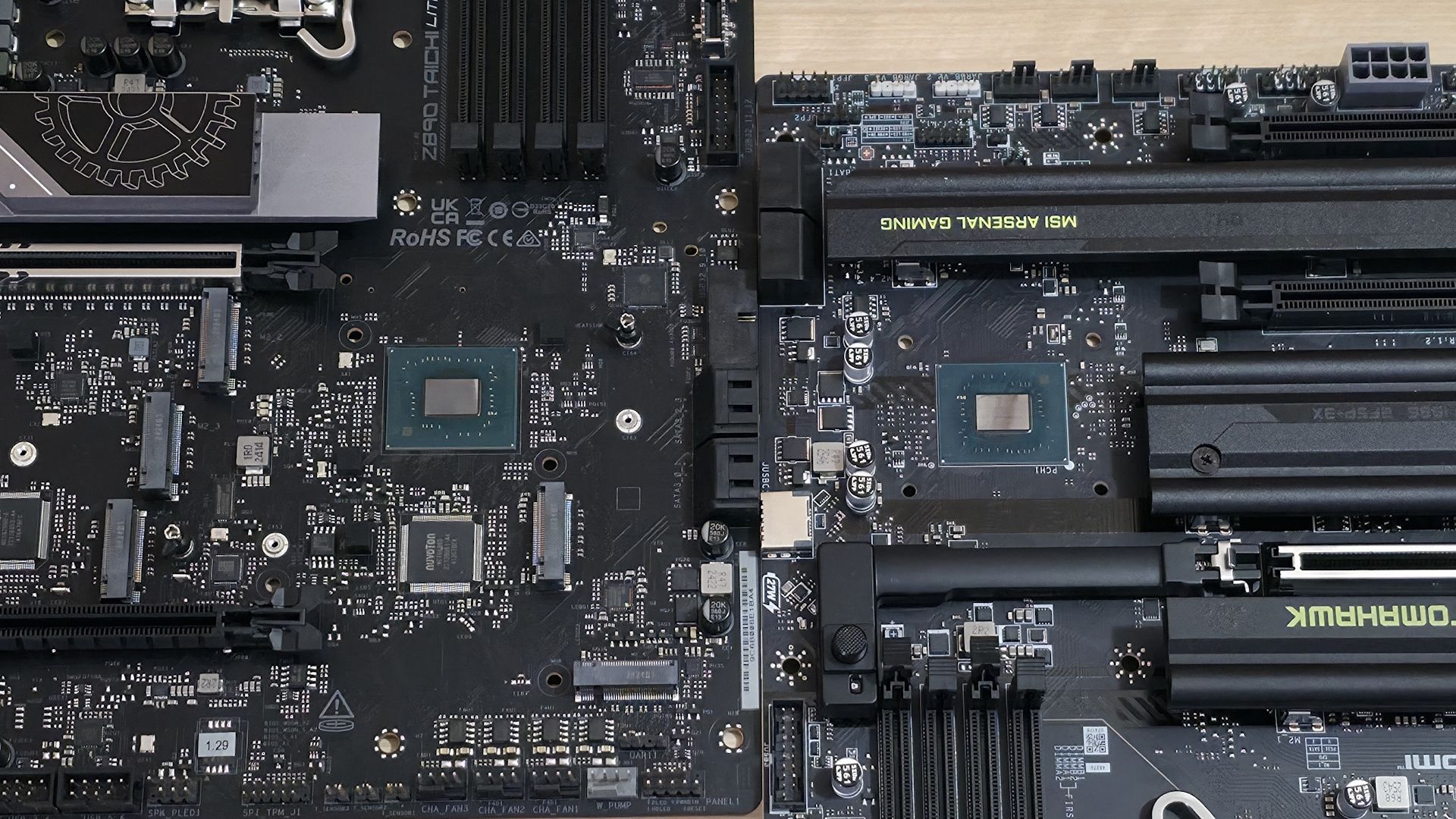
The chipset package itself, internally codenamed “Nova Point,” will also differ slightly and is smaller than Z890 (600 mm² vs 658 mm²). The die-on-package shrinks to 72.5 mm² (11.15 x 6.5mm) compared to 92.9 mm² (11.15 x 8.33 mm), or roughly 22% smaller. Base power increases to 7.9 Watts, up from 6 W on the Z890, with a maximum of 14 W while working.
That power-density increase explains Intel’s rumored active-cooling guidelines for the chipset. When you start connecting components that use the chipset, think some PCIe slots and M.2 drives, the chipset raises its working voltage to maintain signal integrity for all of the bandwidth it now has to provide for the attached devices. Hopefully this is only needed in the high-end Z990/970, where it has a lot more lanes/bandwidth to support, as some of the fans on the chipset (remember early X570?) could get loud.
What to expect from Nova Point motherboards
Beyond the new LGA 1954 socket, not much information has been released about what to expect from motherboard partners. We know the platform's base memory speed is a smoking-fast DDR5-8000, up 800 MT/s over the Arrow Lake refresh chips. And if you don’t have a kit that can run those speeds and want to, it will cost at least $700 from any reputable brand. So the platform's cost of entry will be high unless you’re starting with compatible RAM. That said, you can run slower speeds if you already have DDR5, which would save money, but it could create a performance ceiling.
We’ll also see more abundant PCIe 5.0 connectivity. The upcoming Nova Lake CPUs are said to offer 36 PCIe Gen5 lanes. You get 16 lanes dedicated to graphics, eight lanes to storage, eight lanes to Thunderbolt 5 controllers (4x ea.), and four lanes for the DMI. That said, speeds are the same as the previous generation, since PCIe 4.0 x8 matches PCIe 5.0 x4. The chipset now has 12 dedicated PCIe 5.0 lanes, so motherboard manufacturers can include multiple PCIe 5.0 NVMe slots without sharing bandwidth from the primary PCIe slot or stealing USB4 bandwidth. In theory, you can have five PCIe 5.0 M.2 sockets between the CPU's native lanes and the chipset without sharing bandwidth among PCIe slots or M.2 sockets—a significant upgrade over Z890.
Lane Category | Lane Count | Type | Functionality |
Graphics | 16 Lanes | PCIe 5.0 | Primary GPU Slot (x16) |
Storage | 8 Lanes | PCIe 5.0 | Two dedicated M.2 NVMe sockets (4x ea.) |
Thunderbolt Reserved | 8 Lanes | PCIe 5.0 | Dual Thunderbolt 5 Controllers (x4 ea.) |
DMI Reserved | 4 Lanes | PCIe 5.0 | DMI 5.0 x4 Link to Chipset |
Total CPU Native | 36 Lanes | Gen5 | Total Lanes |
Thunderbolt 5 (TB5) is another feature we’ll see more of on some of these new boards, offering baked-in support via a controller chip, typically the Intel JHL9580. We’ve seen at least one Z890 board (Asus ProArt) already using it, but it should be more prevalent in this generation.
TB5 speeds hit 80 Gbps (bidirectional) or up to a wicked-fast 120 Gbps in single-direction boost mode. TB5 also supports DisplayPort 2.1, USB4, and USB PD 3.1(100-130W depending). So for anyone who needs fast external storage, a board with TB5 plus an appropriately speedy M.2 external drive means transfers will be much faster.
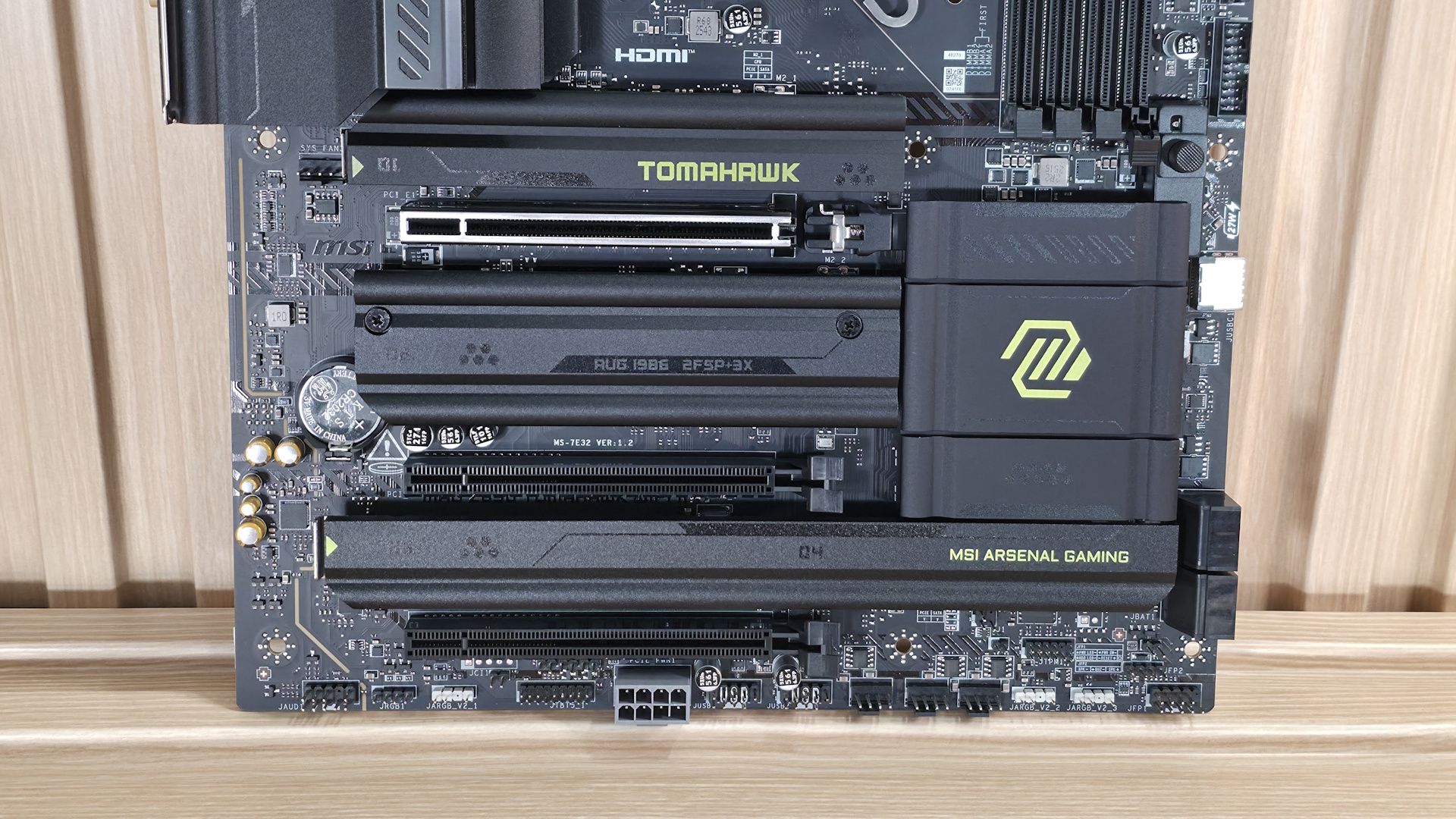
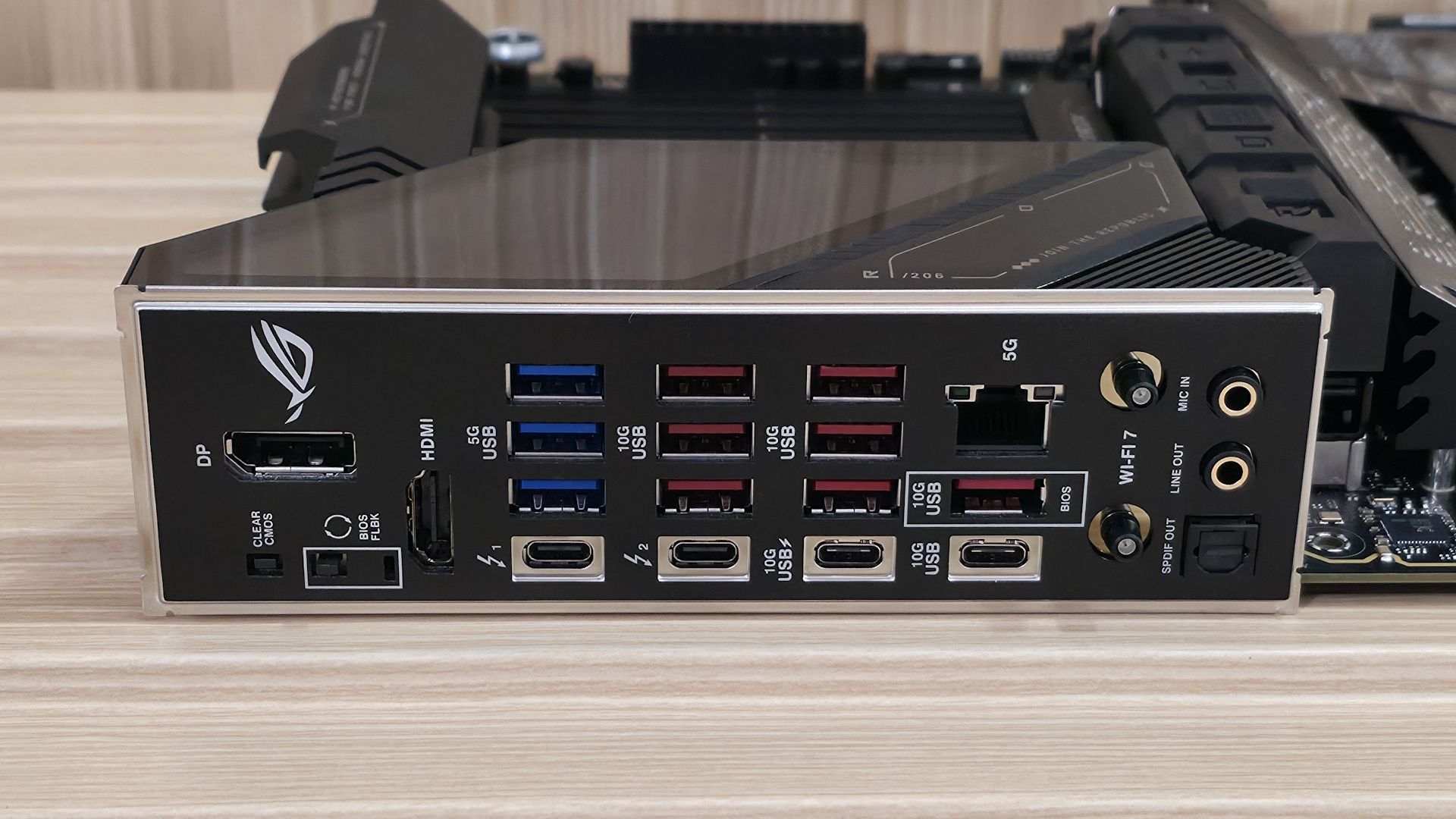
On the networking side, expect another round of 2.5-5GbE on most boards, with the cheapest options opting for the less expensive 1GbE. Premium boards, on the other hand, will work in dual Ethernet connections and 10 GbE. We’ll see a lot of Realtek 8125/8126 (2.5/5GbE) chips, along with some Killer E3100G, and perhaps Killer’s E5000 mixed in, too. 10GbE will still rely on the Marvell AQtion, like the AQC113C.
Integrated Wi-Fi support will vary, with most SKUs opting to use Wi-Fi 7. You’ll see a smattering of the ‘slower’ 160 MHz Wi-Fi 7 which, in reality, is plenty fast and will not be a choke point for most users on less expensive boards. The faster 320 MHz widens the bandwidth highway from four lanes to eight, so you can move twice as much data simultaneously. We expect chips from MediaTek (MT7927), Intel (BE200/202), and Realtek (RTL9822AE) to dominate the Wi-Fi 7 scene for Nova Point boards. Just remember: to take advantage of Wi-Fi 7, you need a Wi-Fi 7-capable router in the first place.
What motherboards can we expect to see?
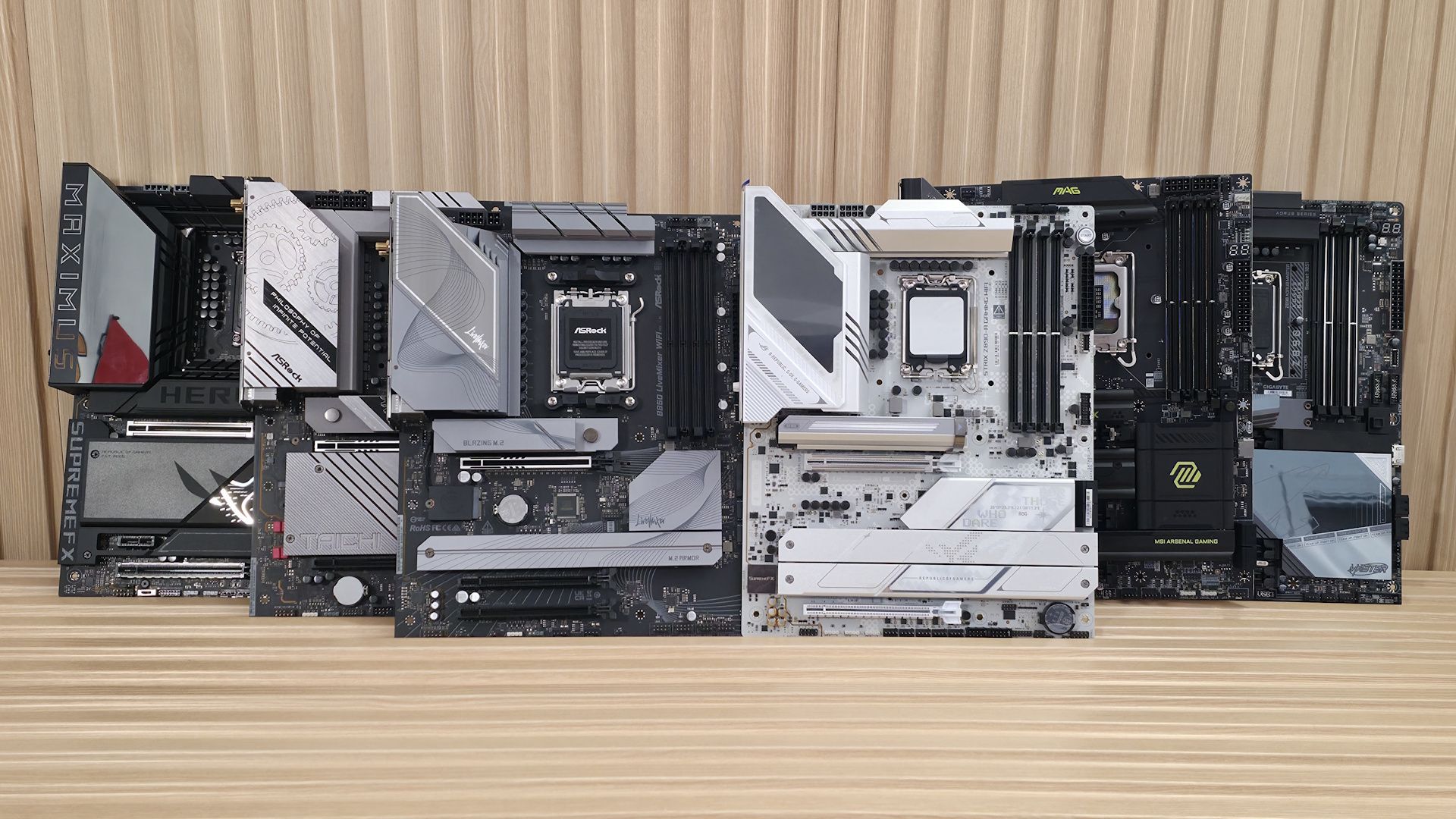
We’ve seen leaks from the Eurasian Economic Union database Gigabyte (via Videocardz), listing a whopping 24 SKUs. We’ve also seen leaks about several ASRock motherboards via shipping records (via Club386). So far, there's not been a peep from MSI or Asus, but you can bet they’ll have a full complement of new boards of all shapes, sizes, and price points. But remember, just because something is listed in the EEU database doesn’t mean it will be released, or released in the U.S. So until we see an official list from the board partners, take this with a pinch of salt.
For Gigabyte, we see a lot of familiar faces in the list, including the flagship Aorus Xtreme, Aorus Master (now in three different SKUs), Aorus Pro and Elite (six total SKUs), and it even looks like they are planning multiple rear-connect Aorus Stealth options. We’ll also see several Aorus Elite and more affordable Eagle SKUs, along with more Duo X boards (this time from different families), all presumably using a 2-DIMM topology that supports high-density CQDIMMs. Micro ATX and Mini-ITX boards are also listed along with the wood-accent Aero models that made a splash this year.
ASRock is offering six different models, from the flagship-class Taichi (White) and Taichi Creator to the budget Pro RS Wifi and Z990 Challenger SKUs. In between, they have multiple variants of the Steel Legend Wi-Fi. What we don’t see from here are Micro ATX or Mini-ITX form factors, or any Z970 or B960 offerings out of the gate. We'll almost certainly be seeing those before long.
Asus has been tight-lipped, and as of this writing, we haven’t heard a peep about their boards. I’m confident we’ll see the usual ROG Maximus, ROG Strix, ProArt, TUF, and Prime lines (among others), with their typical Asus flair and value-add features like AI-assisted functionality (automating performance, optimizing cooling, managing network traffic, etc.).
MSI has also kept its cards close to the vest, and we haven’t seen much from them yet. But we do expect to see the company's lineup in full force. We expect to see the flagship Godlike board from the MEG series, high-end Ace, and mid-range MPG offerings like the Carbon and Edge, along with the MAG value series like the Tomahawk. I’d also imagine we’ll see some small-form-factor offerings, too, like a Z990 Edge Ti Wifi. In short, motherboard partners won’t miss the boat for a fresh revenue stream, and we’re sure to see a lot of options available come launch day.
Pricing for these future motherboards hasn't been listed. Still, you can imagine, with the increase in PCIe 5.0 bandwidth available and the copper needed to support it, hardware upgrades, and other external factors, it's safe to assume most SKUs will increase in price, or, with some luck, be the same as previous-gen versions. Either way, this is the start of a new platform, and those looking for a long-lasting socket should get in on the ground floor, assuming the performance is good, of course.
Final thoughts
So who are these motherboards for, really? With the cost of video cards, storage, and, of course, RAM through the roof, upgrading to the new platform isn’t going to be cheap, especially if you want to get the most out of it. While RAM speeds tend not to make a significant difference in many cases, it can in others. So reaching the base memory speeds of this new platform will cost an arm and a leg. As mentioned earlier, it will run with existing RAM below that value. Still, performance losses will range from negligible to notable, depending on differences in speed and timings, as well as the work being executed and the application used.
Nova Point-based motherboards are shaping up as a meaningful step for Intel’s new platform: a new LGA 1954 socket, 12 PCIe 5.0 lanes attached to the chipset for Z990, Thunderbolt 5 support, and increased base memory speed to DDR5-8000. We even saw Intel add another enthusiast chipset to bridge the gap between enthusiast and mainstream in these trying times. Most of this information comes from leaks and rumors, and without a firm launch date from Intel, details and lineups could change before the Nova Lake CPUs arrive, supposedly in early 2027. We expect to see a lot of boards at CES 2027, with launches following soon after.
If the new CPUs are competitive with AMD's X3D offering, we can imagine those also costing more than the Arrow Lake refresh chips. If you already have a capable system, waiting to see the official lineups, performance, and pricing is the smarter move. But if you want the most PCIe 5.0 storage and the fastest external connectivity with TB5, this platform is built for you. Otherwise, you can likely make do with what you have for a little while longer, hopefully until inflated prices on at least some major components drop.
正文保留英文原文,标题与摘要由机器翻译。
原文发布于 Tom's Hardware(Intel’s next-gen Nova Lake needs new motherboards — what we expect from Nova Point and Z990, Z970, and B960 chipsets),标题、摘要与正文由机器翻译,术语按行业惯例统一,未经人工逐句校订。