2026 年值得尝试的 8 个 LLM 推理框架
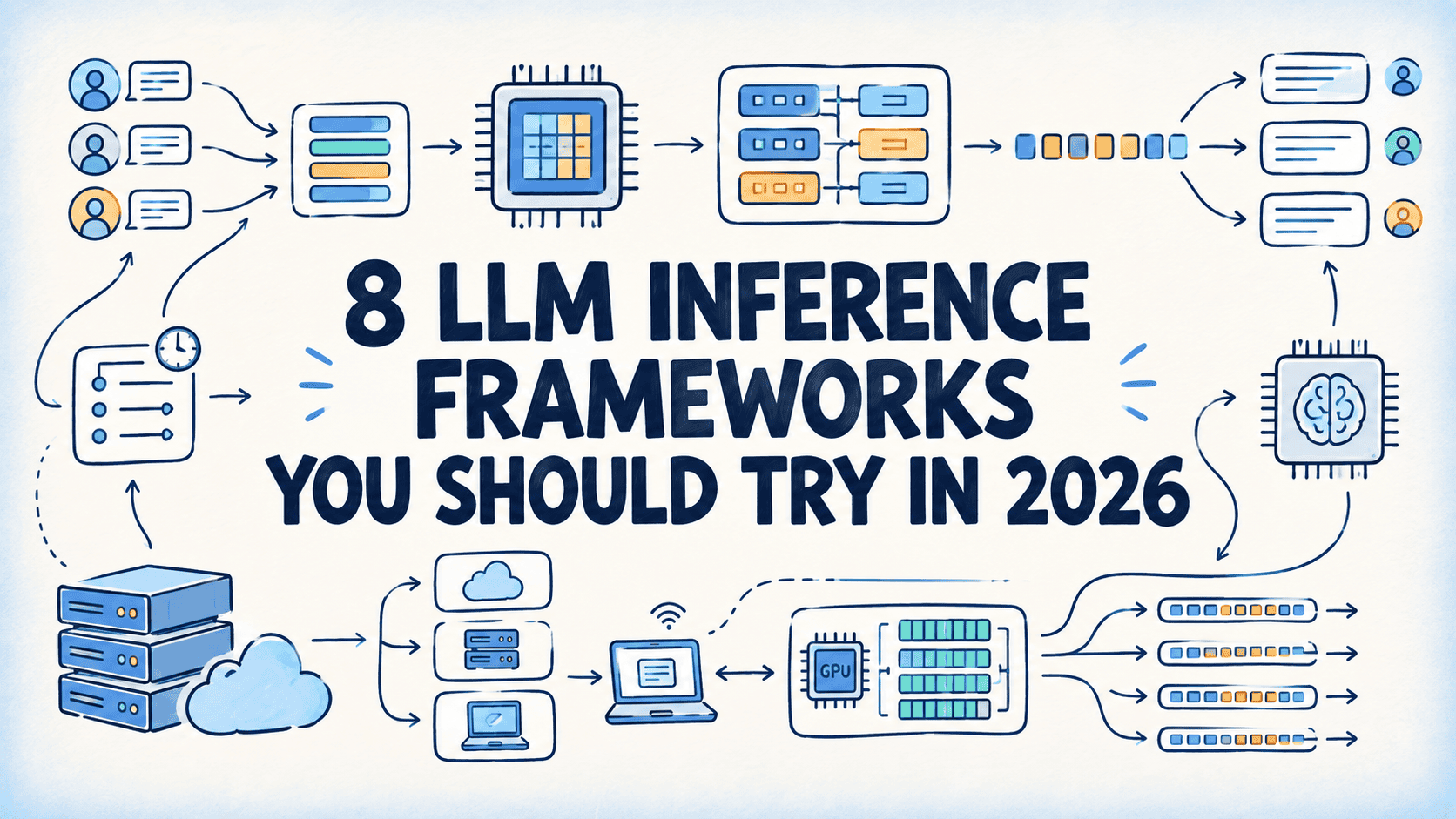
对比用于生产环境服务、请求批处理、KV 缓存管理和高效部署的 LLM 推理框架。
作者:Bala Priya C,KDnuggets 特约编辑兼技术内容专家,2026 年 11 月 3 日,语言模型栏目
在 notebook 里运行的模型一次只能处理一个请求。而生产环境的端点会同时接收大量请求,每个请求都需要为其键值(KV)缓存分配 GPU 显存、在批次中占用一个位置,并需要一条响应流。单纯的 PyTorch 或 Hugging Face Transformers 也能提供模型服务,但请求调度、缓存管理和 API 层都得你自己搭建。
推理框架提供了这些组件。它们位于模型与你的应用之间,覆盖 Token 生成、KV 缓存管理、请求批处理和 API 接口,这样你就不必为每一个上线的模型重复搭建这套机制。有了合适的框架,同一块 GPU 无需改动模型,就能以更低的延迟服务更多并发请求。
本文涵盖面向高吞吐、数据中心级服务的推理框架,也介绍面向本地、边缘和低资源环境的工具。
下面我们来逐一了解这些框架。
vLLM 是大规模服务大语言模型(LLM)时应用最广泛的引擎之一,许多从纯 Transformers 迁移过来的开发者往往最先选择它。
以下是 vLLM 在许多实际应用中表现出色的原因:
使用 PagedAttention 以小块(block)方式管理 KV 缓存内存,从而能在同一块 GPU 上塞入更多并发请求
支持连续批处理(continuous batching),新请求可以加入正在运行的批次,而此时先前的请求仍在生成
提供兼容 OpenAI 的服务器,因此现有客户端代码通常无需改动
既可通过其 LLM 类作为进程内库运行,用于离线批处理任务和评估流水线,也可作为独立服务器运行
支持 NVIDIA、AMD 和 Intel GPU,以及 CPU 和 TPU
先从 vLLM 文档入手,如果你要把模型拆分到多块 GPU 上,再看它对张量并行的支持。
SGLang 将快速的后端运行时与用于描述模型交互的前端语言相结合,适合提示逻辑复杂的工作负载。
SGLang 的实用之处:
协同设计服务后端与提示前端,让你对多步骤或分支式生成拥有更精细的控制
使用 RadixAttention 在共享前缀的请求之间复用 KV 缓存
支持结构化输出和约束解码,这对于工具调用和 JSON 格式输出很有用
通过 SGLang Diffusion 为图像和视频工作负载提供扩散模型服务
提供服务器模式和进程内引擎,类似于 vLLM 的库模式和独立部署两种选项
SGLang 的 GitHub 仓库是最好的起点,其文档对前端语言有更深入的介绍。
MAX 是 Modular 的服务框架,它能让你把控制精细到内核级别。
以下是 MAX 的一些实用特性:
同时支持在 CPU 和 GPU 上运行,如果你的机群并非只有 GPU,这会很有帮助
允许在模型和内核层面进行定制,因此拥有自定义架构的团队可以自行添加支持
在标准 LLM 服务之外,还支持扩散模型服务
通过其 max serve 命令,提供与 vLLM 和 SGLang 同类别的调优选项,例如批大小、内存利用率和最大序列长度
MAX 文档展示了这些服务标志如何映射到你的硬件。
TensorRT-LLM 是 NVIDIA 面向自家 GPU 的推理库,如果你的机群全部是 NVIDIA 硬件,这种专注通常会在速度上带来回报。
以下特性让 TensorRT-LLM 的部署成本物有所值:
构建于 NVIDIA 的 TensorRT 生态之上,该生态面向 NVIDIA 芯片上的低延迟推理
支持在途批处理(in-flight batching),以及带块复用的分页 KV 缓存
支持低精度量化,包括 H100 及后续 GPU 上的 FP8、Blackwell GPU 上的 FP4,以及 INT4 激活感知权重量化(AWQ)
可融入以 NVIDIA 为中心的 MLOps 技术栈,包括通过其专用后端接入 Triton Inference Server
NVIDIA TensorRT-LLM 仓库提供了在决定采用之前所需的构建说明和模型支持矩阵。
LMDeploy 是一个用于压缩、部署和提供 LLM 服务的工具包,重点关注解码吞吐和量化。
LMDeploy 的主要特性包括:
运行两种推理引擎:TurboMind,一个 C++/CUDA 引擎,以及一个基于 PyTorch 的引擎
使用持久批处理(persistent batch,即其所说的连续批处理)和分块 KV 缓存来服务并发请求
支持仅权重量化,例如 4-bit AWQ 以及 INT8/INT4 KV 缓存量化,这能降低较大模型的内存占用。
除量化外,还支持自动前缀缓存。
提供离线流水线 API 和 API 服务器,因此你可以使用相同的设置,在你自己的模型和硬件上将其与 vLLM 进行基准测试。
从 LMDeploy 快速入门指南开始。其 GitHub 仓库记录了支持的模型列表和量化选项。
llama.cpp 是一个用纯 C/C++ 编写的轻量级运行时,没有外部依赖。它支持许多模型系列,包括 Llama、Qwen、DeepSeek 和 Mistral。
llama.cpp 的实用之处在于:
可在多种硬件上运行,包括消费级 GPU 和纯 CPU 机器
将依赖占用保持在最低限度,从而简化在资源受限设备上的部署
包含 llama-server,这是一个兼容 OpenAI 的 HTTP 服务器,支持并行解码和连续批处理
适合低延迟、单请求的场景,在这些场景下完整的服务栈会超出实际所需
llama.cpp 的 GitHub 页面是几分钟内在本地跑起一个模型的最快途径。
Ollama 将模型下载、版本管理和本地服务打包在简洁的 CLI 与 API 之后,这使它成为开发者常用的第一个推理工具。
为什么 Ollama 对在本地运行和服务 LLM 极为有用:
几乎无需配置,是从「我有一个模型」到「我有一个可运行的端点」的最短路径
通过简洁的 CLI 处理模型拉取、版本管理和本地服务
通过 OLLAMA_NUM_PARALLEL 设置处理每个模型的并行请求,并将额外请求排队,上限为 OLLAMA_MAX_QUEUE
将内存划分为固定的并行槽位,因此内存占用会随并行设置与上下文长度的乘积而增长
适合单用户和小团队的工作负载;若需同时服务大量用户,vLLM 或 SGLang 会加入分页 KV 缓存管理和连续批处理
Ollama 文档详细介绍了安装、模型库和并发设置。
MLC-LLM 是构建在 Apache TVM 之上的基于编译器的引擎,当你的目标硬件较为特殊,或部署需要横跨多个平台时,它就很合适。
以下特性使 MLC-LLM 有别于本列表中的其他方案:
使用 Apache TVM 编译模型库,既可在引擎启动时即时编译,也可面向 web、iOS 和 Android 目标进行提前编译
支持 AMD、NVIDIA、Apple 和 Intel GPU
同一套工具链即可运行在 Linux、Windows、macOS、iOS、Android 和网页浏览器上
提供兼容 OpenAI 的 REST 服务器,并带有服务器模式,可在专用 GPU 上提高请求并发量
适合需要在不同设备类型上发布同一模型的团队,即一套运行时必须覆盖所有设备类型
MLC-LLM 文档涵盖权重转换和模型编译,这是 Web、iOS 和 Android 部署在首次运行前所需的步骤。
以下是本文所涵盖内容的总结:
NVIDIA、AMD 和 Intel GPU;CPU;TPU
结构化与多步提示工作负载
NVIDIA 和 AMD GPU;TPU
跨硬件推理服务、内核级调优
NVIDIA 硬件上的最高速度
量化、并发服务
GPU(TurboMind 面向 NVIDIA)
轻量级、可移植推理
是,通过 llama-server 槽位
是,可按模型配置
多平台边缘部署
AMD、NVIDIA、Apple 和 Intel GPU;手机;浏览器
根据你的流量模式、硬件和部署目标来做出选择,并在你自己的模型上测量延迟和成本。
祝你构建和实验愉快!
Bala Priya 是一位常驻印度的开发者、教育者和技术作者。她撰写关于编程、数据科学、机器学习和 AI 的内容,专注于让复杂的技术理念变得实用且易于理解。她创作教程、操作指南和深度解析,帮助开发者构建项目、解决问题并理解复杂的技术概念。她的技术兴趣包括 LLM 应用、智能体式 AI、图算法、计算机视觉、可解释 AI 和机器学习系统。不写作或不写代码时,Bala 通常在读经典文学、史诗奇幻或思辨小说。她也喜欢谈论书籍、学习新事物,并与开发者社区分享所学。
译文由英文原文机器翻译,术语按行业惯例统一,可在文末展开原文核对。
查看英文原文(8 LLM Inference Frameworks You Should Try in 2026)
8 LLM Inference Frameworks You Should Try in 2026 - KDnuggets
8 LLM Inference Frameworks You Should Try in 2026
Compare LLM inference frameworks for production serving, request batching, KV cache management, and efficient deployment.
By Bala Priya C, KDnuggets Contributing Editor & Technical Content Specialist on November 3, 2026 in Language Models
A model that runs in a notebook serves one request at a time. A production endpoint receives many requests at once, and each one needs GPU memory for its key-value (KV) cache, a slot in the batch, and a response stream. Plain PyTorch or Hugging Face Transformers can serve the model, but you have to build the request scheduling, cache management, and API layer around it yourself.
Inference frameworks supply those pieces. They sit between the model and your application and cover token generation, KV cache management, request batching, and the API surface, so you don't build that machinery for every model you ship. With a suitable framework, the same GPU can serve more concurrent requests at lower latency with no change to the model.
This article covers inference frameworks for high-throughput, data-center-scale serving, as well as tools designed for local, edge, and low-resource environments.
Let’s explore the frameworks.
vLLM is one of the most widely adopted engines for serving large language models (LLMs) at scale, and developers moving off plain Transformers often start with it.
Here's why vLLM is great for many practical applications:
Uses PagedAttention to manage KV cache memory in small blocks, which packs more concurrent requests onto the same GPU
Supports continuous batching, so new requests join a running batch while earlier ones are still generating
Ships an OpenAI-compatible server, so existing client code often needs no changes
Runs as an in-process library through its LLM class for offline batch jobs and evaluation pipelines, as well as a standalone server
Supports NVIDIA, AMD, and Intel GPUs, plus CPUs and TPUs
Start with the vLLM documentation, then look at its support for tensor parallelism if you're splitting a model across multiple GPUs.
SGLang pairs a fast backend runtime with a frontend language for describing model interactions, which suits workloads with complex prompting logic.
What makes SGLang useful:
Co-designs the serving backend and the prompting frontend, giving you finer control over multi-step or branching generations
Uses RadixAttention to reuse the KV cache across requests that share a prefix
Supports structured outputs and constrained decoding, which are useful for tool calls and JSON-shaped outputs
Serves diffusion models for image and video workloads through SGLang Diffusion
Offers a server mode and an in-process engine, similar to vLLM's library and standalone options
The SGLang GitHub repository is the best starting point, and its docs cover the frontend language in more depth.
MAX is Modular's serving framework, and it gives you control down to the kernel level.
The following are some useful features of MAX:
Runs on both CPUs and GPUs, which helps if your fleet is not GPU-only
Allows customization at the model and kernel level, so teams with custom architectures can add support themselves
Serves diffusion models alongside standard LLM serving
Exposes the same category of tuning options as vLLM and SGLang, such as batch size, memory utilization, and max sequence length, through its max serve command
The MAX documentation shows how the serving flags map to your hardware.
TensorRT-LLM is NVIDIA's inference library for its own GPUs, and if your fleet is all NVIDIA, that focus tends to pay off in speed.
The following features make TensorRT-LLM worth the setup cost:
Builds on NVIDIA's TensorRT ecosystem, which targets low-latency inference on NVIDIA silicon
Supports in-flight batching and a paged KV cache with block reuse
Supports low-precision quantization, including FP8 on H100 and later GPUs, FP4 on Blackwell GPUs, and INT4 activation-aware weight quantization (AWQ)
Fits into NVIDIA-centric MLOps stacks, including Triton Inference Server through its dedicated backend
The NVIDIA TensorRT-LLM repository has the build instructions and model support matrix you'll need before committing to it.
LMDeploy is a toolkit for compressing, deploying, and serving LLMs, with a focus on decoding throughput and quantization.
The key features of LMDeploy include:
Runs two inference engines: TurboMind, a C++/CUDA engine, and a PyTorch-based engine
Uses a persistent batch (its term for continuous batching) and a blocked KV cache to serve concurrent requests
Supports weight-only quantization such as 4-bit AWQ and INT8/INT4 KV cache quantization, which lowers memory use for larger models
Supports automatic prefix caching alongside quantization
Provides an offline pipeline API and an API server, so you can benchmark it against vLLM on your own model and hardware with the same setup
Start with the LMDeploy quickstart guide. Its GitHub repository documents the supported model list and quantization options.
llama.cpp is a lightweight runtime written in plain C/C++ with no external dependencies. It supports many model families, including Llama, Qwen, DeepSeek, and Mistral.
What makes llama.cpp useful:
Runs on a wide range of hardware, including consumer GPUs and CPU-only machines
Keeps the dependency footprint minimal, which simplifies deployment on constrained devices
Includes llama-server, an OpenAI-compatible HTTP server with parallel decoding and continuous batching
Suits low-latency, single-request scenarios where a full serving stack would be more than you need
The llama.cpp GitHub page is the fastest way to get a model running locally in minutes.
Ollama packages model download, versioning, and local serving behind a simple CLI and API, which makes it a common first inference tool for developers.
Why Ollama is super helpful for running and serving LLMs locally:
Requires almost no setup, making it the shortest path from "I have a model" to "I have a running endpoint"
Handles model pulling, versioning, and local serving through a clean CLI
Processes parallel requests per model through the OLLAMA_NUM_PARALLEL setting and queues additional requests up to OLLAMA_MAX_QUEUE
Divides memory into fixed parallel slots, so memory use grows with the parallel setting multiplied by the context length
Suits single-user and small-team workloads; for many simultaneous users, vLLM or SGLang add paged KV cache management and continuous batching
The Ollama documentation walks through installation, the model library, and concurrency settings.
MLC-LLM is a compiler-based engine built on Apache TVM, and it fits when your target hardware is unusual or your deployment spans multiple platforms.
The following features make MLC-LLM different from the rest of this list:
Compiles model libraries with Apache TVM, either just-in-time when the engine launches or ahead of time for web, iOS, and Android targets
Supports AMD, NVIDIA, Apple, and Intel GPUs
Runs on Linux, Windows, macOS, iOS, Android, and web browsers from the same toolchain
Provides an OpenAI-compatible REST server with a server mode that raises request concurrency on dedicated GPUs
Suits teams shipping the same model across different device types, where one runtime has to cover all of them
The MLC-LLM documentation covers weight conversion and model compilation, which web, iOS, and Android deployments need before the first run.
Here's a summary of what we've covered in this article:
NVIDIA, AMD, and Intel GPUs; CPUs; TPUs
Structured and multi-step prompting workloads
NVIDIA and AMD GPUs; TPUs
Cross-hardware serving, kernel-level tuning
Maximum speed on NVIDIA hardware
Quantized, concurrent serving
GPUs (TurboMind targets NVIDIA)
Lightweight, portable inference
Yes, through llama-server slots
Yes, configurable per model
Multi-platform edge deployment
AMD, NVIDIA, Apple, and Intel GPUs; phones; browsers
Choose based on your traffic pattern, hardware, and deployment targets, and measure latency and cost on your own model.
Happy building and experimenting!
Bala Priya is a developer, educator, and technical writer based in India. She writes about programming, data science, machine learning, and AI, with a focus on making complex technical ideas practical and approachable. She creates tutorials, how-to guides, and deep dives that help developers build, solve problems, and understand complex technical concepts. Her technical interests include LLM applications, agentic AI, graph algorithms, computer vision, explainable AI, and ML systems. When she’s not writing or coding, Bala is usually reading classic literature, epic fantasy, or speculative fiction. She also enjoys talking about books, learning new things, and sharing what she learns with the developer community.
原文为英文,正文由自动抓取并保留原文。
原文发布于 KDnuggets(8 LLM Inference Frameworks You Should Try in 2026),标题、摘要与正文由机器翻译,术语按行业惯例统一,未经人工逐句校订。