亚马逊数据中心社区:2026 年美国各地动态
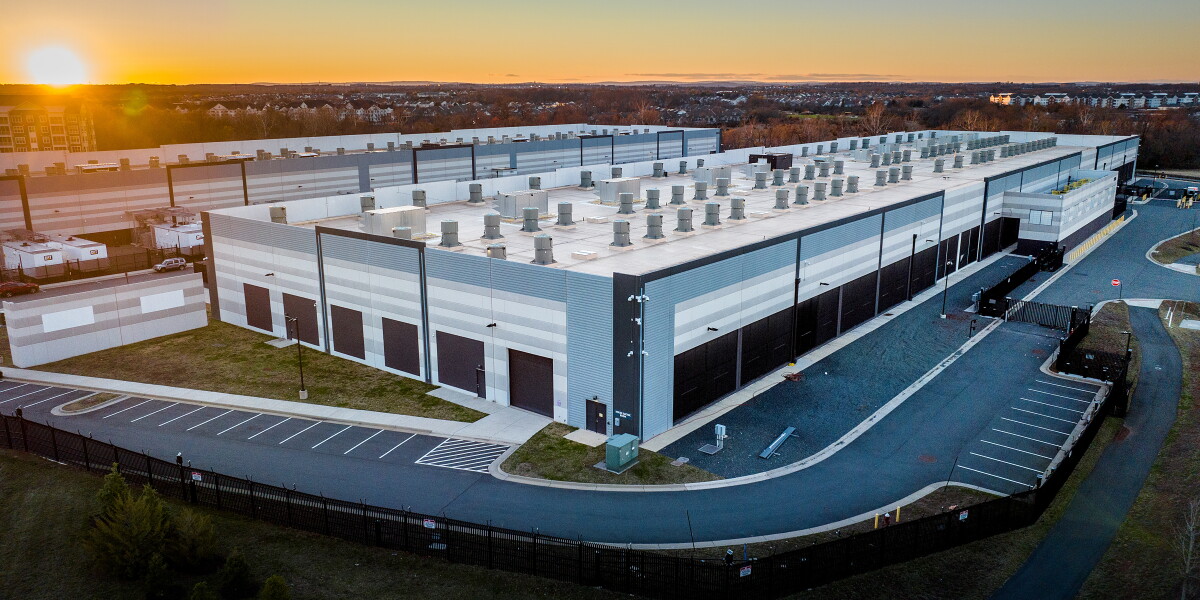
Amazon 数据中心:Amazon 如何在得克萨斯州萨默维尔县负责任地建设
Amazon 数据中心社区:2026 年全美各地数据中心周边正在发生什么
了解 Amazon 如何在 AWS 数据中心周边支持小型企业、创造就业岗位、推行可持续发展举措并开展教育项目的最新动态。
Amazon 如何在得克萨斯州萨默维尔县负责任地建设
Amazon 计划在 Glen Rose 附近建设一个数据中心园区,用地归 Vistra Corp. 所有,紧邻 Comanche Peak 核电站。该项目预计将提供至少 550 个全职岗位,薪资远高于该县平均水平,此外还将带来数千个建筑岗位以及面向当地承包商和小型企业的新机会。
用水与水资源回补
Amazon 的设施全年约 84% 的时间使用外部空气进行冷却。在需要使用水时,水源来自 Comanche Creek 水库——这是一座专用工业冷却水库,其含盐量使其不适合饮用;取水依据的是从 Vistra 租用的地表水权,而非当地地下水或饮用水。Amazon 还在投资约 375 万美元用于一项节水项目,预计每年可向 Brazos River Basin 回补超过 3.3 亿加仑的水。
能源与电网可靠性
电力来自毗邻的 Comanche Peak 电厂,通过专用输电线路输送至场内的变电站,Amazon 承担其能源的全部成本,因此这些成本不会转嫁给其他用户。该设施接入的是高压输电系统,而非为居民供电的本地配电线路,因此其用电需求不会影响其他用户的供电可靠性。
就业、税收与社区投资
通过其 Built Together 计划,Amazon 将支持教育及人才培养路径,并已与 Glen Rose 独立学区合作开展 STEM 相关活动。Amazon 与 Vistra 正共同支持 Texas Amphitheater Performing Arts Foundation,并计划举办一场社区见面会,还将在不久后启动一项本地社区基金。
Amazon 致力于达到或超过适用的噪声和空气质量标准。备用发电机是一项安全设施,并非主要电力来源,运行频率很低,主要用于午间的短暂测试,且采用先进的排放控制技术。
如需了解常见问题的解答,请阅读 Amazon 新闻中心上的完整说明。
Amazon 蒙哥马利县社区基金向 16 家本地机构发放 150,000 美元资助
获得 Amazon 蒙哥马利县社区基金资助的机构在 10 月 29 日的一场活动上手持资助凭证合影。
密苏里州蒙哥马利县的 16 家机构在 Amazon 蒙哥马利县社区基金的支持下,正把本地的想法付诸实践。该基金向致力于食品保障、STEAM 教育、劳动力发展、数字技能、退伍军人支持等领域的非营利组织、学校和社区组织发放了 150,000 美元资助,单笔最高 12,000 美元。受资助机构在 10 月 29 日于密苏里州 Hermann 举行的庆祝活动上受到表彰。
“在座的都是这样的人:他们为邻居提供食物,照顾我们的退伍军人,教孩子们搭建机器人、种植食物森林,并确保我们小镇上的家庭和其他任何人一样拥有同等的机会,”Amazon 区域社区参与经理 Afrika Alsup 说。“资金本身并不是重点。重点是你们将用这些资金做什么。”
为家庭提供食物,满足基本需求
Hermann Community Food Pantry 获得了该基金最大的一笔拨款,用于扩大其服务能力。Street Patrol 正在应对食物不安全问题,Neighborhood Forest 正在种植一片食物森林,Montgomery County 卫生部门则正在为年轻家庭推出一项尿布计划。
从课堂到职场培养技能
Wellsville-Middletown R1 正在启动 Tiger Robotics 项目,Montgomery County 4-H Council 正在扩大 STEAM 项目。Per Scholas 正在提供技术培训,帮助密苏里州居民进入科技行业就业,Revival KC 则通过其 DOT 计划带来数字技能培训项目。
加强社区活动的场所
Montgomery City Lions Club 和 New Florence Lions Club 正在对其社区建筑进行再投资。Wellsville Community Athletic League 正在改善其棒球场,Montgomery County Senior Center 正在升级其设施,Veterans of Foreign Wars(VFW)第 4436 分会正在为其 National Home Store 提供资金,以支持退伍军人。
该基金是 Amazon 在密苏里州更广泛投资的一部分,自 2010 年以来,该公司已在该州投资超过 90 亿美元。Amazon 还宣布计划在 Montgomery County 投资数十亿美元,建设一个数据中心园区,将创造数百个就业岗位。
进一步了解 Amazon 在社区中的行动。
Amazon 与 Seattle Seahawks 将 Tech Touchdown 带到俄勒冈州东部
10 月 10 日,60 多名学生走进 Hermiston 高中的球场,参加 Tech Touchdown——这场由 Amazon 和 Seattle Seahawks 主办的免费活动,将橄榄球训练与科学、技术、工程和数学(STEM)动手学习结合在一起。
学生们接受了关于基本功、脚步、传球、接球、敏捷性以及位置专项技能的直接指导,教练包括第 XLVIII 届超级碗冠军、2025 年 Seattle Seahawks 年度传奇人物 Sydney Rice 以及 USA Football 教练 Terry Summerfield,同场的还有 Seattle Seahawks 工作人员、Hermiston 高中教练和在校球员,以及 Amazon 志愿者。
前 Seahawks 外接手 Sidney Rice 在橄榄球场上带领 Hermiston 学生进行敏捷性训练。
离开球场后,学生们转入室内,参加聚焦体育领域数据驱动决策的 STEM 挑战。在由 Maven Philanthropy 和 Amazon 设置的各个站点,学生们探究了运动表现如何被捕捉和测量、过往比赛中的规律如何为预测提供依据,以及人工智能、机器学习、工程、机器人技术和云计算如何共同帮助打造常胜球队。
这场活动让学生们与职业运动员和技术领导者面对面,向他们展示了 STEM 如何在场上和场下都发挥作用。
Hermiston 学生在由前 Seahawks 外接手 Sidney Rice 指导的游戏中互动
“Tech Touchdown 的意义在于让学生了解技术如何驱动他们所热爱的比赛,并激励他们看到更多可能性,”Amazon 社区参与经理 Benjamin Harvey 表示。
Hermiston 的学生在 Tech Touchdown 活动现场踏上橄榄球场,亲手体验。
Amazon 扎根东俄勒冈已有 15 年,建设并运营着构成现代互联网骨干的数据中心基础设施。支撑从流媒体到在线购物等一切服务的同一套 AWS 技术,也驱动着职业橄榄球背后的数据分析。
Tech Touchdown 让这种联系变得鲜活,向当地青少年展示:就在他们社区建设的技术,正是他们所热爱的比赛背后的力量。
在 Louisa County,以清洁能源为餐食供能
每个月,弗吉尼亚州 Louisa County 有近 4,000 人向 Louisa County Resource Council(LCRC)寻求帮助。
30 多年来,Louisa County Resource Council 一直是其邻居们的生命线,提供食品杂货、衣物、牙科援助以及前往就医的交通服务。Amazon 的太阳能资助正在帮助降低运营成本,让更多资源能够直接投向社区。
对一些人来说,这意味着为家人提供食品杂货。对另一些人来说,则是去一趟 Community Closet、领取一张牙科援助代金券,或乘车前往就医。30 多年来,LCRC 一直是其邻居们的生命线,而维持这条生命线运转需要消耗大量能源。
该组织运营着一座占地 15,000 平方英尺的设施,拥有十多台冷冻柜和冷藏设备;随着对其服务的需求增长,其维护成本也在上升。
这正是清洁能源的用武之地。Amazon 最近提供了一笔赠款,全额资助 LCRC 的屋顶太阳能项目,新系统现已投入使用。预计这将使该组织的每月公用事业账单减少约 1,000 美元。据 LCRC 自己估计,这些节省每年可为该组织的服务对象提供近 48,000 份餐食。
“我们在运营成本上节省的每一美元,都是可以重新用于服务邻里的一美元。这个屋顶太阳能项目意味着我们能够继续开门运营、让冷柜保持运转,并把食物摆上每月依赖我们的数千个 Louisa County 家庭的餐桌。我们感谢 Amazon 为我们使命的长期可持续性进行投资,”Louisa County Resource Council 执行董事 Elizabeth Goodwin 说。
Amazon 提供了一笔赠款,全额资助 Louisa County Resource Council 的屋顶太阳能项目,该组织每月为近 4,000 人提供服务。预计这些节省每年可为服务对象额外提供近 48,000 份餐食。
原文较长,译文为节选;译文由英文原文机器翻译,术语按行业惯例统一,可在文末展开原文核对。
查看英文原文(Amazon data center communities: Here’s what’s happening near data centers across the US in 2026)
Amazon data centers: How Amazon is building responsibly in Somervell County, Texas
Amazon data center communities: Here’s what’s happening near data centers across the US in 2026
Get the latest updates on how Amazon supports small businesses, creates jobs, sets up sustainability initiatives, and develops educational programs near AWS data centers.
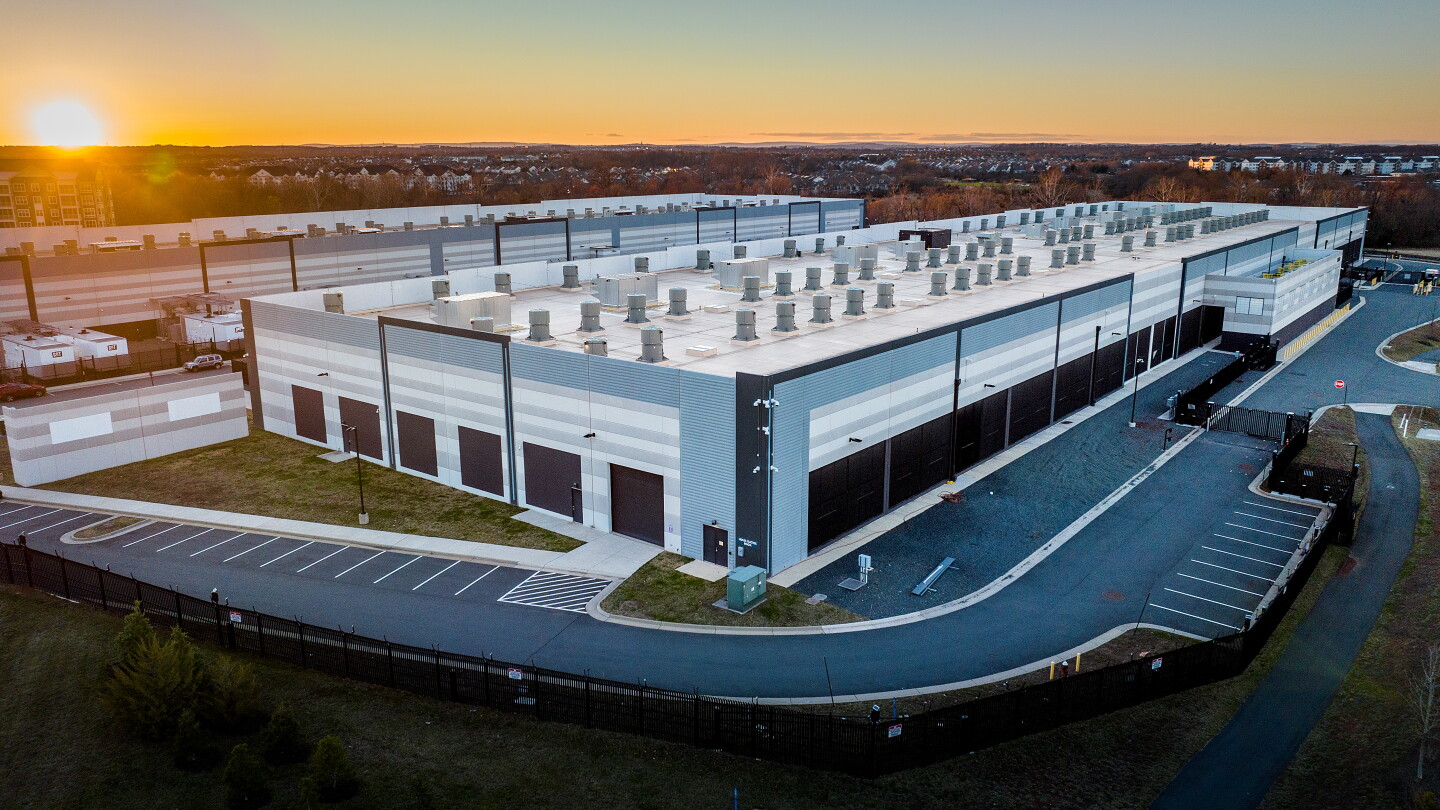
How Amazon is building responsibly in Somervell County, Texas
Amazon is planning a data center campus near Glen Rose on land owned by Vistra Corp. adjacent to the Comanche Peak Nuclear Power Plant. The project is expected to support at least 550 full-time positions at wages well above the county average, plus thousands of construction jobs and new opportunities for local contractors and small businesses.
Water use and replenishment
Amazon's facilities use outside air for cooling roughly 84% of the year. When water is used, it comes from the Comanche Creek reservoir, a dedicated industrial cooling reservoir whose salinity makes it unsuitable for drinking, and is drawn under surface water rights leased from Vistra, not local groundwater or drinking water. Amazon is also investing about $3.75 million in a water-efficiency project expected to return more than 330 million gallons per year to the Brazos River Basin.
Energy and grid reliability
Electricity comes from the adjacent Comanche Peak plant through dedicated transmission lines to an on-site substation, with Amazon paying the full cost of its energy so those costs aren't passed to other customers. The facility connects to the high-voltage transmission system, not local distribution lines serving homes, so its power needs won't affect reliability for others.
Jobs, tax revenue, and community investment
Through its Built Together initiative, Amazon will support education and workforce pathways, and has partnered with Glen Rose Independent School District on STEM engagement. Amazon and Vistra are jointly supporting the Texas Amphitheater Performing Arts Foundation and are planning a community meet-and-greet and launching a local Community Fund in the near future.
Amazon works to meet or exceed applicable noise and air quality standards. Backup generators are a safety feature, not a primary power source, and run infrequently, mostly for brief midday tests, using advanced emissions-control technology.
For answers to common questions, read the full overview on the Amazon Press Center.
October 30, 2026 1:14 PM
Amazon Montgomery County Community Fund awards $150,000 to 16 local organizations
 Groups selected for grants from the Amazon Montgomery County Community Fund pose with their awards at an event on October 29.
Sixteen organizations across Montgomery County, Missouri, are putting local ideas into action with support from the Amazon Montgomery County Community Fund. The fund awarded $150,000 in grants of up to $12,000 to nonprofits, schools, and community organizations working on food access, STEAM education, workforce development, digital skills, veterans support, and more. Recipients were recognized at a celebration on October 29 in Hermann, Missouri.
"In this room are people who feed their neighbors, care for our veterans, teach kids to build robots and grow food forests, and make sure families in our small towns have the same opportunities as anyone else," said Afrika Alsup, regional community engagement manager at Amazon. "The dollars aren't the story. The story is what you'll do with them."
Feeding families and meeting basic needs
Hermann Community Food Pantry received the fund's largest grant to expand its capacity. Street Patrol is tackling food insecurity, Neighborhood Forest is planting a food forest, and the Montgomery County Health Department is launching a diaper program for young families.
Building skills from the classroom to the workforce
Wellsville-Middletown R1 is launching a Tiger Robotics program, and Montgomery County 4-H Council is expanding STEAM programming. Per Scholas is delivering technology training to connect Missourians with tech careers, and Revival KC is bringing digital skills programming through its DOT initiative.
Strengthening the places where community happens
Montgomery City Lions Club and New Florence Lions Club are reinvesting in their community buildings. Wellsville Community Athletic League is improving its ballpark, Montgomery County Senior Center is upgrading its facility, and Veterans of Foreign Wars (VFW) Post 4436 is funding its National Home Store to support veterans.
The fund is part of Amazon's broader investment in Missouri, where the company has invested more than $9 billion since 2010. Amazon has also announced a planned investment of several billion dollars in Montgomery County for a data center campus that will create hundreds of jobs.
Learn more about Amazon in the Community.
October 27, 2026 3:38 PM
Amazon, Seattle Seahawks bring Tech Touchdown to Eastern Oregon
On October 10, more than 60 students took to the field at Hermiston High School for Tech Touchdown, a free event hosted by Amazon and the Seattle Seahawks that combined football drills and hands-on science, technology, engineering, and math (STEM) learning.
Students received direct coaching on fundamentals, footwork, passing, catching, agility, and position-specific skills from Super Bowl XLVIII champion and 2025 Seattle Seahawks Legend of the Year Sydney Rice and USA Football coach Terry Summerfield, alongside Seattle Seahawks staff, Hermiston High School coaches and current players, and Amazon volunteers.
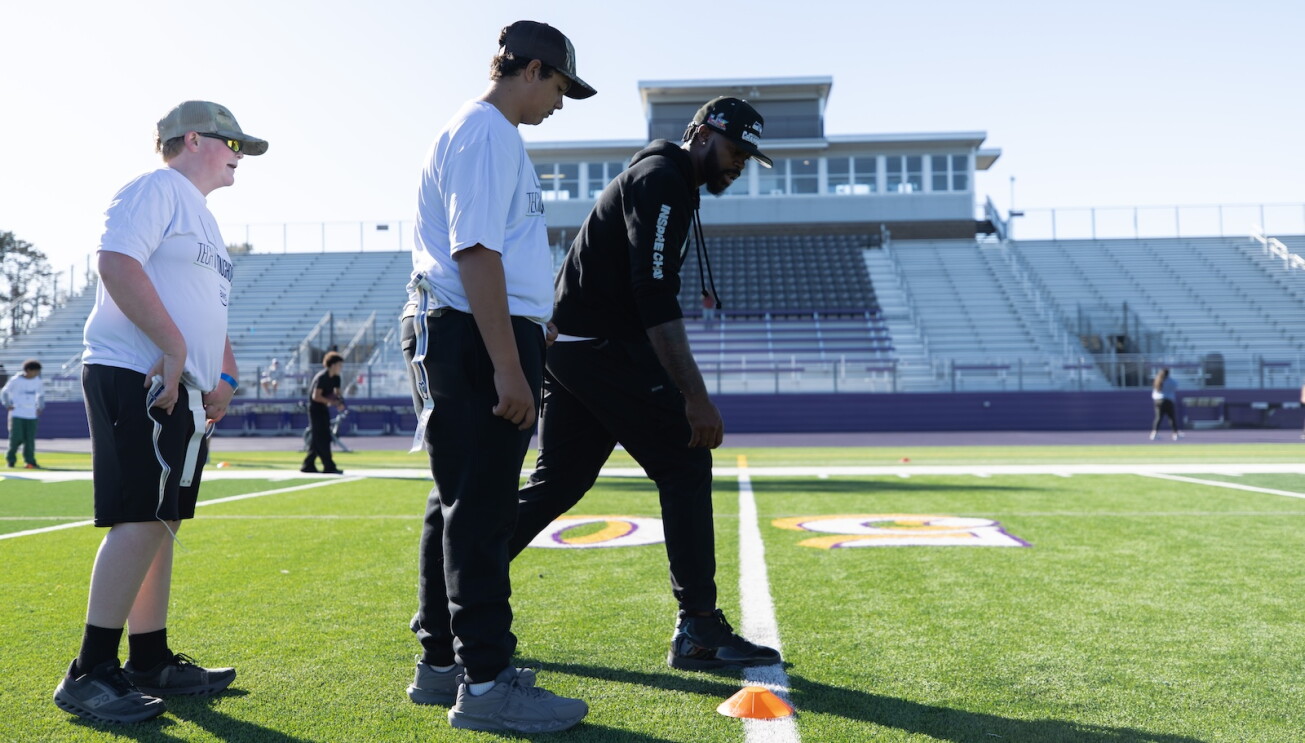 Former Seahawks wide receiver Sidney Rice leads Hermiston students in an agility drill on a football field.
After hitting the field, students moved indoors for STEM challenges focused on data-led decision-making in sports. At stations facilitated by Maven Philanthropy and Amazon, students explored how performance is captured and measured, how patterns in past plays inform predictions, and how artificial intelligence, machine learning, engineering, robotics, and cloud computing come together to help build winning teams.
The event connected students with professional athletes and technology leaders, showing them how STEM plays a role both on and off the field.
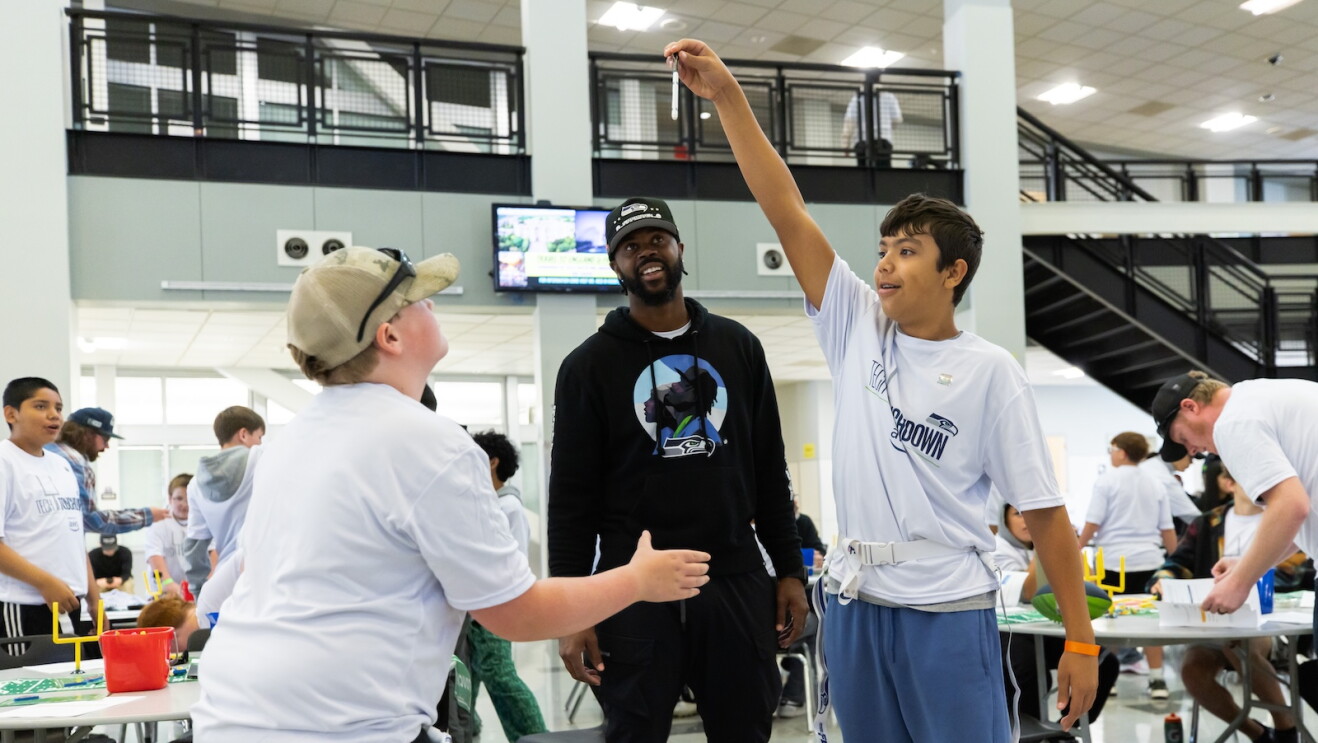 Hermiston students engage in a game, coached by Former Seahawks wide receiver Sidney Rice
"Tech Touchdown is about educating students about how tech drives the game they love, and inspiring them to see what's possible," said Benjamin Harvey, community engagement manager for Amazon.
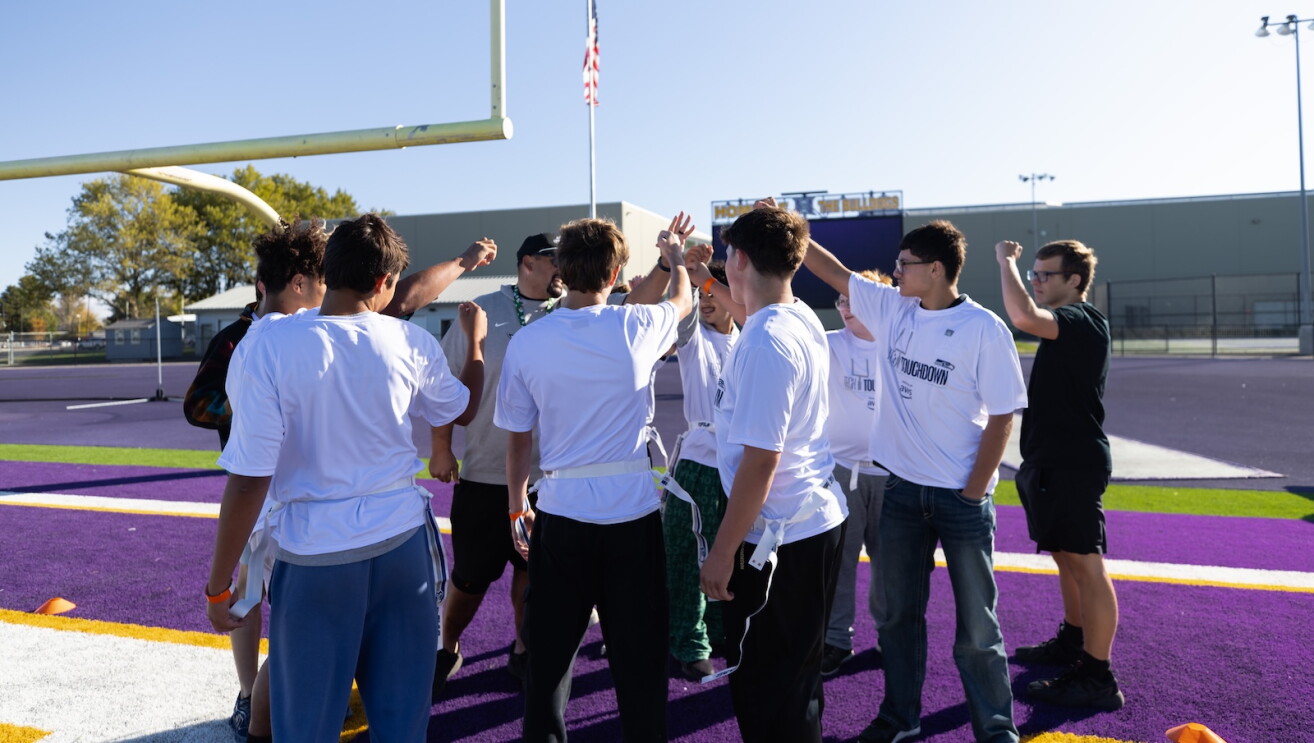 Hermiston students go hands in on the football field at the Tech Touchdown event.
Amazon has been part of Eastern Oregon for 15 years, building and operating the data center infrastructure that forms the backbone of the modern internet. The same AWS technology that powers everything from streaming to online shopping also drives the analytics behind professional football.
Tech Touchdown brings that connection to life, showing local youth that the technology built right here in their community is behind the game they love.
October 16, 2026 2:10 PM
Powering meals through clean energy in Louisa County
Each month, nearly 4,000 people in Louisa County, Virginia turn to the Louisa County Resource Council (LCRC) for help.
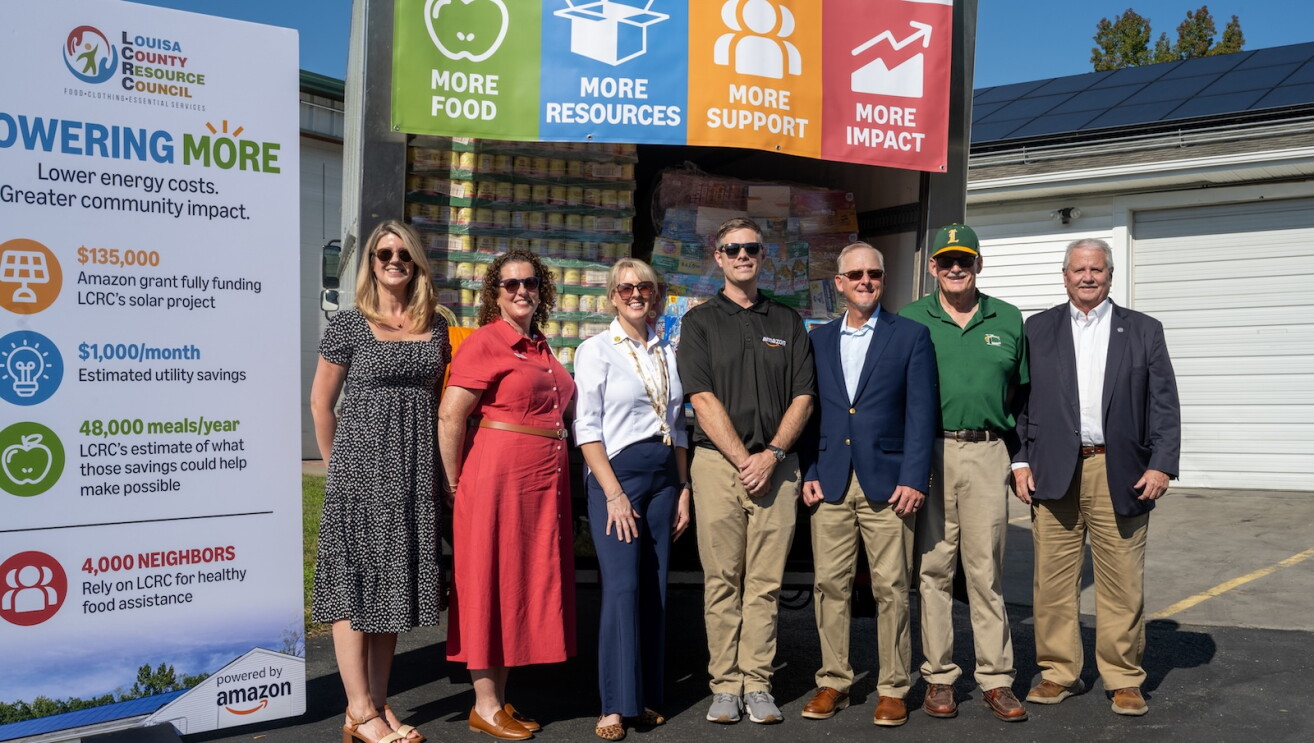 The Louisa County Resource Council has been a lifeline for its neighbors for more than 30 years, providing groceries, clothing, dental assistance, and transportation to medical appointments. Amazon's solar grant is helping reduce operating costs so more resources can go directly to the community.
For some, that means groceries for their families. For others, it is a visit to the Community Closet, a dental assistance voucher, or a ride to a medical appointment. For more than 30 years, LCRC has been a lifeline for its neighbors, and keeping that lifeline running takes a tremendous amount of energy.
The organization operates a 15,000-square-foot facility with more than a dozen freezer and refrigeration units, and as demand for its services grows, so do its maintenance costs.
That is where clean energy comes in. Amazon recently awarded a grant to fully fund a rooftop solar project for LCRC, and the new system is now live. It is expected to cut roughly $1,000 from the organization’s monthly utility bill. By LCRC’s own estimate, those savings could put nearly 48,000 meals on its clients’ tables each year.
"Every dollar we save on operating costs is a dollar we can put back into serving our neighbors. This rooftop solar project means we can keep our doors open, our freezers running, and food on the tables of the thousands of Louisa County families who count on us each month. We’re grateful to Amazon for investing in the long-term sustainability of our mission, said Elizabeth Goodwin, Executive Director of the Louisa County Resource Council
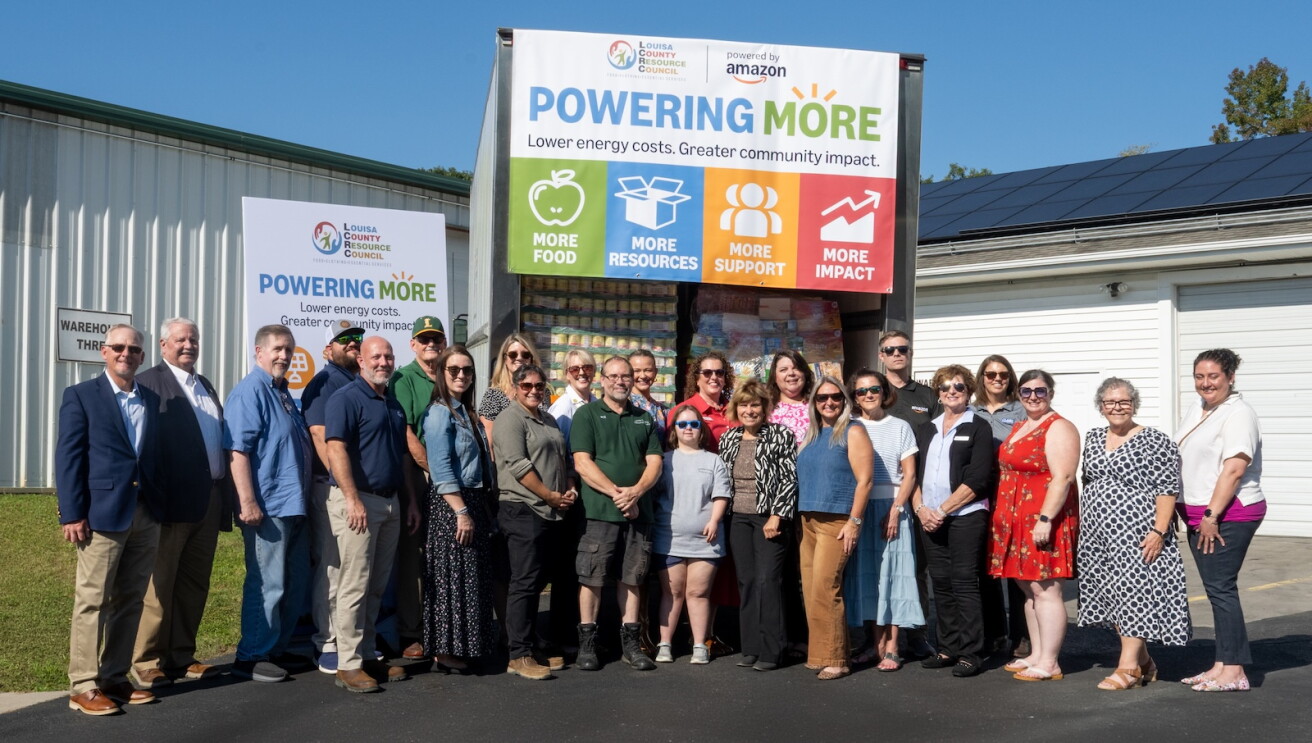 Amazon awarded a grant to fully fund a rooftop solar project for the Louisa County Resource Council, which serves nearly 4,000 people each month. The savings are expected to put nearly 48,000 additional meals on clients’ tables each year.
The LCRC project is one example of a broader contribution. A new independent study by Oxford Economics found that Amazon’s carbon-free energy investments contributed nearly $11 billion to the U.S. GDP and supported nearly 22,000 jobs annually from 2023 through 2025. In Virginia, those projects added more than $331 million to the state’s economy.
For years to come, these solar panels will power LCRC’s mission by turning sunlight into stability for the thousands of neighbors who depend on it.
October 6, 2026 10:59 AM
Amazon Celebrates 15 Years in Eastern Oregon with Community Day
The event brought families, community leaders, and Amazon employees together for a day filled with hands-on STEM activities, live demonstrations, giveaways, and free food. Local partners helped make the day special, with Eastern Oregon University's GO STEM program and Sage on the Go leading interactive science and engineering activities, including a data center learning game designed just for kids. The South Morrow Art Center set up creative stations for all ages, and Creativo District offered free haircuts to help boost confidence in local youth.
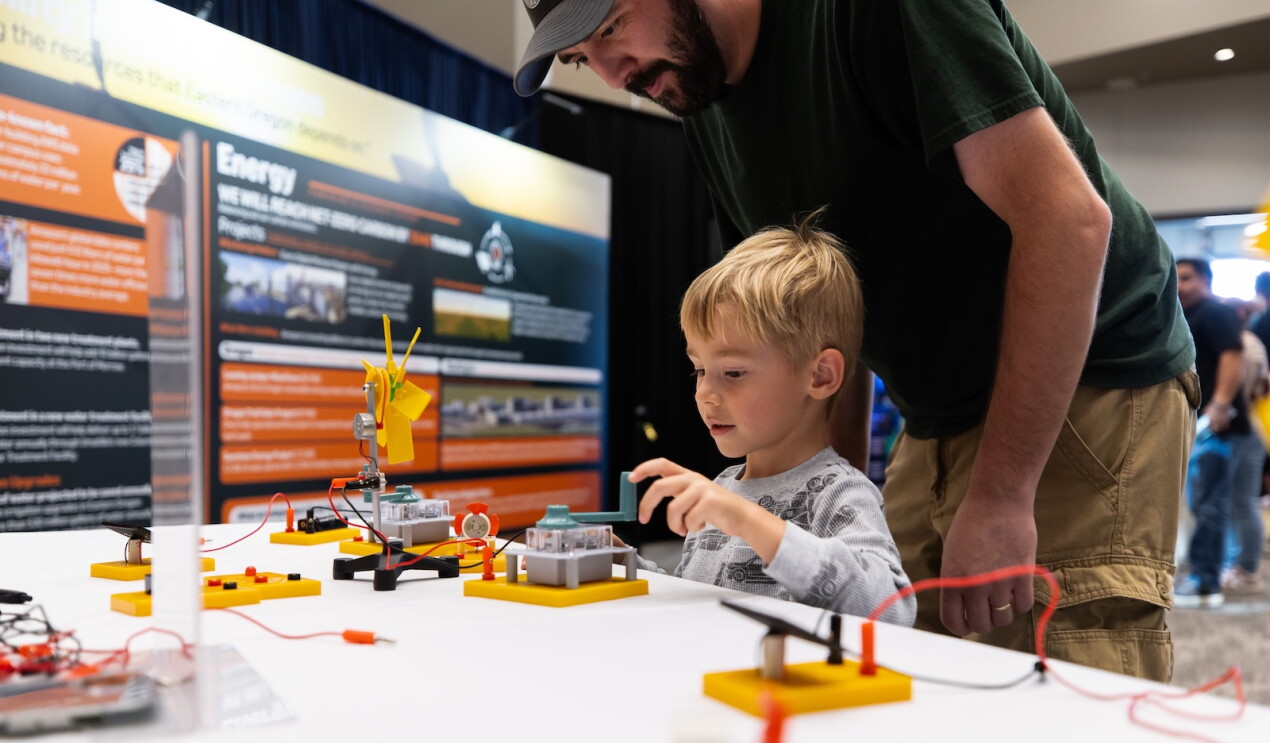 A parent and child engage with one of the creative stations at Amazon's Community Day.
One of the day's highlights: five lucky attendees were selected in a drawing to each direct a $2,000 donation to a local nonprofit of their choice serving Morrow and Umatilla Counties.
"Amazon's presence in Eastern Oregon for the past 15 years is only possible because of the families, local organizations, and community leaders, and we don't take that partnership for granted," said David Tanner, director of infrastructure operations for Amazon Web Services. "We look forward to continuing to grow together and finding new ways to give back to the community we're proud to call home."
Amazon has operated in Eastern Oregon for more than 15 years, with more than 2,500 employees working in Amazon's data centers across the region. The Community Day offered a chance for families to connect directly with Amazon's local team, explore hands-on STEM programming, and learn about resources available in their community.
September 25, 2026 11:03 AM
How Amazon is protecting energy affordability in Indiana
Data centers house the computers that make the modern internet possible. As more Americans rely on data centers to power their daily lives, more energy is needed to run them.
In Indiana, Amazon has data centers in two utility service areas: Northern Indiana Public Service Company (NIPSCO) in Northwestern Indiana and Indiana Michigan Power (I&M) in the Northeast and East Central regions. In both cases, we entered long-term agreements that ensure our energy costs are not passed on to our neighbors.
Indiana Michigan Power (I&M)
Amazon reached an agreement with I&M that provides binding, long-term financial commitments so that our costs are not passed on to existing customers.
Amazon covers 100% of the electricity costs for our data centers and guarantees I&M payment for at least 80% of our projected demand, whether we use that capacity or not. If Amazon uses less capacity than expected, we absorb the cost—not ratepayers.
Amazon is also funding $2.5 million in energy assistance and efficiency programs for low-income I&M customers through the Indiana Community Action Association, helping lower bills for families struggling to make ends meet.
I&M announced a 3.6% reduction in residential utility bills in May, followed by an additional 5% reduction in August—driven in part by revenue from large users like data centers.
Northern Indiana Public Service Company (NIPSCO)
Amazon and NIPSCO developed a first-of-its-kind framework to add up to 3 gigawatts of new capacity to the Indiana power grid without increasing costs for other ratepayers. Amazon pays fees to use existing power lines and to cover the costs of any system upgrades needed to power our data centers. The agreement is estimated to generate $1.25 billion in savings for NIPSCO customers over the next 15 years.
What this means for Hoosiers
At Amazon, we believe data center growth should strengthen the grid, help lower electricity costs, and make power more reliable. That's our commitment to the communities where we operate.
September 23, 2026 9:49 AM
Amazon employees pack 450 meal kits, make a home accessible in North Carolina
Forty-five Amazon employees volunteered nearly 170 hours across three projects during the United Way of Richmond County's annual Days of Caring.
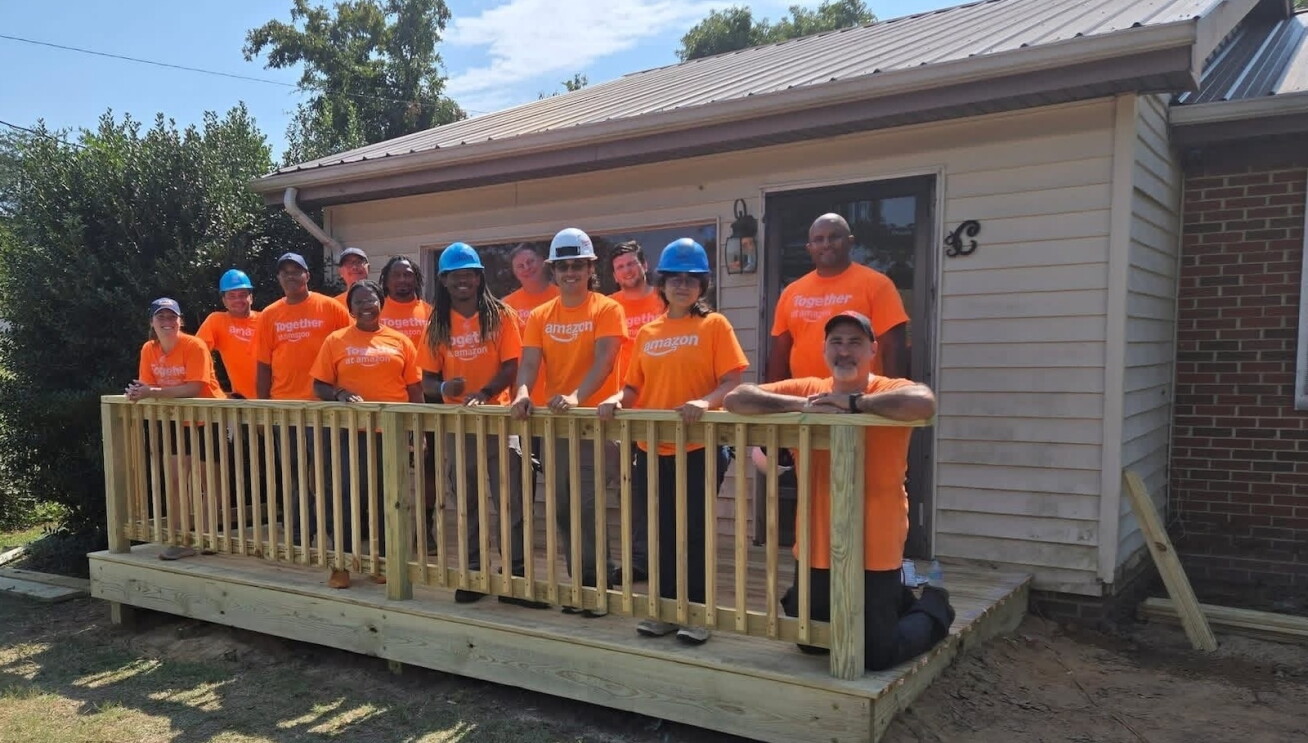 Amazon employees smile on a newly rebuilt deck for a resident during the United Way of Richmond County's annual Days of Caring.
Amazon is building a new data center campus in Richmond County, North Carolina, but the team didn't wait for operations to begin to start getting involved. From September 16–18, 45 employees fanned out across the county for the United Way of Richmond County's annual Days of Caring, volunteering on three projects and logging nearly 170 hours combined.
Feeding kids on the weekends
The team spent the morning with Backpack Pals, assembling more than 450 weekend meal kits for children across Richmond County schools. The kits make sure students have something to eat when the cafeteria isn't an option. Many of our employees are parents, so this project was personal.
Making Ms. Vickie's home accessible again
Part of the team joined Habitat for Humanity of the NC Sandhills for a multiday volunteer effort to demolish and rebuild three decks for Ms. Vickie, a local resident who could no longer safely get in and out of her home. Our team was proud to be part of the crew that made her home accessible again.
Getting the food pantry ready
The rest of the team deep-cleaned and restocked Our Daily Bread Food Ministry's food pantry from floor to ceiling—organizing shelves, rotating inventory, and preparing it to serve the families who depend on it most.
This was the first volunteer day for the team, but it won't be the last. They're already planning more community projects before the end of the year.
"We know actions matter more than words. 70% of our team showed up on a single Friday to pack meal kits for kids, rebuild a deck, and restock a food pantry—and we're just getting started. We want to be the kind of neighbor who's there when it counts," said Kelly Felix, data center cluster operations leader for North Carolina.
September 17, 2026 12:47 PM
Nearly 500 data center employees roll up their sleeves to clean up Umatilla
Nearly 500 Amazon data center employees from across Eastern Oregon joined forces with the City of Umatilla and the Umatilla Chamber of Commerce to clean up a 1.9-mile corridor burdened by years of illegal dumping and littering. In just 90 minutes, volunteers collected nearly 3 tons of trash and helped restore a road bordering the Umatilla River.
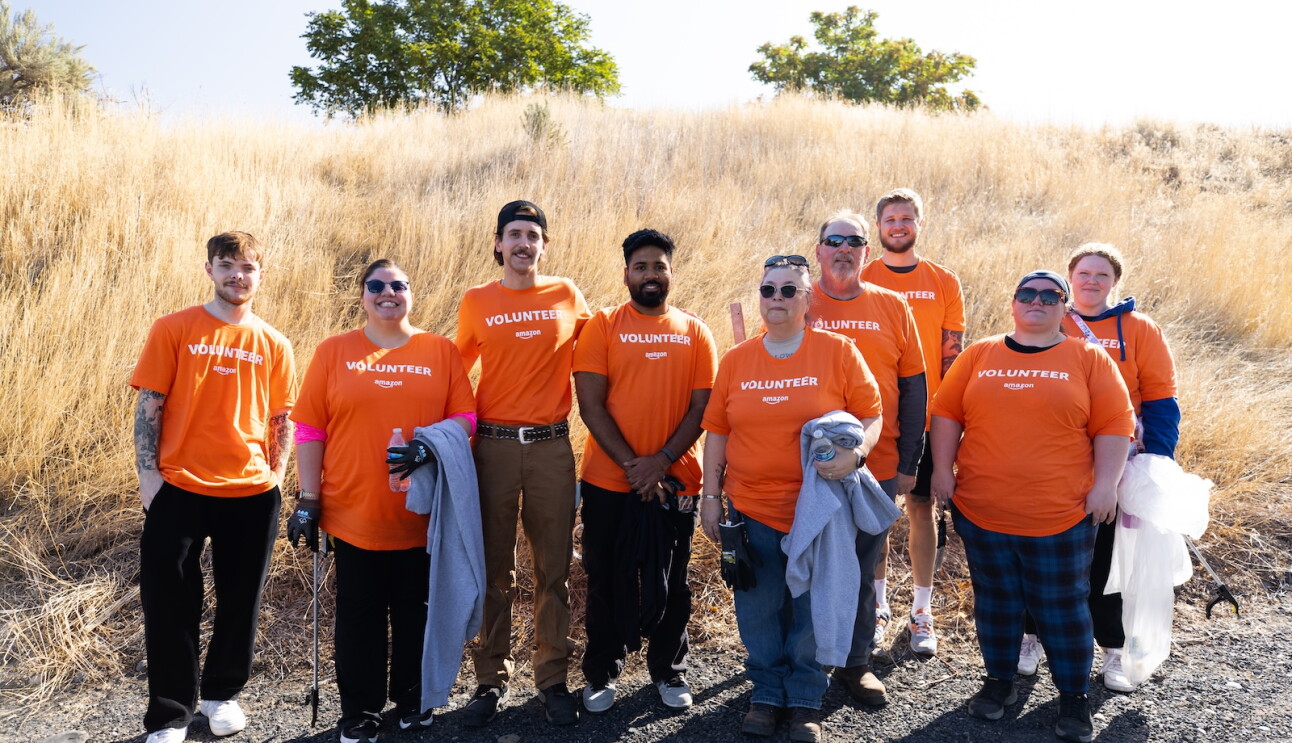 Nearly 500 Amazon employees from across Eastern Oregon volunteered to collect nearly 3 tons of trash along a 1.9-mile stretch of Old River Road, the future home of the Umatilla River Trail.
The Old River Road corridor is the future home of the Umatilla River Trail, a project backed by a $5.7 million Oregon Department of Transportation Oregon Community Paths grant. When completed, the trail will connect the City of Umatilla to northern Hermiston, creating a multi-use path along the river for residents and visitors. Before construction can begin in late 2027, the corridor needed to be cleared of years of accumulated debris — a task that required a mass volunteer effort.
Amazon data centers employ more than 2,500 people across Eastern Oregon, and this cleanup marks roughly 3,000 volunteer hours these teams have contributed to the community in 2026 alone.
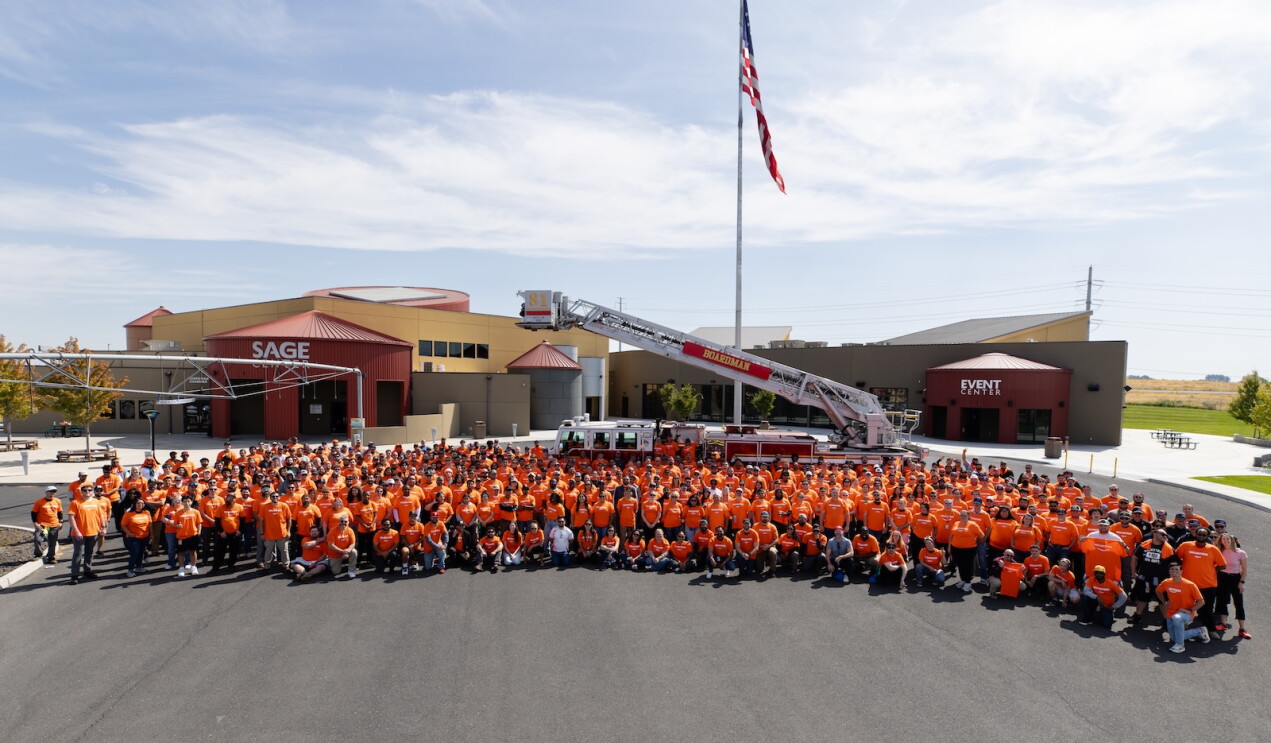 Amazon employees from across Eastern Oregon gathered at the Sage Center alongside members of the Boardman Fire Department to celebrate the day's volunteer cleanup and connect across sites.
The day wrapped up at the Sage Center, where Amazon hosted a regional update for employees from across Eastern Oregon. Teams were joined by members of the Boardman Fire Department as hundreds came together to celebrate the day's work and connect across sites.
September 11, 2026 3:25 PM
How we're building responsibly in Wharton County, Texas
Amazon has been building and operating data centers for nearly two decades. In that time, we've proven that we are not only good neighbors, but committed long-term collaborators in the communities where we operate and our employees live. As this project in Wharton County progresses, we want to share what we are planning, how we intend to use water and power, and what the project will mean for people who live nearby.
We are currently planning a data center campus outside of Boling, Texas, about 10 miles southeast of Wharton. The project will support at least 300 full-time positions, with 150 full-time roles by mid-2027, with wages well above the county average. The construction process will generate thousands of additional jobs and expanded opportunities for local contractors and small businesses.
We see long-term potential here and are evaluating options for future investment, but today only have plans for 13 buildings.
As with any project of this scale, development will occur in stages. Site preparation is already underway, and we are committed to providing transparency and updates to the community as the project progresses. Ultimately, each location is driven by campus size and may evolve over time.
The 13 buildings planned on the Wharton County campus will not use water for cooling. No groundwater will be used for data center cooling at this site. As we evaluate future investment or expansion at this campus, we are working directly with the regional and local water authority to develop responsible, nonpotable water solutions for any potential cooling needs. This is part of our standard process for finding the most efficient method for operating our data centers, with a key tenet of ensuring that our projects do not negatively impact water needs for the surrounding community.
Besides cooling, data centers use water for everyday needs like bathrooms, cleaning, and fire suppression systems. For our current plans, potable use is limited to approximately 16,000 gallons per day, equivalent to roughly 54 households or a typical office building with a similar number of employees.
Replenishing local water resources
Amazon is committed to being water-positive globally by 2030, meaning we'll return more water to communities than we use in our data center operations—and we're already 75% of the way there.
Amazon is actively working with local organizations to develop water-positive programs, including in Wharton County, that will return more water than we use to the local watershed.
As part of this project, Amazon is funding a water replenishment project in Wharton County that helps local farmers adopt Alternate Wetting and Drying (AWD) irrigation practices—reducing flood-based irrigation demand by 25% or more without reducing crop yields—in the lower Colorado River watershed, where both area farmers and other users draw from the same surface water source. This effort is expected to replenish more than 225 million gallons of water per year over a 10-year period.
Powering our operations responsibly and supporting the Texas electric grid
Amazon works closely with energy providers in Texas to pay the full costs of powering our operations—so those costs are not passed to other customers. These investments often extend beyond our immediate needs and help modernize the broader grid.
We do not plan to build or operate a gas plant at our Wharton County site. We are actively working with energy companies to explore power supply options in ERCOT, delivered by existing transmission infrastructure and substations we are funding on-site. We remain committed to responsible energy procurement, having invested in more than 10 GW (gigawatts) of energy supply in Texas—enough to power roughly 8 million U.S. homes—and we continue pursuing both dispatchable and renewable solutions to meet our needs.
Backup generation and grid reliability
We rely on the utility grid to power our data centers. To ensure uninterrupted service for the critical customers who depend on our infrastructure—including hospitals, schools, and emergency services—our data centers include backup generators in case of rare power disruptions. These generators are an essential safety feature, not a primary power source, and they run very infrequently—mostly for brief mid-day tests to ensure they are ready and reliable when needed.
We take air quality seriously. Our backup generators use Tier 4 compliant emissions control technology—the most stringent EPA standard for diesel engines—which significantly reduces nitrogen oxides, carbon monoxide, volatile organic compounds, and particulate matter. These controls deliver the same environmental performance as Tier 4 certified engines, and we conduct comprehensive field testing as required by our environmental permits to verify they achieve the required emission reductions.
During grid emergencies, we actively participate in grid management protocols and will curtail our load or activate backup power—just like other large industrial users. We are also fully committed to complying with all Texas grid reliability standards, including Senate Bill 6.
Designing and building responsibly—our permitting and environmental review process
Building a data center campus of this scale requires extensive planning, design, and regulatory review—and we approach every phase with a commitment to doing it right.
Before any work began at the Wharton County site, we completed a Phase I Environmental Site Assessment, which found no contamination or recognized environmental conditions. The site has been agricultural pastureland and forestland since at least the 1940s. We also commissioned a thorough natural resources assessment by working with environmental consultants to evaluate the property's waterways, wetlands, and wildlife.
Our permitting and compliance work spans multiple areas:
Air quality: We work with state environmental agencies to secure and comply with all applicable air permits for our operations, including emissions from backup generators. We voluntarily invest in advanced emissions control technology that reduces pollutants well beyond minimum regulatory requirements.
Water and waterways: The campus layout achieves 100% avoidance of the jurisdictional stream—Gardner Slough—and its associated wetlands, with all buffer zones exceeding regulatory minimums. We are coordinating with the U.S. Army Corps of Engineers on the jurisdictional determination process for the property. We comply with all applicable water discharge permits and monitor water quality to meet or exceed regulatory standards.
Stormwater management: We build stormwater management infrastructure, such as retention ponds and drainage systems, to control runoff and protect local waterways and groundwater.
Wildlife and habitat: A qualified biological consultant completed a habitat assessment across the full property. No federally listed threatened or endangered species were observed on the development footprint. Migratory bird breeding areas were identified and flagged so construction crews knew where active or potential nesting habitat existed before any clearing began.
Building and site design: Throughout design and construction, we work with acoustic engineers to keep noise levels low and design our facilities to meet federal guidance for the health and welfare of surrounding communities. We implement noise mitigation measures including sound-dampening building materials, strategic placement of cooling equipment, visual screening, and acoustical enclosures for generators.
Spill prevention and emergency response: Every facility maintains a Spill Prevention, Control, and Countermeasure (SPCC) plan with regular training, monthly inspections, and established notification and cleanup protocols that meet all federal and state requirements.
We comply with all environmental regulations—including those related to water quality, air emissions, stormwater management, noise levels, and waste disposal—and work closely with environmental agencies throughout every phase of our projects to ensure we meet and often exceed all applicable standards.
Jobs, tax revenue, and community investment
This project will support at least 300 full-time positions—with 150 by mid-2027—at wages well above the county average. During construction and operations, the campus will employ plumbers, pipe fitters, electricians, project engineers, fiber technicians, line workers, and data center technicians. We're working with local organizations on workforce development programs to prepare residents for these roles.
We've established the Wharton County Community Fund with an initial $200,000 commitment for science, technology, engineering, and math (STEM) programming, youth recreation, veterans programs, housing, and other local priorities. We're also launching a dedicated project website with FAQs and a way for community members to share questions and feedback.
The project is expected to generate tens of millions of dollars in new tax revenue, providing sustainable funding for local schools, public safety, and infrastructure.
In summary, Amazon is committed to building responsibly in Wharton County—creating good jobs, generating sustainable tax revenue, and investing in the community while being thoughtful stewards of local water and energy resources.
We look forward to sharing updates as the project progresses.
Will the data center be loud for nearby homes or businesses?
We work hard to ensure our data centers operate as quietly as possible in a way that respects our neighbors and the surrounding community. In addition to meeting all local noise regulations, we strive to design our facilities to federal guidance for the health and welfare of surrounding communities, which often are lower than the regulatory standards. We implement several noise mitigation measures including:
Sound-dampening building materials and insulation
Strategic placement of cooling equipment
Visual screening where needed
Generators that utilize acoustical enclosures and mufflers
Throughout design and construction, we work with acoustic engineers to keep noise levels low and ensure the facility fits comfortably within the surrounding community.
How is Amazon investing in Wharton County?
Amazon is committed to being a good neighbor throughout the construction process. We listen and engage with local officials and community members to address concerns proactively. We aim to minimize disruption while still being able to deliver meaningful benefits including new construction and long-term technology jobs, opportunities for local contractors and small businesses, and sustainable tax revenue that supports schools, public safety, and community services.
This project is expected to generate tens of millions of dollars in new tax revenue, providing sustainable funding for essential services, local schools, and infrastructure. We have also started the Wharton County Community Fund, with an initial commitment of $200,000 that will be used for STEM programming, youth recreation, veterans programs, housing, and other hyperlocal programs.
Will this impact the reliability of the grid?
We understand concerns about grid reliability, and we want to clarify how our data center operates within the electrical system. Our data centers connect to the high-voltage transmission system, not the local distribution lines that power homes and businesses in your neighborhood. Our facility uses the transmission system, which operates at much higher voltages and is completely separate from the infrastructure serving the community. Our power needs will not impact local voltage levels or increase the risk of brownouts in your area.
We are also fully committed to complying with all Texas grid reliability standards, including Senate Bill 6.
We actively participate in grid management protocols and will curtail our load or activate backup power during grid emergencies—just like other large industrial users.
Will this project impact my electricity rates?
Amazon works closely with energy providers in Texas to pay the full costs of powering our operations so those costs are not passed to other customers.
The electricity investments we make often extend beyond our immediate needs and help modernize the broader grid. We have invested in enough energy supply in Texas to power roughly 3 million U.S. homes, and we continue pursuing both dispatchable and renewable solutions to meet our needs.
In fact, a recent national analysis by the Lawrence Berkeley National Laboratory and The Brattle Group found that states with growing electricity demand—including from sectors like manufacturing and data centers—saw lower retail electricity prices. Adding new customers spreads fixed grid costs across more users, which helps reduce pressure on rates.
How much water will this project use?
The 13 buildings planned on the Wharton County campus will not use water for cooling. No groundwater will be used for data center cooling at this site. Besides cooling, data centers use water for everyday needs like bathrooms, cleaning, and fire suppression systems. For our current plans, potable use is limited to approximately 16,000 gallons per day, equivalent to roughly 54 households or a typical office building with a similar number of employees.
Amazon is also funding a water replenishment project in Wharton County that helps local farmers adopt Alternate Wetting and Drying (AWD) irrigation practices—reducing flood-based irrigation demand by 25% or more without reducing crop yields—in the lower Colorado River watershed, where both area farmers and other users draw from the same surface water source. This effort is expected to replenish more than 225 million gallons of water per year over a 10-year period.
September 10, 2026 1:19 PM
Amazon is turning Spotsylvania's sewage water into a resource
When you flush a toilet, take a shower, or run a load of laundry, that water flows into the sewage system. In Spotsylvania County, it gets treated and discharged into the Rappahannock River. You may not think about it again.
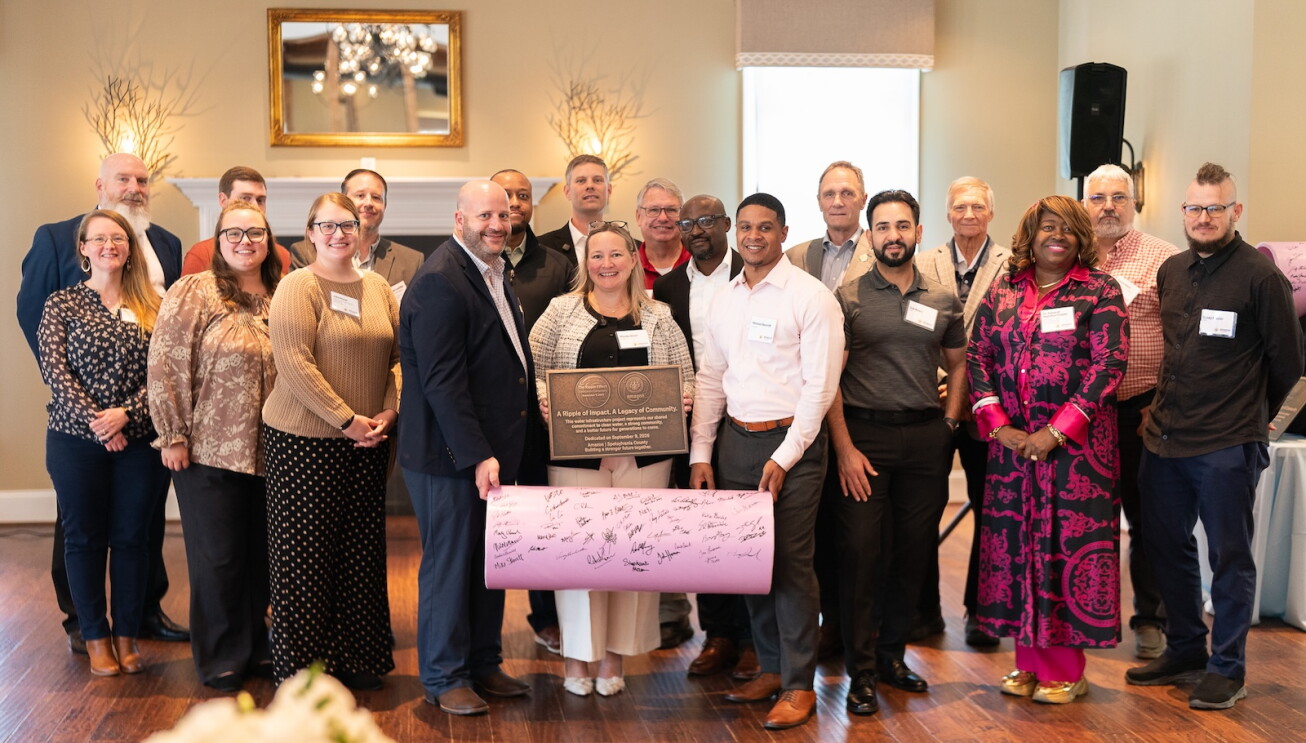 Amazon and Spotsylvania County leaders celebrate the start of construction on a new water reuse system that will recycle treated wastewater to cool Amazon's data centers.
Amazon did. A new $480 million water project, built in partnership between Amazon and Spotsylvania County, will upgrade the Massaponax Wastewater Treatment Plant and add more than 20 miles of new pipeline to turn that wastewater into a resource. The system will produce the second-largest water reuse capacity in Virginia.
The project conserves drinking water by directing reclaimed water to industrial customers. Preserving Spotsylvania's potable supply for residents and other business users.
How it benefits the community
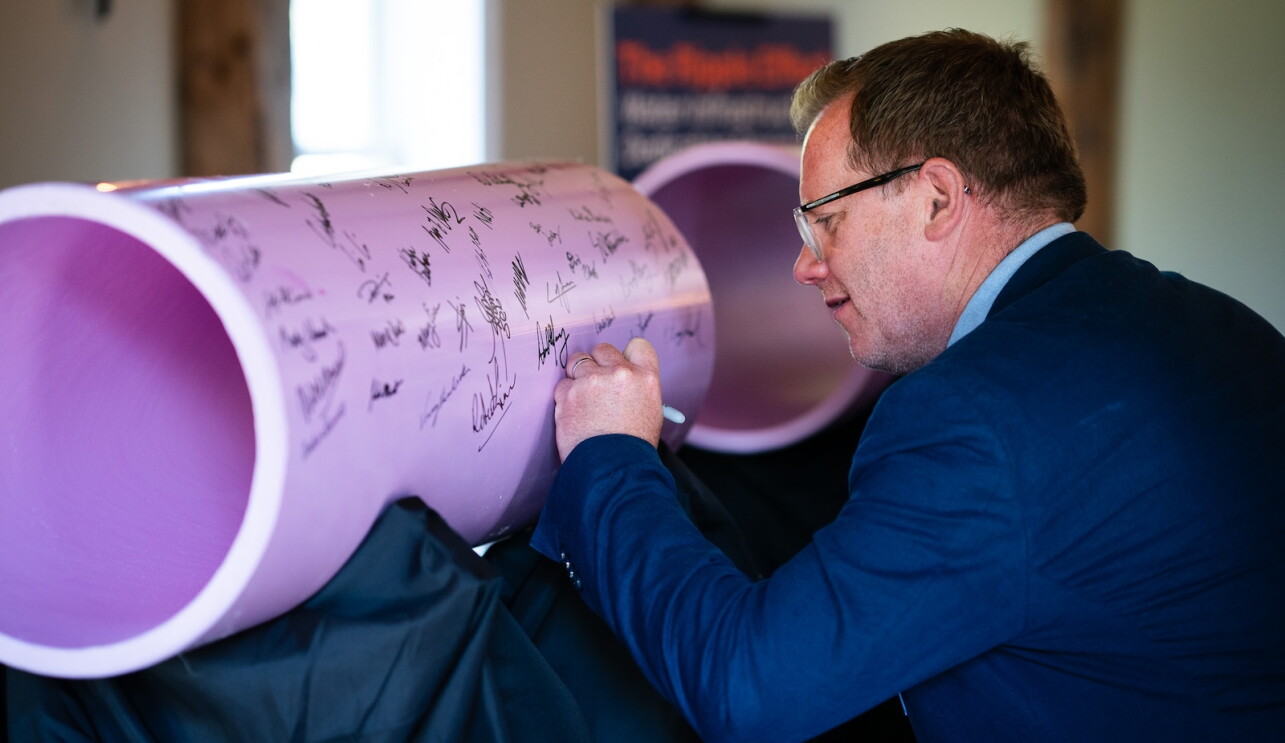 Attendee signs a "purple pipe" to commemorate the project's launch. Purple pipes are used across the utilities industry to carry recycled wastewater, and this system will repurpose the county's treated wastewater to cool Amazon's data centers.
The county will own the system and can sell reclaimed water to other businesses, creating a new revenue stream. And residents won't see any of this on their water bills, because they aren't paying for it. Use of the system is also seasonal—typically late spring to early fall. During cooler months, the full capacity is available for other uses or can be returned to the river as it does today.
Because of how we design our facilities, we cool servers with outside air about 96 percent of the year in Spotsylvania. Water enters the picture only during the hottest hours of the hottest days, roughly 4 percent of the time when outside air alone can't do the job. We use outside air because it balances water and energy usage. If we used traditional air conditioning instead, we would draw 25-35% more power from the grid.
We were the first data center operator in Virginia to cool with reclaimed water. Globally, we are seven times more water-efficient than the average data center in the industry.
As demand for cloud computing continues to grow, so does our commitment to doing more with less. In Spotsylvania, that means a county-owned system that turns waste into a resource, protects drinking water supplies, and creates lasting economic value for the community.
September 10, 2026 11:43 AM
Amazon's Girls' Tech Day inspires Gilroy’s next generation
Sixth grade is a turning point at Gilroy Unified School District. It's the first time students choose their own electives, and those choices can shape the direction of their academic journey. Amazon's Girls' Tech Day is designed to inspire young girls to explore opportunities in science, technology, engineering, arts, and math (STEAM) by giving them positive, hands-on experiences with these fields before they make those decisions.
On a sunny day in August, nearly 150 rising sixth-grade girls came together at Solorsano Middle School in Gilroy, California, for the third annual Girls' Tech Day.
"We know that middle school is when girls' interest in math and science begins to wane, as their academic confidence might decrease," said Jennifer Evans, Gilroy Unified School District STEAM coordinator and former fifth grade teacher. "We want to support all our students in STEAM pursuits, and this event was the perfect introduction to the future career possibilities for attendees."
 Middle schoolers break for snacks on Amazon's Girls' Tech Day
Students were welcomed by district, school, and Amazon leaders, then rotated through interactive sessions in color-coded groups. They tackled coding and engineering challenges, worked through creative problem-solving exercises, designed their own LED light art projects, and even visited a petting zoo. The day was built to spark curiosity and confidence in a fun, encouraging environment.
Amazon is proud to support Gilroy Unified School District with this event and looks forward to continuing to grow Girls' Tech Day in the years ahead.
How beehives on Amazon's data center campuses are supporting local ecosystems in Virginia
Amazon harvests honey on its data center campuses in Louisa County, Virginia—and this summer, the team shared that story with the community.
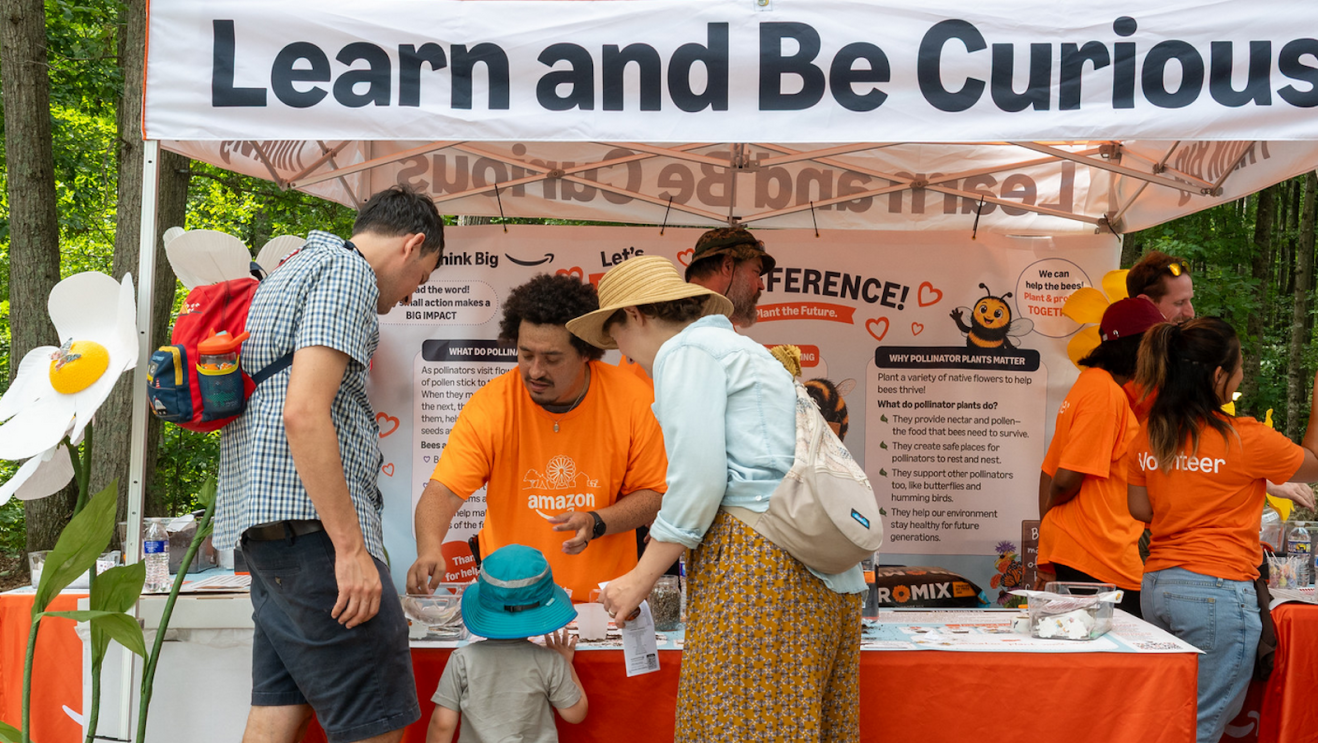 Locals learn about the power of pollination from Amazon volunters at the Louisa County Fair
Managed in partnership with Siller Pollinator Co., a local apiculture firm, the on-site beehive program encompasses 15 hives across three campuses, including one with active construction. Each hive is home to an estimated 60,000 bees. In 2025, the hives produced 240 pounds of honey—five times more than in 2024. Three of those hives are in Louisa County, contributing roughly 50 pounds of honey last year, and are on track to match that output in 2026.
At the Louisa County Fair, Amazon sponsored an interactive activation called "Bee the Difference: Amazon Think Big Discovery Zone." Over one weekend, the team connected with more than 1,100 community members about pollinator and environmental stewardship programs. Families explored hands-on activities about how bees, plants, and people support local ecosystems. Children played games and took home pollinator-friendly flowers to plant. On Saturday, local beekeeper Allison Wickham, founder of Siller Pollinator Company, joined to share her expertise with fairgoers.
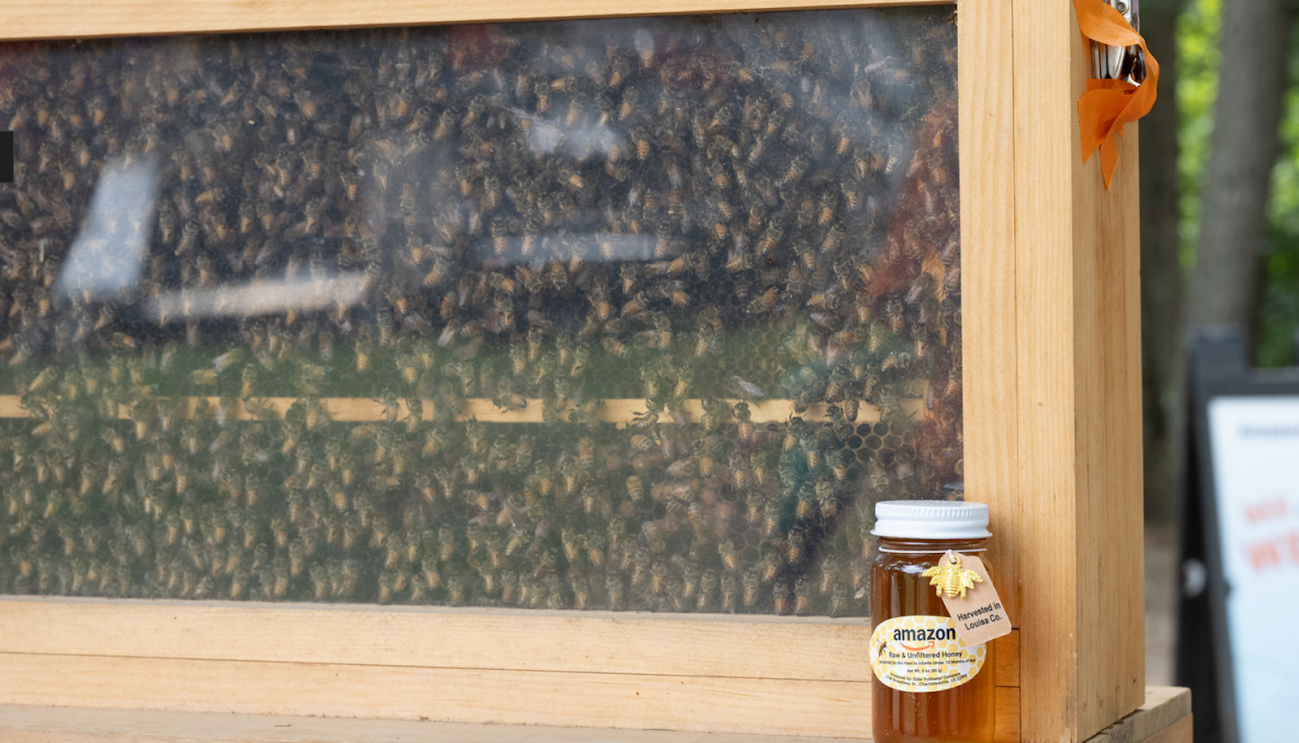 An Amazon observation hive sits beside a jar of honey produced by our bees.
Guests also sampled honey from the campus hives—part of a 2025 holiday harvest that filled 640 six-ounce jars for employees and community partners, a small but tangible connection between Amazon's operations and the community around them.
Amazon has been in Virginia for more than 20 years, investing more than $190 billion in the Commonwealth since 2010 and supporting an estimated 45,000 full- and part-time jobs annually. In Louisa County, that commitment shows up as partnerships with local organizations, environmental programs, and a presence where neighbors gather.
How we're protecting air quality in Richmond County, North Carolina
Amazon has invested more than $20 billion in North Carolina since 2010, including infrastructure and compensation to our employees, and in 2025 alone, donated $10 million to more than 25 local community organizations. In June 2025, we announced plans to invest $10 billion to build a new data center campus in Richmond County, creating at least 500 high-skilled jobs and supporting thousands more in construction and the supply chain. We also signed a multibillion-dollar agreement with Corning to produce optical fiber for data centers, creating 1,000 jobs at Corning’s manufacturing facilities across North Carolina and supporting hundreds of additional construction jobs—continuing our commitment to the state. Locally, we’ve partnered with the City of Hamlet Fire Department to provide $1.5 million to enhance public safety services in the region, provided $200,000 in community grants, and collaborated with Richmond Community College to provide workforce development programs that prepare local residents for skilled jobs in cloud computing and technology.
As we move forward with this project, we want to share how we're protecting the local environment. Amazon is committed to environmental responsibility in every phase of building and operating our data centers. We work closely with environmental agencies to ensure we meet or exceed all applicable standards.
Understanding Our Air Quality Permit
As part of this project, we've applied for an air quality permit from the North Carolina Division of Air Quality for the backup generators at our campus. Here's what that means and how we protect local air quality.
Why does the facility need so many generators?
Amazon data centers serve millions of customers, including hospitals, first responders, energy systems, and national security agencies. A single power failure could halt life-saving care, cut emergency communications, or cripple vital infrastructure. As a result, Amazon has built resilience into every layer of its operations, and backup power generators are critical to ensure our customers can access cloud computing during emergencies. Our Richmond County campus will include 21 buildings, and each needs backup generators to ensure reliability for customers.
How often will the generators actually run?
Backup generators run very infrequently — on average 10 hours per year — mostly for brief biweekly tests to ensure they are ready and reliable when needed during rare emergencies. All testing must meet local noise and permit requirements. This careful approach keeps facilities prepared for emergencies while minimizing any potential disruption to the community.
How much air pollution will the generators produce?
We take air quality very seriously. Our generators are carefully maintained and fully compliant with all Environmental Protection Agency (EPA) and North Carolina Department of Environmental Quality regulations. Beyond meeting these requirements, we install Tier 4 compliant emission control systems on our backup generators that significantly reduce emissions below required levels to protect public health. Our generators comply with the EPA's strictest standards for diesel engines.
Tier 4 is the cleanest EPA emission standard for diesel engine technology. Our data center facilities use Tier 4 compliant generators that achieve the same stringent emission reductions as Tier 4 certified engines:
90% reduction in nitrogen oxides (NOx)
80% reduction in carbon monoxide (CO)
40% reduction in volatile organic compounds (VOC)
70% reduction in particulate matter (PM)
To ensure our emission control systems meet Tier 4 standards, we conduct comprehensive field testing as required by our environmental permits. We routinely test a representative sample of our Tier 4 compliant generators at each facility to verify they achieve the required emission reductions.
How are emissions monitored and reported?
Throughout every phase of our projects, from initial planning through construction and ongoing operations, we work with environmental regulators to ensure that we comply with all environmental permits. These standards are enforced through multiple layers of oversight, including environmental permitting and compliance processes with local, state, and federal agencies, routine performance testing, ongoing monitoring and reporting requirements, and regular inspections. Amazon’s annual compliance reports will be publicly available via North Carolina Department of Environmental Quality and demonstrate that our facilities emit a fraction of the emissions that our permits limits allow.
In summary, this permit exists to protect local air quality. Generator operation will be limited to emergencies and required maintenance and testing. Our Richmond County campus will use Tier 4 compliant emissions controls, operate under strict state oversight, and report emissions data to regulators on a regular basis.
Amazon connects with future data center talent in Hamlet, North Carolina
 Amazon data center employees at a career networking event at Richmond Community College in Hamlet, North Carolina, on June 25.
On June 25, Amazon welcomed 95 attendees to Richmond Community College in Hamlet, North Carolina, for a free networking and recruiting event focused on data center careers. The gathering brought together hiring managers, technicians, recruiters, and community members for conversations about engineering, operations, and install technician roles at Amazon's data center facilities.
The event offered a relaxed, one-on-one setting where attendees could speak directly with Amazon employees about career paths, compensation, benefits, and training programs. Some familiar faces were in the crowd, including participants from the AWS Information Infrastructure Pre-Apprenticeship (I2PA) program held at Richmond Community College in March. That paid four-week program delivered practical, hands-on training to prepare participants for careers building, connecting, powering, and operating the infrastructure that supports the information economy.
Attendees explored Amazon's mobile data center training lab, a facility designed to mimic the infrastructure of one of our data centers. The lab gave people hands-on experience with hardware, networking, and fiber optics.
 Amazon's mobile data center training lab, equipped with servers and networking hardware, at a recruiting event in Hamlet, North Carolina.
Throughout the evening, attendees networked with leadership and data center employees across a variety of roles to hear firsthand about their experiences.
The event was open to people with IT hardware and infrastructure experience, as well as those transitioning from other hands-on technical roles or exploring new career directions entirely.
"We want people in this community to see themselves in these careers," said Kelly Felix, data center cluster operations leader for North Carolina. "Nights like this give us a chance to sit down with folks, answer their questions honestly, and show them what the work looks like. The talent is here. We just need to make sure people know the door is open."
Amazon awards $500,000 to strengthen 46 local organizations in Northwest Louisiana
Forty-six organizations across Northwest Louisiana are turning local ideas into action with support from the Amazon Northwest Louisiana Community Fund, managed by nonprofit partner ChangeX. The fund awarded nearly $500,000 in grants of up to $10,000 to nonprofitst, schools, and individual community members across Caddo and Bossier Parishes and the greater Shreveport area. STACK Infrastructure, Amazon's data center development partner in the region, contributed $100,000 as part of a partnership to support community-led investment.
The grants were announced at a celebration on July 8 at Chef's Table by BeauxJax in Bossier City, Louisiana.
"We're proud to support the people and organizations doing meaningful work in Northwest Louisiana," said Afrika Alsup, community engagement manager at Amazon. "This fund puts resources directly into the hands of community members who understand what their neighbors need and are stepping up to deliver it."
"Supporting community-led projects like these is a meaningful way to invest in the people and neighborhoods around us,” said Kevin Hughes, chief external affairs officer at STACK Americas. "We're glad to help expand access to resources for organizations doing important work across the region."
From food rescue operations to youth robotics competitions to transitional housing for homeless families, the funded projects reflect the diverse priorities of the region, each one addressing a specific gap identified by people who know their communities firsthand.
Feeding families, students, and seniors
Grants will provide tens of thousands of pounds of food and weekend meal bags for children, secure infrastructure to rescue surplus restaurant meals and redirect them to people in need, expand home-delivered meals to seven days a week for homebound seniors, and deliver thousands of hot meals to families while their child is hospitalized.
Connecting young people to skills and opportunity
Funding will connect hundreds of high school girls with professional women mentors for career development, build a regional robotics competition series serving hundreds of students and educators, provide trade training programs with tools and equipment to deliver employer-aligned instruction and industry credentials, and provide underserved youth with bootcamps in financial literacy, digital skills, and career readiness.
Supporting people in crisis and transition
Grants will provide emergency relocation, phones, and transportation for domestic violence victims, sustain a 24/7 shelter that transitions homeless veterans into permanent housing, equip justice-impacted individuals with bicycles to overcome transportation barriers to employment, deliver professional development and employer connections to help survivors of violence achieve economic independence, and build transitional micro-housing with wraparound services for homeless families.
Strengthening neighborhoods and local institutions
Other funded projects will build connections and improve quality of life across the region through weekly community dinners that link residents with services, neighborhood revitalization and accessibility improvements, intergenerational mentorship programs, and community murals.
"Investments like these strengthen the foundation that makes our region attractive to businesses and families alike,” said Justyn Dixon, president and CEO at North Louisiana Economic Partnership. “At NLEP, we work to recruit companies that will be strong long-term community partners. Amazon and STACK are doing exactly that by investing in workforce readiness, food access, and quality of life. That's how economic development benefits the entire region."
The Amazon Northwest Louisiana Community Fund is part of Amazon’s broader investment in Louisiana and its commitment to supporting the communities where it operates.
How Amazon and Blue Mountain Community College are building a pipeline for data center careers in Oregon
About 10 years ago, Amazon came to Blue Mountain Community College (BMCC) with plans to build data centers in the region. The company needed trained technicians. The Data Center Technician program, launched in 2015, helped make that possible.
When Jesus Casas was unsure of his next career step, he considered skipping school entirely. "But when funding became available," he said, "I knew it was meant for me."
Amazon has committed more than $700,000 in scholarships to the BMCC Foundation, helping students who might not otherwise pursue the program.
"Amazon has given a lifeline for students who need that financial support," said Leah Gadsden, BMCC Foundation engagement officer. "They have enabled so many students not just to get a job, but a real career they can be proud of."
Peter Hernberg, mathematics and computer science instructor at BMCC, remembers those early days. "I drafted a brief curriculum," he said. Getting students enrolled was tough at first. But
原文为英文,正文由自动抓取并保留原文。
原文发布于 About Amazon(Amazon data center communities: Here’s what’s happening near data centers across the US in 2026),标题、摘要与正文由机器翻译,术语按行业惯例统一,未经人工逐句校订。

