7 个专业小模型,单项任务胜过巨型大模型
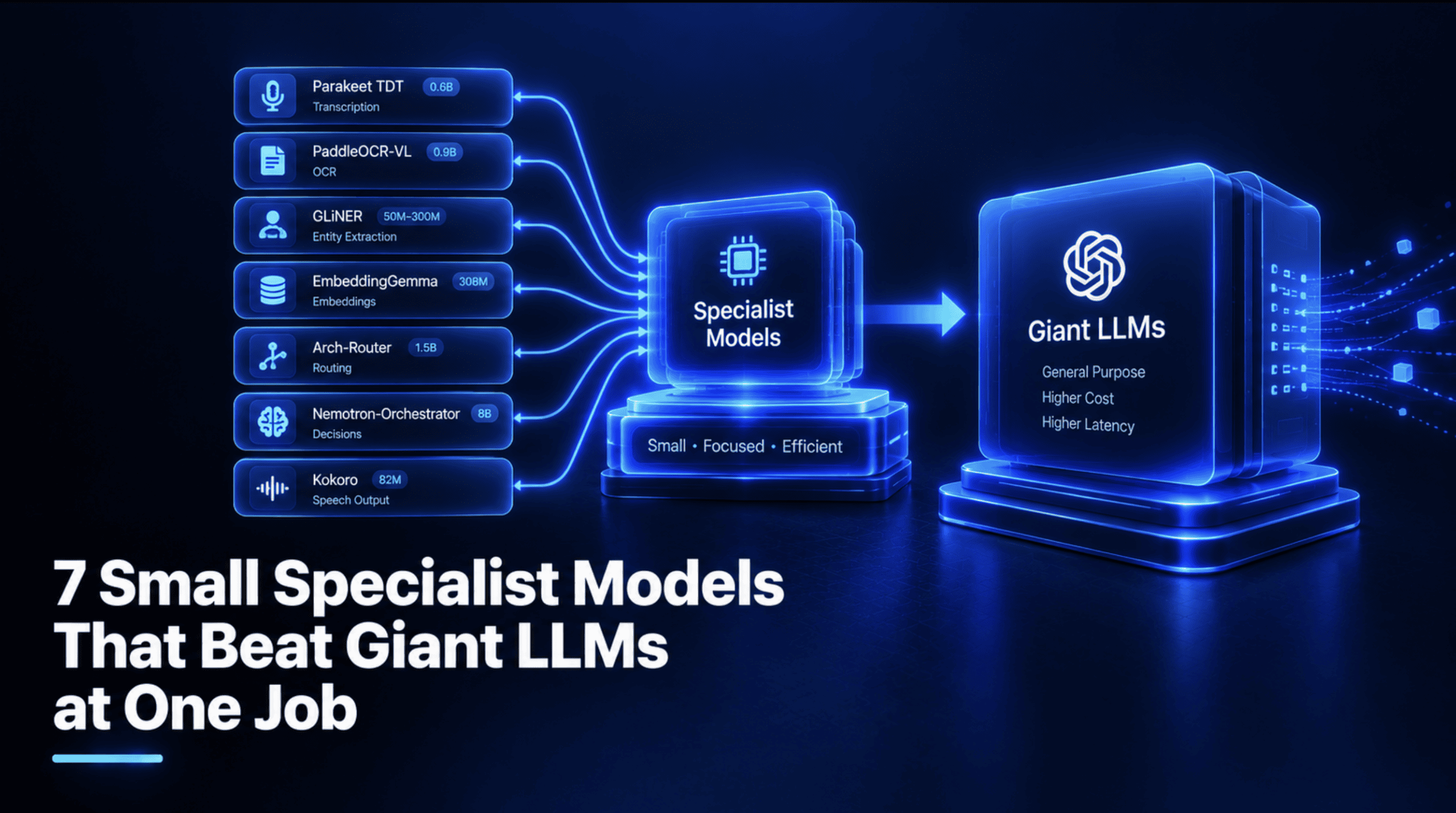
认识七款参数量低于 100 亿的开放专用模型,它们每款只做一项任务,却能匹敌体量大得多的系统,覆盖从转录、OCR 到路由和语音。
作者:Shittu Olumide,技术内容专家,2026 年 11 月 4 日,发表于语言模型分类。
设想一条用偷懒方式搭建的客服处理流水线。一个巨型模型转写通话、读取附带的发票、提取姓名和金额、决定工单分给哪个团队,再把回复读给客户听。这套流程能用,但每一步都按前沿模型的价格计费。
其中大多数步骤都是单一任务,而小型专用模型正是为此而生。本文将介绍七款开放模型,每款参数量均低于 100 亿,它们能在单项任务上与体量大得多的系统正面抗衡。对每一款,你都会看到它擅长的任务、规模和许可证、已发布的验证结果,以及可在本地运行的代码。这些任务专用模型不会在所有地方取代巨型大语言模型(LLM),最后一节会说明它们无法胜任的场景。
这七款模型是如何选出的
每款模型都必须满足四条规则:开放权重、一项明确任务、有已发布的与体量大得多的模型对比的证明,以及占用足够小、可在单台机器上运行。“巨型”并不总是指“聊天 LLM”。如果对比对象是更大的通用模型,我会明确说明。如果对比对象是闭源 API 或更大的专用模型,我会改为说明这一点。
Whisper large-v3:准确率与速度
光学字符识别(OCR)
Gemini 3 Pro 与 GPT-5.2 在 OmniDocBench v1.6 上的表现
ChatGPT 在零样本命名实体识别(NER)上的表现
参数量低于 500M 的开源嵌入模型
GPT-4o 与 Claude-Sonnet-3.7 在路由任务上的表现
NVIDIA 许可证(仅限研究用途)
GPT-5 在 Humanity's Last Exam 上的表现
更大的开源文本转语音(TTS)模型在盲听测试中的表现
为每个模型使用单独的虚拟环境。这些技术栈锁定了不同版本的 PyTorch 及相关库,把 NeMo、Paddle 和 vLLM 混在同一个环境里,就是在自找冲突。
# 每个模型一个环境,例如第一个:python -m venv parakeet-env source parakeet-env/bin/activate # Windows:parakeet-env\Scripts\activate
有两个模型需要额外的一点操作。EmbeddingGemma 属于受限访问(gated)模型,因此需要在模型页面上接受其许可协议,并登录一次:
from huggingface_hub import login login() # 出现提示时粘贴 Hugging Face 访问令牌
如其 GitHub 页面所述,Kokoro 需要 espeak-ng 系统软件包(Ubuntu 上为 sudo apt-get install espeak-ng,macOS 上为 brew install espeak-ng)。
这次 login() 调用会保存你的令牌,这样之后再下载受限模型就不会再弹出提示。每个模型都会在首次运行时下载权重,所以第一次需要等待一段时间。
我们来看看这七个模型。它们按流水线顺序运行:语音输入、文档输入、抽取、搜索、路由、决策、语音输出。
1. Parakeet TDT 0.6B v3:语音转写
规模与许可:600M 参数,CC-BY-4.0,支持 25 种欧洲语言并具备自动语言检测,依据模型卡说明。
证据:Open ASR Leaderboard 的论文列出 Parakeet v3 的平均词错误率为 6.32,而 Whisper large-v3 为 7.44;吞吐量则是 3,330 对 146(RTFx,数值越高越快)。也就是说,它速度快约 23 倍,错误还更少。一份汇总文章认为,Parakeet 的规模只有 Whisper large-v3 的四分之一。注意,它击败的是一个更大的语音模型,而不是聊天类 LLM。
pip install -U "nemo_toolkit[asr]"
import nemo.collections.asr as nemo_asr # 首次运行时会下载模型;模型卡说明至少需要预留 2 GB 内存 asr_model = nemo_asr.models.ASRModel.from_pretrained( model_name="nvidia/parakeet-tdt-0.6b-v3" ) # 传入一个音频文件列表;模型期望的是 16 kHz 单声道音频 output = asr_model.transcribe(["meeting.wav"]) print(output[0].text) # 加上 timestamps=True 还能获得词级时间戳 # output = asr_model.transcribe(["meeting.wav"], timestamps=True)
from_pretrained 会从 Hugging Face 拉取检查点并构建模型。transcribe 接收一个列表,因此可以在一次调用中批量处理多个文件,每个结果的 .text 字段中包含转写文本。注释掉的那一行展示了模型卡中的时间戳选项。
问题在于:Whisper 仍覆盖 99 种语言,而 Parakeet 只有 25 种。2026 年 10 月的榜单快照显示,Parakeet 在英语上领先(错误率 5.66% 对 6.5%),但在其跟踪的另外六种欧洲语言中,有五种落后于 Whisper。
2. PaddleOCR-VL-1.6:光学字符识别
规模与许可:0.9B 参数,根据模型卡于 2026 年 5 月 28 日发布,在 2026 年 9 月的一份 OCR 汇总中被列为 Apache 2.0。
证据:在 PaddleOCR-VL-1.6 的论文中,其在 OmniDocBench v1.6 上的总分为 96.33,而 Gemini 3 Pro 为 92.91,GPT-5.2 为 86.59。一个 0.9B 的模型在文档解析上领先于这两个前沿系统。
# 用于 CUDA 12.6 的 GPU 构建版本,与模型卡上一致(如果没有 GPU,请使用 Paddle 安装指南中的 CPU 构建版本) python -m pip install paddlepaddle-gpu==3.2.1 -i https://www.paddlepaddle.org.cn/packages/stable/cu126/ python -m pip install -U "paddleocr[doc-parser]>=3.6.0"
from paddleocr import PaddleOCRVL # pipeline_version="v1.6" 选择此版本(需要 paddleocr >= 3.6.0) pipeline = PaddleOCRVL(pipeline_version="v1.6") # 可接受本地路径或页面图像的 URL output = pipeline.predict("invoice.png") for res in output: res.print() # 显示解析结果 res.save_to_json(save_path="output") # 结构化输出 res.save_to_markdown(save_path="output") # 可读的 Markdown,包含表格
该流水线先进行版面检测,然后由 0.9B 模型读取每个区域。一次调用即可获得页面的 JSON 和 Markdown 输出,相比原始文本,这更便于输入到下一步。
问题在于:它并非独自占据榜首。同一份 9 月的汇总在 OmniDocBench v1.6 上将 TeleOCR(96.91)和 OvisOCR2(96.47)排在其之上,所以应理解为“前三名”,而非“第一名”。原模型卡还建议在 Windows 上使用适用于 Linux 的 Windows 子系统或 Docker。
3. GLiNER:实体抽取
规模与许可证:这篇 NAACL 2024 论文涵盖从 50M 参数起的模型。该仓库采用 Apache-2.0 许可证,但各个检查点有所不同,一些较旧的检查点被标注为 CC BY-NC 4.0,因此请核对你所选的检查点。
证据:论文的域外测试表中,50M 参数的 GLiNER-S 在零样本 NER 上平均达到 52.7,而 ChatGPT 为 47.5。其摘要称,在零样本评估中,GLiNER 的表现优于 ChatGPT 和经过微调的 LLM。
from gliner import GLiNER # 一个 90M 级别的检查点;该仓库将其列为 Apache 2.0 模型 model = GLiNER.from_pretrained("urchade/gliner_medium-v2.1") text = ( "Sarah Okafor from Brightwave Ltd confirmed invoice INV-20418 " "for $12,400, due on 14 November 2026." ) # 标签由你在运行时选择;README 建议 v2.1 使用首字母大写 labels = ["Person", "Company", "Invoice number", "Amount", "Date"] entities = model.predict_entities(text, labels, threshold=0.5) for e in entities: print(f"{e['text']} => {e['label']} ({e['score']:.2f})")
关键思路在于,标签只是你传入的字符串,因此无需重新训练就能改变提取的内容。threshold 控制严格程度:调高它会得到更少但更确定的匹配。正如 README 所说,它可以在普通 CPU 上运行。
注意点:那个对比中的 "ChatGPT" 是 2023 年时期的模型。GLiNER 提取的是文本片段。它不会对这些片段进行推理,也不会补全任何缺失的信息。
4. EmbeddingGemma:嵌入
规模与许可:据 Google 公告,308M 参数,其中约 100M 在模型中,200M 在嵌入中。许可证为 Google 的 Gemma 条款,且该仓库需授权访问。
佐证:Google 称其为 MTEB 上 500M 参数以下排名最高的开放多语言文本嵌入模型,在 100 多种语言上训练,且经量化后小到可在 200 MB 内存以内运行。诚实的表述:这是关于其规模级别的说法,并非战胜巨型 LLM 的胜利。它之所以有立足之地,是因为检索这项工作可以让 300M 模型以低成本完成。
pip install -U sentence-transformers
from sentence_transformers import SentenceTransformer # 受限模型:需先在 Hugging Face 页面接受许可,并先运行 login() model = SentenceTransformer("google/embeddinggemma-300m") query = "How do I reset my password?" documents = [ "To reset your password, open Settings and choose Security.", "Invoices are emailed on the first day of each month.", "Our office is closed on public holidays.", ] # 这两个方法会自动加上模型推荐的查询与文档提示词 query_embedding = model.encode_query(query) document_embeddings = model.encode_document(documents) # 每个文档对应一个相似度分数,最高分即最佳匹配 scores = model.similarity(query_embedding, document_embeddings)[0] best = int(scores.argmax()) print(documents[best], float(scores[best]))
encode_query 和 encode_document 很关键。Hugging Face 的指南解释说,这两个方法会自动应用正确的提示词前缀,否则你就得手动添加。similarity 会为每一对查询与文档返回一个分数。
原文较长,译文为节选;译文由英文原文机器翻译,术语按行业惯例统一,可在文末展开原文核对。
查看英文原文(7 Small Specialist Models That Beat Giant LLMs at One Job)
7 Small Specialist Models That Beat Giant LLMs at One Job - KDnuggets
7 Small Specialist Models That Beat Giant LLMs at One Job
Meet seven open specialist models under 10 billion parameters that rival much bigger systems at one job each, from transcription and OCR to routing and speech.
By Shittu Olumide, Technical Content Specialist on November 4, 2026 in Language Models
Picture a support pipeline built the lazy way. A giant model transcribes the call, reads the attached invoice, pulls out the names and amounts, decides which team gets the ticket, and reads the reply back to the customer. It works, and every step is billed at frontier prices.
Most of those steps are single jobs, and small specialist models are built for exactly that. In this article, you will meet seven open models, each under 10 billion parameters, that go head to head with much bigger systems on one task. For each, you get the job it wins, its size and license, the published proof, and code to run it locally. These task-specific models won't replace a giant large language model (LLM) everywhere, and the last section covers where they don't.
How These Seven Were Picked
Every model had to meet four rules: open weights, one clear job, published proof against something much bigger, and a footprint small enough for a single machine. "Giant" does not always mean "a chat LLM." Where the proof is against a bigger general model, I say so. Where it is against a closed API or a larger specialist, I say that instead.
Whisper large-v3, on accuracy and speed
Optical character recognition (OCR)
Gemini 3 Pro and GPT-5.2 on OmniDocBench v1.6
ChatGPT on zero-shot named entity recognition (NER)
Open embedding models under 500M
GPT-4o and Claude-Sonnet-3.7 on routing
NVIDIA License (research only)
GPT-5 on Humanity's Last Exam
Larger open text-to-speech (TTS) models in blind listening tests
Use a separate virtual environment for each model. These stacks pin different versions of PyTorch and related libraries, and mixing NeMo, Paddle, and vLLM in one environment is asking for conflicts.
# One environment per model, for example for the first one
python -m venv parakeet-env
source parakeet-env/bin/activate # Windows: parakeet-env\Scripts\activate
Two models need a little extra. EmbeddingGemma is gated, so accept its license on the model page and log in once:
from huggingface_hub import login

login() # paste a Hugging Face access token when prompted
Kokoro needs the espeak-ng system package (sudo apt-get install espeak-ng on Ubuntu or brew install espeak-ng on macOS), as its GitHub page notes.
That login() call stores your token so later downloads of gated models work without more prompts. Each model downloads its weights on first run, so expect a wait the first time.
Let's take a look at the seven models. They run in pipeline order: speech in, documents in, extraction, search, routing, decisions, speech out.
1. Parakeet TDT 0.6B v3: Transcription
Size and license: 600M parameters, CC-BY-4.0, 25 European languages with automatic language detection, per the model card.
The proof: The Open ASR Leaderboard paper lists Parakeet v3 at an average word error rate of 6.32 against 7.44 for Whisper large-v3, with a throughput of 3,330 against 146 (RTFx, higher is faster). That is about 23 times faster with fewer errors. One roundup puts Parakeet at a quarter of Whisper large-v3's size. Note that this beats a bigger speech model, not a chat LLM.
pip install -U "nemo_toolkit[asr]"
import nemo.collections.asr as nemo_asr

# Downloads the model on first run; the card says to allow at least 2 GB of RAM
asr_model = nemo_asr.models.ASRModel.from_pretrained(
 model_name="nvidia/parakeet-tdt-0.6b-v3"
)

# Pass a list of audio files; 16 kHz mono audio is what the model expects
output = asr_model.transcribe(["meeting.wav"])
print(output[0].text)

# Add timestamps=True to also get word-level timing
# output = asr_model.transcribe(["meeting.wav"], timestamps=True)
from_pretrained pulls the checkpoint from Hugging Face and builds the model. transcribe takes a list, so you can batch several files in one call, and each result has a .text field with the transcript. The commented line shows the timestamp option from the model card.
The catch: Whisper still covers 99 languages to Parakeet's 25. An October 2026 leaderboard snapshot shows Parakeet ahead in English (5.66% against 6.5% error) but behind Whisper on five of the six other European languages it tracks.
2. PaddleOCR-VL-1.6: Optical Character Recognition
Size and license: 0.9B parameters, released May 28, 2026 according to the model card, and listed as Apache 2.0 in a September 2026 OCR roundup.
The proof: In the PaddleOCR-VL-1.6 paper, its overall score on OmniDocBench v1.6 is 96.33, against 92.91 for Gemini 3 Pro and 86.59 for GPT-5.2. A 0.9B model is ahead of both frontier systems on document parsing.
# GPU build for CUDA 12.6, as on the model card (use the CPU build from the Paddle install guide if you have no GPU)
python -m pip install paddlepaddle-gpu==3.2.1 -i https://www.paddlepaddle.org.cn/packages/stable/cu126/
python -m pip install -U "paddleocr[doc-parser]>=3.6.0"
from paddleocr import PaddleOCRVL

# pipeline_version="v1.6" selects this release (it needs paddleocr >= 3.6.0)
pipeline = PaddleOCRVL(pipeline_version="v1.6")

# Accepts a local path or a URL to a page image
output = pipeline.predict("invoice.png")

for res in output:
 res.print() # show the parsed result
 res.save_to_json(save_path="output") # structured output
 res.save_to_markdown(save_path="output") # readable Markdown, tables included
The pipeline runs layout detection first, then the 0.9B model reads each region. One call gives you the page as JSON and as Markdown, which is easier to feed to the next step than raw text.
The catch: It is not alone at the top. The same September roundup ranks TeleOCR (96.91) and OvisOCR2 (96.47) just above it on OmniDocBench v1.6, so read "top three," not "number one." The original model card also recommends Windows Subsystem for Linux or Docker on Windows.
3. GLiNER: Entity Extraction
Size and license: The NAACL 2024 paper covers models from 50M parameters up. The repo is Apache-2.0, but individual checkpoints differ, and some older ones are listed as CC BY-NC 4.0, so check the checkpoint you pick.
The proof: The paper's out-of-domain table has GLiNER-S, at 50M parameters, averaging 52.7 against 47.5 for ChatGPT on zero-shot NER. Its abstract says GLiNER outperforms both ChatGPT and fine-tuned LLMs in zero-shot evaluations.
from gliner import GLiNER

# A 90M-class checkpoint; the repo lists this one as Apache 2.0
model = GLiNER.from_pretrained("urchade/gliner_medium-v2.1")

text = (
 "Sarah Okafor from Brightwave Ltd confirmed invoice INV-20418 "
 "for $12,400, due on 14 November 2026."
)

# You choose the labels at run time; the README suggests title case for v2.1
labels = ["Person", "Company", "Invoice number", "Amount", "Date"]

entities = model.predict_entities(text, labels, threshold=0.5)
for e in entities:
 print(f"{e['text']} => {e['label']} ({e['score']:.2f})")
The key idea is that labels are just strings you pass in, so you can change what you extract without retraining. threshold controls strictness: raise it for fewer, surer matches. It runs on a plain CPU, as the README says.
The catch: The "ChatGPT" in that comparison is the 2023-era model. GLiNER extracts spans of text. It won't reason about them or fill in anything missing.
4. EmbeddingGemma: Embeddings
Size and license: 308M parameters, about 100M of them in the model and 200M in embeddings, per Google's announcement. The license is Google's Gemma terms, and the repo is gated.
The proof: Google calls it the highest-ranking open multilingual text embedding model under 500M parameters on MTEB, trained on 100+ languages and small enough to run in under 200 MB of RAM with quantization. Honest framing: that is a claim about its size class, not a win over a giant LLM. It earns its place because retrieval is a job where a 300M model does the work cheaply.
pip install -U sentence-transformers
from sentence_transformers import SentenceTransformer

# Gated model: accept the license on the Hugging Face page and run login() first
model = SentenceTransformer("google/embeddinggemma-300m")

query = "How do I reset my password?"
documents = [
 "To reset your password, open Settings and choose Security.",
 "Invoices are emailed on the first day of each month.",
 "Our office is closed on public holidays.",
]

# These methods add the model's recommended query and document prompts for you
query_embedding = model.encode_query(query)
document_embeddings = model.encode_document(documents)

# One similarity score per document; the highest is the best match
scores = model.similarity(query_embedding, document_embeddings)[0]
best = int(scores.argmax())
print(documents[best], float(scores[best]))
encode_query and encode_document matter. The Hugging Face guide explains that they apply the right prompt prefixes automatically, which you would otherwise have to add by hand. similarity returns a score for every query and document pair.
The catch: Context is 2,048 tokens, so long documents need chunking. A larger embedder like jina-embeddings-v5-text-small posts higher MTEB scores at about 677M parameters, if you can spare the size.
Size and license: 1.5B parameters, fine-tuned from Qwen2.5-1.5B-Instruct on 43,000 examples, per VentureBeat. The license is Katanemo's own research license, not Apache, so read it before shipping.
The proof: The paper reports a 93.17% overall routing score, 7.71% above the proprietary models it tested (GPT-4o and Claude-Sonnet-3.7 among them) on average. PromptHub reports about 50 ms per decision against roughly 510 ms for Gemini-2.0-flash-lite and 1,450 ms for Claude-Sonnet-3.7.
pip install -U transformers accelerate torch
import json
from transformers import AutoModelForCausalLM, AutoTokenizer

model_name = "katanemo/Arch-Router-1.5B"
model = AutoModelForCausalLM.from_pretrained(
 model_name, device_map="auto", torch_dtype="auto"
)
tokenizer = AutoTokenizer.from_pretrained(model_name)

# Prompt templates from the model card; the model works best with this exact wording
TASK_INSTRUCTION = """
You are a helpful assistant designed to find the best suited route.
You are provided with route description within  XML tags:


{routes}


{conversation}


"""

FORMAT_PROMPT = """
Your task is to decide which route is best suit with user intent on the conversation in  XML tags. Follow the instruction:
1. If the latest intent from user is irrelevant or user intent is full filled, response with other route {"route": "other"}.
2. You must analyze the route descriptions and find the best match route for user latest intent.
3. You only response the name of the route that best matches the user's request, use the exact name in the .

Based on your analysis, provide your response in the following JSON formats if you decide to match any route:
{"route": "route_name"}
"""

# Your routes, written in plain English
route_config = [
 {"name": "billing", "description": "Questions about invoices, charges, refunds, or payment methods"},
 {"name": "tech_support", "description": "Troubleshooting errors, bugs, or setup problems with the product"},
 {"name": "sales", "description": "Pricing, plans, demos, or buying decisions"},
]

# Which downstream model handles each route (names are placeholders)
ROUTE_TO_MODEL = {
 "billing": "small-fast-model",
 "tech_support": "strong-reasoning-model",
 "sales": "mid-tier-model",
 "other": "default-model",
}


def pick_route(user_message: str) -> str:
 conversation = [{"role": "user", "content": user_message}]
 prompt = (
 TASK_INSTRUCTION.format(
 routes=json.dumps(route_config), conversation=json.dumps(conversation)
 )
 + FORMAT_PROMPT
 )
 inputs = tokenizer.apply_chat_template(
 [{"role": "user", "content": prompt}],
 add_generation_prompt=True,
 return_tensors="pt",
 return_dict=True,
 ).to(model.device)

 output_ids = model.generate(**inputs, max_new_tokens=64)
 reply = tokenizer.decode(
 output_ids[0][inputs["input_ids"].shape[-1]:], skip_special_tokens=True
 )
 try:
 return json.loads(reply)["route"]
 except (json.JSONDecodeError, KeyError):
 return "other" # fall back if the reply is not clean JSON


route = pick_route("I was charged twice for my March invoice")
print(route, "->", ROUTE_TO_MODEL.get(route, ROUTE_TO_MODEL["other"]))
This follows the model card with three deliberate changes. Output is capped at 64 tokens instead of 32,768, because the reply is one short JSON object. return_dict=True and generate(**inputs) keep it working across Transformers versions. And trust_remote_code is dropped, since the repo has no custom model code. Routes are plain descriptions, so adding or changing one means editing route_config, with no retraining, which the card calls out as a feature.
The catch: It only routes. You still need the models behind each route. And the descriptions you write decide how well it works, so test them.
6. Nemotron-Orchestrator-8B: Decisions
Size and license: 8B parameters, built on Qwen3-8B. The model card uses the NVIDIA License and says the model is for research and development only.
The proof: On Humanity's Last Exam it scores 37.1% against GPT-5's 35.1%, at about 30% of the cost and 2.5 times faster, per the card and the paper. On FRAMES the figures are 76.3% against 74.0%, and on τ²-Bench 80.2% against 77.7%.
Read that carefully. It wins by deciding which tool or model to call. On τ²-Bench it still calls a large model like GPT-5 in about 40% of steps and cheaper options for the rest. The skill is the decision, not replacing the giant.
Run it: The full orchestration loop, with its tool setup and prompts, lives in NVIDIA's ToolOrchestra repo. Here is just a smoke test that loads the model and asks it to choose a tool:
pip install vllm openai
vllm serve "nvidia/Nemotron-Orchestrator-8B"
from openai import OpenAI

# vLLM exposes an OpenAI-compatible API on port 8000 by default
client = OpenAI(base_url="http://localhost:8000/v1", api_key="EMPTY")

prompt = (
 "You can use these tools: web_search, python_interpreter, "
 "large_generalist_model (expensive), small_math_model (cheap). "
 "Task: what is 18% of 4,250? "
 "Name the single best tool and give one sentence of reasoning."
)

response = client.chat.completions.create(
 model="nvidia/Nemotron-Orchestrator-8B",
 messages=[{"role": "user", "content": prompt}],
 temperature=0,
)
print(response.choices[0].message.content)
vllm serve and the request shape come from the model card's own vLLM instructions. The prompt is my own, so treat the answer as a sanity check, not a benchmark. Plan for a GPU with 24 GB of memory (my estimate for an 8B model).
The catch: The research-only license rules out production use for now. The comparator, GPT-5, is also no longer the frontier.
7. Kokoro-82M: Speech Output
Size and license: 82 million parameters, Apache 2.0, about 327 MB of weights, per the model card.
The proof: At launch it ranked first on the TTS Spaces Arena, ahead of XTTS v2 (467M) and others, according to UnfoldAI. A 2026 roundup still ranks it sixth among open models on the Artificial Analysis Speech Arena (Elo 1,060). Its comparators are other TTS models, not chat LLMs.
pip install "kokoro>=0.9.4" soundfile
import soundfile as sf
from kokoro import KPipeline

# "a" means American English; the language code must match the voice
pipeline = KPipeline(lang_code="a")

text = "Your invoice has been paid. Thank you for your business."

# The pipeline yields audio in chunks: text, phonemes, then the audio itself
for i, (graphemes, phonemes, audio) in enumerate(pipeline(text, voice="af_heart")):
 sf.write(f"speech_{i}.wav", audio, 24000) # Kokoro outputs 24 kHz audio
KPipeline handles text-to-phoneme conversion and voice loading, and af_heart is the voice used in the official example. Long text comes out as several WAV files, one per chunk, so join them if you need a single file.
The catch: It is not the leader anymore. The same roundup says NVIDIA's Magpie (357M) now outranks it, and Kokoro has no voice cloning.
You met seven small specialist models and what each one wins: Parakeet at transcription, PaddleOCR-VL at OCR, GLiNER at entity extraction, EmbeddingGemma at embeddings, Arch-Router at routing, Nemotron-Orchestrator-8B at tool decisions, and Kokoro at speech output. You saw the published proof, the license caveats, and runnable code for each, plus the limits that keep a giant LLM in the picture.
Now pick one job in your own stack, such as transcription or extraction, and swap in the matching specialist. Time it, score it against your current model on your own data, and keep the giant for what only it can do. If you try one, share your results.
Shittu Olumide is a software engineer and technical writer passionate about leveraging cutting-edge technologies to craft compelling narratives, with a keen eye for detail and a knack for simplifying complex concepts. You can also find Shittu on Twitter.
原文为英文,正文由自动抓取并保留原文。
原文发布于 KDnuggets(7 Small Specialist Models That Beat Giant LLMs at One Job),标题、摘要与正文由机器翻译,术语按行业惯例统一,未经人工逐句校订。