为关键时刻蓄力
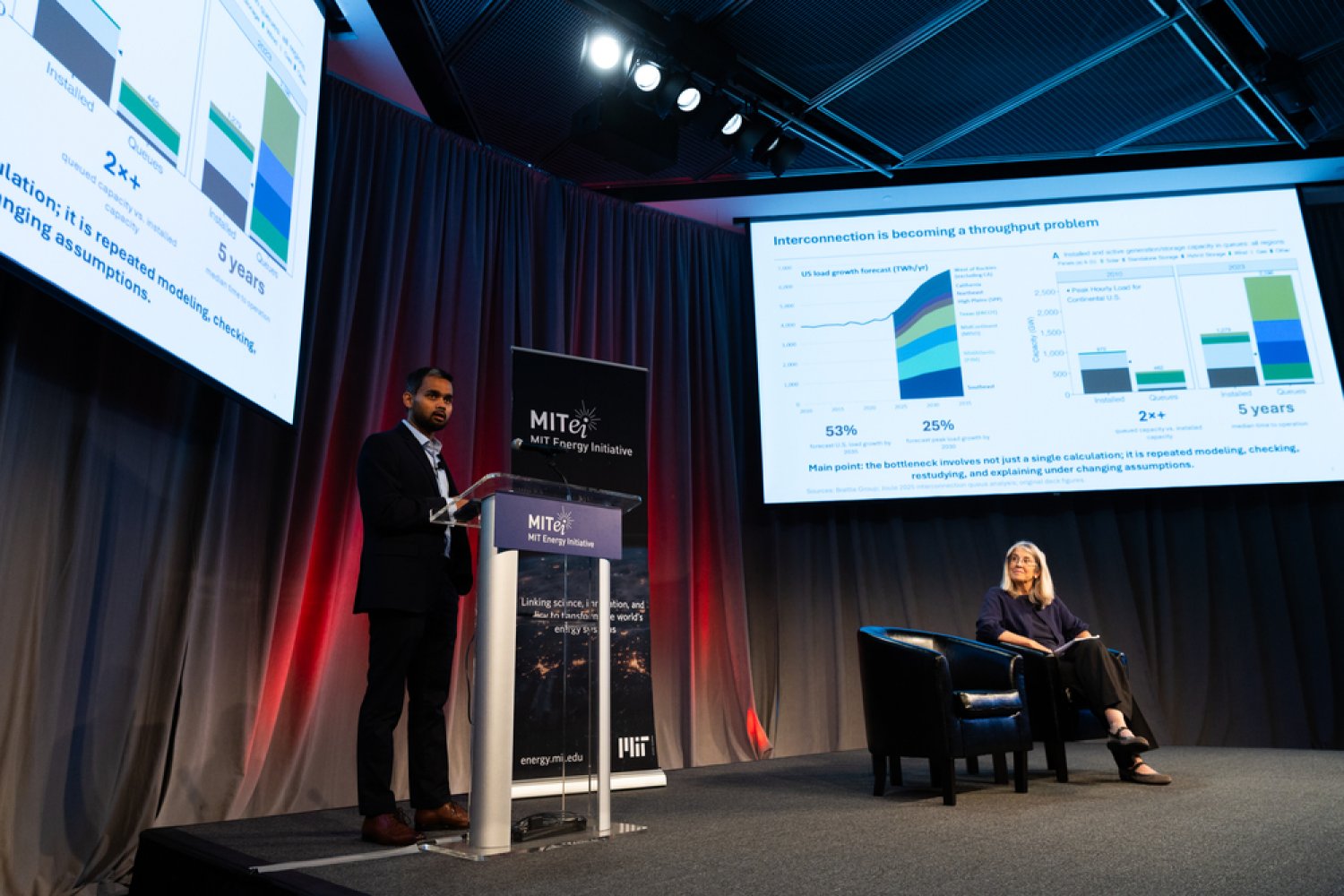
大规模利用废弃碳、评估公众对人工智能和数据中心的信任,以及为关键应用构建量子工具包,是能源专家在9月22日至23日举行的 MIT Energy Initiative(MITEI)年度研究会议上探讨的议题之一。
MIT 校级教授、MIT 工程学院院长 Paula Hammond 在会议开幕时说,能源转型的复杂性要求采取“真正跨学科、国际化的方法”。本次会议的主题是“在关键时刻推动能源转型”。
超过200人以线下和线上方式参加了这场名为 Energizing@MIT 的 MITEI 年度研究会议,与会者包括教职人员、科学家和研究人员,以及全球能源企业、非营利组织和学术机构的代表。
随着人工智能和数据中心的快速扩张,能源转型面临的挑战愈发严峻,需要“能够探究材料、化学和能源系统等基础问题的研究人员……能够设计新技术并确定其如何大规模运行的工程师……以及能够帮助我们理解这些技术将如何与社区及我们周围的世界互动的经济学、政策、人类行为和社会学专家,”Hammond 说。
从主题演讲嘉宾到小组讨论成员,从种子基金创新者到初创企业创业者,本次会议汇集了上述各个领域的典范人物。
部署当今的技术
Breakthrough Energy 首席技术官兼管理合伙人 Eric Toone 在主旨演讲中为第一天的议程定下基调,他的评估清醒而务实。“如果能源就是繁荣,”他对听众说,“那么至少在今天,繁荣就意味着排放。”不过 Toone 依然乐观,他列举了 Breakthrough Energy 资助项目的案例——从铁空气电池到真空隔热玻璃窗——这些技术都能降低能源的碳成本。
“我们完全有能力开发出提供完全相同服务、但零碳排放的新技术。”他说。
这场会议让 Toone 的说法变得具体可感,因为其议题贯穿了脱碳的完整脉络——从部署我们今天已经掌握的技术,到探索明天可能实现的方向。
麻省理工学院能源与环境政策研究中心(MIT Center for Energy and Environmental Policy Research)研究副主任 John Parsons 表示,有些“项目确实正在开发之中,有些公司眼下就真正破土动工、把电子送上电网,就在当下或非常非常近的将来提供发电容量”。Parsons 主持了一场关于核裂变发电复兴的专题讨论。
会议亮点包括:Crane Clean Energy Center 对三里岛核电站 1 号机组的修复,该机组计划于 2027 年年中重启;法国电力公司(EDF)为法国由 57 座反应堆构成的核电体系进行延寿和现代化改造、让电厂适应气候变化影响的工作;以及 GE Vernova 在成熟轻水堆技术方面的开发,其位于安大略省的一座新电厂正在建设中。
碳利用为减少二氧化碳(CO2)排放提供了另一条路径。“陆地和海洋被动吸收了近 50% 的人为 CO2 排放,”MITEI 科学与技术副主任、该专题讨论会主持人 Carolyn Ruppel 说。“我们的想法是为其余部分中的一些找到用途。”该场次展示了探索利用捕获的 CO2 制造产品的多种技术的研究。
MIT 材料科学与工程系(DMSE)研究科学家 Nicola Ferralis 强调了碳废料大规模用途的重要性,例如用于车辆和建筑的结构碳。“我们需要找到在质量上真正能够与供应相匹配的应用,”他说。
MIT 土木与环境工程系及 DMSE 副教授 Admir Masic 介绍了在日本札幌实际条件下使用的自加热混凝土板,以及能够储存能量的新型混凝土材料。
“向可再生能源经济转型的步伐,将在很大程度上取决于可规模化的批量储能解决方案是否可得,”Masic 说。
MIT 机械工程系教授 Kripa K. Varanasi 正致力于让电厂排放烟羽捕集等技术在经济上可行。
在一场专门面向与 MITEI 或 MITEI 成员企业有关联的初创公司的专题讨论中,发言者讲述了如何将新型能源技术从研究推向商业化:Adaion 的 Alfredo Rivela 开发出一款面向电力公用事业公司的 AI 工具,可优化其对电网的使用;Raptor Maps 的 Eddie Obropta 训练无人机巡检太阳能电站;Michele Guarnieri 的 HiBot 打造出一款可检测电力线路问题的机器人;Lithios 的 Michael Wang 则正在开展现场试点,利用电化学方法从低品位卤水中分离锂。
发言者一致认为,成功的创业项目始于一个清晰的客户问题——它能够被行业用户验证,并提供一条通往规模化部署的路径。对于行业用户而言,“创新不是一种企业美德,”Alliance Partners 管理合伙人 Steve Hellman 表示,“而是一项关乎存亡的硬性要求。”
早期研究与基础科学
本次会议还呈现了大量前景可期的早期研究,涉及削减碳排放的技术与方法。一场关于 MITEI Seed Innovation Fund Program 项目的专题讨论介绍了多位 MIT 科学家,他们分别在分离并回收稀土元素;设计用于决定哪些电厂应投入运行以满足电力需求的算法;以及建模开发与脱碳对人类和自然系统的影响。
一场海报展示环节展示了化学、建筑、航空航天以及计算机科学等领域的新一代能源研究者。研究生们正在开发种类繁多的碳减排与新型能源系统技术,例如用于制氢的蒸汽电解工艺、建筑全流程脱碳模型,以及以氢和甲烷为燃料的飞机设计。
会议强调了基础科学在为新能源技术管线提供源头供给方面的重要性。周三的主题演讲者、MIT 化学系 F. G. Keyes 化学教授、MIT 量子计划(QMIT)首任主任 Danna Freedman,回顾了科学家将量子计算作为工具、用以解决包括能源领域在内的一系列问题的能力演变。
“我们在 QMIT 想做的就是解决难题,而难题并不是开发这些复杂得令人难以置信又精妙的量子工具,”Freedman 说,“而是把量子工具与将改变世界的应用连接起来。”
一场配套小组讨论探讨了其中一项应用:量子传感,它利用基础物理学来在纳米尺度上观察材料及其特性。例如,SLB 综合传感与测量项目的科学顾问 Lukasz Zielinski 使用配备单光子探测器的激光雷达相机来识别甲烷羽流。主持人、MIT 核科学与工程系的 Ford 工程学教授 Paola Cappellaro 描述了她利用基于金刚石的传感器检测电池电流产生的微弱磁场的工作,这可能有助于在不以电气方式干扰电池的情况下测量电池状态。Cappellaro 说,这类量子传感器可以“既实用又有影响力”。
数据中心与公众信任
在为期两天的各场会议中,一个摆在能源研究人员和产业界面前的关键挑战反复浮现:AI 的爆发式增长,以及为这项技术提供动力的高耗能数据中心。正如 MITEI 首席研究科学家 Deepjyoti Deka 所说:“眼下 AI 面临的重大考验在于,AI 能否以快于自身为完成训练和部署而消耗电力的速度,降低能耗、提高效率并带来创新。”
“为人工智能新建的‘超大规模’设施,用电量可能超过整座城市,”忧思科学家联盟(Union of Concerned Scientists)气候与能源项目能源研究主任 Steve Clemmer 说,并分享了近期对数据中心激增情况的一项分析。他说,新设施的规模比仅仅十年前建成的数据中心大 10 倍、甚至 10,000 倍,批发电价将会上涨,而“对化石燃料依赖的加深将造成数百亿美元的健康损失,以及数万亿美元的气候损失”。他指出,决策者可以通过发展清洁能源、有力的电费缴纳者保护以及其他保障措施来减轻这些有害影响。
原文较长,译文为节选;译文由英文原文机器翻译,术语按行业惯例统一,可在文末展开原文核对。
查看英文原文(Powering up for a pivotal moment)
Utilizing waste carbon at scale, assessing public trust in artificial intelligence and data centers, and building a quantum toolkit for critical applications were among the topics energy experts explored at the MIT Energy Initiative (MITEI)’s annual research conference on Sept. 22-23.
The complexity of the energy transition demands “a truly interdisciplinary and international approach,” said Paula Hammond, Institute Professor and dean of the MIT School of Engineering, kicking off the conference, which was themed “Transitioning energy at a pivotal moment.”
More than 200 people attended Energizing@MIT: MITEI’s Annual Research Conference in person and online, including faculty, scientists, and researchers; representatives of global energy firms; nonprofit organizations; and academic institutions.
With the rapid proliferation of artificial intelligence and data centers, the challenge of the energy transition grows ever greater, requiring “researchers who can pursue fundamental questions about materials, chemistry, and energy systems … engineers who can design new technologies and determine how they might function at scale … and experts in economics, policy, human behavior, and sociology who can help us understand how those technologies will interact with communities and with the world around us,” said Hammond.
From keynote speakers to panelists, seed grant innovators to startup entrepreneurs, the conference featured exemplars in all these categories.
Deploying today’s technologies
Eric Toone, chief technical officer and managing partner at Breakthrough Energy, set the tone for day one with a keynote address that was clear-eyed in his assessment. “If energy is prosperity,” he told the audience, “at least today, prosperity is emissions.” Yet, Toone was optimistic when he heralded examples of Breakthrough Energy-funded ventures, from iron-air batteries to vacuum-insulated glass windows, which can reduce the carbon costs of energy.
“We can absolutely develop new technologies that provide the exact same service, but at zero carbon,” he said.
The conference made Toone’s claim tangible as it spanned the full arc of decarbonization — from deploying what we know today to uncovering what may be possible tomorrow.
There are “projects that are actually being developed, companies that are putting steel in the ground now, electrons onto the grid to deliver capacity now, or in the very, very near term,” said John Parsons, deputy director for research at the MIT Center for Energy and Environmental Policy Research. Parsons moderated a panel on the revival of nuclear fission power.
Highlights included Crane Clean Energy Center’s restoration of the Three Mile Island Unit 1 nuclear plant, set to restart in mid-2027; work by Électricité de France (EDF) to extend and modernize France’s 57-reactor nuclear fleet, adapting plants to climate impacts; and GE Vernova’s development of mature light-water reactor technology, with a new plant under construction in Ontario.
Carbon utilization offers another path to mitigating carbon dioxide (CO2) emissions. “The land and ocean are passively taking up almost 50 percent of anthropogenic CO2 emissions,” said Carolyn Ruppel, MITEI’s deputy director for science and technology, who moderated the panel. “The idea is to find uses for some of the rest of it.” The session showcased research exploring a host of technologies for making products with captured CO2.
Nicola Ferralis, a research scientist in the MIT Department of Materials Science and Engineering (DMSE), highlighted the importance of large-scale uses for carbon waste, such as structural carbon for vehicles and buildings. “We need to find applications that are actually able to match the supply by mass,” he said.
Admir Masic, an associate professor in the MIT Department of Civil and Environmental Engineering and DMSE, described self-heating concrete panels used in real-world conditions in Sapporo, Japan, as well as new concrete materials that can store energy.
“The pace of the transition to a renewable-energy economy will strongly rely on the availability of scalable, bulk energy-storage solutions,” said Masic.
Kripa K. Varanasi, a professor in the MIT Department of Mechanical Engineering, is working on ways to make technologies such as emissions-plume capture at power plants economically viable.
In a panel devoted to startups with links to MITEI or MITEI member companies, speakers described moving novel energy technologies from research to commercialization: Alfredo Rivela of Adaion has developed an AI tool for electrical utilities that optimizes their use of the grid; Eddie Obropta of Raptor Maps trains drones to inspect solar farms; Michele Guarnieri’s HiBot has created a robot that detects issues in power lines; and Michael Wang of Lithios is conducting field pilots that use electrochemistry to separate lithium from low-grade brines.
Successful ventures, the speakers agreed, begin with a clear customer problem that can be validated by industry users and that offers a path to scaled deployment. For industry users, “innovation is not a corporate virtue,” said Steve Hellman, managing partner at Alliance Partners. “It’s an existential requirement.”
Early-stage research and basic science
The conference also offered a bounty of promising early research on technologies and approaches for cutting carbon emissions. A panel on MITEI’s Seed Innovation Fund Program projects introduced MIT scientists who are separating and recycling rare earth elements; designing algorithms to decide which power plants should run to meet electricity demand; and modeling the impacts on human and natural systems of development and decarbonization.
A poster session revealed the next generation of energy researchers in such fields as chemistry, architecture, aeronautics and astronautics, and computer science. Graduate students are developing a wide array of technologies for carbon mitigation and new energy systems, such as a steam electrolysis process for hydrogen production; models of end-to-end decarbonization in buildings; and designs for hydrogen- and methane-fueled aircraft.
The conference highlighted the importance of fundamental science in feeding the pipeline of new energy technologies. Wednesday’s keynote speaker, Danna Freedman, the F. G. Keyes Professor of Chemistry at MIT and inaugural director of the MIT Quantum Initiative (QMIT), traced scientists’ evolving capacity to harness quantum computing as a tool for solving a range of problems, including those in energy.
“What we want to do at QMIT is solve the hard problem, and the hard problem isn’t developing these ridiculously intricate and beautiful quantum tools,” said Freedman. “It is connecting the quantum tools with the applications that will change the world.”
A companion panel explored one such application: quantum sensing, which leverages fundamental physics to capture a nanoscale view of materials and their properties. For instance, Lukasz Zielinski, scientific advisor to the Integrated Sensing and Measurement Program at SLB, uses a lidar camera with single-photon detectors to identify methane plumes. Moderator Paola Cappellaro, the Ford Professor of Engineering in the MIT Department of Nuclear Science and Engineering, described her work using diamond-based sensors for detecting tiny magnetic fields from battery current, potentially helping measure battery conditions without disturbing the battery electrically. Such quantum sensors, Cappellaro said, can be “practical and impactful.”
Data centers and public trust
One critical challenge facing energy researchers and industry emerged in sessions throughout the two days: the explosive growth of AI and the energy-hungry data centers that fuel this technology. As Deepjyoti Deka, a MITEI principal research scientist, put it, “the big test for AI right now is whether AI can reduce energy usage, improve efficiency, as well as bring in innovation faster than the rate at which it is going to consume electricity to get trained and deployed.”
“New ‘hyperscale’ facilities built for artificial intelligence can use more power than entire cities,” said Steve Clemmer, director of energy research in the Climate and Energy Program at the Union of Concerned Scientists, sharing a recent analysis of data center proliferation. With new facilities being 10 to even 10,000 times larger than data centers built just a decade ago, he said, wholesale electricity costs will rise, and “increased reliance on fossil fuels will result in tens of billions of dollars in health damages, and trillions in climate damages.” He noted that decision-makers can mitigate these harmful impacts through clean energy development, strong ratepayer protections, and other safeguards.
Given mounting opposition to data centers, Kathryn Kline Tyndall, associate director of energy at the Bipartisan Policy Center, recommended that industry proponents provide early, accessible information about power, water, quality-of-life, land-use, environmental, and economic impacts, tailored to each community in which they hope to set up shop.
Larry Susskind, the Ford Professor of Urban and Environmental Planning in the MIT Department of Urban Studies and Planning, recommended that developers go further, and demonstrate credible benefits to communities. To achieve this, Susskind suggests a facilitated negotiation process between developers and local groups whose object is a community benefits agreement — a deal that might involve altering the data center design, and providing workforce development, infrastructure investment, and clean energy partnerships.
Ultimately, developers must accept that they can’t rush community acceptance; they have to earn it by giving residents a meaningful role in shaping projects and sharing their benefits.
“You’re going to have to proceed at the speed of trust,” said Susskind.
正文保留英文原文,标题与摘要由机器翻译。
原文发布于 MIT News AI(Powering up for a pivotal moment),标题、摘要与正文由机器翻译,术语按行业惯例统一,未经人工逐句校订。