群联SSD内置NPU与64GB内存,可跑AI框架
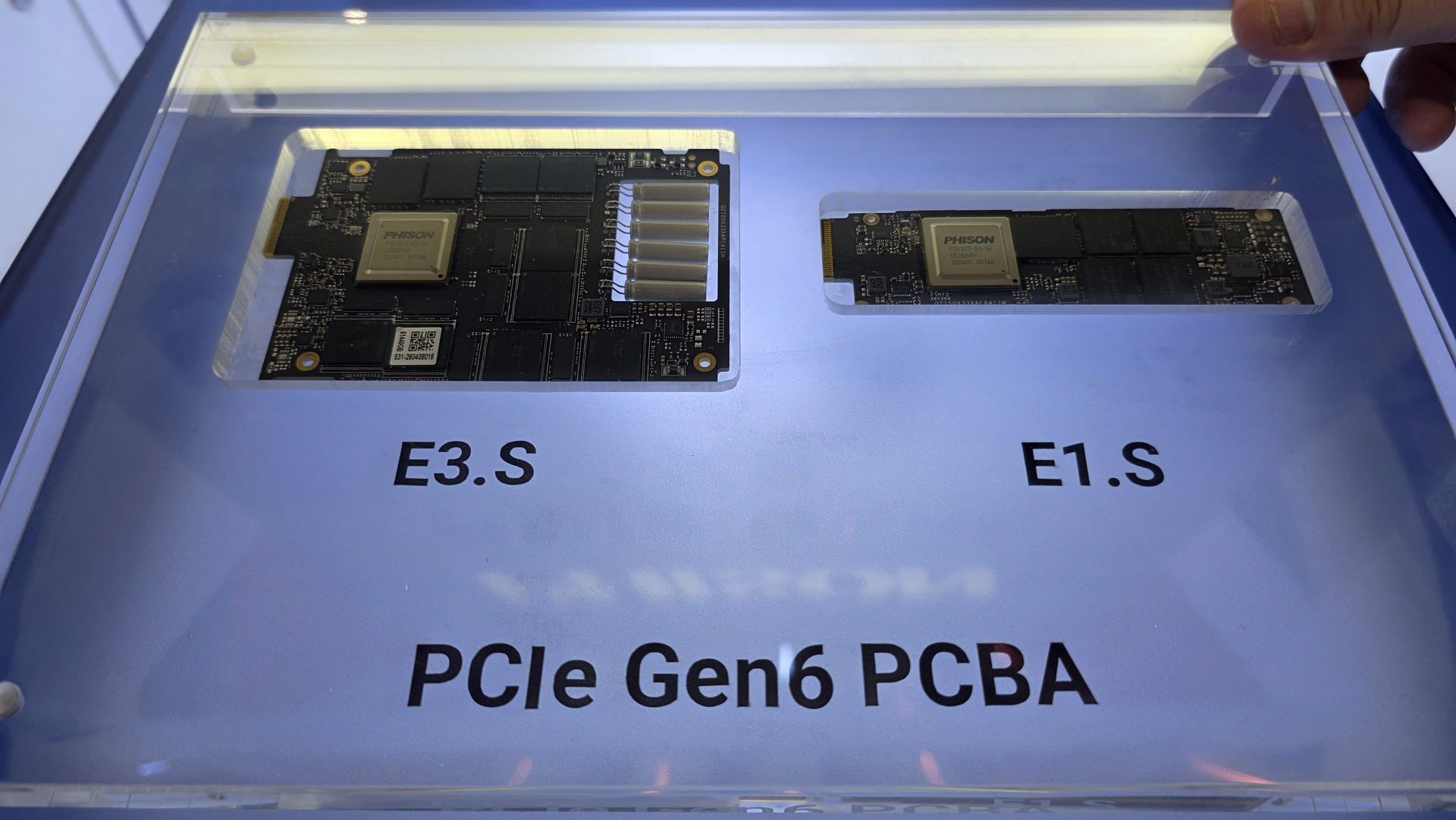
Phison 在 Supercomputer 2026(SC26)上详细介绍了两款新的企业级 SSD 设计,分别针对两个不同的问题:一款内置 NPU 和 64GB 的 130 GB/s 内存,支持直接在盘上运行 PyTorch、vLLM、OpenVINO 和 llama.cpp;另一款则仅用一颗控制器,就把快速 pSLC 缓存与大容量 QLC 结合在一起。该公司指出,“文中提到的许多产品和功能仍处于开发阶段”,将在最终定稿后推出。
计算存储设计的理念是,服务器可以把更多工作卸载到 SSD:SSD 在数据原本所在的位置上运行 AI 代码,然后回传结果,而不是整个数据集。而 pSLC-QLC 设计则把缓存放进每一块盘内,这可能降低系统复杂度,因为每个盘位都能贡献可用容量,无需占用盘位作为专用缓存盘。
Phison 表示,集成 NPU 预计可提供“36,800 DMIPS 的计算性能”,即 Dhrystone Million Instructions Per Second(每秒百万条 Dhrystone 指令),这是一种典型的合成基准测试。必须承认,这是 1980 年代一种老旧的 CPU 整数基准测试,而 NPU 通常以 TOPS 计,但该数据并未给出。作为参照,Phison 在 Computex 上展示的 Topaz NPU 扩展卡搭载了八个 NPU,每个最高可达 40 TOPS。因此,这个 DMIPS 数字很可能指的是与之配合的 CPU 核心,我们预计其基于 Arm Cortex 设计,足以驱动这一级别的 SSD,但并不能衡量其 AI 能力。
无论如何,对于预期的工作负载而言,内存及其带宽更为重要;虽然该公司没有说明类型,但根据一份二手报道,LPDDR5X 是热门选项,可能会与 Topaz NPU 搭配使用。如果这块硬盘是可与 Phison 的 X3 控制器相媲美的 PCIe 6.0 部件,其对主机的传输速度最高可达 28 GB/s,这将使内存带宽达到该速度的 4 倍以上。作为参考,130 GB/s 略低于 DGX Spark 硬件带宽的一半,而后者是为 AI 开发而设计的。
Phison 表示,开发者可以在这块硬盘上构建应用,“无需专门的编程工具”,在这件事上这是件好事。当然,该硬盘支持多种通用推理服务器和运行时,但关于主机如何访问该硬盘的算力,并未披露任何信息。这块硬盘能够“并行扫描和处理数据”,这表明其具备可扩展性,并返回“相关结果”,Phison 声称对于适用的工作负载,这可能意味着数据传输量减少 10 到 100 倍。这或许能让主机 CPU 腾出来处理其他任务。
Phison 将算力放到存储上的想法并不新鲜。Samsung 曾在其 SmartSSD 上尝试过这一思路——把 FPGA 放在硬盘上,无需移动数据即可处理数据——该产品于 2018 年亮相。随后在 2022 年,该设计在第二代中改用 AMD 的 Xilinx Versal FPGA 进行了改进,Samsung 声称,对于扫描密集型的数据库查询,相比传统 SSD,处理时间降低超过 50%,能耗降低最多 70%,服务器 CPU 占用降低最多 97%。据报道,该产品此后已从 Samsung 的产品线中消失,不过截至去年,第一代型号仍以 AMD 的 Xilinx 品牌销售。
ScaleFlux 走了一条更窄的路线,把压缩放在 SSD 控制器内部处理。服务器看不到这一过程,因此这块盘看起来与任何其他 NVMe SSD 无异,应用也无需改变自身行为。这位 CEO 声称,它是唯一一家在超大规模厂商处实现量产部署的计算存储公司。这表明,不让客户为该盘编写新代码才是成功的秘诀,因为 SmartSSD 需要为 FPGA 以及每一种工作负载编写代码。Phison 在此的卖点则是灵活性,客户可以使用为常见 AI 框架编写的代码。
公司 CTO Sebastien Jean 于 2025 年在 All About Circuits 上撰文认为,通用型计算存储之所以停滞不前,是因为“每个用例都高度独特,根本无法规模化”。他把在配备更大处理器的硬盘上运行 Linux 操作系统的想法称为“空中楼阁式的做法”。
加速器在数据中心早已被广泛使用,Jean 的提议是把有针对性的加速器放进 SSD 内部,每个加速器在一段逻辑块地址(LBA)范围上执行一项设定好的运算。按他的估算,一个装有 90 块 PCIe 6.0 SSD 的机箱可以在不影响 CPU 的情况下以 2.5 TB/s 的速度处理数据。不过,在 SC26 上公布的设计似乎更接近通用型方案,这可能是因为 AI 的相关性日益提升,以及对内存和算力的双重需求。
Jean 还在大会的“新兴存储技术”专题讨论上发言,探讨未来发展方向,其中包括将以“50、56 GB/s”运行的 PCIe 7.0 硬盘,他称其“比 DDR 通道还快”。以这一速度配备 32 块硬盘,单个机箱可达“1.8 TB/s”。他明确将其描述为面向 HPC 的计算存储。
转向 Mixed Media 解决方案,也就是那款“高耐久 pSLC 与大容量 QLC 闪存”SSD;它是一款 16 通道的产品,因此无法与零售市场上看到的任何产品相提并论。该硬盘的 pSLC 部分让 4-bit QLC 闪存以 1-bit SLC 模式工作,以空间换取性能和耐久度。Phison 表示,该设计基于标准 NVMe 接口构建,可融入现有基础设施,“无需专用主机软件”。
Jean 在同一场专题讨论中进一步说明,该硬盘上“负责耐久度的部分,也就是 SLC”,是与 XLC(3-bit TLC 或 4-bit QLC)分开管理的,每个区域都分配一个命名空间,因此在操作系统看来就像是多块硬盘。这样一来,写入量大的数据可以专门发送到 SLC 区域,而 QLC 中的数据则更可能是读取密集型的。这符合企业级市场向 QLC 寻求容量的一般趋势,但将其中一部分以 SLC 模式运行有助于减少对专用缓存的需求。
目前,高容量 SSD 通常会用单独的 SSD 来承担这一角色,但那会占用更多硬盘位。Phison 这一方案的代价是,单块硬盘故障会同时损失容量和一部分缓存。话虽如此,从缓存的角度看,Phison 的方案更为稳健,因为公司表示“24 块硬盘中损失一块只会造成 4% 的缓存损失,而不是 25% 的损失”,这 25% 想必是假设使用四块专用缓存硬盘的情况。
专用缓存硬盘需要由主机或阵列软件来处理分层,而在 Mixed Media 中,每块硬盘同时承载两个层级,主机只需选择它想要写入的命名空间即可。
该公司也不是第一个提出这一想法的,因为 Kioxia 在 FMS 2025 上展示了其 Mixed Mode 构想,其中每块盘都有 pSLC 与 QLC 的比例,并在首次使用时按盘设定一次。Kioxia 称 1:4 是“不错的起始比例”,不过它表示客户通常希望 pSLC 仅占最大 QLC 容量的 0.5% 到 2%。该实现还在多块盘之间对 pSLC 空间提供奇偶校验保护。Kioxia 同样宣传了所需插槽和现场可更换单元(FRU)更少的好处,其幻灯片甚至有两个图表标题使用了“Mixed Media”一词。
DapuStor 则更进一步,推出了双模式 J5060,这是一款带有 pSLC 区域的 QLC SSD,截至 8 月仍在客户验证中;它在一个 24 盘系统中将该设计与“四块专用 SLC 盘”进行对比,这种配置会产生 Phison 的 25% 这一数字。Solidigm 的 Cloud Storage Acceleration Layer 工作方式不同,它采用主机侧闪存转换层,可以在 SLC 或 TLC 盘上管理小写入,然后再以有利的大顺序块写入 QLC。
还有 Enmotus FuzeDrive P200,它在 CES 2020 上以 MiDrive 之名预览,使用了 Phison 控制器,似乎最接近当前 Mixed Media 的前身。那款消费级盘我们在 2021 年评测过,其 SLC 和 QLC 部分行为上截然不同,但由 Enmotus 软件管理。
缓存位于何处
pSLC 与 QLC 的比例
如何管理
Phison Mixed Media
在每块盘中,位于一个 16 通道控制器之后
将独立的 NVMe 耐久性组分配给命名空间;Phison 表示无需专用主机软件
Kioxia 混合模式
在每块盘内实现,并跨盘对 pSLC 空间提供奇偶校验保护
1:4 是“不错的起始比例”;客户通常希望 pSLC 占最大 QLC 容量的 0.5% 至 2%
比例设置一次,即创建 pSLC 命名空间和耐久性组
DapuStor 双模式
在每块盘内实现,作为 QLC 旁的 pSLC 区域
在 30.72TB 盘上提供 400GB、800GB 或 1.2TB 的 pSLC
在同一块硬盘上分离 SLC 和 QLC 块设备
Enmotus FuzeDrive P200
在硬盘内,作为消费级 QLC SSD 的固定 SLC 部分
900GB 型号配备 24GB SLC
Enmotus 自己的软件
Solidigm CSAL
在专用 SLC 或 TLC 缓存盘上
参考系统:三块 800GB SLC 盘和七块 61.44TB QLC 盘
在主机上运行的闪存转换层
原文较长,译文为节选;译文由英文原文机器翻译,术语按行业惯例统一,可在文末展开原文核对。
查看英文原文(Phison details SSD with a built-in NPU and 64GB of memory that supports AI frameworks on the drive)
Phison detailed two new enterprise SSD designs at Supercomputer 2026 (SC26) that aim to answer two separate problems: one with a built-in NPU and 64GB of 130 GB/s memory that supports running PyTorch, vLLM, OpenVINO, and llama.cpp directly on the drive, and another that merges fast pSLC cache with large QLC capacity behind just one controller. The company notes that “many of the products and features mentioned are still in development” and will arrive once finalized.
The computational-storage design’s premise is that a server can offload more to the SSD, which runs AI code on the data where it already resides and sends back results, instead of whole datasets. The pSLC-QLC design, meanwhile, puts the cache inside each drive, which may reduce system complexity, as every drive bay contributes usable capacity and none goes to dedicated cache drives.
Phison says that the integrated NPU is expected to deliver “36,800 DMIPS of compute performance,” or Dhrystone Million Instructions Per Second, a typical synthetic benchmark. This is admittedly an old CPU integer benchmark from the 1980s, while NPUs tend to be rated in TOPS, but that figure was not given. For reference, the Topaz NPU add-in card Phison showed at Computex carried eight NPUs rated at up to 40 TOPS each. The DMIPS figure therefore likely refers to, instead, the CPU cores that work alongside it, which we would expect to be based on an Arm Cortex design, adequate for running an SSD of this class but no measure of its AI capability.
The memory and its bandwidth are more important for the expected workload, anyway, and while the company doesn’t state the type, LPDDR5X is a popular option and may be used with the Topaz NPU, according to one secondary report. If the drive is a PCIe 6.0 part comparable to Phison’s X3 controller, it could hit up to 28 GB/s to the host, which would put the memory above 4x that speed. For reference, 130 GB/s is a bit less than half of that of the DGX Spark’s hardware, designed for AI development.
Phison says developers can build on the drive “without specialized programming tools,” which, in this case, is a good thing. The drive does, of course, support multiple general-purpose inference servers and runtimes, but nothing was disclosed about how a host reaches the drive’s compute. The drives “scan and process data in parallel,” which indicates scalability, and return “relevant results” which Phison claims could mean 10 to 100 times less data transferred for applicable workloads. This may free up the host CPU for other tasks.
Phison’s idea to put compute on storage isn’t new. Samsung tried this with its SmartSSD — where an FPGA sat on the drive to process data without moving it — which was shown in 2018. Later, in 2022, the design was refined with AMD’s Xilinx Versal FPGA in its second generation, with Samsung claiming more than 50% lower processing time, up to 70% lower energy consumption, and up to 97% lower server CPU usage for scan-heavy database queries, compared to conventional SSDs. The drive has reportedly since disappeared from Samsung’s lineup, though the first-generation model was still sold under AMD’s Xilinx name as of last year.
ScaleFlux took a narrower route, with compression handled inside the SSD controller. The server doesn’t see this, so the drive looks like any other NVMe SSD, and no application has to change its behavior. The CEO claims it is the only company with computational storage in production at hyperscalers. This suggests that not making customers write new code for the drive is the secret to success, as SmartSSD needed that for its FPGA and for each workload. Phison’s selling point here is flexibility for the client to use code written for common AI frameworks.
Company CTO Sebastien Jean, writing in All About Circuits in 2025, argued that generic computational storage had stalled because “each use case is highly unique and it’s simply not scalable.” He called the idea of running the Linux operating system on a drive with bigger processors a “pie-in-the-sky approach.”
Accelerators have long been widely used in data centers, and Jean’s proposal was to put targeted ones inside the SSD, each running a set operation over a range of logical block addresses (LBAs). By his reckoning, a chassis with 90 PCIe 6.0 SSDs could process data at 2.5 TB/s without affecting the CPU. The design revealed at SC26, though, appears closer to the general-purpose model, possibly due to the increasing relevance of AI and the demand for both memory and compute.
Jean also spoke at the Emerging Storage Technology panel at the conference to discuss future developments, including PCIe 7.0 drives that would operate at “50, 56 gigabytes per second,” which he called “faster than a DDR channel.” With 32 drives at this speed, a single chassis could reach “1.8 terabytes per second.” He described this specifically as computational storage for HPC.
Turning to the Mixed Media solution, that’s the “high-endurance pSLC and high-capacity QLC flash” SSD; it’s a 16-channel part, so not comparable to anything you see in retail. The pSLC portion of the drive has the 4-bit QLC flash act in a 1-bit SLC mode, which trades space for performance and endurance. Phison says the design builds on standard NVMe interfaces and fits into existing infrastructure “without requiring specialized host software.”
Jean elaborated at the same panel that the “endurance group on the drive, which is SLC,” is managed separately from the XLC — 3-bit TLC or 4-bit QLC — and each region gets a namespace, so it appears as multiple drives to the OS. Then, high-write data can be sent specifically to the SLC group, while data in the QLC is likely to be more read-heavy. This follows a general trend of enterprise shifting toward QLC for capacity, but having some of it in SLC mode can help reduce the need for specialized caching.
Right now, high-capacity SSDs usually have separate SSDs to fulfill this role, but that takes up more drive bays. The tradeoff with Phison’s approach is that a single drive failure takes out both capacity and a share of the cache. That said, Phison’s approach is more robust from a cache perspective, as “losing one drive out of 24 would result in a 4% cache loss instead of a 25% loss,” the company says, with the 25% presumably assuming four dedicated cache drives.
Dedicated cache drives need tiering handled by the host or array software, while with Mixed Media each drive holds both tiers and the host simply picks the namespace it wants to write to.
The company is not the first to have this idea, either, as Kioxia presented its Mixed Mode idea during FMS 2025, where each drive has a ratio of pSLC to QLC, set once per drive when it’s first used. Kioxia called 1:4 a “good beginning ratio,” though it said customers typically want pSLC at just 0.5% to 2% of maximum QLC capacity. That implementation also had parity protection on the pSLC space across multiple drives. Kioxia similarly marketed the benefit of needing fewer slots and field-replaceable units (FRUs), and its slides even used the term “Mixed Media” in two chart headings.
DapuStor went further with its dual-mode J5060, a QLC SSD with a pSLC region that was in customer validation as of August; it compared the design against “four dedicated SLC drives” in a 24-drive system, the kind of setup that would produce Phison’s 25% figure. Solidigm’s Cloud Storage Acceleration Layer works differently, with a host-side flash translation layer, where it can manage small writes on SLC or TLC drives before writing to QLC in favorable large sequential chunks.
There’s also the Enmotus FuzeDrive P200, previewed at CES 2020 as the MiDrive, which used a Phison controller and seems to be the closest to an ancestor of the current Mixed Media. That consumer drive, which we reviewed in 2021, had SLC and QLC portions that acted distinctly, but they were managed by Enmotus software.
Design | Where the cache is | pSLC-to-QLC ratio | How it is managed |
|---|---|---|---|
Phison Mixed Media | In every drive, behind one 16-channel controller | Not stated | Separate NVMe endurance groups assigned to namespaces; no specialized host software, Phison says |
Kioxia Mixed Mode | In every drive, with parity protection on the pSLC space across drives | 1:4 as a “good beginning ratio”; customers typically want pSLC at 0.5% to 2% of maximum QLC capacity | Ratio set once, creating a pSLC namespace and endurance group |
DapuStor dual-mode | In every drive, as a pSLC region beside the QLC | 400GB, 800GB or 1.2TB of pSLC on a 30.72TB drive | Separate SLC and QLC block devices on one drive |
Enmotus FuzeDrive P200 | In the drive, as a fixed SLC portion of a consumer QLC SSD | 24GB of SLC on the 900GB model | Enmotus’ own software |
Solidigm CSAL | On dedicated SLC or TLC cache drives | Reference system: three 800GB SLC drives and seven 61.44TB QLC drives | Flash translation layer running on the host |
It’s also inevitable that these two approaches will be compared to Phison’s other upcoming part, the X3 enterprise SSD controller, a PCIe 6.0 design promising up to 28 GB/s of sequential throughput and 6.8 million IOPS. Those figures are unchanged since Computex in June.
The X3’s IOPS sounds like a lot, but we’ve heard considerable banter about AI needing way more than that, as Nvidia’s roadmap target for PCIe 7.0 is at 100 million IOPS, though that target counts 512-byte reads, a smaller unit than the 4KB that SSD ratings usually use, so the two figures aren’t directly comparable. Jean said at the panel that Phison is “very optimistic” it can achieve that. He added that the eightfold jump in IOPS that comes with moving from 4KB to 512-byte accesses would, on existing NAND, mean “eight times as much power,” or “roughly in the 140 to 180 watt range,” which is beyond reasonable, so perhaps a different solution will be required.
For the X3, Phison told us in June to expect customer samples by the end of the year, with volume coming in the middle of next year, though the SC26 release gives no dates. Notably, Micron and Samsung are already offering PCIe 6.0 SSDs, and the Bravera SC6 controller is expected from Marvell. Phison also says its PS7161, which its site lists as a customer sample, is “the first PCIe 6.0 redriver on the PCI-SIG Integrators List.”
Of the two designs, Mixed Media looks like the nearer product. It builds on standard NVMe features, and DapuStor’s similar dual-mode drive reached customer testing this summer, while the one processor figure given for the computational-storage drive says little about what it can do for AI. What remains to be seen for Mixed Media is its pSLC-to-QLC ratio and how configurable it is. CES and Computex are the notable dates on the 2027 calendar to find out more about both, as well as the X3.
正文保留英文原文,标题与摘要由机器翻译。
原文发布于 Tom's Hardware(Phison details SSD with a built-in NPU and 64GB of memory that supports AI frameworks on the drive),标题、摘要与正文由机器翻译,术语按行业惯例统一,未经人工逐句校订。