OpenAI 助 AMD 新旗舰 GPU PPA 提升 14%
OpenAI 刚刚披露了其与 AMD 持续合作的新细节,其中工程师使用未公开的 AI 模型,帮助优化这家硬件制造商即将推出的旗舰 GPU 和 CPU 设计。最引人注目的数据是 GPU 电路实现最高 14% 的 PPA(功耗、性能和面积)提升,处理器的 PPA 提升则为未具体说明的个位数百分比。
OpenAI 表示,其模型通过重写描述芯片电路的代码,“发现了进一步改进空间”。这项工作使用 SystemVerilog RTL 完成,这是高端芯片设计常用的语言。该公司声称,其模型的优化工作相当于将一年的传统芯片设计工作压缩到“不到 5 个月”——它称这种时间压缩在该领域前所未有。
此外,OpenAI 表示,其模型在 RTL 上的推理“达到专家级微架构师的水平”,并预计将在 GPU 和 CPU 设计中,在现已提升的基线上进一步挤出 PPA 改进。
这并非 AI 首次参与芯片工作。它曾与 Broadcom 合作设计 OpenAI Jalapeño——一款面向推理的芯片,早在 2026 年 6 月就已用工程样品运行实际工作负载。
该公司预计在 2026 年底前后进行小规模初始 Jalapeño 部署,并将更大范围推广定在 2027 年。测试基准结果已经发布一段时间,显示在单 Token 预测工作负载中,相比市场领先的 NVIDIA Blackwell GPU,其在功耗和整体延迟方面据称有出色的节省。
这篇博文还解释了 GPT 的芯片设计能力是如何演进的。研究人员测试了其高端大语言模型,让它们改进 PicoRV32 和 Ibex 芯片核心。每次运行给模型 112,000 个 Token,要求它们以吞吐(每时钟指令数与时钟周期时长两者的综合表现)为优化目标,并对结果打分。
如果芯片无法工作,或者占用面积超过此前的 16 倍,就得零分;在测试约束下表现最佳的设计则得 1.0 分。测试也没有告诉模型这些芯片将用于哪些工作负载。不出所料,GPT-6.2 Astra 在两个维度上都遥遥领先:总体成本最低,优化得分最高。
第二项测试还揭示了一个有趣但并不令人意外的事实:当模型基本上按照最初规格重新设计芯片,而不是去优化现有代码时,给出的结果更好。
目前尚不清楚科学家们是否使用了未经修改的 GPT 版本来完成这项工作。对于买得起的人来说,市面上已有面向特定任务的高端大语言模型;OpenAI 自己也表示,正在与 Synopsys 合作训练 GPT-Synopsis,这是一个用于操作芯片设计工具的模型。
译文由英文原文机器翻译,术语按行业惯例统一,可在文末展开原文核对。
查看英文原文(OpenAI helped AMD improve its upcoming flagship GPU design by 14% PPA — GPT models also helped Lisa Su's outfit boost its new CPUs)
OpenAI just revealed new details about its ongoing partnership with AMD, in which engineers used undisclosed AI models to help optimize the hardware maker's upcoming flagship GPU and CPU designs. The leading figures are up to 14% PPA (power, performance, and area) improvement for the GPU circuitry, and unspecified single-digit PPA gains on the processor.
OpenAI says that its model spotted "further improvements by rewriting the code that describes the chip’s circuits." This work was done in SystemVerilog RTL, the language commonly used for high-end chip design. The firm claims that its models' optimization efforts are equivalent to condensing a year's worth of conventional chip design work into "under 5 months" — a time crunch it says is unprecedented in this arena.
Furthermore, OpenAI says its model was reasoning on RTL "at the level of an expert microarchitect," and that it expects to squeeze further PPA improvements in both GPU and CPU designs, up from the now-improved baseline.
This isn't AI's first time working on chips. It worked with Broadcom on designing OpenAI Jalapeño, an inference-targeted chip that was already running actual workloads with engineering samples as far back as June 2026.
The company expected to have small initial Jalapeño deployments around late 2026, and pinned a broader rollout to 2027. Test benchmarks have been out for a while, displaying purported excellent savings on power draw and overall latency versus the market-leading Nvidia Blackwell GPUs in single-token prediction workloads.
The blog post also explains how GPT's chip-design acumen evolved. The researchers tested its high-end LLMs by asking them to improve PicoRV32 and Ibex chip cores. The models were given 112,000 tokens per run and told to optimize for throughput (a combination of Instructions-per-Clock and clock cycle duration), and scored the results.
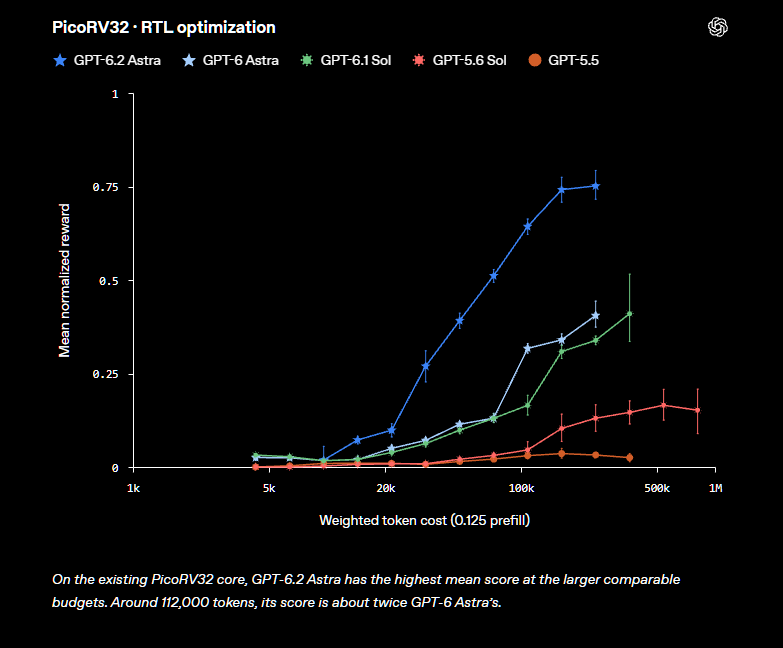
A fat zero was given if the chips didn't work or used more than 16x the previous area, and 1.0 was given for the best designs under the test constraints. The test also didn't tell the models which workloads the chips were going to be used for. As expected, GPT-6.2 Astra had by far the best showing, on both axes: both the lowest overall cost and the highest optimization score.
A second test also revealed an interesting but unsurprising fact: the models provided better results when essentially redesigning the chips according to their initial specifications, rather than optimizing existing code.
There's no word on whether the scientists used unmodified versions of GPT to perform this work. Task-specific high-end LLMs exist for those who can afford them, and OpenAI itself says it's working with Synopsys to train GPT-Synopsis, a model for using chip design tools.
正文保留英文原文,标题与摘要由机器翻译。
原文发布于 Tom's Hardware(OpenAI helped AMD improve its upcoming flagship GPU design by 14% PPA — GPT models also helped Lisa Su's outfit boost its new CPUs),标题、摘要与正文由机器翻译,术语按行业惯例统一,未经人工逐句校订。