2026年11月Top500榜单新增系统寥寥无几
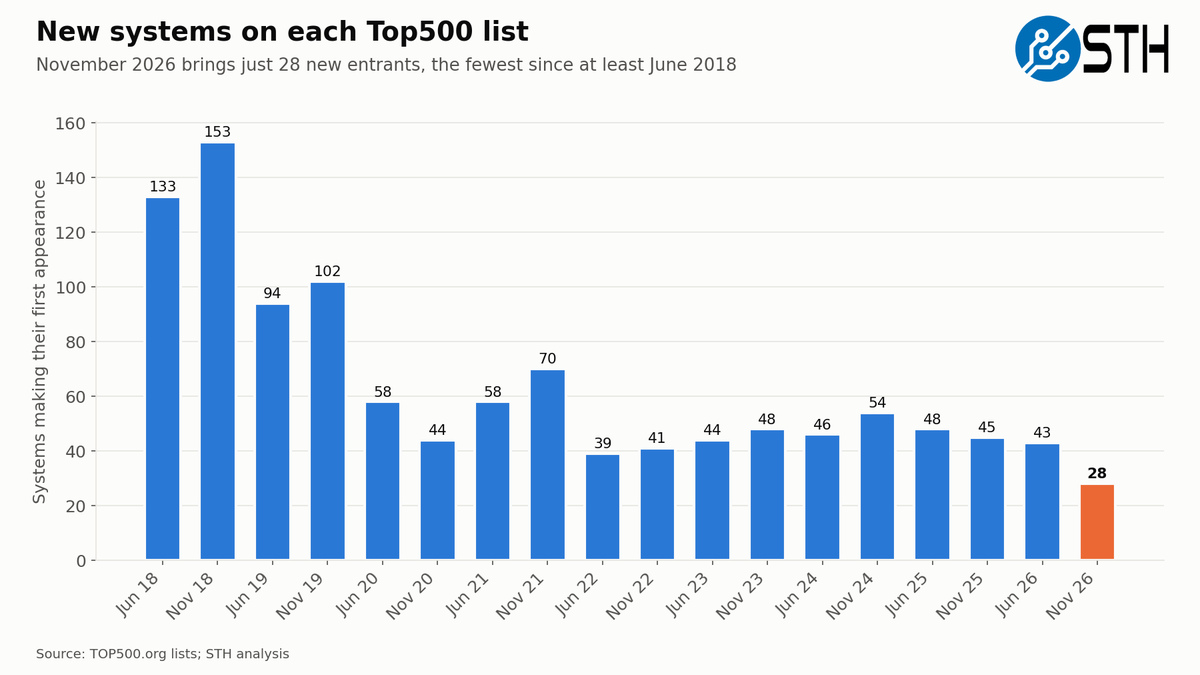
2026年11月的TOP500榜单仅有28台新系统,是我们可追溯至2018年6月的追踪系列中的最低数量。与前几期相比,这一急剧放缓标志着榜单以新硬件进行更替的频率发生了显著转变。
新系统数量创该系列新低
先做一点说明:Top500官方文章称有27台新系统,但我们按First Appearance 68(68即2026年11月的榜单)筛选榜单时,得到的是28台新系统。我们的分析将采用这些新系统。2026年11月榜单上的这28台新系统,是我们系列中自2018年6月以来的最低数量,低于2026年6月的43台。此前的低点是2022年6月的39台,2024年11月虽回升至54台,但本期是一次明显的回落。
2026年11月Top500各期榜单新系统数量
2018年6月的榜单有133台新系统,2018年11月有153台。每期榜单有约四分之一或更多系统被更替的日子早已一去不返。如今的28台新系统仅占整个Top500的5.6%。
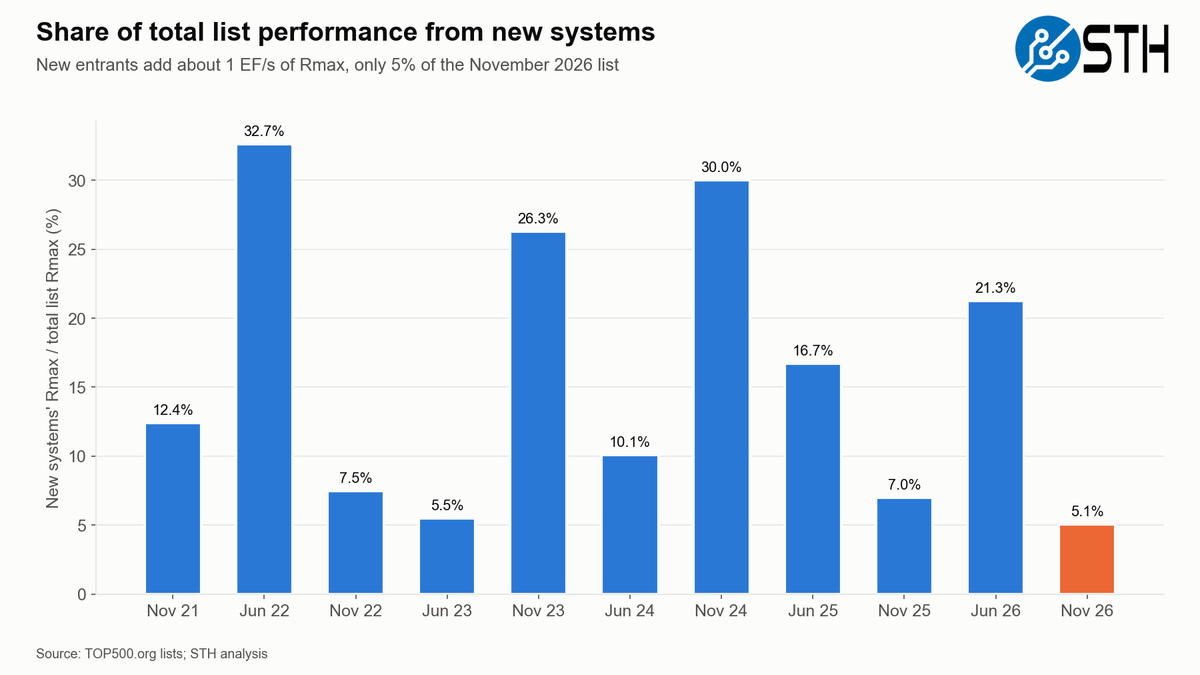
这28台新系统合计贡献约1.0 EF/s的Rmax,约占榜单总性能的5.1%。这是至少自2021年11月以来最低的占比,当时新系统贡献超过12%。此前的低点是2023年6月的5.48%,因此这延续了一种模式:即便是那些确实被提交的系统,其合计新增的HPL算力也十分有限。部分原因是LineShine已于2026年6月被加入榜单,因此近期新出现的第1名往往会拉低总体新增数据。
2026年11月Top500新系统Rmax占比
只有五套新系统进入 Top 100。排名最高的新面孔是 KISTI 的 HANGANG,位列第 12,这是一套 HPE Cray EX254n 系统,采用 NVIDIA Grace CPU 和 GH200 Superchip,并配备 HPE 的 Slingshot 400 互连。没有新系统进入 Top 10。LineShine 仍位居第 1,保持了其在 2026 年 6 月榜单上的位置——当时它凭借基于 Arm 定制的 LX2 处理器,以 2.198 EF/s 的 HPL 性能首次登榜。
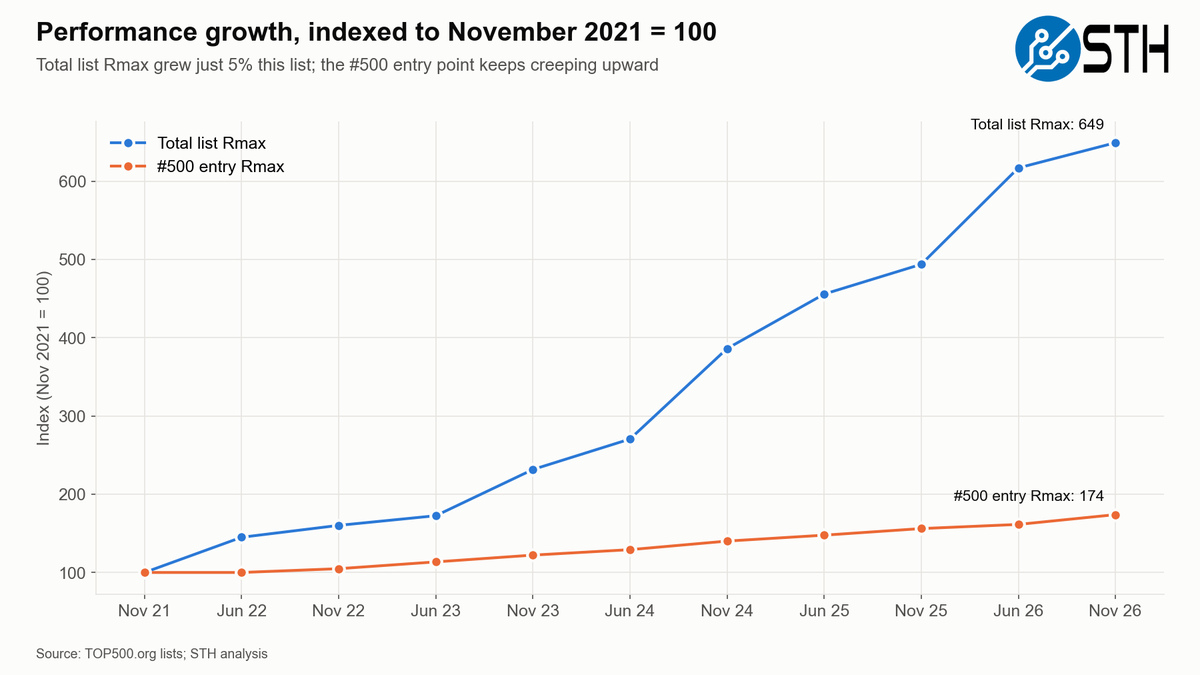
由于新系统数量如此之少,且新入榜系统性能平平,榜单的总 Rmax 从 2026 年 6 月的约 18.7 EF/s 增长到如今的约 19.7 EF/s。相比之下,上一期榜单的增长接近 25%,主要受 LineShine 首次登榜推动。
2026 年 11 月 Top500 性能增长(指数化)
第 500 名的入围门槛从 2026 年 6 月的约 2.66 PF/s 升至如今的约 2.87 PF/s,增幅约 8%。作为参照,2021 年 11 月的门槛仅为 1.65 PF/s,因此进入该榜单的门槛一直相对较低。仅从 CPU 角度看,当时最先进的是 64 核 AMD EPYC 7003 “Milan” CPU。如今,我们已有 256 核的 AMD EPYC 9006 “Venice” CPU。CPU 性能提升了四倍以上(因为每核性能更高),但“入围”性能数值仅增长了约 74%。
榜单正迅速老化
仅有 28 套新系统替换了 28 套掉出榜单的系统,如今榜单上系统的平均上榜时长约为 3.2 年。这是我们统计窗口内的最高值,高于 2021 年 11 月的约 2.2 年,也高于近在 2026 年 6 月的约 3.0 年。
2026 年 11 月 Top500 系统平均年龄
本次跌出榜单的系统,截至当前榜单日期计算,平均已在榜约5.4年。就上榜时长而言,这已是相当长的时间,也凸显出这些离榜集群此前地位之稳固。
本次跌出榜单的系统与新增系统形成鲜明对比。在跌出榜单的28套系统中,有24套是纯CPU系统,其中大多数使用约2017—2019年的Intel Skylake或Cascade Lake处理器。在离榜系统中,有17套属于产业界类别,17套由Lenovo构建,14套位于中国。
2026年11月 Top500 新上榜与跌出系统
相比之下,28套新上榜系统中有23套采用GPU或其他加速器加速。这种更替不仅缓慢,也正从老旧的纯CPU商业集群转向更新的GPU加速研究与学术系统。
中国与产业界提交量已崩塌
中国服务提供商的提交和商业产业界集群作为新上榜来源几乎已消失。中国上榜系统从2021年11月榜单的173套降至如今的仅18套。中国仍凭借LineShine保持第1名,但除此之外,中国已基本停止大规模提交。本期中国仅新增一套系统:CTyun HPC – shanghai15,这是eSurfing Cloud的参评系统,采用MetaX C588加速器和China Telecom C86 CPU。
2026年11月 Top500 中国与产业界系统
产业界类别已从2021年11月的258套降至如今的146套,而28套新系统中仅有2套被归类为产业界。其余为12套研究类、12套学术类和2套政府类。
这与我们在 2023 年 6 月分析中提出的主题相同。感觉 Top500 的提交并不构成对所有 HPC 或 AI 部署的普查,而过去常出现在榜单上的商用系统如今基本已不再现身。
谁建造了新系统
HPE 在本期榜单中领先,拥有 8 套新系统,且新增 Rmax 遥遥领先,约为 615 PF/s。这一总量主要由两套系统贡献:排名第 12、342.6 PF/s 的 HANGANG,以及排名第 14、220.79 PF/s 的 ORNL 的 Lux——后者是一套采用 AMD EPYC 9575F、搭载 Instinct MI355X 加速器的系统。
2026 年 11 月 Top500 新系统(按集成商划分)
Lenovo 有 6 套新系统,MEGWARE 有 4 套,Dell 和 Fujitsu 各有 3 套。值得注意的是,Fujitsu 的三套上榜系统均为基于 Supermicro 的平台,包括 RIKEN 采用 GB200 Superchip 的 RIKYU 系统,以及名古屋大学的 Flow 2.0 子系统。
从地域来看,欧洲以 11 套新系统领先,其次是亚洲的 9 套和北美的 8 套。德国新增 6 套新系统,几乎与美国新增的 7 套持平。
2026 年 11 月 Top500 新系统(按国家/地区划分)
韩国共有 3 套新系统,分别来自 HANGANG 及其在 KISTI 的配套 CPU 系统,以及 Elice Inc. 一套搭载 B200 加速器的 Dell PowerEdge XE9680L。日本同样新增 3 套。
CPU:Grace 与 Intel 持平,AMD 领跑 x86
在 28 套新系统中,AMD 以 13 套领先,NVIDIA Grace 和 Intel 各占 7 套。其余系统使用中国电信 C86 处理器。
五套全新的纯 CPU 系统全部基于 AMD,其中四套采用 Turin Dense(Zen 5c)芯片:KISTI 的 HANGANG-CPU、Navy DSRC 的 Manta CPU、名古屋的 Flow 2.0 Type I 子系统,以及 TU Darmstadt 的 Lichtenberg NHR-1 CPU。第五套是 ERDC 的 Barfoot,采用 Genoa。
2026 年 11 月 Top500 新系统按 CPU 代际划分
七套新的 Intel 系统全部是 GPU 主机:六套使用 Emerald Rapids,一套使用 Granite Rapids。这份榜单上完全没有新的 Intel 纯 CPU 系统,对于一家历史上长期主导 Top500 的厂商而言,这是一个显著转变。或许更能说明问题的是,在最新一代(Venice/Vera 之前)中,Intel 只有一套 Granite Rapids CPU 系统,而 AMD 的 Turin 有 11 套系统。
在整个榜单中,Intel 的份额已降至 50.2%,低于 2021 年 11 月的 82%。AMD 占 39.8%,NVIDIA Grace 目前为 6.4% 的系统提供动力,共有 32 个条目。
2026 年 11 月 Top500 CPU 厂商份额
NVIDIA Grace 是新增系统中最常见的 CPU,出现 7 次,全部担任 GPU 主机角色。其次是 AMD EPYC 9655,有 3 套系统,之后是若干各占 2 套的 SKU,包括 EPYC 9965、EPYC 9654、Xeon Platinum 8568Y+ 和 Xeon Platinum 8570。
2026年11月 Top500 新系统按 CPU SKU 划分
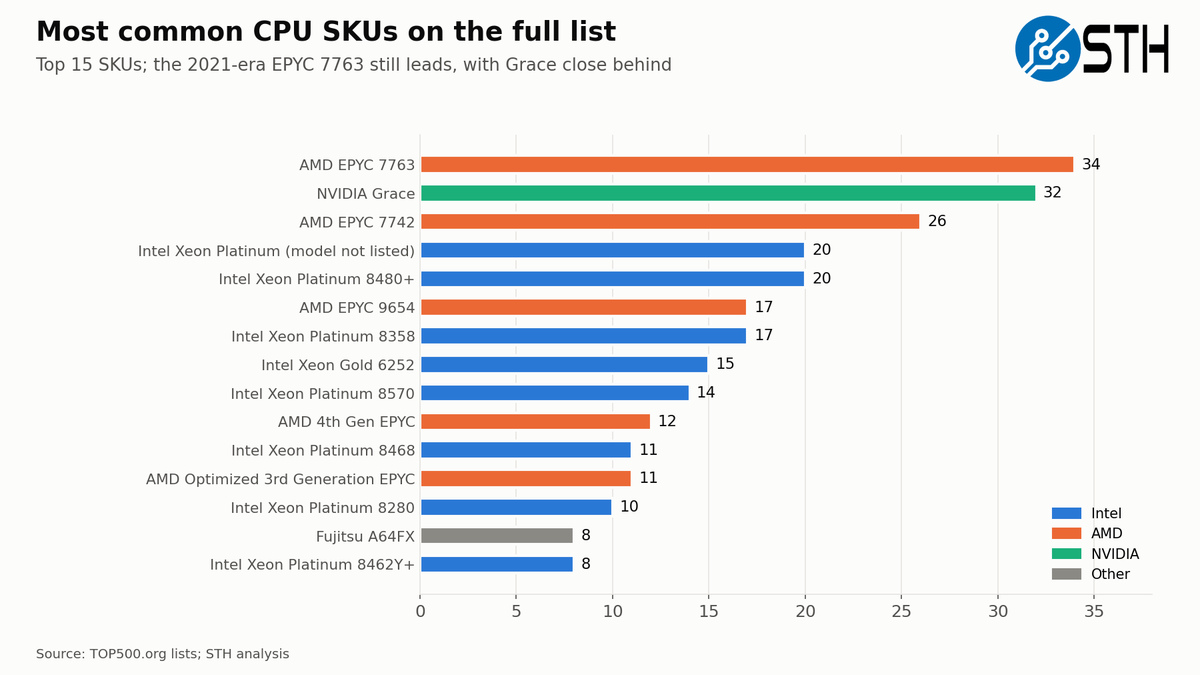
这 28 个新系统总共使用了 16 种不同的 CPU SKU。然而在完整榜单上,情况却大不相同。2021 年发布的 AMD EPYC 7763 仍是最常见的 SKU,共有 34 个系统采用,NVIDIA Grace 紧随其后,为 32 个。
2026年11月 Top500 完整榜单中排名靠前的 CPU SKU
EPYC 7742 有 26 个系统采用,Xeon Platinum 8480+ 有 20 个。这些大约来自 2019 至 2023 年的较老型号在这份榜单上仍占有相当比重,尽管在最新新增的系统里,更新的 SKU 占据主导。
按角色划分的核心数
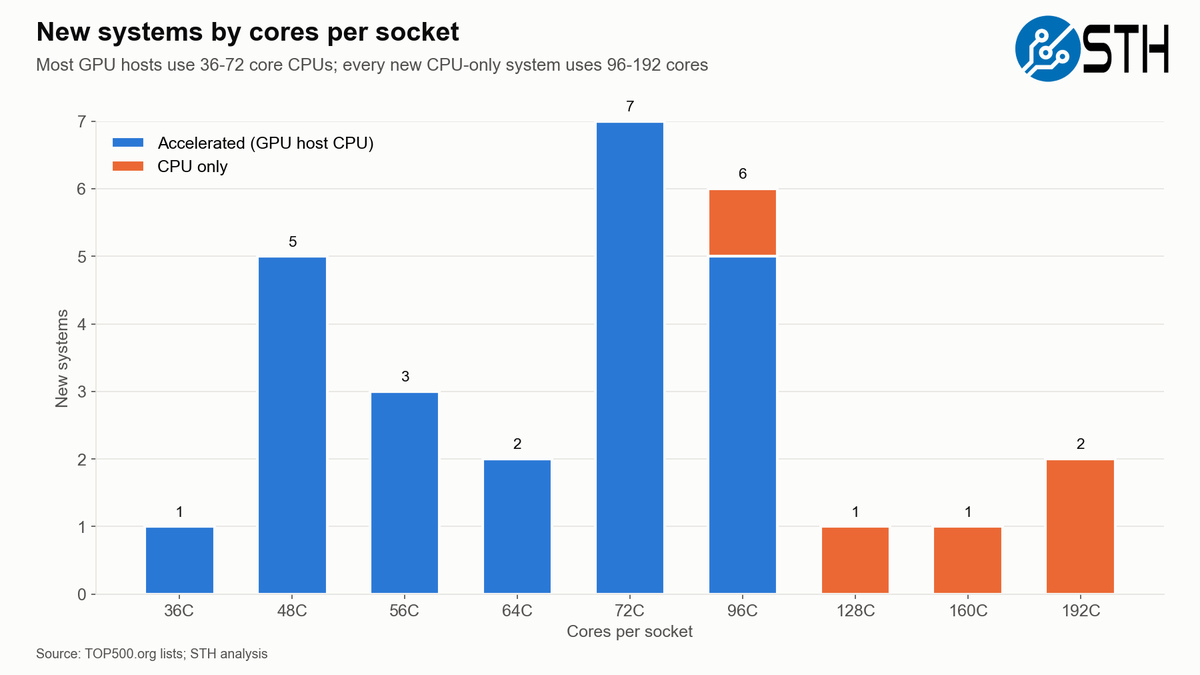
大多数作为 GPU 主机的 CPU 每插槽核心数在 36 到 72 之间。Grace 为 72 核,Emerald Rapids 主机通常运行 48 至 56 核,另有五套 GPU 系统采用 96 核的 EPYC 型号。
2026年11月 Top500 新系统按每插槽核心数划分
所有新的纯 CPU 系统都采用了每颗 96 至 192 核的型号。这包括 Barfoot 中的 96 核 EPYC 9654、HANGANG-CPU 中的 128 核 EPYC 9745、Manta CPU 中的 160 核 EPYC 9845,以及两套采用 192 核 EPYC 9965 的系统。
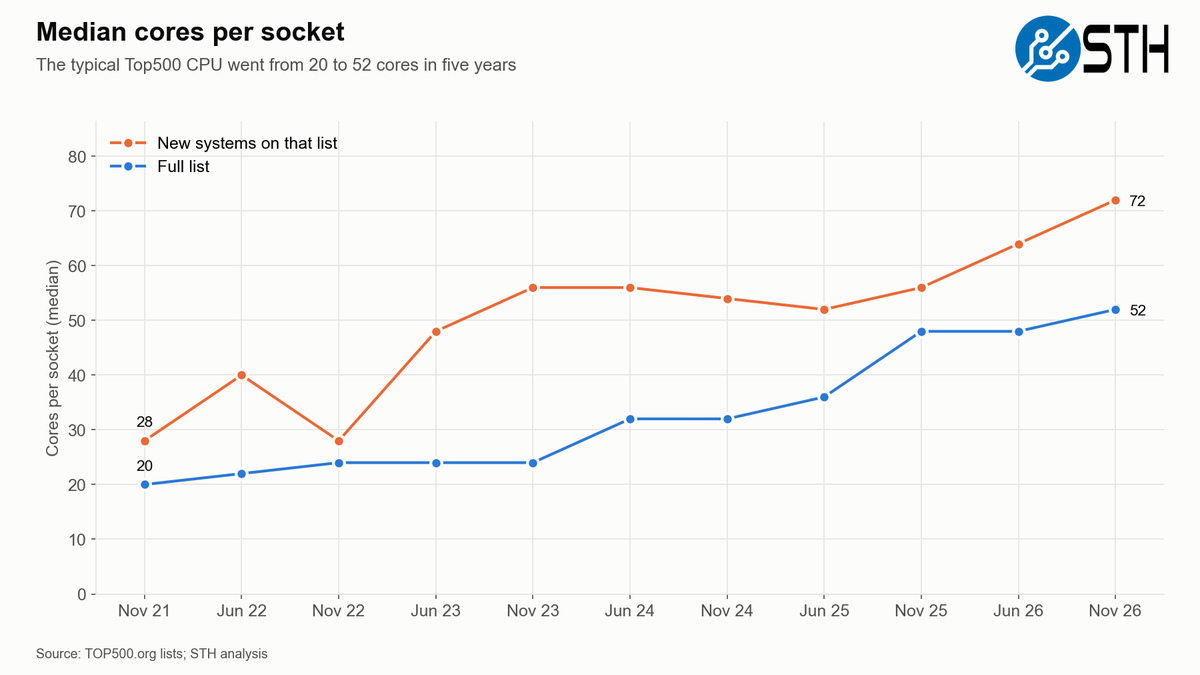
新增系统的每插槽核心数中位数为 72,而完整榜单的中位数为 52。五年前,完整榜单的中位数仅为每插槽 20 核。
2026 年 11 月 TOP500 每插槽核心数中位数
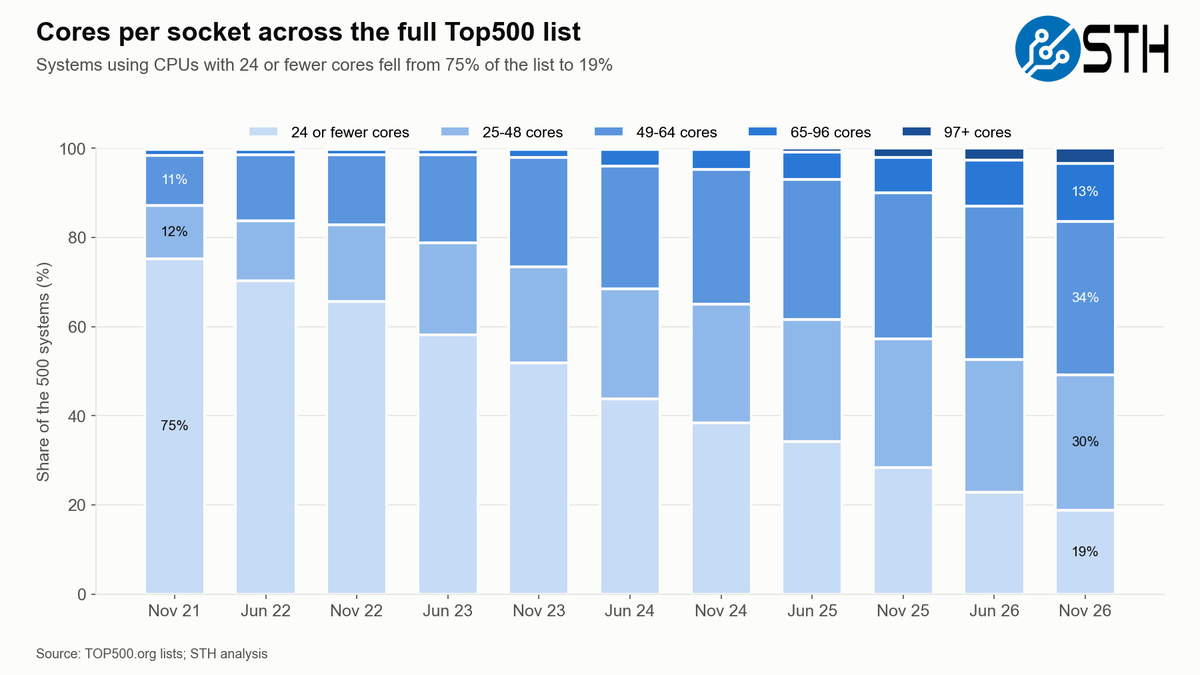
使用 24 核及以下 CPU 的系统,已从 2021 年 11 月占榜单的 75% 降至如今的仅 19%。28 个新入榜系统均未采用这类低核心数处理器,这表明 TOP500 上出现的 CPU 构成正在发生明显转变。
2026 年 11 月 TOP500 每插槽核心数构成(完整榜单)
向更高核心数的转变,反映出新系统设计中一道清晰的分野。GPU 主机通常采用中等核心数的 CPU,而纯 CPU 系统则利用高密度 EPYC 处理器,以最大化每插槽的计算吞吐。
原文较长,译文为节选;译文由英文原文机器翻译,术语按行业惯例统一,可在文末展开原文核对。
查看英文原文(November 2026 Top500 New Systems Are Few and Far Between)
The November 2026 TOP500 list has only 28 new systems, the lowest count in our tracking series going back to June 2018. This dramatic slowdown from previous editions marks a significant shift in how often the list turns over with fresh hardware.
New System Counts Hit a Series Low
Just as a quick note, the official Top500 post says there were 27 new systems, but when we filtered the list on First Appearance 68 (with 68 being the November 2026 list), we got 28 new systems. We will use these new systems for our analysis. The 28 new systems on this November 2026 list mark the lowest count in our series since June 2018, dropping from 43 in June 2026. The previous low was 39 in June 2022, and while November 2024 rebounded to 54, this edition represents a clear step down.
November 2026 Top500 New Systems per List
The June 2018 list had 133 new systems, and November 2018 had 153. Those days of roughly a quarter or more of the list turning over with each publication are long gone. Today’s 28 newcomers represent 5.6% of the full Top500.
The 28 new systems together contribute about 1.0 EF/s of Rmax, or roughly 5.1% of the list’s total performance. That is the lowest share since at least November 2021, when new systems contributed over 12%. The prior low was 5.48% in June 2023, so this continues a pattern in which even the systems that do get submitted add little aggregate HPL capability. Part of that is because LineShine was added to the list in June 2026, so a recent new #1 tends to SKU the aggregate addition numbers.
 November 2026 Top500 New System Rmax Share
Only five new systems made the Top 100. The highest-ranked newcomer is KISTI’s HANGANG at #12, an HPE Cray EX254n system using NVIDIA Grace CPUs and GH200 Superchips with HPE’s Slingshot 400 interconnect. No new systems made the Top 10. LineShine remains at #1, holding its position from the June 2026 list where it debuted with 2.198 EF/s of HPL performance using custom Arm-based LX2 processors.
With so few new systems and modest newcomer performance, total list Rmax grew from roughly 18.7 EF/s in June 2026 to approximately 19.7 EF/s now. That compares with nearly 25% growth on the previous list, which was driven largely by LineShine’s debut.
 November 2026 Top500 Performance Growth Indexed
The #500 entry point rose from about 2.66 PF/s in June 2026 to roughly 2.87 PF/s now, an increase of around 8%. For context, the November 2021 threshold was just 1.65 PF/s, so the bar has been relatively low to enter the list. Just on a CPU basis, that was when a 64-core AMD EPYC 7003 “Milan” CPU was state of the art. Now, we have 256-core AMD EPYC 9006 “Venice” CPUs. CPU performance has gone up by more than a factor of four (since we get more performance per core), but we have only seen a roughly 74% increase in the “get-in” performance number.
The List Is Aging Rapidly
With only 28 new systems replacing 28 that fell off, the average system on the list has now been there for approximately 3.2 years. That is the highest in our tracking window, up from about 2.2 years in November 2021 and roughly 3.0 years as recently as June 2026.
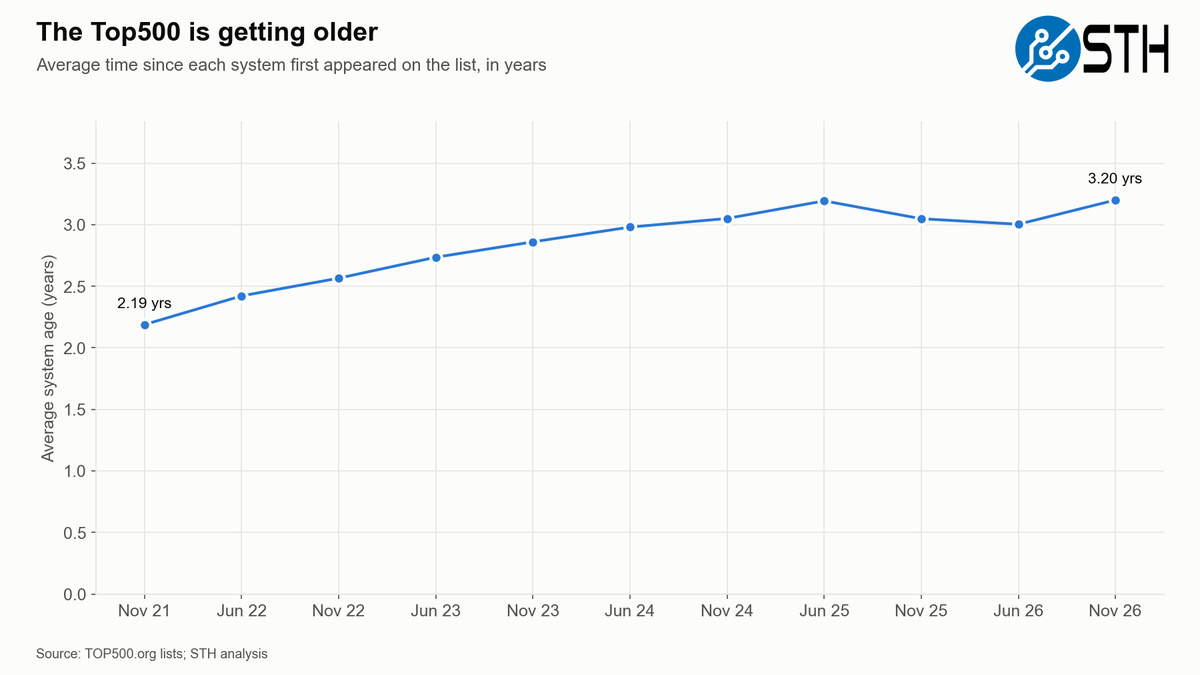 November 2026 Top500 Average System Age
The systems that dropped off this list had been on it for an average of about 5.4 years, measured as of the current list date. That is a long tenure in terms of list appearances, and it highlights how established these departing clusters were.
There is a stark contrast between what fell off this list and what came on. Of the 28 systems that dropped, 24 were CPU-only, with most using Intel Skylake or Cascade Lake processors from roughly 2017-2019. Seventeen of the departed systems were in the Industry segment, 17 were built by Lenovo, and 14 were located in China.
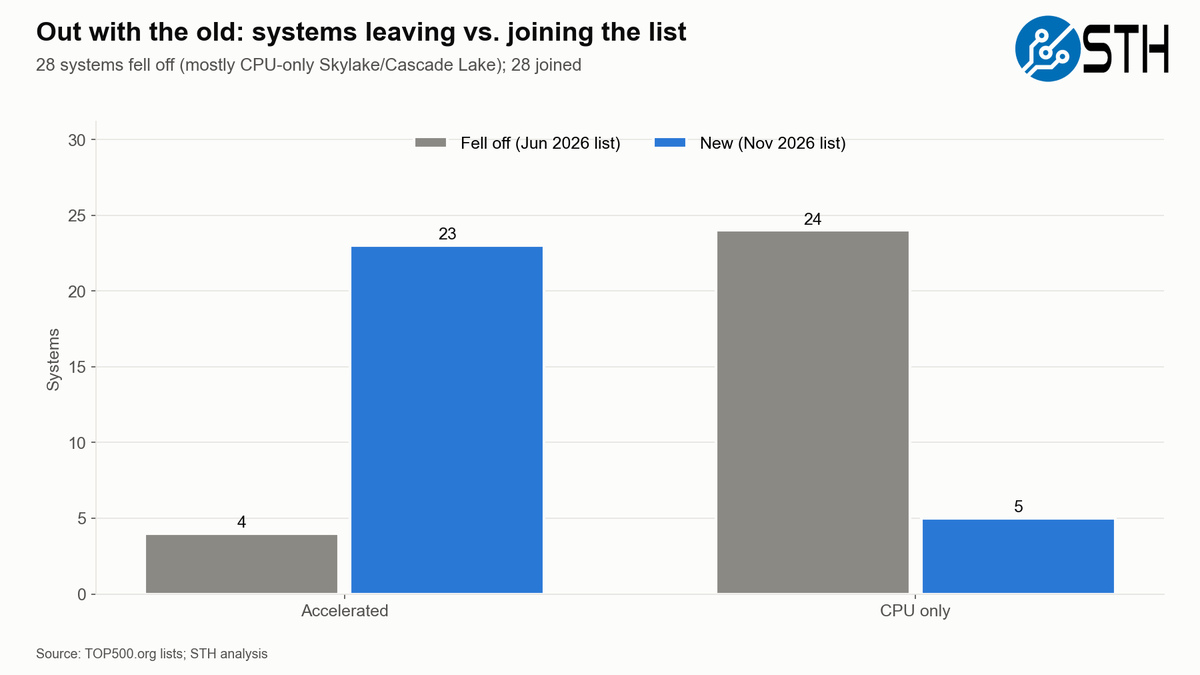 November 2026 Top500 New vs Dropped Systems
By contrast, 23 of the 28 new systems are GPU- or other accelerator-accelerated. The churn is slow as well as turning over from old CPU-only commercial clusters to newer GPU-accelerated research and academic systems.
China and Industry Submissions Have Collapsed
Chinese service-provider submissions and commercial Industry clusters have nearly disappeared as sources of new entries. Systems in China fell from 173 on the November 2021 list to just 18 now. China still holds #1 with LineShine, but it has otherwise largely stopped submitting at volume. The country added only one new system this edition: CTyun HPC – shanghai15, an eSurfing Cloud entry using a MetaX C588 accelerator and China Telecom C86 CPUs.
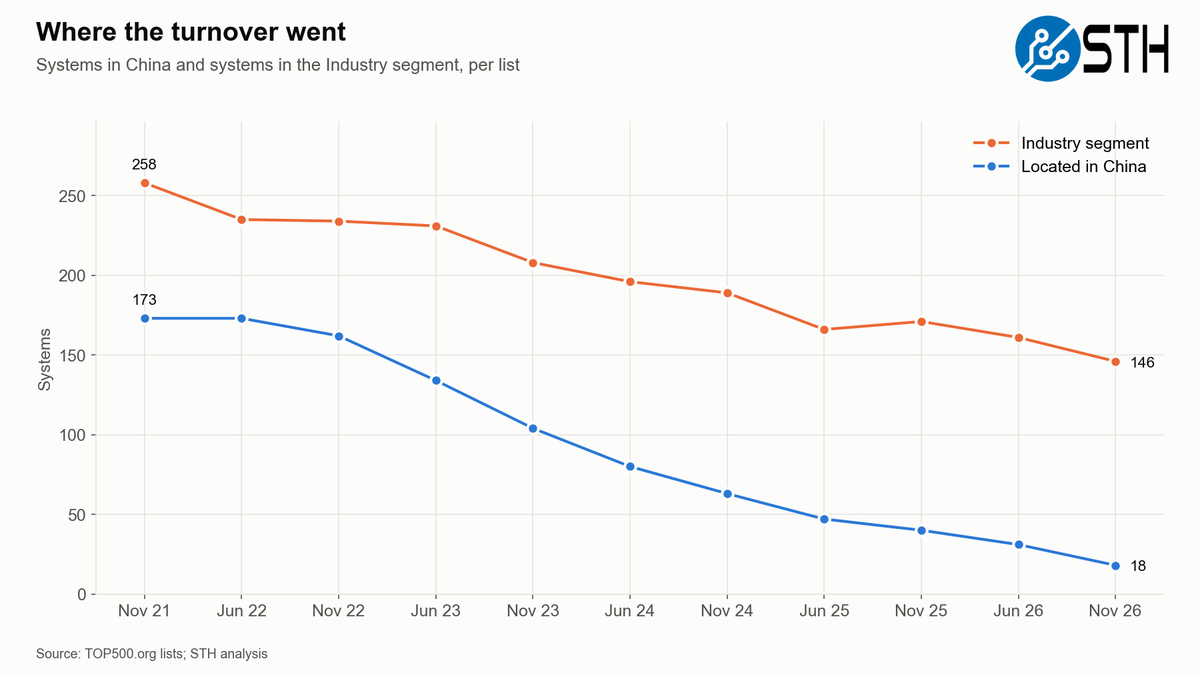 November 2026 Top500 China and Industry Systems
The Industry segment has fallen from 258 systems in November 2021 to 146 now, and only two of the 28 new systems are classified as Industry. The rest break down as 12 Research, 12 Academic, and 2 Government.
This is the same theme we raised in our June 2023 analysis. It feels like the Top500 submissions are not a census of all HPC or AI deployments, and the commercial systems that used to populate the list have largely stopped appearing.
Who Built the New Systems
HPE leads this edition with 8 new systems and by far the most new Rmax at roughly 615 PF/s. That total is dominated by HANGANG at #12 with 342.6 PF/s and ORNL’s Lux at #14 with 220.79 PF/s, an AMD EPYC 9575F system using Instinct MI355X accelerators.
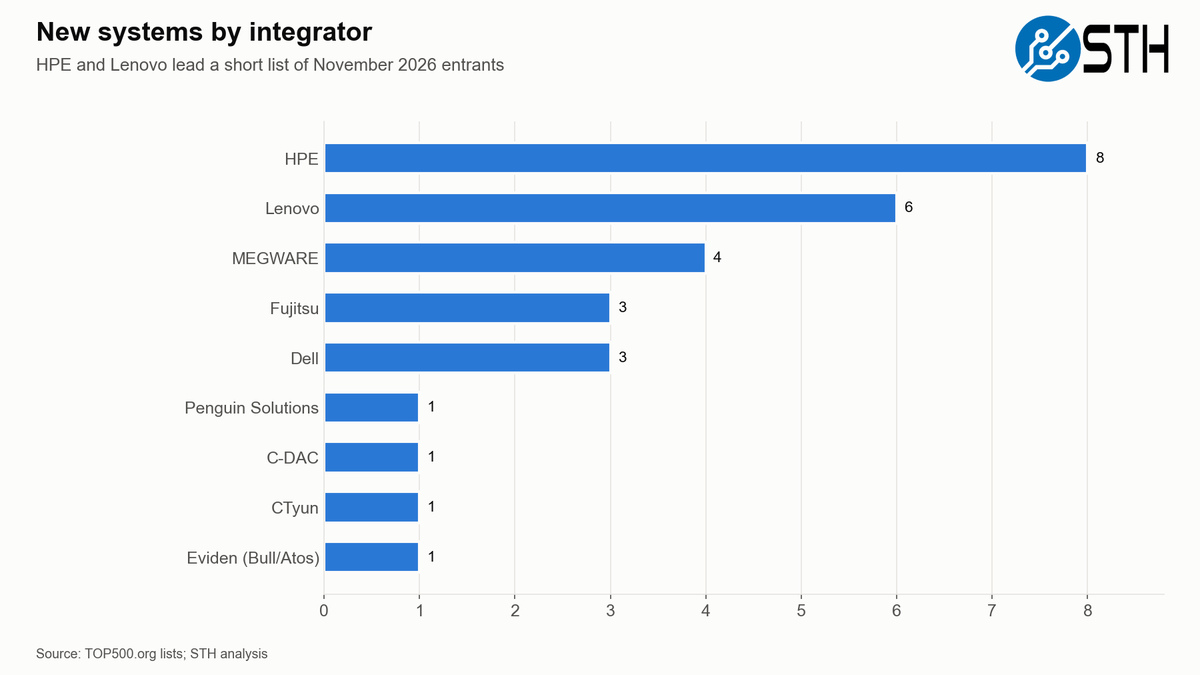 November 2026 Top500 New Systems by Integrator
Lenovo has 6 new systems, MEGWARE has 4, and Dell and Fujitsu each have 3. Notably, all three of Fujitsu’s entries are Supermicro-based platforms, including the RIKYU system at RIKEN using GB200 Superchips and Nagoya University’s Flow 2.0 subsystems.
By geography, Europe leads with 11 new systems, followed by Asia with 9 and North America with 8. Germany added 6 new systems, nearly matching the United States’ 7.
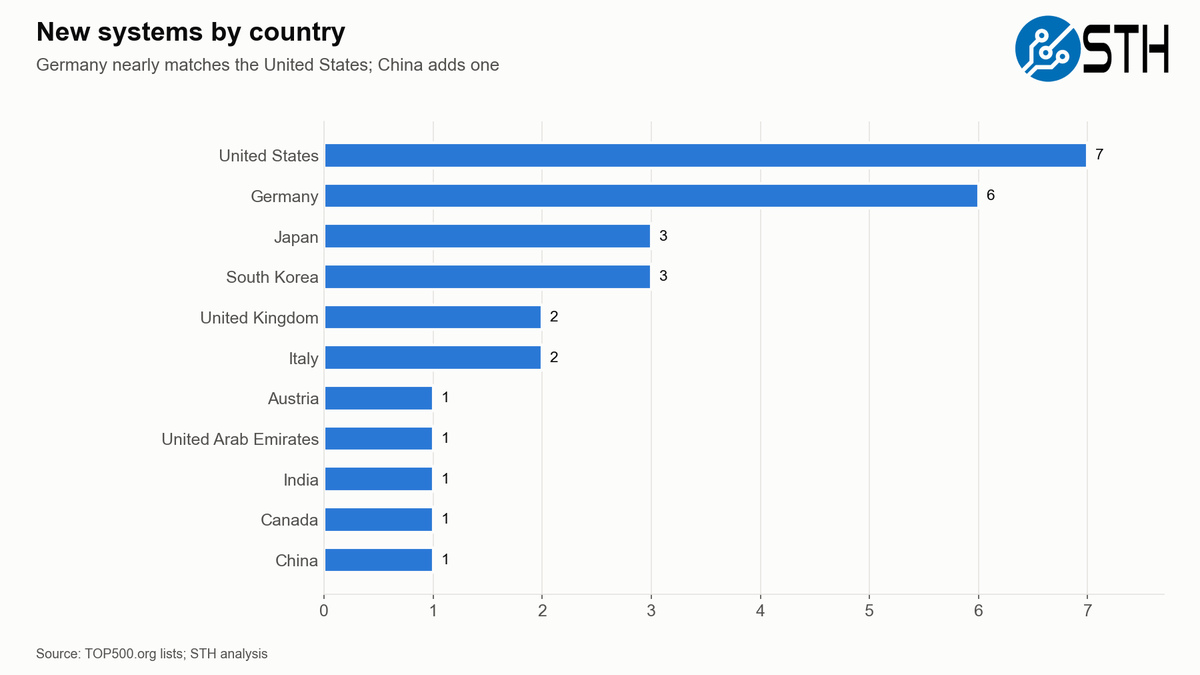 November 2026 Top500 New Systems by Country
South Korea has 3 new systems thanks to HANGANG and its CPU companion system at KISTI, plus a Dell PowerEdge XE9680L with B200 accelerators at Elice Inc. Japan also added 3.
CPUs: Grace Ties Intel as AMD Leads x86
Among the 28 new systems, AMD leads with 13, while NVIDIA Grace and Intel each account for 7. The remaining system uses a China Telecom C86 processor.
All five of the new CPU-only systems are AMD-based, and four of them use Turin Dense (Zen 5c) parts: HANGANG-CPU at KISTI, Manta CPU at Navy DSRC, Nagoya’s Flow 2.0 Type I subsystem, and Lichtenberg NHR-1 CPU at TU Darmstadt. The fifth, ERDC’s Barfoot, uses Genoa.
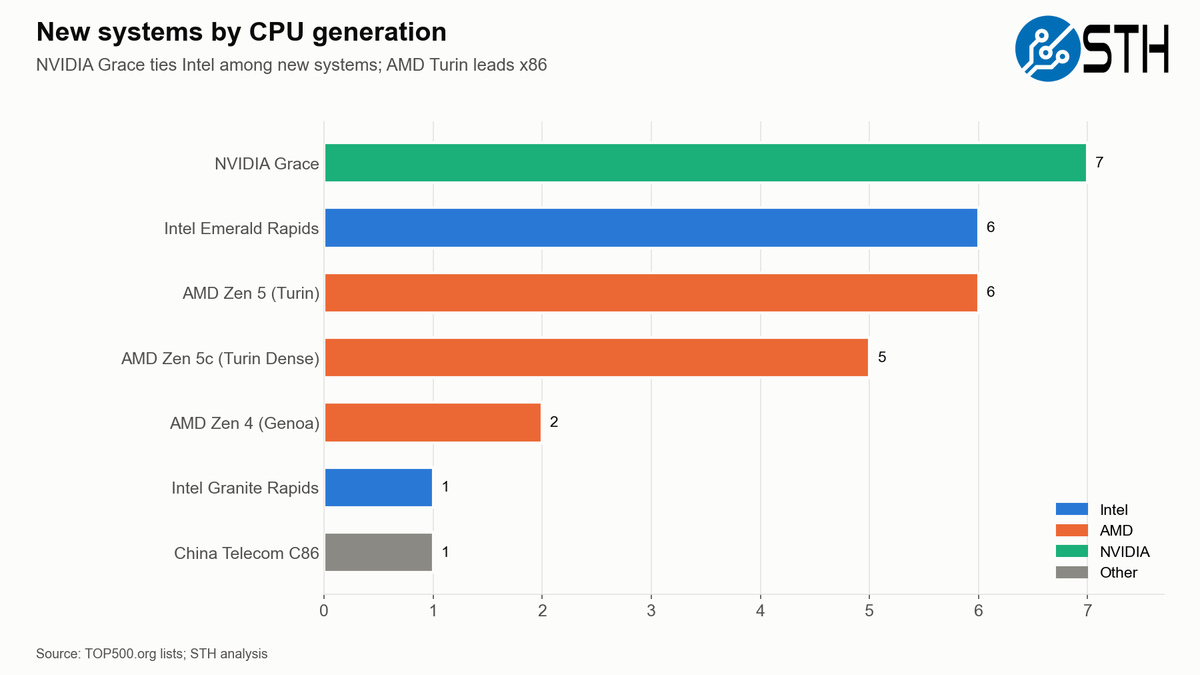 November 2026 Top500 New Systems by CPU Generation
All seven new Intel systems are GPU hosts. Six use Emerald Rapids and one uses Granite Rapids. There are no new Intel CPU-only systems on this list at all, which is a notable shift for a vendor that has historically dominated the Top500. Maybe more telling is that in the latest (pre-Venice/Vera) generation, Intel has only one Granite Rapids CPU system, while AMD’s Turin has 11 systems.
Across the full list, Intel’s share has fallen to 50.2%, down from 82% in November 2021. AMD sits at 39.8%, and NVIDIA Grace now powers 6.4% of systems with 32 entries.
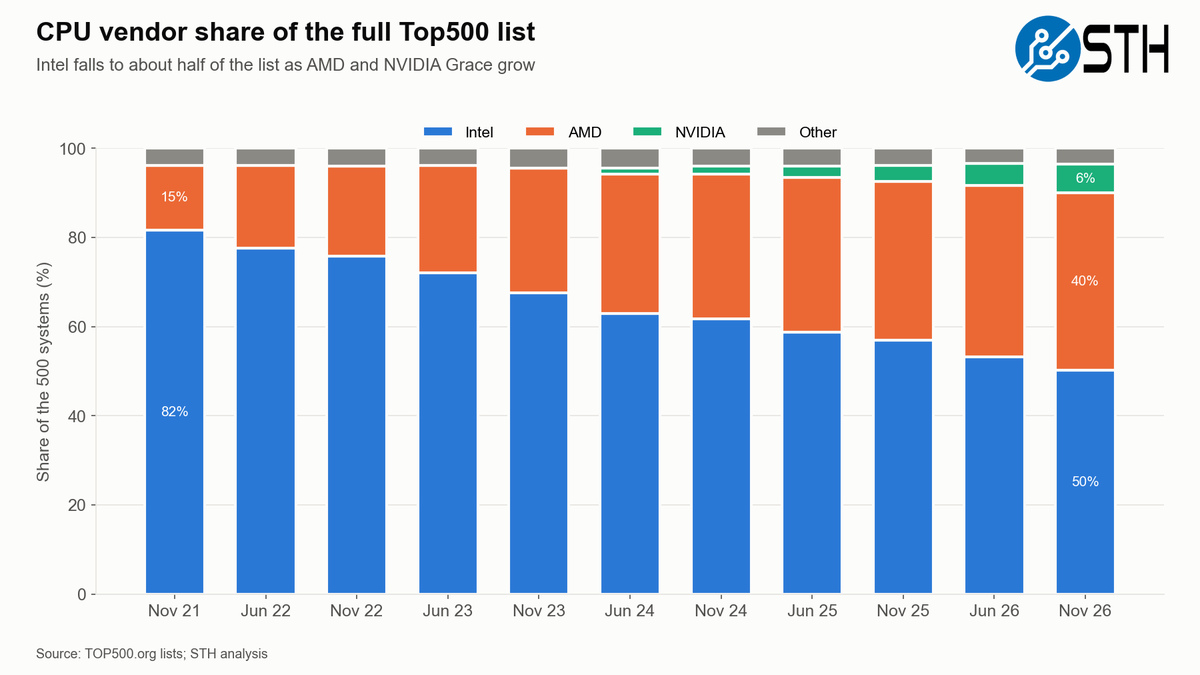 November 2026 Top500 CPU Vendor Share
NVIDIA Grace is the most common CPU among new systems with 7 appearances, all in GPU-host roles. Next comes the AMD EPYC 9655 with 3 systems, followed by several SKUs at 2 each, including the EPYC 9965, EPYC 9654, Xeon Platinum 8568Y+, and Xeon Platinum 8570.
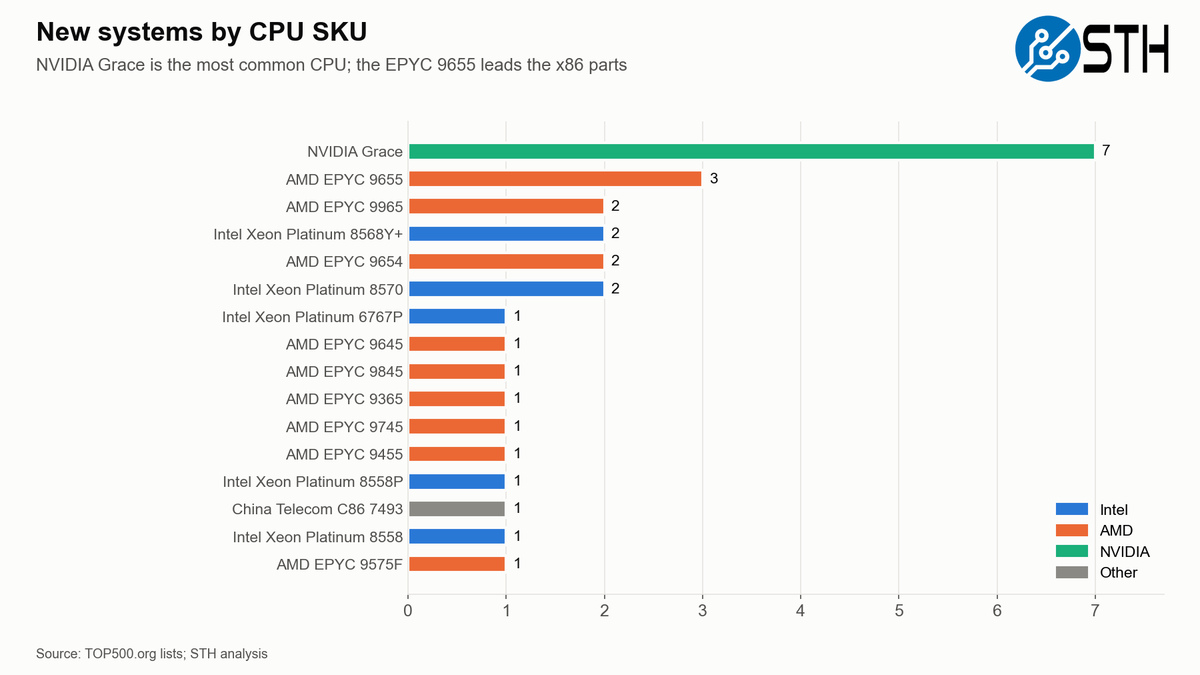 November 2026 Top500 New Systems by CPU SKU
The 28 new systems use 16 different CPU SKUs total. On the full list, however, the story is very different. The AMD EPYC 7763 from 2021 remains the most common SKU with 34 systems, and NVIDIA Grace is close behind at 32.
 November 2026 Top500 Top CPU SKUs Full List
The EPYC 7742 has 26 systems, and the Xeon Platinum 8480+ has 20. These older models from roughly 2019-2023 still hold significant presence on this list, even as newer SKUs dominate among the latest additions.
Core Counts Split by Role
Most GPU-host CPUs have between 36 and 72 cores per socket. Grace has 72, Emerald Rapids hosts typically run 48-56 cores, and five GPU systems use 96-core EPYC parts.
 November 2026 Top500 New Systems by Cores per Socket
Every new CPU-only system uses a part with between 96 and 192 cores. That includes the 96-core EPYC 9654 in Barfoot, the 128-core EPYC 9745 in HANGANG-CPU, the 160-core EPYC 9845 in Manta CPU, and two systems using the 192-core EPYC 9965.
The median new system has 72 cores per socket versus 52 for the full list. Five years ago, the full-list median was just 20 cores per socket.
 November 2026 Top500 Median Cores per Socket
Systems using CPUs with 24 or fewer cores have fallen from 75% of the list in November 2021 to just 19% now. None of the 28 new entries use such low-core-count processors, indicating a distinct shift in the CPU mix appearing on the TOP500.
 November 2026 Top500 Cores per Socket Mix Full List
The shift toward higher core counts reflects a clear division in new system design. GPU hosts typically use moderate-core CPUs, while CPU-only systems leverage high-density EPYC parts to maximize compute throughput per socket.
Accelerators: NVIDIA Blackwell Arrives, but Hopper Is Still the Installed Base
Fourteen of the 28 new systems use NVIDIA Blackwell accelerators, split between 12 with B200 and 2 with GB200 Superchips. Hopper accounts for another 6 systems across H200, GH200, and one remaining H100.
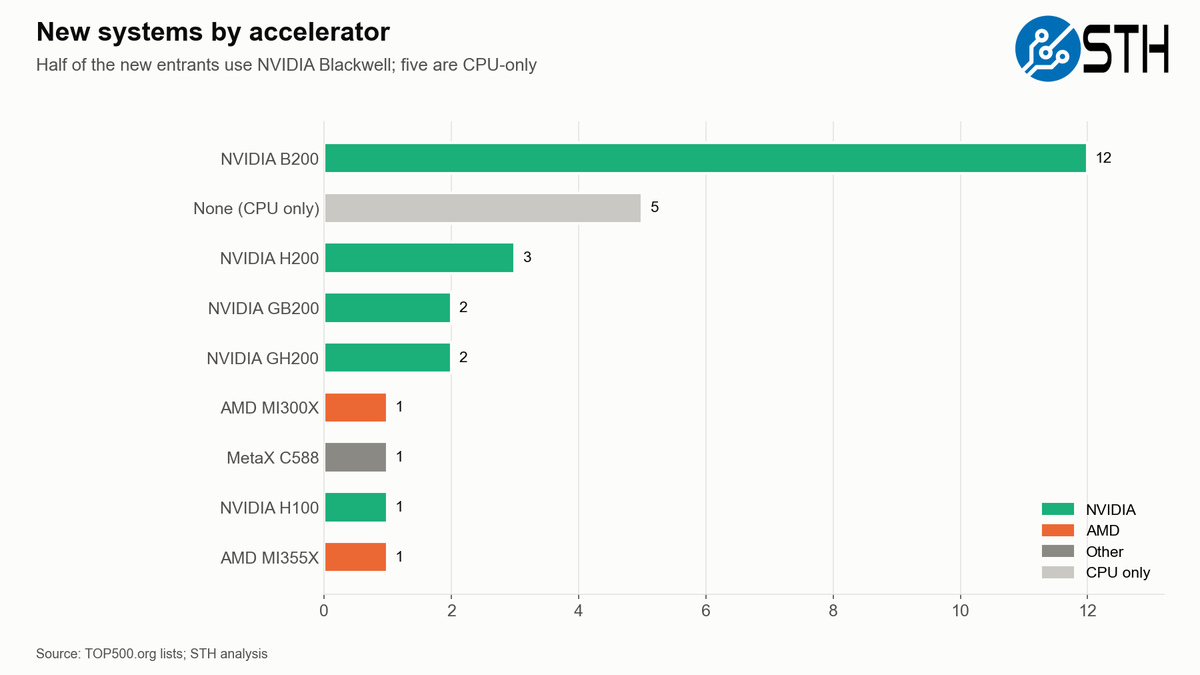 November 2026 Top500 New Systems by Accelerator
AMD has two new accelerated systems: ORNL’s Lux on MI355X at #14 with 220.8 PF/s, and C-DAC’s PARAM KAVERI in India using MI300X. MetaX has one entry with its C588 accelerator in the CTyun system.
Across the full list, accelerated systems now represent 58.6% of systems and 78.8% of Rmax. That compares with just 30% of systems being accelerated back in November 2021.
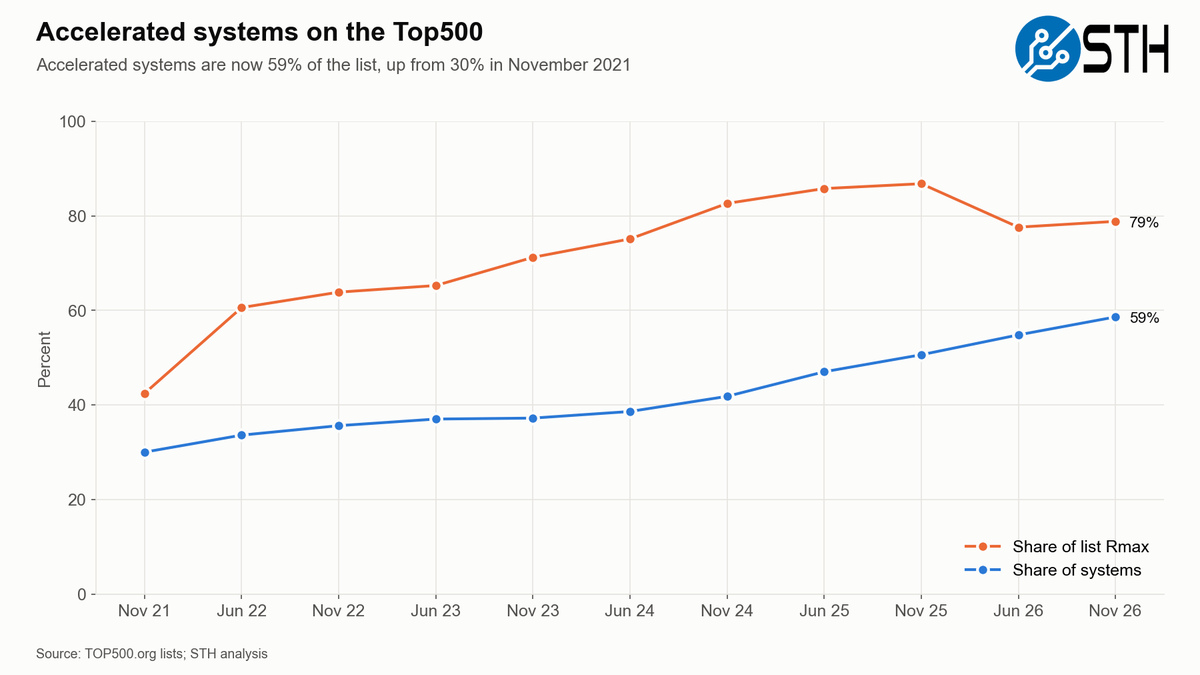 November 2026 Top500 Accelerated Share
Blackwell systems nearly doubled from 18 to 32 since the June 2026 list, while Hopper reached 137 systems. In terms of system count, AMD Instinct across all generations is still roughly at Blackwell’s level.
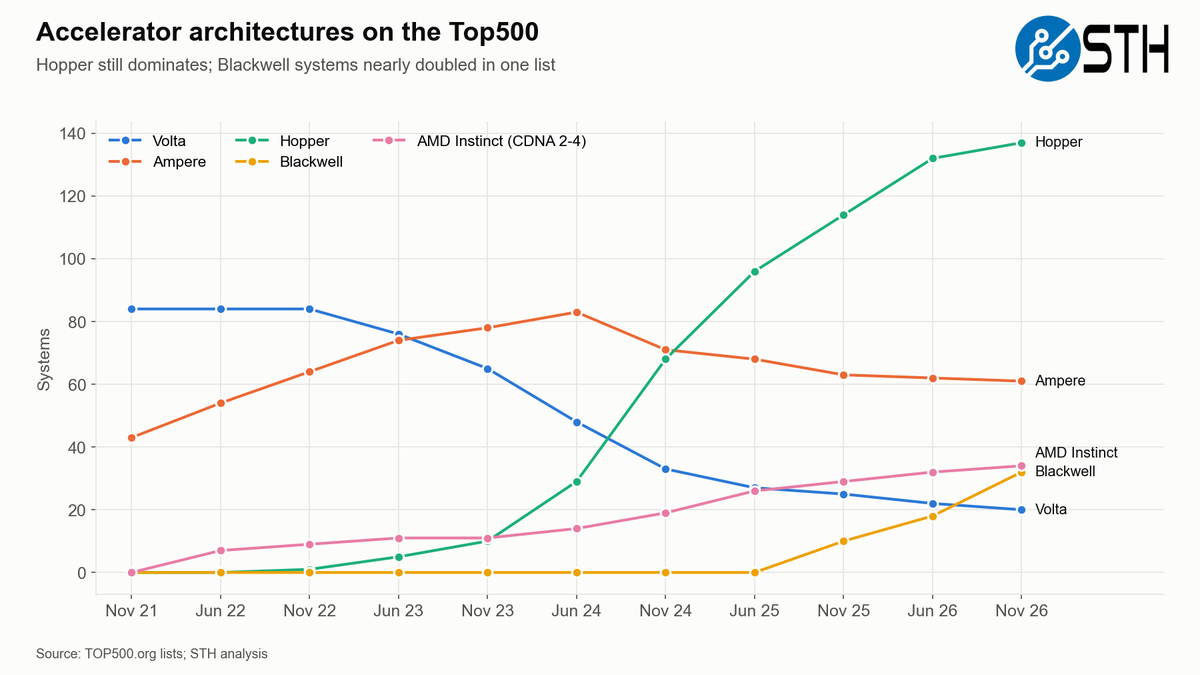 November 2026 Top500 Accelerator Architectures
The installed base story matters here. Even though Blackwell dominates new submissions, the full list still has more Hopper systems than anything else, and 61 Ampere-generation systems from the A100 era remain on the list.
Interconnect: InfiniBand Keeps Taking Share
Among new systems, 19 of 28 use InfiniBand. That breaks down as 14 with NDR, 2 with XDR, 2 with HDR, and one unspecified generation. Five new systems use HPE Slingshot, including the first Slingshot 400 systems on the list: HANGANG and its CPU companion at KISTI.
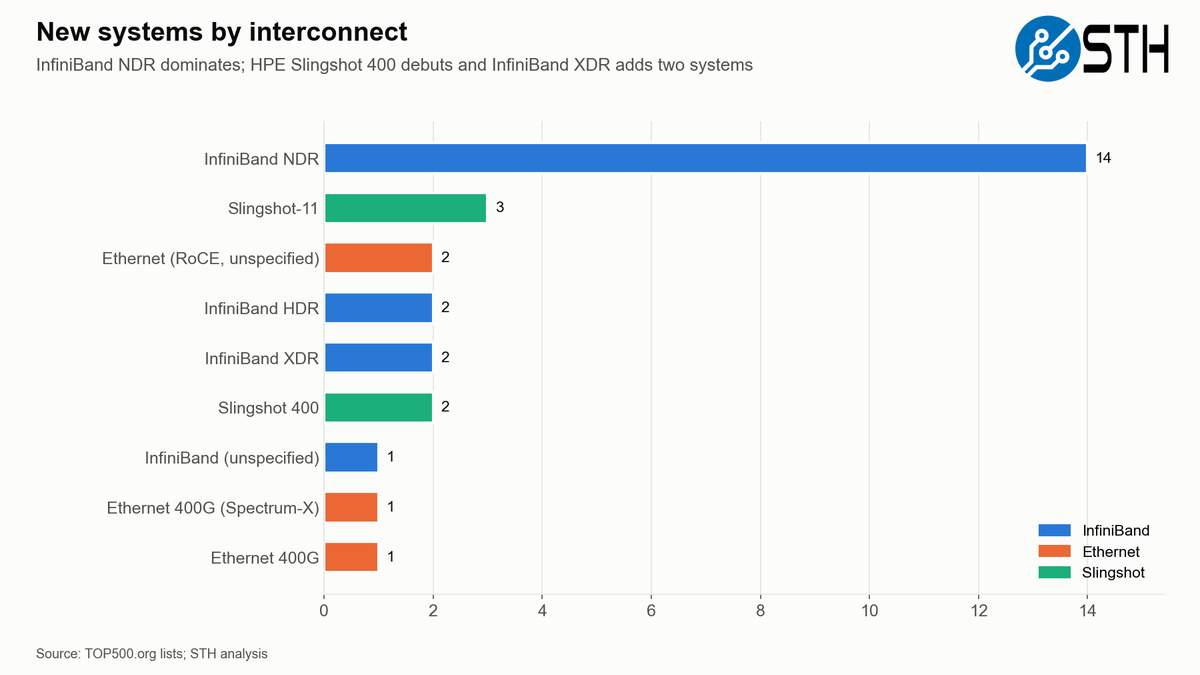 November 2026 Top500 New Systems by Interconnect
Four new systems use Ethernet. Two are RoCE-based, one uses NVIDIA Spectrum-X (the MEGARIDE system at CINECA), and ORNL’s Lux uses HPE Juniper with AMD Pensando 400G Ethernet.
Half of the new systems run 400Gb/s per port, and two run 800Gb/s XDR InfiniBand. These are nominal per-port line rates rather than achieved throughput, but they show where high-end cluster networking is heading.
Across the full list, Ethernet has fallen from 45% of systems in November 2021 to just 18% now. The old 10/25/100GbE commercial clusters that drove those numbers have largely aged off the list. InfiniBand now sits at 60% and Slingshot at 15%.
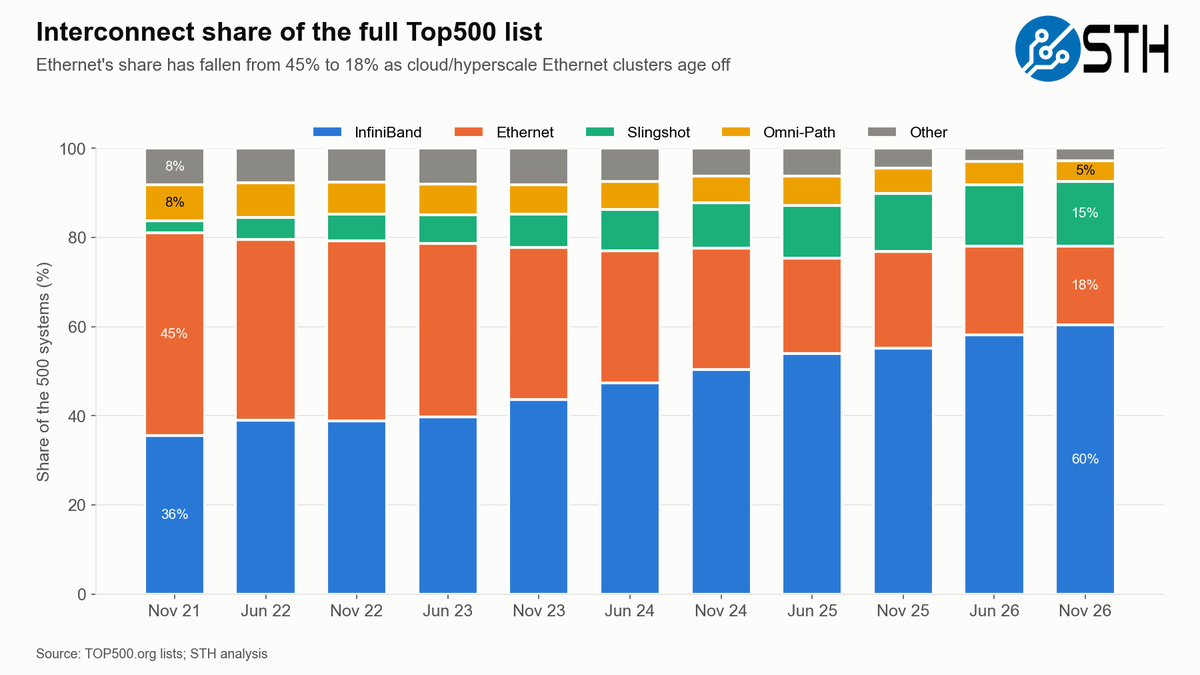 November 2026 Top500 Interconnect Share
InfiniBand leads new submissions with 19 of 28 systems, while Ethernet accounts for only 4. Across the full list, InfiniBand has grown to 302 systems versus 88 for Ethernet and 73 for Slingshot, showing a clear shift in the reported interconnect mix.
The November 2026 TOP500 shows a list with limited turnover, featuring only 28 new systems and roughly 5% performance growth. The average tenure of listed systems has approached 3.2 years, marking the slowest update rate in our tracking window. China’s presence dropped to 18 systems from 173 in November 2021, while the Industry segment fell to 146 from 258. Of the new entries, 23 are accelerators.
New hardware on the list highlights specific architectural trends: Blackwell accelerators appear in 14 systems, all CPU-only newcomers use AMD EPYC processors, and NVIDIA Grace matches Intel’s count among new entrants. The Top500 remains a useful gauge for tracking declared HPL system configurations and platform trends over time. However, it does not capture the full scope of current HPC and AI compute investments, which often prioritize different benchmarks or deployment models.
原文为英文,正文由自动抓取并保留原文。
原文发布于 ServeTheHome(November 2026 Top500 New Systems Are Few and Far Between),标题、摘要与正文由机器翻译,术语按行业惯例统一,未经人工逐句校订。