剑桥科学家造出 10 美元芯片,可把医学实验室戴在手腕上
来自研究机构
剑桥科学家打造出一款10美元芯片,可将医疗实验室装进你的手腕
日期:2026年10月22日 来源:剑桥大学 摘要:剑桥研究人员创造了一款突破性的10美元光学传感器,其精度可媲美实验室设备,而设备小到足以用于可穿戴技术。在测试中,它以100%的准确率识别了食物、塑料和药物,并展示了无需侵入性操作即可监测血糖、酒精和其他健康指标的能力。分享:
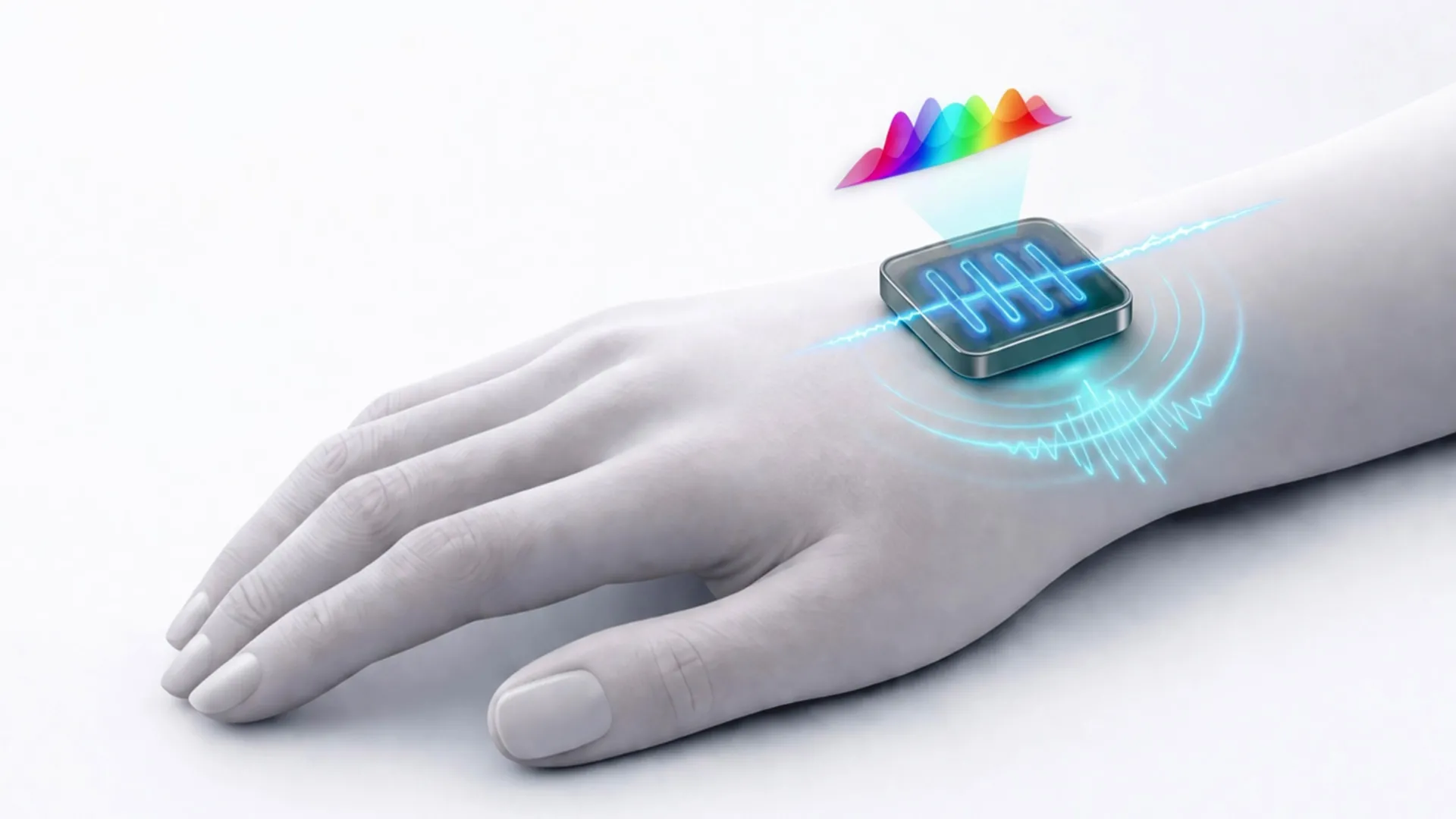
科学家发明了一款微小的10美元传感器,可将实验室级检测和无针血糖监测带入日常可穿戴设备。图片来源:剑桥大学,图像由 ChatGPT 生成
一款仅需10美元的新型光学传感器可为可穿戴健康监测器带来实验室级精度,有望让人们无需针刺即可追踪血糖。这项技术还可能改变食品检测、工业质量控制和环境监测。
剑桥大学和 GlitterinTech(由同一研究团队创立的一家初创公司)的研究人员开发了一种新型光学光谱仪,将卓越的精度与极小的尺寸和低成本结合在一起。该设备仅几厘米宽,可集成到便携式电子产品和可穿戴健康技术中。其潜在应用范围从实时监测重要健康指标,到识别材料以及检测化学成分变化。
光谱仪通过分析光来揭示与其相互作用物质的信息。它们是医学、制造业、化学检测和环境研究中不可或缺的工具。然而,传统上要让这类仪器变得更小,就意味着要牺牲其性能。紧凑型光谱仪的测量范围往往有限,分辨率降低,或精度偏低,因此更适合用于识别物质,而非执行精确测量。
研究人员认为,他们的新设计可以克服这些局限。这种被称为卷积光谱仪的设计利用一种名为卷积定理的数学原理,以一种根本不同的方式分析光。据该团队称,这种方法在多个关键方面都超越了现有类型的光谱仪,包括基于光色散、傅里叶变换和计算重建的设计。
以非凡精度分析光的新方法
传统光谱仪通常将入射光分解为其组成波长,或使用复杂计算来重建其光谱。新设备则采用另一种方法,直接对入射光执行一种名为卷积的数学运算。
为实现这一点,研究人员将具有重复光谱响应的光学元件按一定顺序排列。这些元件可以包括非平衡马赫-曾德尔干涉仪或微环谐振器。通过让它们按彼此的比例进行调整,系统能够以可控的线性方式将其响应平移到不同波长。随后使用快速傅里叶变换来准确恢复光谱。
“关键洞见在于回到数学本身,追问是否存在一种从根本上更简洁的光谱获取方式,”该研究的共同第一作者 Chunhui Yao 博士说。“通过直接在光学域中运用卷积定理,我们避开了许多长期制约微型光谱仪发展的限制。这让我们在紧凑、低成本的系统中同时实现了高精度、强噪声容限和极低的计算开销。”
研究人员采用氮化硅光子平台构建了这台光谱仪,并将其与板载电子器件集成。它可在近红外波段的宽波长范围(1200-1700 nm)内工作,并能在不到一秒内完成测量数据的采集与处理。
另一个重要优势是,它无需大幅改动硬件就能扩展测量能力。由于该系统采用重复的光学图案,其光谱带宽在理论上几乎可以无限延伸。按顺序增加更多光学组件,还能让分辨率呈指数级提升。
一枚 10 美元的传感器,或将改变食品检测与医疗健康
为了在纯理论测量之外评估该器件,研究人员在多种材料和物质上对其进行了测试。结果表明,它有望应用于那些通常依赖更大、更昂贵实验室仪器的场景。
在用于识别塑料、药品、咖啡、面粉和茶叶时,该光谱仪在报告所述测试中实现了 100% 的分类成功率。它还能测量水基溶液和有机溶液中的浓度,准确度约为 0.01%,在这些实验中超过了商用台式光谱仪的表现。
医疗健康方面的演示尤为令人期待。在旨在模拟真实生理环境的条件下,该设备准确测量了多项人体生物标志物,包括皮肤水分、血液酒精、血乳酸和血糖。
研究人员还在一名参与者身上演示了长时间的无创血糖追踪。尽管在这项技术成为实用医疗产品之前还需要进一步测试,但这一发现提示了一条可能的路径:无需反复刺破皮肤即可监测血糖。
“这些生物医学演示尤其令人兴奋,”领导该项目的 Prof. Qixiang Cheng 表示。“这项工作的突出之处不仅在于实验室中的性能表现,还在于技术成熟度。Dr. Chunhui Yao 的贡献至关重要,他把一个数学概念转化为一套完整封装、稳健可靠的系统,能够在极端温度和真实世界条件下稳定运行。正是这种结合,为实际部署打开了大门。”
该传感器还展现出出色的抗温度变化能力。它能在 -20°C 至 80°C 之间持续可靠运行,对微型光谱仪而言,这是异常宽泛的温度范围。这种耐用性对可穿戴设备、工厂设备和户外运行的传感器来说可能尤其有价值。
为什么更简单的设计可能带来重大突破
这款新型光谱仪的优势不止于精度、尺寸和价格。其内部设计还降低了分析入射光所需的算力。
许多现有的微型光谱仪依赖复杂的校准流程和高要求的算法来重建光谱信息。当测量数据中含有噪声时,这些方法可能变得不可靠,而且它们往往需要大量的处理资源。
剑桥团队基于卷积的方法避免了其中大部分复杂性。由于测量结果遵循线性数学关系,该系统能够快速且稳定地重建光谱,同时只消耗相对较少的算力。
「这是一个绝佳的例子,说明优雅的工程如何释放真正的影响力,」参与光子系统设计与集成的 Richard Penty 教授说。「该架构简单、可扩展且可制造,却能提供可与大得多的仪器相媲美甚至更高的精度。Chunhui Yao 博士在将光子设计、系统集成与实验验证结合在一起、使这一切成为可能的过程中发挥了核心作用。」
其相对简单的结构也可能让这项技术更容易实现大规模制造,从而有望把精密光学测量带入那些传统光谱仪过于笨重或昂贵的设备中。
把实验室级测量带入日常设备
研究人员设想了一个未来:精准的光学传感成为日常技术的常规功能,而不再主要局限于专业实验室。
在工业场景中,廉价的光谱仪可以安装在制造设施各处,持续检查材料成分和产品质量。类似的传感器可以监测食品新鲜度、识别物质,并以远超当前可行规模的广度分析环境状况。
医疗健康领域可能也会出现同样重大的变化。紧凑型传感器最终或许能让可穿戴设备测量水合水平、检测酒精中毒迹象、追踪与体能相关的生物标志物,或者为管理糖尿病的人群持续监测血糖水平。
“我们的愿景是让光谱检测像温度或运动传感一样无处不在,”Qixiang Cheng 教授补充道。“这项工作表明,高质量的光谱信息不必局限于实验室——它可以直接嵌入人们日常使用的技术之中。”
原文较长,译文为节选;译文由英文原文机器翻译,术语按行业惯例统一,可在文末展开原文核对。
查看英文原文(Cambridge scientists create a $10 chip that could put a medical lab on your wrist)
Cambridge scientists create a $10 chip that could put a medical lab on your wrist | ScienceDaily
from research organizations
Cambridge scientists create a $10 chip that could put a medical lab on your wrist
Date:October 22, 2026Source:University of CambridgeSummary:Cambridge researchers have created a groundbreaking $10 optical sensor that delivers the precision of laboratory equipment in a device small enough for wearable technology. It identified foods, plastics, and medicines with 100% accuracy in tests and demonstrated the ability to monitor blood glucose, alcohol, and other health markers without invasive procedures.Share:
 Scientists have invented a tiny $10 sensor that could bring laboratory-grade testing and needle-free blood glucose monitoring to everyday wearable devices. Credit: University of Cambridge, image generated by ChatGPT
A new optical sensor costing just $10 could bring laboratory-level precision to wearable health monitors, potentially allowing people to track blood glucose without needles. The technology could also transform food testing, industrial quality control, and environmental monitoring.
Researchers at the University of Cambridge and GlitterinTech (a start-up founded by the same research group) have developed a new type of optical spectrometer that combines exceptional accuracy with a remarkably small size and low cost. Measuring just centimeters across, the device could be incorporated into portable electronics and wearable health technology. Its potential applications range from monitoring important health markers in real time to identifying materials and detecting changes in chemical composition.
Optical spectrometers work by analyzing light to reveal information about the substances it interacts with. They are essential tools in medicine, manufacturing, chemical testing, and environmental research. However, making these instruments smaller has traditionally meant compromising their performance. Compact spectrometers often have limited measurement ranges, reduced resolution, or lower accuracy, making them better suited to identifying substances than performing precise measurements.
The researchers believe their new design could overcome these limitations. Known as a convolutional spectrometer, it uses a mathematical principle called the convolution theorem to analyze light in a fundamentally different way. According to the team, this approach delivers performance that surpasses existing types of spectrometers in several key areas, including designs based on light dispersion, Fourier transforms, and computational reconstruction.
A New Way to Analyze Light With Extraordinary Precision
Traditional spectrometers generally separate incoming light into its component wavelengths or use complex calculations to reconstruct its spectrum. The new device takes another approach by performing a mathematical operation called convolution directly on the incoming light.
To accomplish this, the researchers arranged optical components with repeating spectral responses in a sequence. These components can include unbalanced Mach-Zehnder interferometers or micro-ring resonators. By adjusting them in proportion to one another, the system can shift its response to different wavelengths in a controlled, linear fashion. Fast Fourier transforms are then used to accurately recover the light spectrum.
"The key insight was to go back to the mathematics and ask whether there was a fundamentally cleaner way to retrieve spectra," said Dr. Chunhui Yao, a lead author of the study. "By using the convolution theorem directly in the optical domain, we avoid many of the limitations that have held miniaturized spectrometers back. This gives us high precision, strong noise tolerance, and very low computational overhead, all in a compact and low-cost system."
The researchers built the spectrometer using a silicon nitride photonic platform and integrated it with onboard electronics. It operates across a broad range of near-infrared wavelengths (1200-1700 nm) and can collect and process measurements in less than a second.
Another important advantage is its ability to expand its measurement capabilities without major hardware changes. Because the system uses repeating optical patterns, its spectral bandwidth can theoretically be extended almost without limit. Adding more optical components in sequence can also increase its resolution exponentially.
A $10 Sensor That Could Transform Food Testing and Healthcare
To evaluate the device outside purely theoretical measurements, the researchers tested it on a variety of materials and substances. The results demonstrated its potential for applications that normally depend on larger, more expensive laboratory instruments.
When used to identify plastics, pharmaceuticals, coffee, flour, and tea, the spectrometer achieved a 100% classification success rate in the reported tests. It also measured concentrations in water-based and organic solutions with accuracies of approximately 0.01%, exceeding the performance of commercial benchtop spectrometers in those experiments.
The healthcare demonstrations were particularly promising. Under conditions designed to reflect real physiological environments, the device accurately measured several human biomarkers, including skin moisture, blood alcohol, blood lactate, and blood glucose.
The researchers also demonstrated noninvasive glucose tracking over an extended period in one participant. Although further testing would be needed before the technology could become a practical medical product, the finding suggests a possible route toward monitoring blood sugar without repeatedly piercing the skin.
"These biomedical demonstrations are particularly exciting," said Prof. Qixiang Cheng, who led the project. "What makes this work stand out is not just performance in the lab, but technical readiness. Dr. Chunhui Yao's contribution was crucial in translating a mathematical concept into a fully packaged, robust system that operates reliably across temperature extremes and real-world conditions. That combination is what opens the door to practical deployment."
The sensor also demonstrated impressive resistance to temperature changes. It continued operating reliably between -20°C and 80°C, an unusually wide temperature range for a miniature spectrometer. This durability could be especially valuable for wearable devices, factory equipment, and sensors operating outdoors.
Why a Simpler Design Could Be a Major Breakthrough
The new spectrometer's advantages extend beyond its accuracy, size, and price. Its internal design also reduces the amount of computing power needed to analyze incoming light.
Many existing miniature spectrometers depend on complicated calibration procedures and demanding algorithms to reconstruct spectral information. These methods can become unreliable when measurements contain noise, and they often require substantial processing resources.
The Cambridge team's convolution-based approach avoids much of this complexity. Because the measurements follow a linear mathematical relationship, the system can recover spectra rapidly and consistently while using relatively little computational power.
"This is a beautiful example of how elegant engineering can unlock real impact," said Prof. Richard Penty, who contributed to the photonic system design and integration. "The architecture is simple, scalable, and manufacturable, yet it delivers precision that rivals or exceeds much larger instruments. Dr. Chunhui Yao played a central role in bringing together the photonic design, system integration, and experimental validation that made this possible."
Its relatively simple construction could also make the technology easier to manufacture on a large scale, potentially bringing sophisticated optical measurements to devices where conventional spectrometers would be too bulky or expensive.
Bringing Laboratory-Grade Measurements to Everyday Devices
The researchers envision a future in which accurate optical sensing becomes a routine feature of everyday technology rather than something largely confined to specialized laboratories.
In industrial settings, inexpensive spectrometers could be installed throughout manufacturing facilities to continuously check material composition and product quality. Similar sensors could monitor food freshness, identify substances, and analyze environmental conditions on a much larger scale than is currently practical.
Healthcare could see equally significant changes. Compact sensors might eventually enable wearables to measure hydration levels, detect signs of alcohol intoxication, track biomarkers related to physical fitness, or continuously monitor glucose levels for people managing diabetes.
"Our vision is to make spectrometry as ubiquitous as temperature or motion sensing," added Prof. Qixiang Cheng. "This work shows that high-quality spectral information doesn't have to be confined to the laboratory -- it can be embedded directly into the technologies people use every day."
As photonic technology becomes smaller and more advanced, the convolutional spectrometer provides a promising example of how mathematical insights and practical engineering can make sophisticated scientific instruments simpler, cheaper, and more accessible. By combining high precision with a device that costs around $10, the researchers have opened a potential path toward a new generation of smart sensors capable of measuring the hidden chemistry of our bodies and surroundings.
Materials provided by University of Cambridge. Original written by Michael Shuff. Note: Content may be edited for style and length.
Chunhui Yao, Jie Ma, Ningning Wang, Peng Bao, Wei Zhuo, Tao Zhang, Wanlu Zhang, Kangning Xu, Ting Yan, Liang Ming, Yuxiao Ye, Tawfique Hasan, Ian White, Richard Penty, Qixiang Cheng. Optical convolutional spectrometer. Nature Photonics, 2026; 20 (6): 664 DOI: 10.1038/s41566-026-01891-6
University of Cambridge. "Cambridge scientists create a $10 chip that could put a medical lab on your wrist." ScienceDaily. ScienceDaily, 22 October 2026. .
University of Cambridge. (2026, October 22). Cambridge scientists create a $10 chip that could put a medical lab on your wrist. ScienceDaily. Retrieved November 5, 2026 from www.sciencedaily.com/releases/2026/10/261022081312.htm
University of Cambridge. "Cambridge scientists create a $10 chip that could put a medical lab on your wrist." ScienceDaily. www.sciencedaily.com/releases/2026/10/261022081312.htm (accessed November 5, 2026).
原文为英文,正文由自动抓取并保留原文。
原文发布于 ScienceDaily AI(Cambridge scientists create a $10 chip that could put a medical lab on your wrist),标题、摘要与正文由机器翻译,术语按行业惯例统一,未经人工逐句校订。