Stretto 用 Amazon Nova 2 Sonic 构建 AI 语音智能体
本文由来自 Stretto 的 Danya Gordin 和来自 CI&T 的 Marcelo Wzorek 共同撰写。
在 Stretto 构建 AI 语音智能体之前,在 Bankruptcy.com 网站上考虑申请破产的消费者需要填写一份包含几个字段的网页表单:债务金额、律师状态和联系信息。这些由表单生成的线索利润空间很薄。
网页表单线索与完全合格的线索之间的差距很大。破产律师更看重包含详细财务数据的线索:债务、资产、车辆、房产、工作经历以及以往的申请记录。本可以扩展网页表单来采集这些细节,但表单越长,中途放弃的访客就越多。电话访谈本可以自然地引出这些信息,因为人们在对话中更愿意分享财务方面的敏感细节,但组建并培训一支人工接洽团队来开展这些访谈,成本高得难以承受。
Stretto 看到了机会:用 AI 语音智能体取代网页表单,通过电话进行接洽访谈。该智能体将以对话方式引导来电者完成完整的破产问卷,并实时提取结构化数据。随后,它会依据律师设定的规则对线索进行分类,以支持律师的决策。
挑战在于找到一款语音 AI 解决方案,能够自然地处理敏感的财务对话,具备低延迟、干净利落的中断处理能力和情绪感知能力,同时成本还要让单位经济效益成立。
在本文中,我们将介绍 Stretto 如何与 AWS Generative AI Innovation Center 及 CI&T(AWS 合作伙伴)合作,打造 Tara——一款由 Amazon Nova 2 Sonic 驱动的 AI 语音智能体,该模型是 Amazon Bedrock 中的语音到语音模型。Tara 负责执行多阶段的破产咨询接案访谈,并依据律师定义的规则对线索进行分筛。我们将介绍其架构、从验证到生产部署的分阶段构建过程,以及团队如何针对敏感对话测试语音质量。
Tara 是一款 AI 语音智能体,通过电话进行破产咨询接案访谈。当来电者拨打 Bankruptcy.com 的号码时,Tara 会接听、自我介绍,并引导来电者完成一段结构化的对话。她会收集个人信息、财务细节、资产清单和就业经历,同时根据来电者的情绪状态调整语气。通话结束时,Stretto 的系统会应用律师定义的规则,将该线索归类为合格、不合格或需要更多信息(供律师审核)。
该方案基于 Amazon Nova 2 Sonic 构建,这是一个可通过 Amazon Bedrock 使用的语音到语音基础模型(FM)。它在单一模型中原生处理语音输入并生成语音输出,而不是串联独立的语音转文本、语言模型和文本转语音组件。这种架构旨在降低延迟并产生更自然的对话,这两点对于破产受理通话的敏感性都至关重要。基于 Amazon Bedrock 构建,让团队可以通过一个托管服务同时使用 Amazon Nova 2 Sonic 和 Anthropic 的 Claude,无需运行任何模型基础设施。它还为这一处理敏感财务数据的工作负载带来了 AWS 的安全与治理控制。对这两个模型的访问由 AWS Identity and Access Management(IAM)进行管控。发往 Amazon Bedrock 的流量通过虚拟私有云(VPC)终端节点(AWS PrivateLink)保持在 AWS 网络内。Amazon Bedrock 不会使用提示词或模型输出来训练模型(详情请参阅 Data protection in Amazon Bedrock)。由于这些模型与语音桥接、数据库和 Amazon CloudWatch 监控运行在同一 AWS 环境中,团队可以用一套工具来保障并运营整个方案。Amazon Nova 2 Sonic 和 Amazon Bedrock 并非在所有 AWS 区域都可用。有关当前的区域可用性,请参阅 Amazon Bedrock 支持的区域。
团队基于三个原因选择了 Amazon Nova 2 Sonic,而非此前的语音方案:
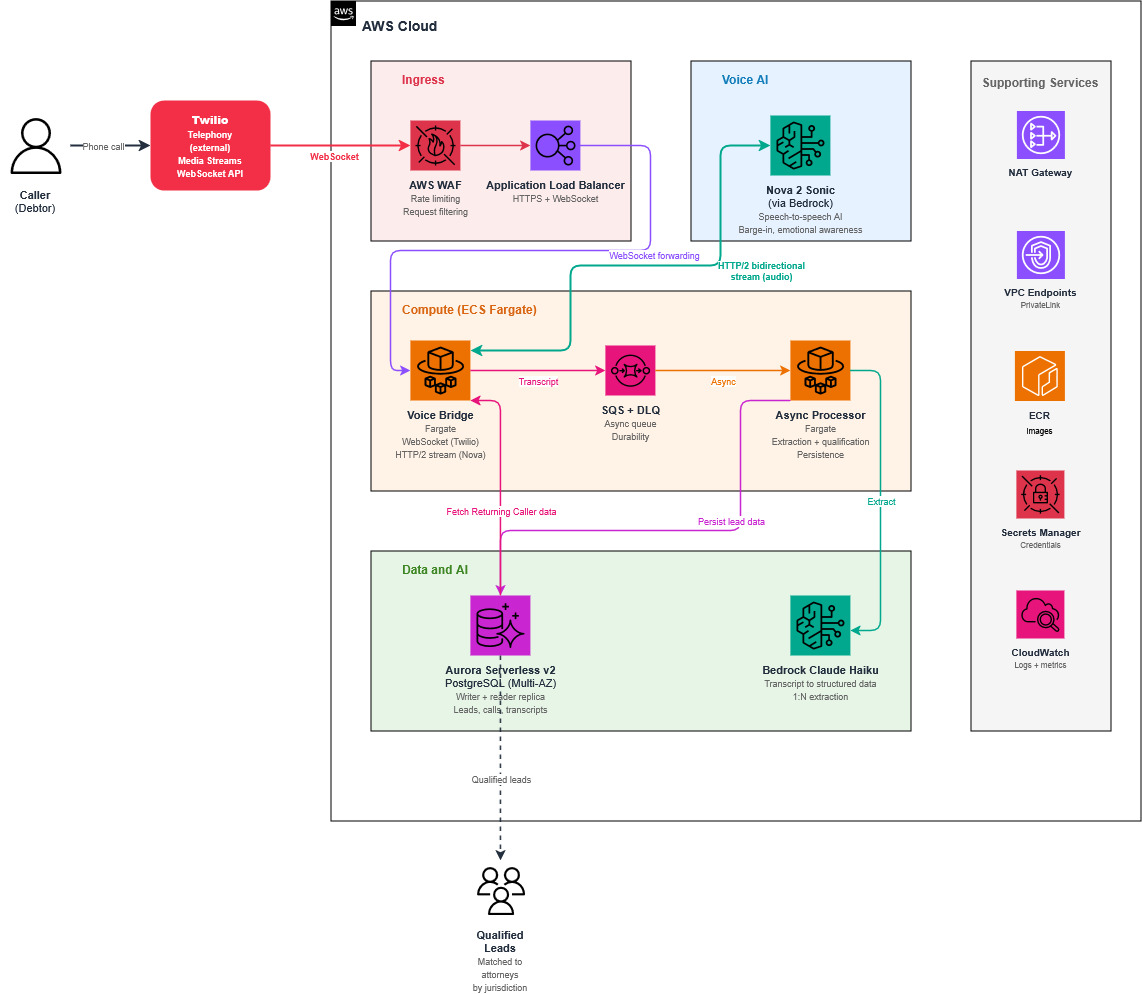
下图展示了端到端架构。
图 1:Tara 架构,展示从电话接入到数据持久化的端到端通话流程
来电者通过 Twilio 联系到 Tara,Twilio 会建立一条进入 AWS 的 WebSocket 连接。流量经过 AWS WAF 和 Application Load Balancer,到达运行在 AWS Fargate 上 Amazon Elastic Container Service(Amazon ECS)中的语音桥接服务,该服务通过 Amazon Nova 2 Sonic(经 Amazon Bedrock 访问)传输音频流。通话结束后,带有死信队列的 Amazon Simple Queue Service(Amazon SQS)将转录文本交给异步处理器。处理器使用 Amazon Bedrock 上的 Anthropic Claude 3 Haiku 提取结构化字段,这些字段持久化保存在 Amazon Aurora Serverless v2 中。符合条件的线索按司法管辖区路由给律师。配套服务包括 NAT 网关、VPC 端点(AWS PrivateLink)、Amazon Elastic Container Registry(Amazon ECR)、AWS Secrets Manager 和 Amazon CloudWatch。
Stretto 选择 Twilio 提供电话能力,是因为 Tara 的接案流程完全自动化,没有人工坐席接听电话,也因为 Stretto 希望与 Amazon Nova 2 Sonic 直接集成,同时保留其现有的 AWS 后端。Twilio Media Streams 通过 WebSocket 传输来电者的原始音频,这正是语音桥接服务所需的输入,而 CI&T 已经将其与 Amazon Nova 2 Sonic 集成。对于在人工坐席之间路由通话的联络中心工作负载,Amazon Connect 也支持 Amazon Nova 2 Sonic。
该架构使用了以下 AWS 服务:
团队采取了分阶段的方法:先验证语音质量,再构建生产集成,然后在系统经受真实来电者检验后扩大问卷范围。
破产相关的对话往往情绪浓重。来电者通常压力很大,犹豫不决,或感到难为情。语音智能体需要听起来有同理心且自然,而不是机械或程式化。在编写任何集成代码之前,团队专门花了一周时间,针对多种来电者场景测试 Amazon Nova 2 Sonic 的语音质量。
验证涵盖以下方面:
这一验证环节产出了一份对比报告,逐项记录了 Amazon Nova 2 Sonic 相较于此前的方案在各个维度上的表现。该报告成为是否推进到集成阶段的 go/no-go 评审关口。
语音质量通过验证后,团队用三周时间完成了端到端集成。通话流程如下:
由律师设计的完整受理流程可能持续 15–20 分钟,超过了单次 Amazon Nova 2 Sonic 流式会话的最长时长(当前数值请参见 Getting started with speech-to-speech)。团队将该会话时长视为一项设计参数,并实现了会话延续模式,这一方式可在会话边界之间保留对话上下文。语音桥接层会跟踪与 Amazon Nova 2 Sonic 的每个双向流已打开多长时间。在接近上限之前,它会用相同的系统提示词和工具配置打开一个新流,并将此前的对话以文本历史的形式发送过去。当 Tara 说完当前这条回复后,桥接层会把来电者的音频切换到新流并关闭旧流,从而让对话对来电者而言保持连贯流畅。
首次部署覆盖了现有的 13 个字段的受理表单,采集的数据点与网页表单相同,但通过自然对话完成。这为团队在扩大范围之前提供了一个可用于衡量对比的生产基线。
在生产试点运行期间,团队在四周内将问卷扩展到由律师设计的完整接案信息采集流程。这是一次范围上的显著扩大:
Amazon Aurora schema 扩展为支持一对多关系的完整关系数据模型。单条来电者记录可能包含四辆车、两处房产和数十条单独的债务明细项。
最后阶段的重点是基于真实来电者行为收集生产数据并调优系统。团队跟踪了关键绩效指标,包括通话量、平均时长、信息采集完成率、资料完整度、转化率和流失点。
生产数据带来的洞察推动了多项优化:重新排序问题以减少早期流失,调整条件分支以在对话中更早收集高价值字段,以及根据律师反馈修改资格阈值。下表展示了两项关键生产指标。
部署处理敏感财务数据的语音智能体,需要的不仅是功能测试。AWS Generative AI Innovation Center (GenAIIC) 顾问团队指导开发了一个涵盖四个类别的全面测试框架:
原文较长,译文为节选;译文由英文原文机器翻译,术语按行业惯例统一,可在文末展开原文核对。
查看英文原文(How Stretto built an AI voice agent with Amazon Nova 2 Sonic)
This post is co-written with Danya Gordin from Stretto and Marcelo Wzorek from CI&T.
Before Stretto built an AI voice agent, consumers considering bankruptcy on its Bankruptcy.com site filled out a web form with a few fields: debt amount, attorney status, and contact information. These form-generated leads carried thin margins.
The gap between a web form lead and a fully qualified lead is significant. Bankruptcy attorneys place more value on a lead that includes detailed financial data: debts, assets, vehicles, real estate, employment history, and prior filings. The web form could have been extended to capture that detail, but the longer it got, the more visitors abandoned it partway through. A phone interview would have drawn the information out naturally, because people are more willing to share financially sensitive details in conversation, but staffing and training a human intake team to run those interviews was cost-prohibitive.
Stretto saw an opportunity: replace the web form with an AI voice agent that conducts the intake interview by phone. The agent would guide callers through the full bankruptcy questionnaire conversationally and extract structured data in real time. It would then sort leads against attorney-defined rules to support attorney decision-making.
The challenge was finding a voice AI solution that could handle sensitive financial conversations naturally, with low latency, clean interruption handling, and emotional awareness, at a cost that made the unit economics work.
In this post, we walk through how Stretto worked with the AWS Generative AI Innovation Center and CI&T (an AWS Partner) to build Tara, an AI voice agent powered by Amazon Nova 2 Sonic, a speech-to-speech model in Amazon Bedrock. Tara conducts multi-phase bankruptcy intake interviews and sorts leads against attorney-defined rules. We cover the architecture, the phased build from validation through production deployment, and how the team tested voice quality for sensitive conversations.
Solution overview
Tara is an AI voice agent that conducts bankruptcy intake interviews over the phone. When a caller dials the Bankruptcy.com number, Tara picks up, introduces herself, and guides the caller through a structured conversation. She collects personal information, financial details, asset inventories, and employment history while adapting her tone to the caller’s emotional state. At the end of the call, Stretto’s system applies attorney-defined rules to sort the lead as qualified, disqualified, or needs-more-information for attorney review.
The solution is built on Amazon Nova 2 Sonic, a speech-to-speech foundation model (FM)available through Amazon Bedrock. It processes speech input and generates speech output natively in a single model rather than chaining separate speech-to-text, language model, and text-to-speech components. This architecture is designed to reduce latency and produce more natural-sounding conversations, both critical for the sensitive nature of bankruptcy intake calls. Building on Amazon Bedrock gave the team both Amazon Nova 2 Sonic and Anthropic’s Claude through one managed service, with no model infrastructure to run. It also brought AWS security and governance controls to a workload that handles sensitive financial data. Access to both models is governed by AWS Identity and Access Management (IAM). Traffic to Amazon Bedrock stays on the AWS network through virtual private cloud (VPC) endpoints (AWS PrivateLink). Amazon Bedrock doesn’t use prompts or model outputs to train models (for details, see Data protection in Amazon Bedrock). Because the models run in the same AWS environment as the voice bridge, the database, and Amazon CloudWatch monitoring, the team could secure and operate the whole solution with one set of tools. Amazon Nova 2 Sonic and Amazon Bedrock are not available in all AWS Regions. For current Region availability, see Amazon Bedrock supported Regions.
The team chose Amazon Nova 2 Sonic over the previous voice solution for three reasons:
- Cost: Stretto reports a 95 percent reduction in per-minute voice cost compared to its previous solution, based on Amazon Bedrock on-demand pricing in us-east-1 as of April 2026.
- Latency: In Stretto’s testing, the previous solution exhibited time-to-first-audio latency above 500 milliseconds, creating awkward pauses. Amazon Nova 2 Sonic is designed for low latency to support natural conversational flow.
- Interruption handling: Callers in stressful situations need to interject, correct themselves, and ask clarifying questions. The previous solution handled barge-in poorly, often breaking the conversation flow. Amazon Nova 2 Sonic is designed to handle interruptions without breaking the session.
The following figure shows the end-to-end architecture.
Figure 1: Tara architecture showing the end-to-end call flow from telephony to data persistence
A caller reaches Tara through Twilio, which opens a WebSocket connection into AWS. Traffic passes through AWS WAF and an Application Load Balancer to the voice bridge on Amazon Elastic Container Service (Amazon ECS) on AWS Fargate, which streams audio with Amazon Nova 2 Sonic (accessed through Amazon Bedrock). After the call, Amazon Simple Queue Service (Amazon SQS) with a dead-letter queue hands the transcript to an asynchronous processor. The processor uses Anthropic’s Claude 3 Haiku on Amazon Bedrock to extract structured fields, which persist in Amazon Aurora Serverless v2. Qualified leads route to attorneys by jurisdiction. Supporting services include NAT gateways, VPC endpoints (AWS PrivateLink), Amazon Elastic Container Registry (Amazon ECR), AWS Secrets Manager, and Amazon CloudWatch.
Stretto used Twilio for telephony because Tara’s intake is fully automated, with no human agents taking calls, and because Stretto wanted a direct integration with Amazon Nova 2 Sonic that kept its existing AWS backend in place. Twilio Media Streams delivers the caller’s raw audio over a WebSocket, which is the input the voice bridge needs, and CI&T had already integrated it with Amazon Nova 2 Sonic. For contact center workloads that route calls among human agents, Amazon Connect also supports Amazon Nova 2 Sonic.
The architecture uses the following AWS services:
- Amazon Nova 2 Sonic (through Amazon Bedrock): The speech-to-speech foundation model that powers Tara’s voice conversations. It handles both speech recognition and response generation in a single pass, supporting tool calling for structured data collection during the interview.
- Amazon Elastic Container Service (Amazon ECS) on AWS Fargate: A serverless compute engine that runs the voice bridge containers connecting the telephony layer to Amazon Nova 2 Sonic. The voice bridge tasks run continuously across three Availability Zones for high availability.
- Amazon Aurora Serverless v2: A PostgreSQL-compatible serverless relational database deployed in Multi-AZ configuration. Stores caller profiles, intake responses, qualification results, and session metadata. The serverless scaling of Aurora matches the variable call volume patterns.
- Amazon Bedrock (Anthropic’s Claude 3 Haiku): Handles structured data extraction from conversation transcripts. After Amazon Nova 2 Sonic generates a transcript, Claude 3 Haiku extracts typed fields (names, dollar amounts, addresses, vehicle details) into the relational schema.
- Amazon Simple Queue Service (Amazon SQS) with dead-letter queues: Manages asynchronous webhook processing for post-call events, preserving failed messages for retry.
- AWS WAF, VPC Endpoints, and Application Load Balancer: Security and networking layers that help protect API endpoints, route traffic across Availability Zones, and provide private connectivity to AWS services.
Building and validating the voice agent
The team took a phased approach: validate voice quality first, build the production integration, then expand the questionnaire scope after proving the system worked with real callers.
Validating voice quality for sensitive conversations
Bankruptcy conversations are emotionally charged. Callers are often stressed, hesitant, or embarrassed. The voice agent needs to sound empathetic and natural, not robotic or transactional. Before writing any integration code, the team spent a dedicated week testing the voice quality of Amazon Nova 2 Sonic against several caller scenarios.
The validation covered:
- Voice quality across caller emotional states (calm, stressed, hesitant, frustrated).
- Time-to-first-audio latency benchmarks against the previous solution’s over 500 ms baseline.
- Barge-in and interruption handling: can a caller interject mid-sentence without breaking the conversation?
- Emotional tone adaptation: does the agent adjust its pace and tone when a caller sounds distressed?
This validation step produced a comparison report documenting the performance of Amazon Nova 2 Sonic against the previous solution across each dimension. The report became the go/no-go gate for proceeding to integration.
Deploying to production with real callers
With voice quality validated, the team built the end-to-end integration over three weeks. The call flow works as follows:
- A caller dials the Bankruptcy.com number. Twilio’s telephony layer receives the call and opens a WebSocket connection to the voice bridge running on Amazon ECS on AWS Fargate.
- The voice bridge streams audio bidirectionally between the caller and Amazon Nova 2 Sonic. Tara introduces herself, collects consent, and begins the intake interview.
- After the call, the full transcript feeds into an extraction pipeline powered by Anthropic’s Claude 3 Haiku on Amazon Bedrock. The pipeline extracts the fields from the conversation and stores them in Amazon Aurora.
The full attorney-designed intake can run 15–20 minutes, which is longer than the maximum duration of a single Amazon Nova 2 Sonic streaming session (for the current value, see Getting started with speech-to-speech). The team treated that session duration as a design parameter and implemented the session continuation pattern, an approach that carries conversation context across session boundaries. The voice bridge tracks how long each bidirectional stream with Amazon Nova 2 Sonic has been open. Shortly before the limit, it opens a new stream with the same system prompt and tool configuration and sends the conversation so far as text history. When Tara finishes her current response, the bridge switches the caller’s audio to the new stream and closes the old one, so the conversation continues smoothly for the caller.
The initial deployment covered the existing 13-field intake form, collecting the same data points the web form captured but through natural conversation. This gave the team a production baseline to measure against before expanding scope.
Expanding the intake and lead qualification
With the production pilot running, the team expanded the questionnaire to the full attorney-designed intake over four weeks. This was a significant increase in scope:
- Over 18 intake categories with conditional branching, where the questions Tara asks depend on the caller’s previous answers.
- Complex relational data: Vehicles (year, make, model, financing status, monthly payment per vehicle), real estate properties, individual debt line items, multiple employment and income sources, and prior bankruptcy filings.
- Rules-based lead sorting: Stretto applies attorney-defined rules to each lead, and attorneys make the final decision. Because a voice agent collects richer, conditional data than a static web form, it gives Stretto more flexibility to apply those rules and qualify leads accurately.
- Lead routing: Qualified leads are routed to bankruptcy practitioners, while callers who do not meet the qualification criteria are directed to alternative resources.
The Amazon Aurora schema expanded to a full relational data model supporting one-to-many relationships. A single caller record might include four vehicles, two properties, and dozens of individual debt line items.
Measuring results and optimizing
The final phase focused on collecting production data and tuning the system based on real caller behavior. The team tracked key performance indicators including call volume, average duration, intake completion rate, profile completeness, conversion rate, and drop-off points.
Insights from production data drove several optimizations: reordering questions to reduce early drop-offs, adjusting conditional branching to collect high-value fields earlier in the conversation, and modifying qualification thresholds based on attorney feedback. The following table shows two key production metrics.
| Average call duration (completed calls) | ~8 min |
| Data extraction accuracy | ~96% |
Testing for quality and compliance
Deploying a voice agent that handles sensitive financial data requires more than functional testing. The AWS Generative AI Innovation Center (GenAIIC) advisory team guided the development of a comprehensive testing framework spanning four categories:
- Happy path testing: Complete end-to-end intake interviews with cooperative callers across the full questionnaire. These calls confirm that the over 18 categories collect accurate structured data and that the qualification rules produce correct results.
- Adversarial testing: Callers who provide contradictory information, change answers mid-conversation, refuse to answer certain questions, or attempt to manipulate the qualification outcome. The agent needs to handle the ambiguity and keep the conversation coherent.
- Compliance testing: Consent collection, disclosure delivery, and data handling workflows. The team verified that the agent delivers disclosures accurately and collects consent before proceeding, because bankruptcy intake involves sensitive financial information.
- Barge-in scenario testing: Callers interrupting at various points in the conversation, including during disclosures, mid-question, and during the agent’s responses. Tara should recover without losing context or asking the caller to repeat information.
Responsible AI controls in production
The team treated responsible AI as a production control, not only a testing step. Amazon Nova 2 Sonic includes built-in safety protections, described in the AWS AI Service Card for Amazon Nova 2 Sonic. On top of those, the solution keeps consequential decisions out of the model: lead sorting runs on explicit attorney-defined rules after the call, and attorneys make the final decision. Consent and disclosures are delivered and logged before intake begins, and the adversarial test suite checks that attempts to manipulate the conversation don’t change lead outcomes. Beyond model inference, the solution uses the Amazon Bedrock bidirectional streaming API for real-time audio, tool use for structured data capture during the interview, and private connectivity to Amazon Bedrock through VPC endpoints.
The GenAIIC advisory team also provided guidance on prompt engineering best practices for voice-specific applications, including techniques for managing conversational state across session continuation boundaries and structuring system prompts that maintain consistent agent personality across long interviews.
Results
After roughly three months in production, Stretto reported the following results:
- Per-lead value: Fully qualified leads with complete intake data are significantly more valuable to bankruptcy attorneys than web form leads, which capture only a few basic fields.
- Lead conversion: Stretto’s early production results show a 20 percent relative increase in conversion rate compared with the web form, even before the solution has been rolled out broadly across additional districts.
- Data quality and call length: Stretto reports that Tara extracts structured fields at approximately 96 percent accuracy in its testing, and completed calls average about 8 minutes.
- Voice solution cost: Stretto reports a 95 percent reduction in per-minute voice cost compared to its previous solution.
“I’m incredibly grateful to the AWS GenAI Innovation Center team. Their expertise helped bring our voice agent, Tara, to life, driving a 20 percent increase in our lead conversion rate.”
— Danya Gordin, Principal AI Architect, Stretto
“As one of the partners in the AWS Generative AI Partner Innovation Alliance, we can confirm that the GenAIIC program is a true catalyst, bringing customers and partners together to solve real problems and deliver business impact. With Stretto, that meant taking a voice agent to production in a matter of weeks and transform the bankruptcy intake process”
— Marcelo Wzorek, Executive Manager, CI&T
Conclusion
Stretto’s journey from web form leads to AI-assisted intake interviews illustrates what becomes possible when voice AI reaches the quality bar for sensitive use cases. By combining the speech-to-speech capabilities of Amazon Nova 2 Sonic with a well-designed architecture on AWS, the team built a voice agent that is natural enough for callers discussing personal financial hardship and cost-effective enough to deliver meaningful savings at scale.
The phased approach, validating voice quality first, deploying a minimal intake to production, then expanding scope based on real-world data, reduced risk at each step. The team built on validated assumptions rather than projections.
If you are exploring AI voice agents for your own use case, here are some resources to get started:
- Learn about Amazon Nova 2 Sonic and speech-to-speech capabilities.
- Get started with Amazon Bedrock to access foundation models including Amazon Nova 2 Sonic.
- Explore AWS Fargate for serverless compute for containers.
- Learn about the AWS Generative AI Innovation Center for advisory support on your generative AI initiatives.
If you are weighing voice AI for a sensitive, high-value intake process, your AWS account team and the AWS Generative AI Innovation Center can help you scope and build it.
About the authors

Mariah Miller
Mariah is a Senior Generative AI Strategist and industry leader for media, entertainment, games, and sports in AWS Forward Deployed Engineering, a role she also held at the AWS Generative AI Innovation Center. She leads customer missions that build production AI systems with enterprise teams across industries, including financial and legal services, and develops reusable solution assets such as multimodal video search, agentic commerce, and voice AI agents. She also built the Innovation Center’s partner program. Outside of work, she likes to spend time outdoors.

Danya Gordin
Danya is a Principal AI Architect at Stretto, where he leads the design and deployment of large-scale LLM cloud infrastructure. A full-stack AI engineer and solutions architect, he holds a master’s degree in artificial intelligence from Northeastern University and has worked on NLP, computer vision, and machine learning across healthcare and genomics.

Marcelo Wzorek
Marcelo is a Technology Delivery Executive at CI&T, an AI deployment company, where he leads large-scale technology transformation and AI-driven delivery programs. With over two decades of experience in the IT industry, he has evolved from hands-on software development and data engineering into executive delivery leadership, helping enterprises turn emerging technologies into measurable business outcomes. His focus is on deploying AI into production at scale, accelerating enterprise AI adoption, improving productivity, and delivering measurable business value.
正文保留英文原文,标题与摘要由机器翻译。
原文发布于 AWS Machine Learning(How Stretto built an AI voice agent with Amazon Nova 2 Sonic),标题、摘要与正文由机器翻译,术语按行业惯例统一,未经人工逐句校订。
