锯齿状智能:AI为何时而惊艳时而犯傻
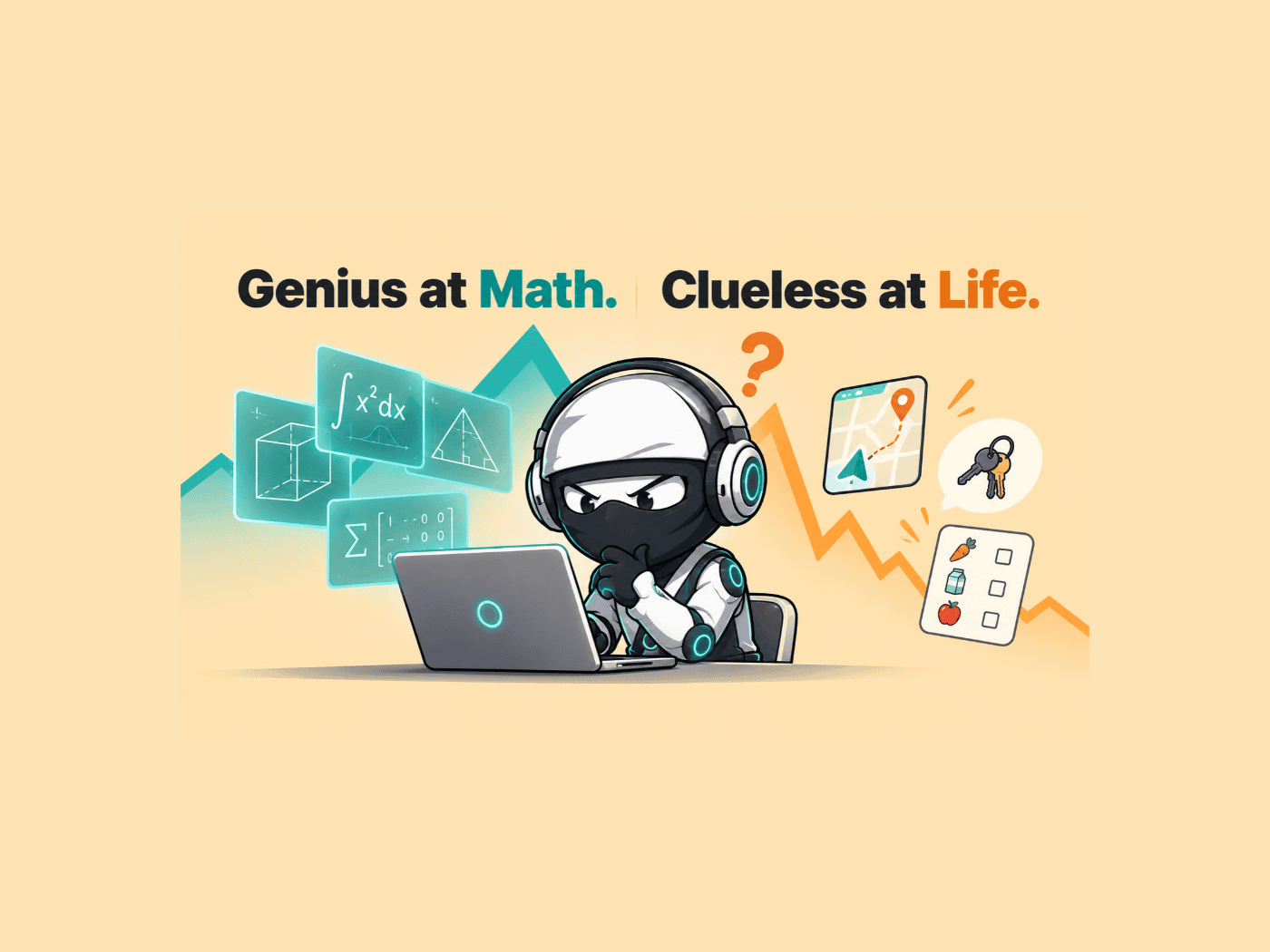
为什么模型能在奥林匹克数学竞赛中拿高分,却仍在简单的日常任务上失手。
作者:Nate Rosidi,KDnuggets 市场趋势与 SQL 内容专家,2026 年 11 月 18 日,人工智能栏目
来自 Google 和 OpenAI 的 AI 系统在国际数学奥林匹克竞赛中解出了六道题中的五道。数月之后,聊天机器人却告诉一位用户,把车“走”到 50 米外的修理店。能做到前者的人绝不会犯后一种错误,正因如此,这道落差才如此难以预料。
研究人员将这种模式称为锯齿状智能。对于任何评估模型、构建 AI 功能,或需要判断某个输出是否可信的人来说,这一点都很重要,因为一个基准测试分数或一次惊艳的演示,几乎说明不了下一个任务会表现如何。
锯齿状智能意味着什么
Andrej Karpathy 是 OpenAI 联合创始人、特斯拉前 AI 负责人,他在 2024 年 7 月提出了这一术语。模型在某些事情上表现极佳,在另一些事情上却一败涂地,而且很难事先分辨哪些属于哪一类。
人类的能力往往相互关联,从童年到成年会一同提升。能解出奥林匹克竞赛题目的人,不会因为 50 米要不要走路而犯迷糊。而在模型中,各项能力往往不会同步提升。
人们会用一个已展示出来的技能去推测其他技能。一个能写出可用函数的模型,看起来也应该能数清一段文字里的词数。但这种推断并不成立,这也正是一次演示所能预测的东西如此有限的原因。
一些研究者将这一模式解读为许多彼此独立的技能,背后并不存在通用智能。
针对这一模式的四种解释假说
没有一种已有定论,而且它们可能相互重叠。
带可验证奖励的强化学习(RLVR)在 2025 年成为一个重要的训练阶段。
它适用于答案明确对错的场景,例如数学和能通过测试的代码。
Karpathy 认为,模型在可验证领域附近会出现能力跃升。创意写作、哲学以及部分科学领域没有自动校验器,因此按这一解释,其进展更慢。
互联网只承载了人类知识的一小部分,关于物理世界的内容更是少之又少。一个基于数字模式训练的模型,在规划、产生新想法以及处理未见过的任务时会力不从心。
Apple 的 GSM-Symbolic 论文作者假设,大语言模型(LLM)只是复现训练数据中的推理步骤,而非进行逻辑推理。与熟悉模板匹配的问题能够被解出,而模板稍有改动就会打断这一链条。
来自 MIT、哈佛大学和芝加哥大学的另一篇关于“波将金式理解”(Potemkin understanding)的论文,将这类失败归因于内部不自洽的概念表征。模型可能同时持有某个概念的正确定义和一个有缺陷的可用版本,而没有任何机制强制两者保持一致。
可验证奖励或许能解释模型为何在某些任务上表现出色,而另外三种理论则为其弱点提供了可能的解释。
例如,模型在时钟相关任务上的困难(比如从模拟时钟图像中读出时间)可能反映了训练数据的缺口。因向问题中添加无关信息而导致的失败,则可能表明模型依赖熟悉的模式,而非逻辑推理。
而模型能正确定义某个概念却无法应用它的情况,可能表明其内部表征不一致。这些关联是合理的,但尚无一项被确认为直接的因果解释。
科学界记录在案的六类失败
我们在此宽泛地使用“参差不齐”(jagged)一词:既指任务之间、难度层级之间的不均衡,也指测试条件与真实使用之间的不均衡。
一个干扰从句就击垮了小学数学题
在 Apple 的 GSM-NoOp 测试中,研究人员在小学数学应用题里加入了一句无关的话,例如“其中五个猕猴桃比平均个头小”。模型便把这些猕猴桃从总数中减掉了。仅仅增加一个看似相关的从句,就让各类最先进模型的性能最多下降 65%。而一名学生读到这句话会直接忽略它。
定义概念与运用概念
GPT-4o 正确给出了 ABAB 押韵格式的定义,随后写出一首诗,却用了一个不押韵的词。Potemkin 研究用来自诗歌、博弈论和心理学的概念测试了七款模型。模型正确给出这些概念定义的比例约为 94%,而在同一批概念的分类任务上失败的比例约为 55%。
如果一款模型能背出定义却仍然误用,那么一个正确的定义几乎说明不了它的理解能力。
在 ClockBench(2025 年 9 月)上,人类读取模拟时钟的准确率为 89.1%。当时表现最好的模型 Gemini 2.5 Pro 达到 13.3%。
读取时钟意味着找到指针、判断其角度,并将其映射为数字。当模型正确读出时间时,后续的算术运算没有问题,也就是说失败的是感知,数学能力则保持正常。ClockBench 是单一作者完成的基准测试,尚未经过同行评审,因此我们把这些数字视为参考性指标。
医疗得分很高,真实用户的结果却很差
在牛津大学发表于 Nature Medicine 的一项试验中,1,298 名参与者尝试识别医疗状况。仅依靠 LLM,识别率为 94.9%。
使用同样这些 LLM 的人,识别率最高只有 34.5%,低于自行查证的对照组 47% 的水平。在选择正确的下一步行动上,LLM 使用者的表现并不优于该对照组。
这里的落差同时落在模型和用户身上,我们把它计入,因为任何基于该模型构建的产品都会继承这一落差。模型单独跑出的分数与它对真实用户的价值可能相差如此之大,而标准基准测试并没有体现出这一点。
逻辑谜题与一个存在争议的结果
Apple 的 Illusion of Thinking 研究在难度递增的条件下测试了汉诺塔(Tower of Hanoi)、过河问题(River Crossing)和积木世界(Blocks World)。在简单谜题上,标准模型击败了推理模型;在中等难度上,推理模型胜出;而在高难度谜题上,两者都崩溃了,即便给出了求解算法也是如此。
哪种模型更优会随难度变化,因此这种不均衡出现在同一类任务的内部。有反驳意见认为,部分崩溃源自测试设置本身,因此我们把这一结果视为尚无定论。
新基准测试版本让得分跌破 1%
ARC-AGI-3 是 2026 年 3 月 25 日发布的基准测试,旨在评估人工智能在完全陌生的情境中学习、推理和适应的能力,而不是仅仅基于此前学到的模式来回答问题。
所有前沿模型的得分都低于 1%,而人类解出了它的全部环境。
Gemini 3.1 Pro 此前已在 ARC-AGI-2 上达到 77.1%,因此在一个版本上的高分并不能延续到下一个版本。
新版本还切换到了交互式环境,因此这一下降混合了格式与难度两方面的因素。分数变化很快,所以在引用具体数字前,请先查看当前的排行榜。
为什么单一基准测试分数会产生误导
Karpathy 曾表示,他在 2025 年对基准测试失去了信任。基准测试本身就是可验证的环境,而这正是 RLVR 发挥作用的地方,因此实验室可以直接在这类任务上进行训练。分数可以提高,而通用能力未必随之提升。
基准测试还假设,少数几个正确答案就代表理解,因为人类的错误遵循可预测的模式。一个能正确写出 ABAB 押韵格式的学生,几乎总能正确地运用它,因此一场考试可以抽样几道题,并推断其余部分。Potemkin 的作者们认为,模型的误解并不遵循这些模式,因此它可以在不理解概念的情况下通过测试。
像 GSM8K 这样的基准测试容易受到数据污染,也无法衡量模型对措辞细微变化的敏感度。在牛津的这项研究中,无论是标准的医疗基准测试还是模拟患者,都未能预测真实用户会出现什么情况。作者建议在部署前进行系统化的人类用户测试。
面试题:一个掩盖了性能回退的 3% 提升
这道 OpenAI 面试题问的是:“一个新模型版本让主要指标整体提升了 3%,但在某一特定用户群体上出现了性能回退。你如何决定是否发布它?”
这与产品层面的“参差不齐”具有相同的形态:平均值上升,而某一用户群体却出现了一个低谷。只有当性能回退可追溯到新模型丧失的某项能力时,它才与模型能力层面的版本相对应。一个只追踪主要指标的仪表盘会报告这 3%。
示例:如果 90% 的用户提升了 4.4%,而另外 10% 的用户下降了 10%,按用户占比加权后的平均值仍会上升约 3%。头条数字永远不会显示那 10%。
官方回答涵盖五点:
在做任何决定之前,先评估受影响细分群体的规模与价值。
找到差距的根本原因。
考虑采用有针对性的回退方案,将该细分群体路由到旧模型。
将涉及公平性或法律风险的细分群体视为需要主观判断的事项。
记录已接受的性能回退,以便下一次发布时与其进行对比。
每一点都假定汇总数字本身不可信。
在实际应用中可靠地使用 AI
原文较长,译文为节选;译文由英文原文机器翻译,术语按行业惯例统一,可在文末展开原文核对。
查看英文原文(Jagged Intelligence: Why AI Is Brilliant One Minute and Clueless the Next)
Why models ace Olympiad math and still fumble simple everyday tasks.
By Nate Rosidi, KDnuggets Market Trends & SQL Content Specialist on November 18, 2026 in Artificial Intelligence
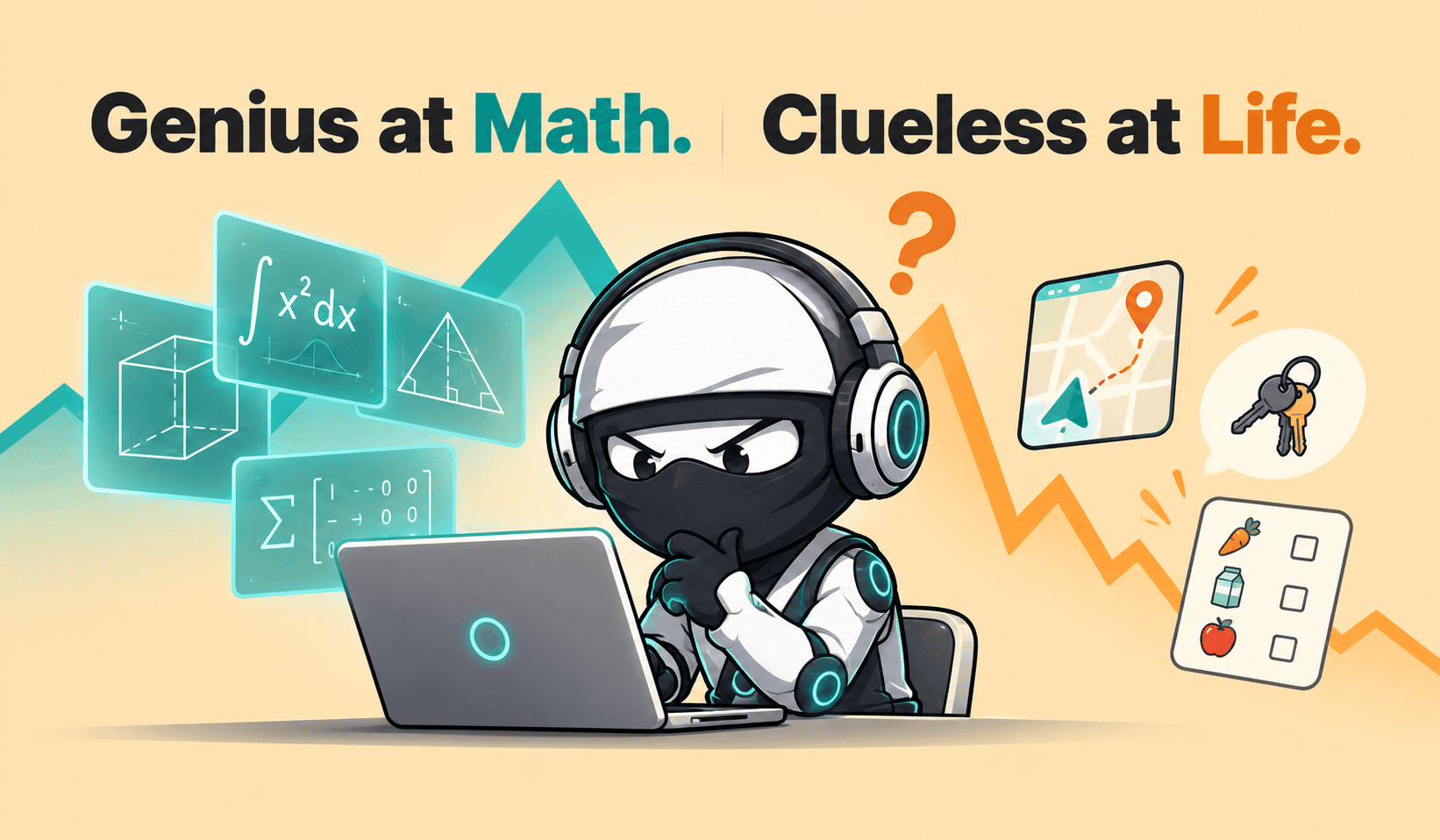
AI systems from Google and OpenAI solved five of six problems at the International Mathematical Olympiad. Months later, chatbots told a user to walk his car to a repair shop 50 meters away. A person who can do the first would never make the second mistake, which is why the gap is so hard to anticipate.
Researchers call this pattern jagged intelligence. It matters to anyone who evaluates models, builds AI features, or decides whether to trust an output, because one benchmark score or one impressive demo says little about the next task.
What Jagged Intelligence Means
Andrej Karpathy, an OpenAI co-founder and former head of AI at Tesla, coined the term in July 2024. Models do some things extremely well and fail badly at others, and it is hard to tell in advance which is which.
Human abilities tend to be correlated and improve together from childhood to adulthood. Someone who solves Olympiad problems will not be confused by a 50-meter walk. In models, capabilities often don't move together.
People use one demonstrated skill to guess at others. A model that writes a working function looks like it can also count the words in a paragraph. That inference fails, which is why a demo predicts so little.
Some researchers frame the pattern as many separate skills with no general intelligence behind them.
Four Proposed Explanations for the Pattern
None is settled, and they may overlap.
Reinforcement learning with verifiable rewards (RLVR) became a major training stage in 2025.
It works where answers are clearly right or wrong, such as math and code that passes tests.
Karpathy argues that models spike near verifiable domains. Creative writing, philosophy, and parts of science have no automatic checker, so in this account progress is slower.
The internet holds only a fraction of human knowledge and very little about the physical world. A model trained on digital patterns struggles with planning, new ideas, and unseen tasks.
The authors of Apple's GSM-Symbolic paper hypothesize that large language models (LLMs) replicate reasoning steps from training data instead of reasoning logically. A problem that matches a familiar template gets solved, and a small change to the template breaks the chain.
A separate "Potemkin understanding" paper from MIT, Harvard, and the University of Chicago traces failures to internally incoherent concept representations. A model can hold a correct definition and a faulty working version of the same concept, and nothing forces the two to agree.
Verifiable rewards may explain why models excel at certain tasks, while the other three theories offer possible explanations for their weaknesses.
For example, difficulties with clock-related tasks (e.g. reading the time from an analog clock image) might reflect gaps in training data. Failures caused by adding irrelevant information to a problem could suggest that models rely on familiar patterns rather than logical reasoning.
And cases where a model correctly defines a concept but fails to apply it could indicate inconsistent internal representations. These connections are plausible, but none has been established as a direct causal explanation.
Six Failures Documented by the Scientific Community
We use "jagged" broadly here: unevenness across tasks, across difficulty levels, and between test conditions and real use.
A Distractor Clause Breaks Grade-School Math
In Apple's GSM-NoOp test, researchers added an irrelevant sentence to grade-school word problems, such as "five of the kiwis were smaller than average." Models subtracted those kiwis from the total. One extra clause that looked relevant cut performance by up to 65% across state-of-the-art models. A student would read the sentence and ignore it.
Defining a Concept Versus Applying It
GPT-4o correctly defined an ABAB rhyme scheme, then wrote a poem that used a word that didn't rhyme. The Potemkin study tested seven models on concepts from poetry, game theory, and psychology. Models defined the concepts correctly about 94% of the time and failed classification tasks on the same concepts about 55% of the time.
If a model can recite a definition and still misapply it, a correct definition tells us little about understanding.
On ClockBench (September 2025), humans read analog clocks with 89.1% accuracy. The best model then, Gemini 2.5 Pro, reached 13.3%.
Reading a clock means finding the hands, judging their angles, and mapping them to numbers. When a model read the time correctly, follow-up arithmetic was fine, so perception failed and the math held. ClockBench is a single-author benchmark and has not been peer reviewed, so we read the numbers as indicative.
Strong Medical Scores, Poor Results for Real Users
In a Nature Medicine trial from Oxford, 1,298 participants tried to identify medical conditions. LLMs alone identified them in 94.9% of cases.
People using the same LLMs identified them in at most 34.5% of cases, below the 47% of a control group that did its own research. On choosing the right next step, LLM users did no better than that control group.
The valley here sits in the model and user together, and we count it because any product built on the model inherits it. A model's solo score and its value to a real user can sit this far apart, and standard benchmarks did not show it.
Logic Puzzles and a Contested Result
Apple's Illusion of Thinking study tested Tower of Hanoi, River Crossing, and Blocks World at rising difficulty. Standard models beat reasoning models on easy puzzles, reasoning models won at medium difficulty, and both collapsed on hard ones, even when given the solution algorithm.
Which model was better changed with difficulty, so the unevenness showed up inside a single task family. A rebuttal argued that part of the collapse comes from the test setup, so we treat this result as open.
A New Benchmark Version Drops Scores Below 1%
ARC-AGI-3 is a benchmark launched on March 25, 2026, designed to evaluate how well artificial intelligence can learn, reason, and adapt to completely unfamiliar situations, rather than simply answer questions based on previously learned patterns.
Every frontier model scored below 1%, while humans solved all of its environments.
Gemini 3.1 Pro had already reached 77.1% on ARC-AGI-2, so a high score on one version did not carry over to the next.
The new version also switched to interactive environments, so the drop mixes format and difficulty. Scores are moving quickly, so check the current leaderboard before quoting a number.
Why One Benchmark Score Misleads
Karpathy has said he lost trust in benchmarks in 2025. Benchmarks are verifiable environments by construction, which is where RLVR works, so labs can train directly on tasks like them. The score can rise without general ability rising with it.
Benchmarks also assume that a few correct answers signal understanding, because human errors follow predictable patterns. A student who defines an ABAB rhyme scheme correctly will almost always apply it correctly, so an exam can sample a few questions and infer the rest. The Potemkin authors argue that a model's misunderstandings don't follow those patterns, so it can pass the test without understanding the concept.
Benchmarks such as GSM8K are vulnerable to contamination and don't measure sensitivity to small changes in wording. In the Oxford study, neither standard medical benchmarks nor simulated patients predicted what happened with real users. The authors recommend systematic human user testing before deployment.
Interview Question: A 3% Gain That Hides a Regression
This OpenAI question asks: "A new model version improves your primary metric by 3% overall but regresses performance for a specific user segment. How do you decide whether to ship it?"
This has the same shape as jaggedness at the product level: the average goes up and a valley opens for one group of users. It matches the model-capability version only if the regression traces to a skill the new model lost. A dashboard that tracks only the primary metric would report the 3%.
Example: if 90% of users improve by 4.4% and the other 10% drop by 10%, the average weighted by user share still rises by about 3%. The headline number never shows the 10%.
The official answer covers five points:
Size and value the affected segment before deciding anything.
Find the root cause of the gap.
Consider a targeted fallback that routes that segment to the old model.
Treat segments with fairness or legal stakes as a judgment call.
Document the accepted regression so the next release is compared against it.
Each point assumes the aggregate number can't be trusted on its own.
Using AI Reliably in Real Applications
Users struggle to know what AI does well, and the answer changes each release. The emerging view works at the level of tasks: some tasks inside a job get automated and others don't. Scale AI's Remote Labor Index found that the best agents fully automated 2.5% of real freelance projects at launch, mostly creative audio and image work plus some data and writing tasks. Scale's leaderboard now shows 20.8% for the top model (October 7, 2026).
Five practices follow from the evidence:
Testing on Your Own Perturbed and Adversarial Cases
Take a real input, then add an irrelevant detail or reword it. An answer that changes when the correct answer shouldn't is a failure. This is the GSM-NoOp test applied to your own data.
Testing Application, Not Recall
A model that states a rule correctly can still misapply it. Ask it to classify new inputs or generate examples that follow the rule, and score those answers.
Reporting Results by Segment
One overall accuracy figure is how a regression hides, as in the 3% question above. Once a weak segment is known, route its requests to the previous model version and review that rule at each release.
Verifying by Hand Where No Automatic Check Exists
These are the domains RLVR can't train on. Oxford participants did worse with the LLM than the LLM did alone, so test the full workflow with real users and don't assume people will catch the errors.
Re-Evaluating After Every Model Update
The jagged edges move between releases, so last quarter's test results describe last quarter's model.
This OpenAI question asks how to build an evaluation set that catches regressions before each release.
The official answer builds the set from real production failures, separates blocking cases from tracked hard ones, and retires solved cases as new ones arrive. It also warns that a static set gets implicitly tuned against, which is the benchmark problem from earlier applied to your own tests.
Jagged intelligence means AI capability is uneven: Olympiad-level math sits next to a failed clock reading. Verifiable training rewards, thin data on the physical world, pattern replication, and incoherent concepts are four proposed explanations, and none is settled.
Distractor clauses, misapplied definitions, clock faces, and real users all exposed weaknesses that a headline score never showed.
For evaluation, that means perturbed tests, application-level checks, segment-level reporting, and testing with real users. For deployment, it means automating individual tasks, checking by hand where outputs are hard to verify, and testing again whenever the model changes. A score describes the tasks the test covered, and a slightly different input can land in a valley. The peaks are real, and so are the valleys, and only your own tests show where they fall for your use case.
Nate Rosidi is a data scientist and in product strategy. He's also an adjunct professor teaching analytics, and is the founder of StrataScratch, a platform helping data scientists prepare for their interviews with real interview questions from top companies. Nate writes on the latest trends in the career market, gives interview advice, shares data science projects, and covers everything SQL.
原文为英文,正文由自动抓取并保留原文。
原文发布于 KDnuggets(Jagged Intelligence: Why AI Is Brilliant One Minute and Clueless the Next),标题、摘要与正文由机器翻译,术语按行业惯例统一,未经人工逐句校订。
