维护者不需要更多AI漏洞报告,而是修复
AI 让发现潜在漏洞变得又快又便宜。但修复漏洞仍然需要人的判断,而在开源领域,这项工作落在了维护者身上。许多人已经被 AI 生成的安全发现淹没,其中既有重复项,也有根本算不上漏洞的报告。再来一次原始扫描对他们毫无帮助。任何人想把新模型对准某个项目,都应先征询其维护者的意见,并且带着修复方案来,而不只是发现问题。
维护者正承受着这波报告洪流的巨大压力。正如 Log4j 维护者 Christian Grobmeier 所言,防御开源的 AI 必须比攻击它的 AI 更强。
AI 不应增加维护者的工作量。因此,GitHub 与 Microsoft 与维护者共同开展了一项试点:AI 能否帮助维护者交付修复,而不是给他们送去更多发现?
GitHub 和 Microsoft 正在使用 Codename MDASH——Microsoft 的多模型智能体式扫描框架——来发现并修复被广泛使用的开源软件中的安全漏洞,从而加固全球大量代码所依托的基础。
我们的试点有两个目标:只提交真正重要的发现,绝不向维护者提交未经核实的发现。具体做法如下:
报告与修复都留在 GitHub 上,也就是维护者本来就在工作的地方。
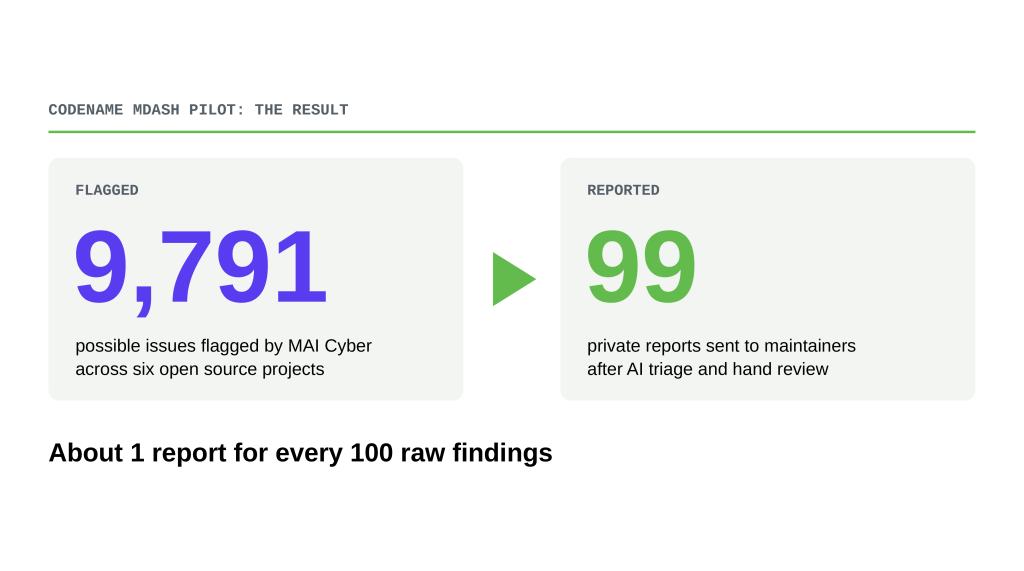
结果是:Codename MDASH 使用 Microsoft 的 MAI Cyber 模型,在六个项目中标记出数千个可能的问题。经过 AI 分诊和七位 Microsoft FORGE Lab 研究人员的人工复核,维护者收到了 99 份非公开报告。截至 11 月 15 日,他们已修复 55 个,其中 14 个修复已进入正式发布版本。
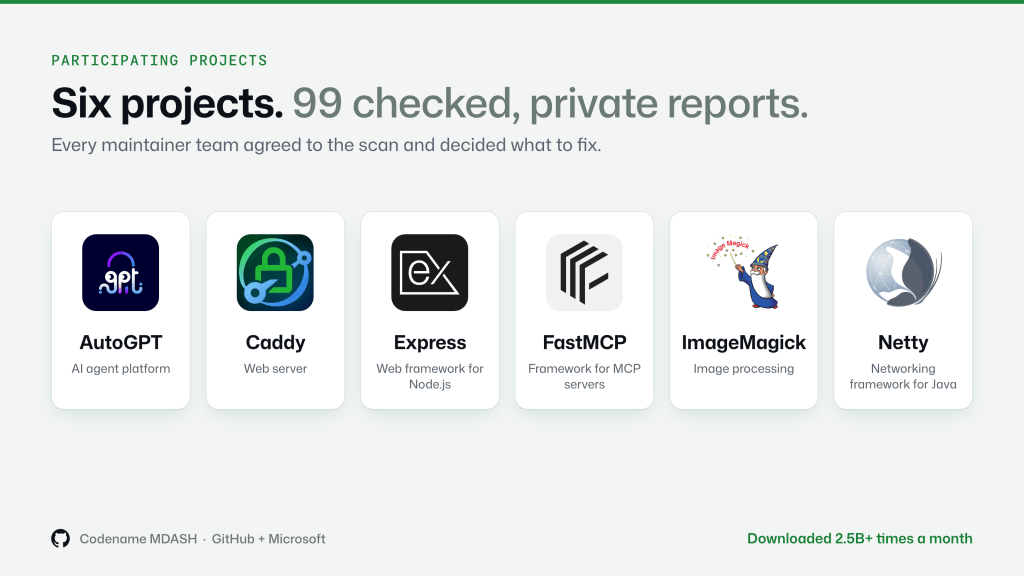
共有六个项目参与,它们都是 GitHub Secure Open Source Fund 的往届项目。其维护者同意接受扫描,私下收到每一份报告,自行决定修复哪些问题,并分享了行之有效的做法:
这些经验来自这六个项目修复的问题,以及其维护者选择分享的内容。六个项目只是一个小样本,因此请把它们当作早期经验来看待。
修复才是维护者花时间的地方。因此每一份报告在送达时都已经过核查,并附有一个建议修复方案,供其审阅、调整和合并。维护者拿到的是一个范围明确的补丁,而不是一条原始发现。
首批修复在初次扫描后约一周内发布。Caddy 的维护者在一周或更短时间内修复了他们收到的全部 22 份报告。维护者采用了建议的修复方案,有些照原样使用,有些做了改动。
AutoGPT 的维护者最近刚上线了一项新检查,而它是失效的。报告在三天后送达,并准确指出了出问题的那一行。他们做的修复超出了建议补丁的范围,在一天内写完,并在不到一周后将其部署到生产环境。
发现漏洞已不再是我们的瓶颈。修复才是难的部分,而这取决于维护者。
维护者收到的是一份简短的清单,而不是大量报告。Express 的维护者表示,这些报告剔除了杂音、直击要点。Caddy 的维护者表示,这些报告揭示了一些冷僻的 bug,并填补了此前报告遗漏的空白。对 FastMCP 而言,这次扫描超出了以往 AI 扫描器所能提供的结果。由两人团队维护的 ImageMagick 收到了 22 份报告。
AI 负责发现,研究人员负责核查,维护者始终掌握主导权。
有一份 ImageMagick 报告看起来像是维护者以前见过的那类问题。但它的摘要表明并非如此,并指出了确切的代码行。他们在 15 分钟内就推送了修复。
通常,一份安全公告平均要花我们 30 分钟到 1 小时来阅读、理解并完成修复。这差别太大了。
代号 MDASH 能够以简洁的报告,在我们的项目中发现未知、隐蔽的安全漏洞,还补齐了一些此前报告中被忽略的空白之处。
这次试点之所以有效,是因为每一步都有人做了细致的工作,而这种工作目前还无法规模化。七名研究员每个项目要花大约两天时间人工核查发现结果。与此同时,低质量的报告每天仍源源不断地涌向维护者。
对于开源项目,修复需要通过私有漏洞报告(PVR)来提交。维护者需要在私有分叉上运行 CI/CD 测试来验证这些修复。而为了缩小防御者与攻击者之间的差距,维护者需要能够使用具备网络安全能力的模型,在修复前后验证概念验证(PoC)。
代号 MDASH 的扫描为我们的项目安全提供了独特的洞察,超越了以往 AI 扫描器所能提供的一切
如果你是维护者,这种方式会改变一份安全报告给你带来的成本。一份经过核查、以私有方式提交并附有建议修复方案的报告,会占用你更少的时间。你不应该去给扫描器的输出做初步筛查。那是提交方的活儿。
如果你用 AI 来发现开源项目中的漏洞,维护者的反馈指向这样一条标准:
功能的发布越来越容易,但未来软件的维护,最终可能取决于谁足够在意、愿意去管理安全问题。
代号 MDASH 非常有助于从海量漏洞报告的噪音中理清头绪、锁定重点。
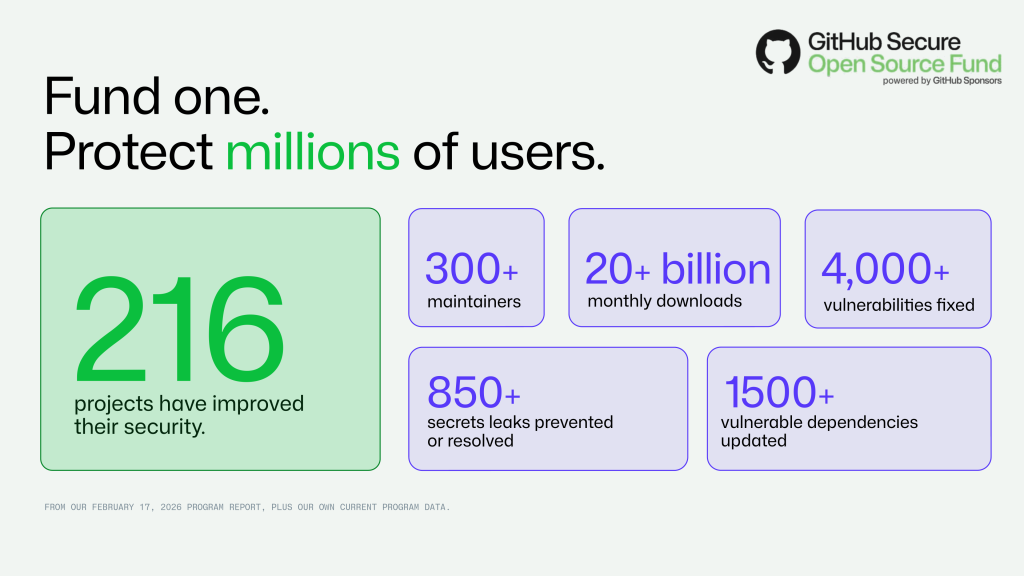
下游的每个人都能从这个系统中受益。当维护者在 GitHub 上发布安全公告,并且该公告经过审核进入 GitHub Advisory Database 后,Dependabot 就能向依赖该软件包的仓库发出告警。这正是 GitHub Secure Open Source Fund 背后的理念:截至目前已有 216 个项目参与,300 多位维护者修复了 4,000 多个漏洞,而这些软件每月的下载量超过 200 亿次。
感谢 AutoGPT、Caddy、Express、FastMCP、ImageMagick 和 Netty 的维护者:感谢你们付出的时间、信任与反馈。同时也感谢 Microsoft Security 的代号 MDASH 团队、MAI Cyber 团队、Microsoft FORGE Lab 的研究人员以及 GitHub Security Lab。
修复工作由维护者完成。我们的职责是确保他们永远不必独自承担。
听听维护者们讲述他们使用代号 MDASH 的体验。👇
本次试点中的六个项目都是 GitHub Secure Open Source Fund 的往届成员,该基金通过 GitHub Sponsors 为每个项目提供 10,000 美元,此外还有安全培训和互助的往届成员社区。
由 GitHub Sponsors 提供支持的 GitHub Secure Open Source Fund,为那些支撑数字供应链、推动创新、对 AI 技术栈至关重要的开源项目提供资金。想让你的公司帮助保障其所依赖的开源软件的安全?请通过基金页面成为资助伙伴。了解该基金的更多信息或提交申请。
通过该基金,维护者可以从 Microsoft for Startups 获得安全培训和 Azure 额度。这项支持与 Microsoft 的欧洲安全计划及其“安全未来倡议”(Secure Future Initiative)并行,后者的原则是安全高于一切。大多数组织同样处于下游位置。如果你的软件依赖开源,也请照做:支持你所依赖的维护者。
AI、机器学习和智能系统
ACI.dev • AlbumentationsX • ArviZ • AutoGPT/GravitasML • CAMEL-AI • Caracal • CocoIndex • Code-Graph-RAG • CodeCarbon • Cognee • Deep Agents • DIPY • DocsGPT • FastMCP • Jupyter • LadybugDB • LangChain • Matplotlib • n8n-MCP • Nasiko • NumPy • Ollama • ONNX • OpenBB Platform • OpenClaw • OpenCV • OpenMetadata • OpenSearch • PageIndex • pandas • Pydantic • PyMC • Ruby-OpenAI • Scenic • scikit-learn • SciPy • Serena • TokenOps • TraceRoot • Zeus
构建系统、供应链和发布工具
Apache Airflow • Babel • Bluefin • bootc • Browserslist • Changesets • Colima • Concourse • Cucumber • CycloneDX Python Library • Flux • Foundry • Gitoxide • golangci-lint • GoReleaser • hardhat-deploy • Jenkins • JReleaser • Jupyter Docker Stacks • NixOS/Nixpkgs • node-lru-cache • oapi-codegen • PostCSS • PyPI/Warehouse • rimraf • Task • Termux • Terra • Turborepo • Warpgate • webpack • zizmor
核心编程语言、运行时和基础库
Apache Commons • Apache Groovy • Byte Buddy • core-js • CPython • FS2 • Gleam • Himmelblau • htmx • LLVM • modernc.org/sqlite • NAPI-RS • Node.js • Pkl • Pyodide • Rustls • termcolor • time-rs
开发者工具与生产力平台
AirQo • API Dash • ArduPilot • AssertJ • AsyncAPI Initiative • Bevy • Bootstrap • calibre • Charset Normalizer • Cheerio • Ciphey • Cobra • CodeRunner • CSS Declaration Sorter • DataJourney • Diesel • DIGIT • Electron • ERPNext • fabric.js • GitPython • Hoppscotch • ImageMagick • jQuery • js-yaml • jsoup • JUnit • libyt • LORIS • MapStruct • Mastodon • Mathesar • Mautic • Mermaid • MessageFormat • Mockoon • NativeScript • Next.js • Nuxt • nvm • Oh My Zsh • p5.js • Path-to-RegExp • Pelias Geocoder • Pest • Pillow • Polly • Proyecto Respira • PypeIt • python-benedict • qs • React Starter Kit • Readest • Resolve • Rocket.Chat • Selenium • shadcn/ui • Sphinx • Spyder • ssh_config • StackQL • Stirling PDF • Svelte • Thunderbird for Android • ToolJet • Two.js • Viper • virtualenv • Vuetify • Wagmi • WebdriverIO • xyflow • YAML • Yii Framework • Yjs
Web、网络、API 与基础设施服务
原文较长,译文为节选;译文由英文原文机器翻译,术语按行业惯例统一,可在文末展开原文核对。
查看英文原文(Maintainers don’t need more AI bug reports. They need fixes.)
AI has made finding potential vulnerabilities fast and cheap. Fixing them still takes human judgment, and in open source, that work falls to maintainers. Many are already flooded with AI-generated security findings, including duplicates and reports that aren’t vulnerabilities at all. Another raw scan doesn’t help them. Anyone pointing a new model at a project should ask its maintainers first and come with fixes, not just findings.
Maintainers are under intense pressure from this flood of reports. As Christian Grobmeier, a maintainer of Log4j, has put it, the AI defending open source has to be better than the AI attacking it.
AI shouldn’t add to maintainers’ workload. So, with maintainers, GitHub and Microsoft ran a pilot together: could AI help maintainers ship fixes instead of handing them more findings?
GitHub and Microsoft are using Codename MDASH, Microsoft’s multi-model agentic scanning harness, to find and fix security vulnerabilities in widely used open source software, strengthening the foundation that much of the world’s code is built on.
The process
Our pilot had two goals: send only findings that matter, and never send a maintainer an unverified finding. Here’s how it worked:
- Find. Codename MDASH, an AI system from Microsoft Security, scanned each project using Microsoft’s MAI Cyber model and suggested fixes for what it found.
- Filter. An AI triage agent from the GitHub Security Lab, built on tailored Copilot skills, removed duplicates, checked validity, and focused on high-impact bugs, so maintainers never had to review raw scan results.
- Verify. Researchers from Microsoft FORGE Lab checked every remaining finding by hand.
- Report privately. Reports reached maintainers through GitHub private vulnerability reporting, with a proof of concept and a suggested fix.
- Fix. Maintainers decided what to fix, how to fix it, and when.
Reports and fixes stayed on GitHub, where maintainers already work.
The result: Codename MDASH, using Microsoft’s MAI Cyber model, flagged thousands of possible issues across the six projects. After AI triage and hand review by seven Microsoft FORGE Lab researchers, maintainers received 99 private reports. As of November 15, they had fixed 55, and 14 of those fixes were already in a release.
Participating projects
Six projects took part, all alumni of the GitHub Secure Open Source Fund. Their maintainers agreed to the scan, received every report privately, decided what to fix, and shared what worked:
- AutoGPT, an AI agent platform
- Caddy, a web server
- Express, a web framework for Node.js
- FastMCP, a framework for building MCP servers
- ImageMagick, image processing software
- Netty, a networking framework for Java
What we learned
These lessons come from what the six projects fixed and what their maintainers chose to share. Six projects is a small sample, so read them as early lessons.
1. Fixes matter more than findings
Fixing is where maintainers spend their time. So every report arrived already checked, with a suggested fix to review, adapt, and merge. Maintainers started from a well-scoped patch, not a raw finding.
The first fixes shipped about a week after the initial scan. Caddy’s maintainers fixed all 22 of the reports they received in a week or less. Maintainers used the suggested fixes, some as written and some with changes.
AutoGPT’s maintainers had recently shipped a new check, and it was broken. The report landed three days later and pointed at the right line. They took the fix further than the suggested patch, wrote it within a day, and had it in production less than a week later.
Finding vulnerabilities is no longer our bottleneck. Fixing them is the hard part, and that depends on maintainers.
Netty maintainer
2. Codename MDASH, with researcher review, gave maintainers high-quality findings with fixes
Maintainers got a short list, not a flood. Express maintainers said the reports cut through the noise. Caddy maintainers said they surfaced obscure bugs and filled gaps that earlier reports had missed. For FastMCP, the scan went beyond what AI scanners had given them before. ImageMagick, maintained by a two-person team, received 22 reports.
AI did the finding, researchers did the checking, and maintainers stayed in charge.
One ImageMagick report looked like a kind of issue the maintainers had seen before. Its summary showed it wasn’t and pointed to the exact lines of code. They were able to push a fix in 15 minutes.
Normally, a security advisory would take us around 30 minutes to 1 hour on average to read, understand, and make a fix. It is a huge difference.
ImageMagick maintainer
Codename MDASH was able to find unknown, obscure security bugs in our project with succinct reports, and it filled in gaps from some prior reports that hadn’t been noticed.
Caddy maintainer
3. Open source still has gaps to close
The pilot worked because people did careful work at every step, and that work doesn’t scale yet. Seven researchers spent about two days per project checking findings by hand. Meanwhile, low-quality reports still reach maintainers every day.
For open source, fixes need to be delivered via private vulnerability reporting (PVR). Maintainers need to run CI/CD tests on private forks to verify those fixes. And to close the gap between defenders and attackers, maintainers need access to cyber-capable models to verify a proof of concept, before and after the fix.
The Codename MDASH scan provided unique insights into the security of our project above and beyond what AI scanners have provided us in the past
FastMCP maintainer
Why it matters
If you’re a maintainer, this approach changes what a security report costs you. A checked, private report that comes with a suggested fix takes less of your time. You shouldn’t have to triage a scanner’s output. That’s the sender’s job.
If you use AI to find vulnerabilities in open source, maintainers’ feedback points to this standard:
- Check every finding before you send it, against what the project already knows and against its threat model and security policy.
- Report it privately.
- Include a suggested fix. Let maintainers set the pace.
Features are easier and easier to ship, but in the future maintaining software will probably come down to who cares enough to manage the security.
AutoGPT maintainer
Codename MDASH is very useful for cutting through the noise of vulnerability reports.
Express maintainer
What you can do today
- If you maintain any open source project, turn on private vulnerability reporting so researchers can report security issues to you without making them public. If your project is on GitHub, turn on core security features in about two minutes with
gh-secure. - If you build on open source, turn on Dependabot alerts so you know when a dependency you use needs a security update.
- If you send AI-generated vulnerability reports to open source projects, hold them to the standard above before you send them.
- Repositories using GitHub code security can use agentic autofix to help automatically remediate their alerts with Copilot
What happens next
- Fixes, where maintainers already work. GitHub is bringing these lessons into private vulnerability reporting and security advisories, where GitHub Security Lab is already investing to reduce the burden of low-quality reports on maintainers.
- MAI Cyber 2. Today Microsoft announced MAI Cyber 2. The Codename MDASH pilot ran on the earlier MAI Cyber model. GitHub and Microsoft will keep working together to help secure open source.
- Closing the gaps, starting with the GitHub Secure Open Source Fund. We’re working with Microsoft to scale researcher review without cutting corners. GitHub will offer every alumni project AI security scans, with findings checked before they’re reported privately. Alumni also get GitHub Copilot Max. We’ll bring this support to future sessions of the Fund.
Everyone downstream benefits from this system. When a maintainer publishes a security advisory on GitHub and it’s reviewed for the GitHub Advisory Database, Dependabot can alert the repositories that depend on that package. That’s the idea behind the GitHub Secure Open Source Fund: 216 projects so far, with more than 300 maintainers fixing more than 4,000 vulnerabilities in software downloaded more than 20 billion times a month.
Thank you
To the maintainers of AutoGPT, Caddy, Express, FastMCP, ImageMagick, and Netty: thank you for your time, your trust, and your feedback. Thank you also to the Codename MDASH team at Microsoft Security, the MAI Cyber team, the researchers of Microsoft FORGE Lab, and GitHub Security Lab.
Maintainers do the fixing. Our job is to make sure they never do it alone.
Hear from maintainers about their experience with Codename MDASH. 👇
About the GitHub Secure Open Source Fund
All six projects in this pilot are alumni of the GitHub Secure Open Source Fund, which gives each project $10,000 through GitHub Sponsors, plus security training and a supportive alumni community.
The GitHub Secure Open Source Fund, powered by GitHub Sponsors, funds open source projects that underpin the digital supply chain, catalyze innovation, and are critical to the AI stack. Want your company to help secure the open source it depends on? Become a funding partner through the Fund page. Learn more about the Fund or apply.
Through the Fund, maintainers receive security training and Azure credits from Microsoft for Startups. That support sits alongside Microsoft’s European Security Program and its Secure Future Initiative, whose principle is security above all else. Most organizations are downstream in the same way. If your software depends on open source, do the same: back the maintainers you rely on.
All alumni of the GitHub Secure Open Source Fund
AI, machine learning, and intelligent systems
ACI.dev • AlbumentationsX • ArviZ • AutoGPT/GravitasML • CAMEL-AI • Caracal • CocoIndex • Code-Graph-RAG • CodeCarbon • Cognee • Deep Agents • DIPY • DocsGPT • FastMCP • Jupyter • LadybugDB • LangChain • Matplotlib • n8n-MCP • Nasiko • NumPy • Ollama • ONNX • OpenBB Platform • OpenClaw • OpenCV • OpenMetadata • OpenSearch • PageIndex • pandas • Pydantic • PyMC • Ruby-OpenAI • Scenic • scikit-learn • SciPy • Serena • TokenOps • TraceRoot • Zeus
Build systems, supply chain, and release tooling
Apache Airflow • Babel • Bluefin • bootc • Browserslist • Changesets • Colima • Concourse • Cucumber • CycloneDX Python Library • Flux • Foundry • Gitoxide • golangci-lint • GoReleaser • hardhat-deploy • Jenkins • JReleaser • Jupyter Docker Stacks • NixOS/Nixpkgs • node-lru-cache • oapi-codegen • PostCSS • PyPI/Warehouse • rimraf • Task • Termux • Terra • Turborepo • Warpgate • webpack • zizmor
Core programming languages, runtimes, and foundational libraries
Apache Commons • Apache Groovy • Byte Buddy • core-js • CPython • FS2 • Gleam • Himmelblau • htmx • LLVM • modernc.org/sqlite • NAPI-RS • Node.js • Pkl • Pyodide • Rustls • termcolor • time-rs
Developer tools and productivity platforms
AirQo • API Dash • ArduPilot • AssertJ • AsyncAPI Initiative • Bevy • Bootstrap • calibre • Charset Normalizer • Cheerio • Ciphey • Cobra • CodeRunner • CSS Declaration Sorter • DataJourney • Diesel • DIGIT • Electron • ERPNext • fabric.js • GitPython • Hoppscotch • ImageMagick • jQuery • js-yaml • jsoup • JUnit • libyt • LORIS • MapStruct • Mastodon • Mathesar • Mautic • Mermaid • MessageFormat • Mockoon • NativeScript • Next.js • Nuxt • nvm • Oh My Zsh • p5.js • Path-to-RegExp • Pelias Geocoder • Pest • Pillow • Polly • Proyecto Respira • PypeIt • python-benedict • qs • React Starter Kit • Readest • Resolve • Rocket.Chat • Selenium • shadcn/ui • Sphinx • Spyder • ssh_config • StackQL • Stirling PDF • Svelte • Thunderbird for Android • ToolJet • Two.js • Viper • virtualenv • Vuetify • Wagmi • WebdriverIO • xyflow • YAML • Yii Framework • Yjs
Web, networking, APIs, and infrastructure services
actix-web • aiohttp • Apache APISIX • Apache Shiro • Apache Solr • Apache ZooKeeper • Arkime • Caddy • cmux • Cryptomator • curl • CycloneDX .NET Library • CycloneDX cdxgen • Ente • etcd • evcc • Express • external-secrets • FastAPI • Fastify • Haraka • Helmet.js • Home Assistant • Hummingbird • jose • Keycloak • Keyshade • kgateway • Log4j • mimetype • NetBird • Netty • Oauth2 (Ruby) • OAuthlib • openapi-stack • OpenWISP • PGPainless • quic-go • ScanAPI • ScanCode • Sniffnet • Social Auth App Django • Stalwart • Starlette • UAParser.js • urllib3 • Vapor • varlock • Veramo • WebAuthn (Go) • ZITADEL
The post Maintainers don’t need more AI bug reports. They need fixes. appeared first on The GitHub Blog.
正文保留英文原文,标题与摘要由机器翻译。
原文发布于 GitHub Blog(Maintainers don’t need more AI bug reports. They need fixes.),标题、摘要与正文由机器翻译,术语按行业惯例统一,未经人工逐句校订。