将大型机 Assembler 现代化为 Java
设想一个批处理作业,几十年来每晚运行从未出错,而唯一看懂它代码的人即将退休。在为银行、保险和航空业客户服务的过程中,我们一次又一次看到这种情况。他们的 Assembler 程序仍在支撑关键业务运营,但每年能读懂这些程序的人越来越少。手工重写这些程序需要数年时间,还可能破坏早已无人记得当初为何写下的业务规则,而且依然依赖那些正在离开的同一批专家。Amazon Bedrock 和 AWS Transform 改变了这一局面。
本文介绍一套多阶段改造方法,使用 Amazon Bedrock、Kiro IDE(一款 AI 驱动的集成开发环境)和 AWS Transform,相比人工方式可帮助缩短现代化改造所需时间,同时通过校验检查点保持业务逻辑的完整性。你将学到如何系统性地从 Assembler 代码中提取业务规则,经由中间的 COBOL 阶段进行转换,并把现代化后的应用以 Java Spring Boot 服务的形式部署在 AWS 上。
在开始现代化改造流程之前,请确保你具备:
通过一套系统化的五阶段方法,你可以将紧耦合 COBOL 的传统大型机 Assembler 应用改造为面向 AWS 云构建的 Java Spring Boot 应用。这种多阶段方法先将 Assembler 转换为 COBOL 作为中间步骤,再进行 Java 改造,相比 Assembler 直接转 Java,能够降低风险,并更可靠地保留业务逻辑。中间的 COBOL 阶段提供了一种结构化、人类可读的格式,便于领域专家(SME)在最终改造前进行验证。这确保了业务规则在整个现代化过程中保持完整。以下各节将分别介绍当前的大型机架构与目标云化状态。
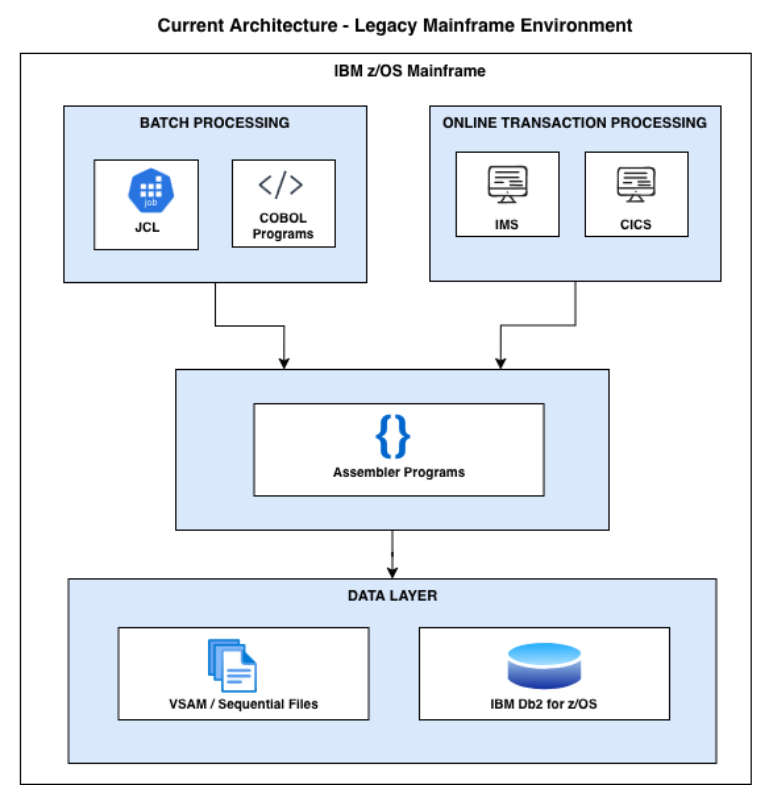
你当前的架构代表一个传统大型机环境:Assembler 程序执行批处理流程,与 COBOL 相连,与数据库交互并处理文件。其核心是,JCL(作业控制语言)作业按既定时间间隔触发 Assembler 程序执行。这些程序从 VSAM(虚拟存储访问方法)和顺序文件中读取输入,并针对 IBM Db2 for z/OS 执行操作。你的业务逻辑通过底层寄存器操作(直接操控 CPU 寄存器)和内存管理来执行。输出写回文件或数据库表,作业完成状态通过 JCL 返回码报告。所有这些都运行在 IBM z/OS 大型机基础设施之上。
图 1:大型机 Assembler 架构
该现代化改造解决方案通过多阶段、AI 驱动的工作流,帮助你将以传统大型机 Assembler 编写的应用转换为面向 AWS 云构建的 Java 应用。该架构使用 Amazon Bedrock 和 Kiro IDE 进行 AI 辅助的代码分析与业务规则提取,并使用 AWS Transform 实现 COBOL 到 Java 的自动化转换。
如果 COBOL 源代码已经存在,则可采用常规做法,直接将其提供给 AWS Transform,转换为 Java Spring Boot 应用。
借助该解决方案,你可以实现:
图 2:AWS 上端到端的 Assembler 到 Java 转换架构,展示五个主要阶段:业务规则提取、规范驱动的数据流、Assembler 到 COBOL 的转换、验证,以及 COBOL 到 Java 的转换
转换工作流首先从分析 Assembler 代码开始,以生成业务规则提取(BRE)文档。随后,你创建详细的功能规格说明,并通过人工介入(human-in-the-loop)进行细化完善。经过验证的规格说明将指导 Assembler 到 COBOL 的转换,生成中间 COBOL 代码,从而在底层硬件指令与面向业务的构造之间架起桥梁。该 COBOL 代码需通过功能等价性测试,之后 AWS Transform 再将其转换为 Java;每个阶段都设有验证检查点,以降低风险并确认业务连续性。
业务规则提取(BRE)的质量直接影响转换的准确性,因此请务必重视这一阶段。你可以通过 Kiro IDE 或 Amazon Bedrock 控制台使用 Amazon Bedrock,并结合 AWS Transform for mainframe,从 Assembler 源代码中提取并记录业务规则。
你可以通过 Chat Playground 直接在 Amazon Bedrock 中使用本文中的这些提示词,也可以在 Kiro IDE 中借助其内置的 AI 聊天和 Spec 面板使用。运行前,请将占位符替换为你实际的 Assembler 代码和上下文。
Amazon Bedrock 是前四个阶段背后的推理平台:业务规则提取、规格创建、Assembler 到 COBOL 的转换,以及验证。请选择一款具备强大代码推理能力和大上下文窗口的基础模型,因为 Assembler 程序往往冗长且密集。将 temperature 设为 0,以确保多次运行得到一致的输出。若要处理大量程序,可通过 Amazon Bedrock Converse API 调用相同的提示词,并将每次输出存入你的 Amazon S3 存储桶,以便为下一阶段提供输入。Amazon Bedrock 不会使用你的提示词或模型输出来训练 AWS 模型,也不会将其分享给第三方。详情请参阅 Amazon Bedrock 中的数据保护。请使用经过脱敏的测试数据,而不是生产数据或个人身份信息(PII)。
你提供给 AI 的上下文越多,它就越能理解代码背后的业务意图。在提示词中提供 Assembler 代码的同时,一并附上相关文档、数据字典和可用的业务上下文。
注意:请随时保存每个提示词的输出。在下一阶段中,你需要将它们作为输入使用。
用于上下文感知分析的示例提示词:
从此汇编代码中提取业务规则和数据映射。[在此粘贴你的汇编代码] ## 提取 1.业务规则:识别每一条规则,包括条件逻辑、计算、验证、转换、错误处理和循环。对于每条规则,提供:- 唯一 ID(BR001、BR002 等)- 名称和描述 - 业务目的 - 输入字段/寄存器 - 输出字段/寄存器 - 用简明英语表述的逻辑 - 触发该规则的条件 2.数据映射:识别数据转换,包括:- 源字段(寄存器或内存位置)- 目标字段(COBOL 变量名)- 转换逻辑 - 验证规则 ## 返回 JSON { "program_name": "string", "business_rules": [ { "id": "BR001", "name": "string", "description": "string", "purpose": "string", "inputs": ["array"], "outputs": ["array"], "logic": "string", "conditions": ["array"] } ], "data_mappings": [ { "source_field": "string", "target_field": "string", "transformation": "string", "validation_rules": ["array"] } ], "summary": "string" } 你可以通过添加来自业务上下文的领域特定术语来自定义此提示词。当你运行此提示词时,你将看到结构化 JSON 输出,可用于自动验证,并直接与下游转换工具集成。数据映射准确性直接影响转换质量。不完整的映射可能导致业务逻辑丢失或损坏。
将 AI 生成的 BRE 文档视为草稿,而非最终输出。在继续推进之前,让领域专家审查并验证提取出的规则。将差异记录在验证日志中,并根据 SME 反馈更新 BRE,然后再进入规格创建阶段。
为帮助 SME 验证规则,可用流程图和数据流图等可视化辅助材料来补充文本形式的 BRE 文档。维护一份验证清单,涵盖业务规则准确性、数据映射正确性、边界情况处理以及错误条件完整性。
在与 SME 共同验证业务规则之后,将其转化为详细的功能规格说明,用以指导代码转换。这种规格驱动的做法可确保在代码转换开始之前,业务需求已被清晰记录并达成一致,从而减少后期代价高昂的返工。
利用提取出的 BRE 文档,编写完整的功能规格说明,以指导 COBOL 代码生成。这些规格说明应包含程序概述、COBOL 数据结构、流程设计以及业务规则覆盖映射。
用于生成功能规格说明的示例提示词:
原文较长,译文为节选;译文由英文原文机器翻译,术语按行业惯例统一,可在文末展开原文核对。
查看英文原文(Modernizing mainframe Assembler to Java using Amazon Bedrock and AWS Transform)
Imagine a batch job that has run every night for decades without failing, and the only person who understands its code is about to retire. We have seen this situation again and again while working with banking, insurance, and airline customers. Their Assembler programs still run critical business operations, but fewer people can read them each year. Rewriting them by hand takes years, risks breaking business rules nobody remembers writing, and still depends on the same experts who are leaving. Amazon Bedrock and AWS Transform change that equation.
This post shows you a multi-stage transformation methodology using Amazon Bedrock, Kiro IDE (an AI-powered integrated development environment), and AWS Transform that can help reduce modernization time compared to manual approaches while maintaining business logic integrity through validation checkpoints. You will learn how to systematically extract business rules from Assembler code, convert them through an intermediate COBOL stage, and deploy modernized applications as Java Spring Boot services on AWS.
Prerequisites
Before starting the modernization process, make sure you have:
- Active AWS account with least-privilege AWS Identity and Access Management (IAM) permissions for Amazon Bedrock, AWS Transform, and Amazon Simple Storage Service (Amazon S3).
- Access to Amazon Q Developer or Kiro for AI-assisted code analysis.
- Access to AWS Transform for COBOL to Java conversion.
- Access to Amazon Bedrock with appropriate foundation models (FMs).
- An Amazon S3 bucket configured for source code and artifact storage, with encryption and Block Public Access enabled.
- Knowledge of the target business domain and application functionality.
- Availability of business and technical subject matter experts (SMEs) for validation sessions.
- Source Assembler code inventory with available documentation.
- Test data sets with expected outputs for functional equivalence testing.
Solution overview
You can transform legacy mainframe Assembler applications tightly bounded with COBOL into Java Spring Boot applications built for the AWS cloud through a systematic five-phase approach. This multi-stage methodology, converting Assembler to COBOL as an intermediate step before Java transformation, reduces risk and preserves business logic with greater reliability than direct Assembler-to-Java conversion. The intermediate COBOL stage provides a structured, human-readable format that subject matter experts (SMEs) can validate before final transformation. This makes sure that business rules remain intact throughout the modernization journey. The following sections describe both the current mainframe architecture and the target cloud-focused state.
Current state
Your current architecture represents a traditional mainframe environment where Assembler programs execute batch processes, connected with COBOL, interact with databases, and process files. At its core, JCL (Job Control Language) jobs trigger Assembler program execution at scheduled intervals. These programs read input from VSAM (Virtual Storage Access Method) and sequential files and perform operations against IBM Db2 for z/OS. Your business logic executes using low-level register operations (direct CPU register manipulation) and memory management. Output is written back to files or database tables, and job completion status is reported through JCL return codes. All of this runs on IBM z/OS mainframe infrastructure.
Figure 1: Mainframe Assembler architecture
Target state
The modernization solution helps you transform legacy mainframe Assembler applications into Java applications built for the AWS cloud through a multi-phase, AI-powered workflow. The architecture uses Amazon Bedrock and Kiro IDE for AI-assisted code analysis and business rule extraction, and AWS Transform for automated COBOL-to-Java conversion.
If COBOL source code is already available, you follow the conventional approach and provide it directly to AWS Transform for conversion to Java Spring Boot applications.
With this solution, you can achieve:
- Reduced transformation time compared to manual approaches.
- Systematic business logic preservation through validation checkpoints.
- Human-in-the-loop validation at critical stages.
- Automated code conversion with functional equivalence testing.
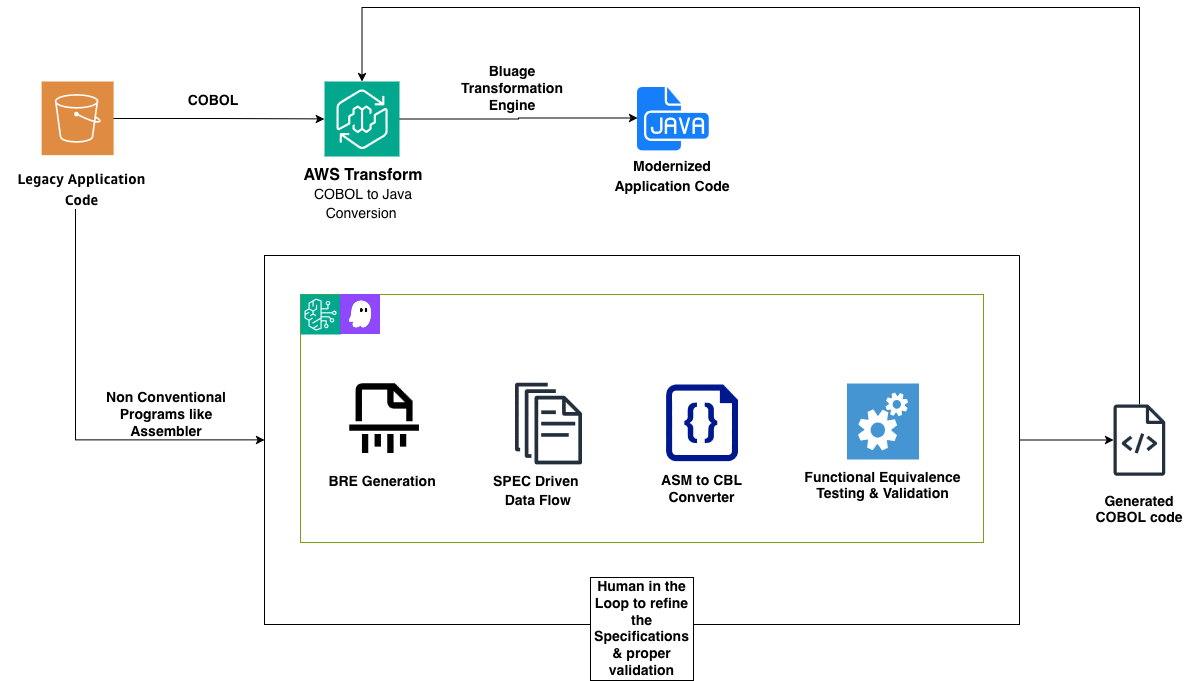
Figure 2: End-to-end Assembler-to-Java transformation architecture on AWS, showing five main phases: business rules extraction, spec-driven data flow, Assembler-to-COBOL conversion, validation, and COBOL-to-Java transformation
You begin the transformation workflow by analyzing Assembler code to generate Business Rules Extraction (BRE) documentation. You then create detailed functional specifications with human-in-the-loop refinement. The validated specifications guide the Assembler-to-COBOL conversion, generating intermediate COBOL code that bridges the gap between low-level hardware instructions and business-oriented constructs. This COBOL code undergoes functional equivalence testing before AWS Transform converts it to Java, with validation checkpoints at each phase to reduce risk and verify business continuity.
Business rules extraction with AI
The quality of your Business Rules Extraction (BRE) directly impacts transformation accuracy, so focus carefully on this phase. Use Amazon Bedrock, through Kiro IDE or the Amazon Bedrock console, along with AWS Transform for mainframe to extract and document business rules from your Assembler source code.
You can use the prompts in this post directly in Amazon Bedrock through the Chat Playground, or within Kiro IDE using its built-in AI chat and Spec panel. Replace the placeholder values with your actual Assembler code and context before running.
Amazon Bedrock is the inference platform behind the first four phases: business rules extraction, specification creation, Assembler-to-COBOL conversion, and validation. Choose a foundation model with strong code reasoning and a large context window, because Assembler programs are long and dense. Set the temperature to 0 so you get consistent output across runs. To process many programs, call the same prompts through the Amazon Bedrock Converse API and store each output in your Amazon S3 bucket so it can feed the next phase. Amazon Bedrock doesn’t use your prompts or model outputs to train AWS models or share them with third parties. For details, see Data protection in Amazon Bedrock. Use sanitized test data instead of production data or personally identifiable information (PII).
The more context you provide to the AI, the better it understands the business intent behind the code. Include relevant documentation, data dictionaries, and available business context alongside the Assembler code when prompting.
Note: Save the output of each prompt as you go. You will need them as inputs in the next phase.
Example prompt for context-aware analysis:
Extract the business rules and data mappings from this Assembly code.
[PASTE YOUR ASSEMBLY CODE HERE]

## EXTRACT

1.Business Rules: Identify EVERY rule including conditional logic, calculations, validations, transformations, error handling, and loops.

For each rule provide:
- Unique ID (BR001, BR002, etc.)
- Name and description
- Business purpose
- Input fields/registers
- Output fields/registers
- Logic in plain English
- Conditions that trigger the rule

2.Data Mappings: Identify the data transformations with:
- Source field (register or memory location)
- Target field (COBOL variable name)
- Transformation logic
- Validation rules

## RETURN JSON
{
"program_name": "string",
  "business_rules": [
    {
      "id": "BR001",
      "name": "string",
      "description": "string",
      "purpose": "string",
      "inputs": ["array"],
      "outputs": ["array"],
      "logic": "string",
      "conditions": ["array"]
    }
  ],
  "data_mappings": [
    {
      "source_field": "string",
      "target_field": "string",
      "transformation": "string",
      "validation_rules": ["array"]
    }
  ],
  "summary": "string"
}
You can customize this prompt by adding domain-specific terminology from your business context. When you run this prompt, you will see structured JSON output that you can use for automated validation and direct integration with downstream transformation tools. Data mapping accuracy directly affects conversion quality. Incomplete mappings can lead to lost or corrupted business logic.
Validate with SMEs
Treat AI-generated BRE documents as drafts, not final outputs. Have subject matter experts review and validate the extracted rules before moving forward. Document discrepancies in a validation log and update the BRE based on SME feedback before proceeding to specification creation.
To help SMEs validate the rules, supplement textual BRE documents with visual aids like flowcharts and data flow diagrams. Maintain a validation checklist covering business rule accuracy, data mapping correctness, edge case handling, and error condition completeness.
Extracting spec-driven data flow
After you validate business rules with SMEs, translate them into detailed functional specifications that will guide code conversion. This spec-driven approach confirms that business requirements are clearly documented and agreed upon before code transformation begins, reducing costly rework later.
Use the extracted BRE documents to create complete functional specifications that guide COBOL code generation. These specifications should include program overview, COBOL data structures, process flow design, and business rules coverage mapping.
Example prompt for functional specification generation:
Generate a complete functional specification for COBOL code generation based on the following Business Rules Extraction (BRE).

[PASTE THE BRE JSON HERE]

Create a comprehensive specification including:

## 1. PROGRAM OVERVIEW
- Program purpose and key functionality
- Business rules coverage summary

## 2. COBOL DATA STRUCTURES
Design data structures with:
- COBOL naming: UPPERCASE-WITH-HYPHENS
- Appropriate PIC clauses:
  * PIC 9(n) / S9(n) for integers (S for signed)
  * PIC 9(n)V9(m) / S9(n)V9(m) for decimals
  * PIC X(n) for alphanumeric, PIC A(n) for alphabetic
  * COMP-3 for packed decimal (efficient storage)
- Hierarchical levels (01, 05, 10, 15)
- 88-level condition names for flags

Include:
- The fields from business rules (inputs/outputs)
- The fields from data mappings (source/target)
- Additional fields for calculations, flags, error handling

## 3. PROCESS FLOW DESIGN
Create step-by-step process flow with:
- Sequential procedure steps (initialization → processing → output)
- Decision points and validation steps
- Calculation sequences and error handling

For each step specify:
- Step number and name
- Description
- Business rules implemented (BR IDs)
- Input/output data

## 4. BUSINESS RULES COVERAGE MAP
Map each business rule to:
- Implementation location (procedure/paragraph name)
- Data structures used
- Dependencies on other rules

Return as JSON:
{
  "program_name": "string",
  "overview": "string",
  "data_structures": [
    {
      "name": "WORKING-STORAGE-SECTION",
      "fields": [
        {
          "level": "01",
          "name": "FIELD-NAME",
          "type": "PIC X(10)",
          "description": "string"
        }
      ]
    }
  ],
  "process_flows": [
    {
      "step": 1,
      "name": "PROCEDURE-NAME",
      "description": "string",
      "business_rules": ["BR001"],
      "inputs": ["array"],
      "outputs": ["array"]
    }
  ],
  "business_rules_coverage": {
    "BR001": "Implementation details"
  }
}
You can adjust the data structure specifications based on your COBOL standards. When you run this prompt, you will receive a complete functional specification with full traceability from business rules to COBOL structures, ready for SME review and direct integration with Kiro for code generation.
Converting legacy Assembler to COBOL
With validated functional specifications in hand, the next phase uses these structured outputs to guide the Assembler-to-COBOL conversion. The intermediate COBOL step helps you bridge the gap between low-level hardware instructions and business-oriented constructs, which helps you verify that business logic is preserved before the final Java transformation.
Example prompt to guide the conversion:
Generate production-ready COBOL code from these specifications.

Program Name: [PROGRAM_NAME]
Assembly Code: [PASTE HERE]
Business Rules (BRE): [PASTE HERE]
Functional Specification: [PASTE HERE]

## REQUIREMENTS
- Implement the business rules from BRE with traceability comments (BR IDs)
- Use exact data structures from specification
- Follow process flow sequence with error handling

## COBOL STRUCTURE
Include: IDENTIFICATION DIVISION (PROGRAM-ID, AUTHOR, DATE-WRITTEN), ENVIRONMENT DIVISION (if needed), DATA DIVISION (WORKING-STORAGE SECTION, FILE/LINKAGE sections if needed), PROCEDURE DIVISION (main paragraph, sub-paragraphs, STOP RUN/GOBACK)

## FORMATTING (STRICT)
Columns 1-6: Sequence numbers (000100, 000200, +100)
Column 7: Indicator (* comment, - continuation, space normal)
Columns 8-11: Area A (Division/Section headers, Paragraphs, Level 01/77)
Columns 12-72: Area B (Level 05-88, statements)

Alignment:
- Level 01/77: Column 8 | Level 05-88: Column 12
- PIC clauses: Column 40 | VALUE clauses: Column 56
- Indent subordinate levels by 4 spaces
- Paragraph names: Column 8 | Statements: Column 12
- Use explicit scope terminators (END-IF, END-PERFORM)

## DATA TYPES
Numeric: PIC 9(n)/S9(n) (integer), PIC 9(n)V9(m)/S9(n)V9(m) (decimal), COMP/BINARY (indexes), COMP-3 (financial)
Alphanumeric: PIC X(n), PIC A(n)
Condition Names: 88-level for flags

## COMMENTS
1.Header(MANDATORY):
000100*****************************************************************
000200* Program: [NAME]                                               *
000300* Purpose: [Description]                                        *
000400* Generated from Assembly using BRE transformation              *
000500* Business Rules: [COUNT] | Data Mappings: [COUNT]              *
000600*****************************************************************

2.Section comments before major sections.
3.Business rule comments reference BR IDs:
002000* Implements BR001: Validate Input Numbers
002100 VALIDATE-INPUTS.

## IMPLEMENTATION
- Create dedicated paragraph per business rule with BR ID comment
- Implement exact logic from BRE, handle the conditions
- Follow process flow order using PERFORM statements
- Use IF/EVALUATE for decisions, PERFORM UNTIL/VARYING for loops
- Include error handling: validate inputs, check division by zero, verify bounds, set error flags

## OUTPUT FORMAT
CRITICAL: Return ONLY COBOL code. NO explanatory text, NO markdown blocks, NO commentary.
START with sequence-numbered header comment. END with STOP RUN/GOBACK.
You can modify the formatting requirements to match your organization’s COBOL standards. When you run this prompt, you will generate COBOL code designed to be syntactically correct, logically equivalent to the original Assembler, and fully traceable, with comments linking each code section back to specific business rules from the BRE document. Once generated, rigorously validate the COBOL code before proceeding to the final Java transformation.
Validating the transformation
You should treat testing as an ongoing activity throughout the transformation process, not only a final phase. Your functional equivalence validation between Assembler and COBOL code should employ a comprehensive testing framework that systematically evaluates syntax correctness, structural alignment, logic equivalence, data flow integrity, business rules coverage, and specification compliance.
Example prompt to guide the testing:
Perform comprehensive validation and analysis of ASM-to-COBOL translation.

Assembly Code: [PASTE HERE]
COBOL Code: [PASTE HERE]
BRE JSON: [PASTE HERE]
Spec JSON: [PASTE HERE]

## PART 1: VALIDATION

Perform 6 validation checks:

1.Syntax Check: Verify COBOL syntax (divisions, PIC clauses, statements, keywords, column alignment)
   Return: valid (true/false), errors array, warnings array
2.Structure Check: Compare program structure (sections, flow, procedures, control flow, data organization)
   Return: equivalent (true/false), score (0.0-1.0), issues array
3.Logic Check: Verify logic equivalence (conditionals, calculations, loops, error handling, edge cases)
   Return: equivalent (true/false), score (0.0-1.0), differences array
4.Data Flow Check: Verify data transformations (mappings, conversions, I/O, calculations, precision)
   Return: equivalent (true/false), score (0.0-1.0), issues array
5.BRE Coverage Check: Verify the business rules implemented (location, inputs/outputs, conditions)
   Return: coverage_score (0.0-1.0), implemented_rules array, missing_rules array, details object
6.Spec Compliance Check: Verify specification adherence (data structures, process flow, functions, data types)
   Return: compliant (true/false), score (0.0-1.0), issues array

Overall Equivalence Score: Weighted average (Syntax 20%, Structure 20%, Logic 30%, Data Flow 30%, BRE Coverage +10%, Spec Compliance +10%). Status "passed" if ≥0.7.

## PART 2: ANALYSIS

1.Quality Assessment: Classify quality (Excellent ≥0.9, Good ≥0.7, Fair ≥0.5, Poor <0.5) with description and validation status
2.Quality Metrics: Detailed scores for the 6 validation dimensions
3.Improvement Areas: Prioritized list with area name, severity (high/medium/low), issues array, priority (1-5)
4.Recommendations: Actionable suggestions per area (syntax fixes, structure alignment, logic verification, data flow corrections, missing BR implementation, spec compliance)
5.BRE Analysis: Per-rule analysis (rule_id, implemented, location, quality 1-5, deviations, notes) with overall_implementation_quality and summary
6.Code Suggestions: Specific improvements with category (Structure/Naming/Error Handling/Performance/Best Practices), suggestion, location, priority, optional example
7.Executive Summary: Quality level, equivalence score, validation status, improvement areas count, top 3 issues, key recommendations

## OUTPUT FORMAT

Return single JSON with validation and analysis objects. Include the fields: status, equivalence_score, validation_results (the 6 checks), findings, recommendations, quality_assessment, quality_metrics, improvement_areas, bre_analysis, code_suggestions, summary.
CRITICAL: Be thorough, specific (line numbers/paragraphs), actionable, honest (accurate scores), comprehensive (the rules/dimensions). Return JSON only, no explanatory text.
Generate complete validation and analysis report now.
You can customize the validation thresholds based on your quality requirements. When you run this prompt, you will receive a comprehensive validation report with actionable recommendations for addressing gaps in program structure, conditional logic, data transformations, and traceability between the original Assembler instructions and the modernized COBOL implementation.
COBOL to Java transformation
In the final phase, you use AWS Transform to automatically convert validated COBOL code into Java Spring Boot applications. Generate production-ready Java code with the intelligent refactoring in AWS Transform. This refactoring preserves the business logic validated in previous phases while introducing modern design patterns, including dependency injection, repository patterns, and service layers.
You can deploy the resulting Java applications on AWS infrastructure to achieve cloud scalability and resilience while maintaining the same business functionality as your legacy mainframe systems. This cloud-focused approach replaces monolithic mainframe architecture with modular, maintainable code that can be independently deployed, monitored, and enhanced.
For detailed step-by-step instructions, refer to the AWS Transform Refactor Workshop.
Lessons learned
When you apply this methodology in practice, here are the key lessons that can shape your approach:
- Human-in-the-loop validation is essential for transformation quality. Amazon Bedrock and Kiro IDE can help improve business rule identification, but AI-generated documents should always be treated as drafts. SME review is essential at every critical stage, not only during extraction, to catch domain-specific logic, edge cases, and business context that AI tools may overlook. This human oversight can help reduce post-deployment defects compared to automated conversion without structured checkpoints.
- The intermediate COBOL step reduces risk. You will find the multi-stage approach (Assembler to COBOL to Java) with validation checkpoints at each phase more reliable than attempting direct conversion. The intermediate step helps you verify business logic preservation before committing to the final Java transformation.
- A spec-driven methodology helps you prevent rework. Creating detailed functional specifications before code conversion catches misunderstandings early. With structured JSON specifications, you can also automate validation and direct integration with transformation tools.
- Incremental validation helps you accelerate your overall timeline. Testing after each transformation stage, rather than waiting until the end, helps you detect issues early and reduces overall rework. Quality gates at each phase help confirm the output is ready for the next stage.
Conclusion and next steps
In this post, we walked through a systematic, AI-powered approach to transform legacy mainframe Assembler applications into Java applications built for the cloud on AWS. This approach combines Amazon Bedrock and Kiro IDE for intelligent business logic extraction with AWS Transform for automated COBOL-to-Java conversion. By following a multi-stage methodology with validation checkpoints at each phase, you can help accelerate modernization timelines while preserving critical business logic integrity.
To evaluate the full service landscape and understand how the components fit together, start with the AWS Mainframe Modernization documentation. When you’re ready to see the pipeline in action, the AWS Transform Refactor Workshop walks you through the end-to-end process with sample workloads you can run in your own environment. If you’d like to discuss how this approach applies to your specific environment, contact an AWS representative.
Tell us about your modernization journey and share your thoughts in the comments.
About the authors

Abhishek Ashish
Abhishek is a Senior Delivery Consultant at AWS specializing in legacy application modernization and cloud-focused architecture design. He brings strategic expertise in transforming complex legacy systems into scalable modern solutions that drive long-term business value for enterprise customers.

Manish Roy
Manish builds software and cloud solutions at AWS, working at the intersection of AI, agentic systems, and application modernization. He designs and builds scalable, cloud-native applications and developer tooling, with a focus on helping teams modernize legacy systems and adopt generative AI patterns that deliver measurable business value. Outside of work, he enjoys playing football and riding his motorcycle.

Sravanthi Bikkina
Sravanthi is a Delivery Consultant at AWS, helping enterprise customers accelerate mainframe transformation journeys using Generative AI and cloud-focused technologies. She brings deep expertise in AWS Mainframe Modernization, COBOL-to-Java refactoring, and AI-driven migration strategies.
正文保留英文原文,标题与摘要由机器翻译。
原文发布于 AWS Machine Learning(Modernizing mainframe Assembler to Java using Amazon Bedrock and AWS Transform),标题、摘要与正文由机器翻译,术语按行业惯例统一,未经人工逐句校订。


