Duco 借 AgentCore 改造金融数据自动化
金融机构面临一项关键挑战:要以速度、准确性和合规性处理海量数据,同时还要在最严格的监管框架之一下运营。Duco 是面向金融服务的智能体式运营(agentic Operations)平台,服务对象包括一级银行及其他金融机构。它每月为 200 多家客户处理 200 亿笔交易,其中包括前 20 大银行中的 7 家和前 20 大资产管理公司中的 10 家。随着数据处理需求不断增长,为了跟上节奏,Duco 从传统机器学习模型演进到 Amazon Bedrock 和 Amazon Bedrock AgentCore 的智能体式 AI 能力。在本文中,我们分享 Duco 如何在这些服务上重建其智能体式 AI 技术栈,在缩短部署时间、降低入驻成本的同时,保持每家银行的数据相互隔离。
Duco 的平台让团队能够借助 AI 和无代码模型自动化关键任务的数据处理流程,涵盖从数据提取到下游发布的各个环节。它此前已使用传统机器学习模型进行预测性标注和模式识别,帮助银行整合并自动化了超过 20,000 个流程。
然而,这些经典机器学习方法存在固有局限。它们需要大量历史数据进行训练,面对新场景时力不从心,且每新增一个用例都需要大量定制化。最关键的是,它们无法快速适应现代金融运营中多样且不断演变的数据格式和业务规则。
“经典预测模型在一定程度上是有效的,但它们不够敏捷、不够灵活。传统机器学习模型只能放大它们已经学到的东西——它们无法帮助推进下一步,也无法发现新问题。”
—— Rob Gates,Duco 首席架构师兼创新官
Duco 做出了一项战略决策:采用 Amazon Bedrock 来以托管方式访问基础模型,并采用 Amazon Bedrock AgentCore 来规模化运行智能体。这不仅仅是技术升级,更是其系统理解、推理和处理金融数据方式的一次根本性转变。
关于 Amazon Bedrock 和 Bedrock AgentCore
Amazon Bedrock 是一项全托管服务,通过单一 API 提供来自领先 AI 公司的高性能基础模型供选择,并配备一系列广泛能力,帮助以安全、隐私保护和负责任 AI 的方式构建生成式 AI 应用。了解有关 Amazon Bedrock 的更多信息。
Amazon Bedrock AgentCore 是用于规模化构建、连接和优化 AI 智能体的平台。可使用任意开源框架和任意模型进行构建。借助内置的身份验证和访问控制,将智能体与你的工具和数据连接起来。通过追踪和评估,在生产环境中监控并改进智能体。AgentCore 负责处理基础设施,让你专注于智能体逻辑而非后端管道,同时在不牺牲开源灵活性的前提下获得企业级安全性和可靠性。
在 Amazon Bedrock AgentCore 产品页面了解更多信息。
有几个因素使 Amazon Bedrock 成为 Duco 所面对的受监管金融服务行业(FSI)环境的理想选择:
Duco 现有的智能体基础设施基于 LangChain 和 LangGraph 构建,两者均已投入生产使用。在为其智能体式工作负载评估运行时方案时,AgentCore 凭借三个关键原因成为明确之选:
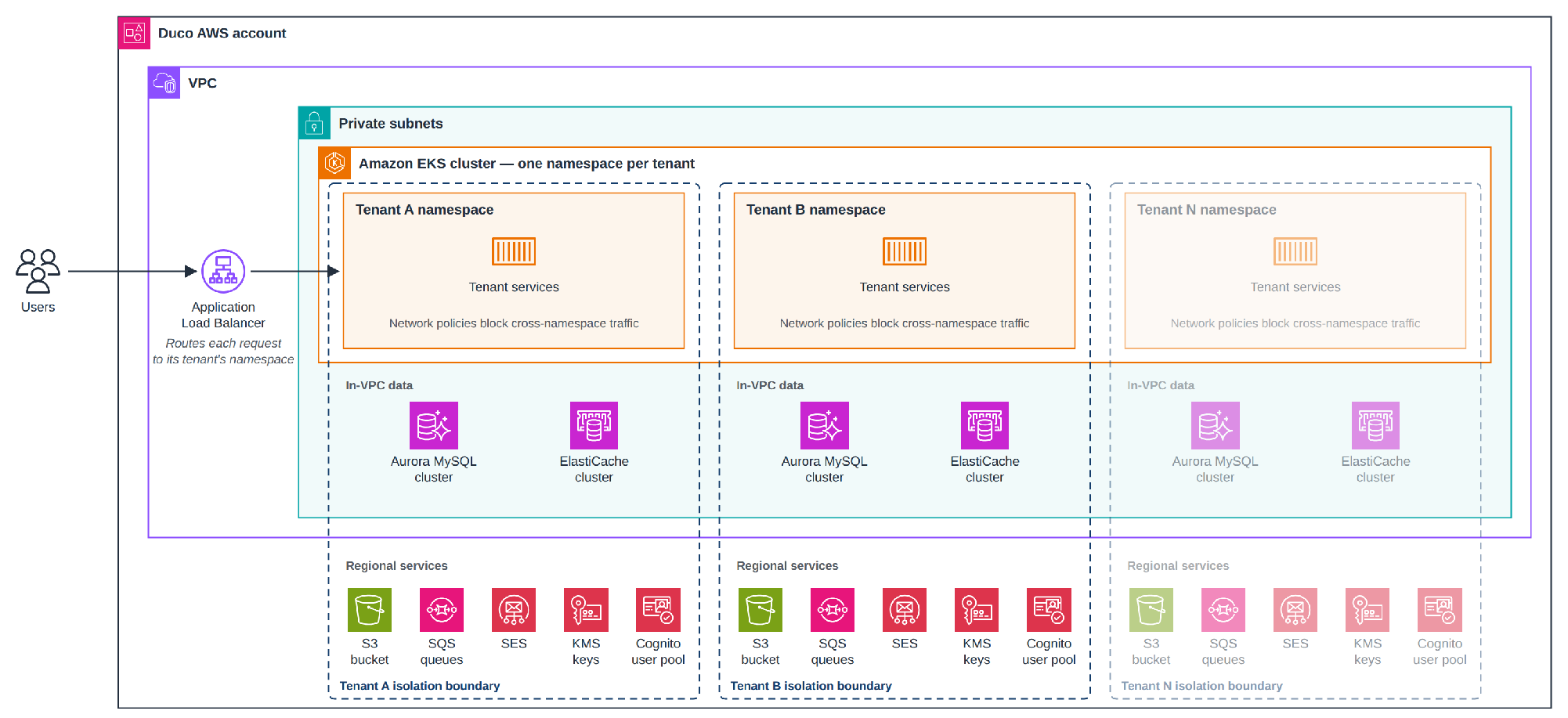
Duco 平台以多租户软件即服务(SaaS)的形式运行,具备严格的租户隔离(图 1)。对于受监管的机构而言,这是不可妥协的要求。该架构在每一层都体现了这一点,从底层云基础设施一直到 AI 智能体运行时。
图 1:多租户架构
隔离通过身份与基础设施两方面强制执行,用户与其数据之间的每一跳都经过身份验证(图 2):
隔离原则完整延伸至智能体架构中:
该架构有助于维持一种模式:每个智能体只能访问一家银行的数据、上下文和推理,从而促进跨银行上下文的真正隔离。
图 2:高层架构
Duco 并不绑定单一基础模型,而是为每项任务选用合适的模型,将其智能体设计中的每个角色分配给最适合的模型。这种方法将恰当的模型能力匹配到每个具体工作负载,从而兼顾质量与成本效率:
Anthropic Claude Opus
这种多模型方案在架构设计上允许在不中断整个技术栈的情况下更换模型,而在模型能力快速演进的当下,这一点至关重要。
Duco 最重要的技术创新之一,解决了任何构建生产级智能体系统的人都熟悉的一个难题:上下文窗口管理。
每个租户通过 AgentCore Gateway 暴露 300–400 个工具(该网关为每个底层 Duco 服务前置一个独立的 MCP server),因此在工作开始前,约有 200,000 个 Token 的工具描述被加载进上下文。这导致了上下文过载:随着对话变长,回复质量下降,模型也丢失了此前推理的线索。团队强调,仅凭“感觉智能体能力在下降”并不足以作为证据,必须在做出工程决策之前先运行评估。
Duco 利用 MCP 资源类型构建了一套技能架构,将工具描述移出静态上下文,只在需要时加载:
在 Duco 的智能体运行框架中实现的三个新元工具,取代了此前臃肿的工具描述负载:
图 3:上下文加载与 MCP 连接
一个关键的架构决策是在启动时实现 MCP 工具发现。当新服务部署时,其 MCP server 会作为部署的一部分,被注册为租户的 AgentCore Gateway 上的目标。当智能体启动时,运行框架会构建一份注册表,涵盖 Gateway 暴露的每一个工具,并且只共享工具名称。智能体随后使用 find_tool 和 invoke_tool 来发现详细信息并按需调用工具。因此,智能体自动获得该能力,无需重新部署或重新配置智能体。访问控制由底层服务自身执行:由于用户身份会通过 Gateway 传递,只有当该用户被允许执行相应操作时,每次工具调用才会成功。
这带来了运维灵活性:平台团队可以通过部署一个新的微服务向智能体交付新能力,无需改动智能体配置,也不需要停机。对于一个服务 200 多家客户、且客户运营需求多样并不断演变的平台来说,这种动态能力模型是显著的竞争优势。
Duco 实施了 Amazon Bedrock 和 Bedrock AgentCore,为两个此前需要大量人工投入的关键工作流提供支持:
此前,新增对账流程的上线是一项依赖人工、耗时的工作,需要投入大量专业服务资源。银行迁移数千个流程要耗费数年时间,速度大约为每周一个。
借助 Amazon Bedrock 和 Bedrock AgentCore,Duco 现在可以:
一家全球性银行在新对账流程的上线成本上下降了 70%,并通过更好的匹配率和分配规则,使直通处理率提升了 20% 以上。
金融机构在系统之间设置了数千道质量关卡,每天产生无数异常。传统上,大批分析师需要逐一人工排查每一处差异,以判断它是否值得关注、是否已在调查中,还是代表着一项新风险。
Duco 的智能体现在负责调查工作的“第一英里”:
这种智能体式方法之所以表现出色,是因为金融工作流涉及高度多变的信息路径,而这正是基础模型所擅长处理的复杂、重上下文的推理任务。
在金融服务领域部署 AI 智能体,仅靠技术能力远远不够,还需要严格的合规、可审计性和风险管理。Duco 基于 Amazon Bedrock 的实现通过四项核心原则满足了这些要求:
Duco 采用 Amazon Bedrock 后,在客户部署中带来了可量化、可审计的业务成效:
对账部署速度更快
客户接入成本降低
直通式处理率提升
人工调查所节省的工时
或许最重要的是,Duco 现在拥有了快速创新的基础。构建新的智能体式能力不再需要大量的机器学习工程投入,因此团队可以专注于解决业务问题,而不是管理基础设施。
Duco 的架构设计初衷并非取代员工,而是提升他们的价值。该平台设想,随着智能体式能力日趋成熟,人类角色将呈现一条清晰的演进路径:
任务执行者 → 调查人员 → 决策者
原文较长,译文为节选;译文由英文原文机器翻译,术语按行业惯例统一,可在文末展开原文核对。
查看英文原文(How Duco transforms financial data automation with Amazon Bedrock AgentCore)
Financial institutions face a critical challenge: processing massive volumes of data with speed, accuracy, and compliance while operating under some of the world’s strictest regulatory frameworks. Duco is the agentic Operations platform for financial services, serving tier-one banks and other financial institutions. It processes 20 billion transactions monthly for 200+ clients, including 7 of the top 20 banks and 10 of the top 20 asset managers. To keep pace as data processing demands grew, Duco evolved from traditional machine learning models to the agentic AI capabilities of Amazon Bedrock and Amazon Bedrock AgentCore. In this post, we share how Duco rebuilt its agentic AI stack on these services, cutting deployment time and onboarding costs while keeping each bank’s data isolated.
The challenge: Scaling intelligence in a regulated environment
Duco’s platform empowers teams to automate mission-critical data processes using AI and no-code models, handling everything from data extraction to downstream publication. It already used traditional machine learning models for predictive labeling and pattern recognition, helping banks consolidate and automate over 20,000 processes.
However, these classical machine learning approaches had inherent limitations. They required extensive historical data for training, struggled with novel scenarios, and demanded significant customization for each new use case. Most critically, they couldn’t adapt quickly to the diverse, constantly evolving data formats and business rules that characterize modern financial operations.
“The classical prediction models worked to an extent, but they weren’t agile or flexible enough. Traditional machine learning models can only amplify what they’ve already learned — they can’t help with the next step or find new problems.”
— Rob Gates, Chief Architect and Innovation Officer, Duco
The solution: Amazon Bedrock and Bedrock AgentCore
Duco made a strategic decision to adopt Amazon Bedrock for managed access to foundation models, and Amazon Bedrock AgentCore to run agents at scale. This was more than a technology upgrade. It was a fundamental shift in how its system could understand, reason about, and act on financial data.
About Amazon Bedrock and Bedrock AgentCore
Amazon Bedrock is a fully managed service that offers a choice of high-performing foundation models from leading AI companies through a single API, along with a broad set of capabilities to build generative AI applications with security, privacy, and responsible AI. Learn more about Amazon Bedrock.
Amazon Bedrock AgentCore is the platform to build, connect, and optimize AI agents at scale. Build with any open source framework and any model. Connect agents to your tools and data with authentication and access controls built in. Monitor and improve agents in production with tracing and evaluation. AgentCore handles the infrastructure so you focus on agent logic, not backend plumbing, and you get enterprise security and reliability without giving up open source flexibility.
Learn more on the Amazon Bedrock AgentCore product page.
Why Amazon Bedrock?
Several factors made Amazon Bedrock the ideal choice for Duco’s regulated financial services industry (FSI) environment:
- Security and compliance first: With Amazon Bedrock, customer data stays within the AWS environment, and it is not used to train models. With private endpoints in its virtual private cloud (VPC), Duco can connect to internal systems while keeping them completely isolated, which matters for sensitive financial data processing.
- Model flexibility: Access to leading foundation models from the Amazon Nova 2 family, Anthropic, OpenAI, Cohere, Meta, and Mistral AI through a single API means Duco can choose the right model for each task. Duco can switch between models by changing a configuration parameter.
- Built for financial services: Amazon Bedrock provides the robust governance controls and compliance frameworks that financial services require, avoiding infrastructure complexity while maintaining the security standards tier-one banks demand.
Choosing AgentCore as the runtime
Duco’s existing agent infrastructure was built on LangChain and LangGraph, both of which were already in production. When evaluating runtime options for its agentic workloads, AgentCore emerged as the clear choice for three key reasons:
- Compatibility with existing primitives: AgentCore is fully compatible with Duco’s existing LangChain and LangGraph code, so most existing code continued to work without modification.
- Managed runtime: Instead of Duco running its own agent infrastructure, AgentCore provides a fully managed runtime, reducing operational overhead for the engineering team.
- Regulated environment suitability: AgentCore met the stringent requirements of deploying in regulated financial services environments, with built-in security and compliance controls.
Multi-tenant architecture: Isolation by design
Duco’s platform operates as a multi-tenant software as a service (SaaS) offering with strict tenant isolation (figure 1). This is a non-negotiable requirement for regulated institutions. The architecture reflects this at every layer, from the underlying cloud infrastructure right up to the AI agent runtime.
Figure 1: Multi-tenant architecture
Infrastructure layer
- Amazon Elastic Kubernetes Service (Amazon EKS) clusters with namespace-per-tenant isolation and network segregation help maintain workload separation at the Kubernetes layer.
- Per-tenant dedicated AWS services: every tenant receives a dedicated Amazon Aurora MySQL database, Amazon Simple Storage Service (Amazon S3) storage bucket, AWS Key Management Service (AWS KMS) encryption keys, Amazon Simple Email Service (Amazon SES) and Amazon Simple Queue Service (Amazon SQS) messaging stack, Amazon ElastiCache layer, and Amazon Cognito user pool. Zero shared data infrastructure across clients.
- Per-tenant autoscaling helps minimize the impact of one client’s compute-intensive workload on another tenant’s performance.
Security and access control
Isolation is enforced through identity as well as infrastructure, with every hop between the user and their data authenticated (figure 2):
- Tenant-scoped authentication: every request carries a JSON Web Token (JWT) issued by the tenant’s dedicated Cognito user pool, validated by the inbound authorizer of the AgentCore runtime, a capability of Amazon Bedrock AgentCore, before agent logic runs.
- Gateway-mediated tool access: agents reach tools only through the tenant’s dedicated AgentCore Gateway, a capability of Amazon Bedrock AgentCore, which passes calls through to the tenant’s container-based Model Context Protocol (MCP) services running in Amazon EKS.
- End-to-end user identity: the user’s identity is passed through to downstream services, and each MCP server validates both the agent’s and the user’s identity against the tenant’s Cognito user pool, so every tool call is authorized as the calling user, made by a trusted agent.
- Private networking: tenants share a VPC and Amazon EKS cluster, segregated by namespace and network policy, with private endpoints keeping traffic to Amazon Bedrock and AgentCore on the AWS network. Each tenant’s AgentCore runtime runs in VPC network mode, with network interfaces in the private subnets, so its outbound traffic enters the VPC and is governed by security groups.
Agent layer
The isolation principle extends fully into the agent architecture:
- One AgentCore runtime and Gateway per tenant: each tenant is served by a dedicated runtime and Gateway, configured against that tenant’s own Cognito user pool and Amazon EKS namespace. Combined with the built-in session isolation of AgentCore, this means there is no shared memory, context, or tooling between clients. Each bank’s unique schemas, naming conventions, and institutional knowledge remain completely isolated from other tenants.
- Per-tenant MCP servers: each tenant has its own set of MCP servers providing service-specific capabilities, dynamically discovered at boot time.
The architecture helps maintain a model where each agent only has access to one bank’s data, context, and reasoning, facilitating real isolation of context across banks.
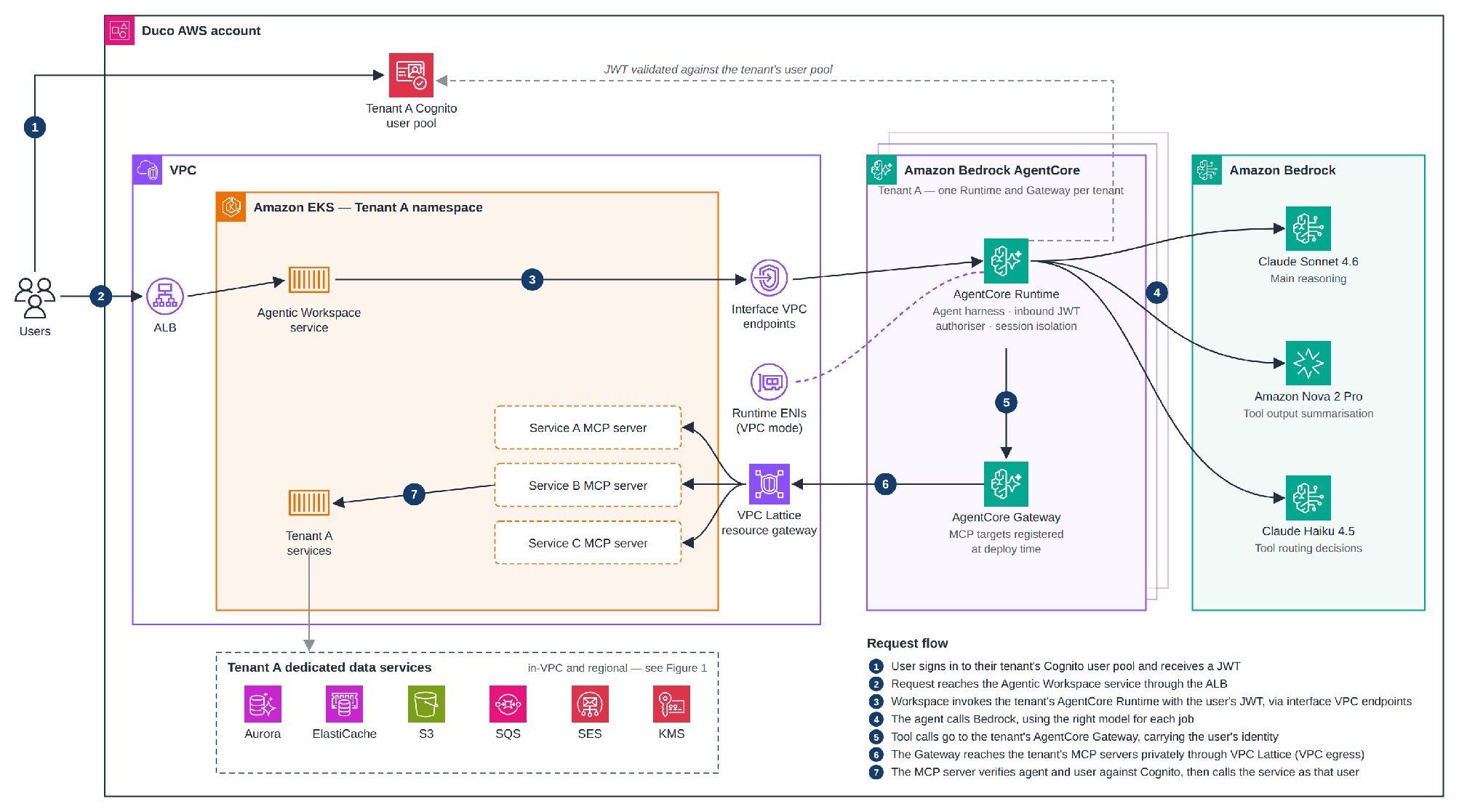
Figure 2: High-level architecture
Multi-model strategy
Rather than committing to a single foundation model, Duco uses the right model for each job, assigning each role in its agent design to the model best suited to it. This approach delivers both quality and cost efficiency by matching the right model capability to each specific workload:
| Model | Primary role | Use cases |
| Anthropic Claude Opus |
Planning agent | For complex reasoning and understanding, formulating up front plans for other agents to execute on |
| Anthropic Claude Sonnet | Main reasoning & complex decision-making | Exception investigation, reconciliation logic, rule interpretation |
| Anthropic Claude Haiku | Lightweight tool routing decisions | Fast routing choices, low-latency classification, cost-efficient first-pass triage |
| Amazon Nova 2 Pro | Tool output summarization | Condensing MCP tool responses, generating readable summaries for analysts |
This multi-model approach is architecturally designed to allow model swapping without disrupting the stack, which is critical in a landscape where model capabilities evolve rapidly.
Solving context bloat: The MCP skills architecture
One of Duco’s most significant technical innovations addresses a challenge familiar to anyone building production agent systems: context window management.
The problem
With 300–400 tools exposed per tenant through AgentCore Gateway (which fronts a separate MCP server for each underlying Duco service), approximately 200,000 tokens of tool descriptions were loaded into context before work began. This caused context overloading: response quality degraded as conversations lengthened, and the model lost the thread of earlier reasoning. The team emphasized that a feeling an agent is becoming less capable isn’t enough evidence on its own. Evaluations must be run before engineering decisions are made.
The solution: On-demand skills loading
Duco created a skills architecture using MCP resource types to move tool descriptions out of the static context and load them only when needed:
skill:// resources— on-demand tool descriptions loaded only when a skill is required.system:// resources— dynamic system prompt sections composed at runtime, keeping the base system prompt lean.ui:// resources— UI-specific resources, isolated from operational tooling.
Three new meta-tools, implemented in Duco’s agent harness, replaced the bloated tool description payload:
load_skill— fetches skill descriptions on demand, only when the agent determines a skill is needed.find_tool— locates relevant tools without loading all schemas into context.invoke_tool— executes the selected tool once identified.
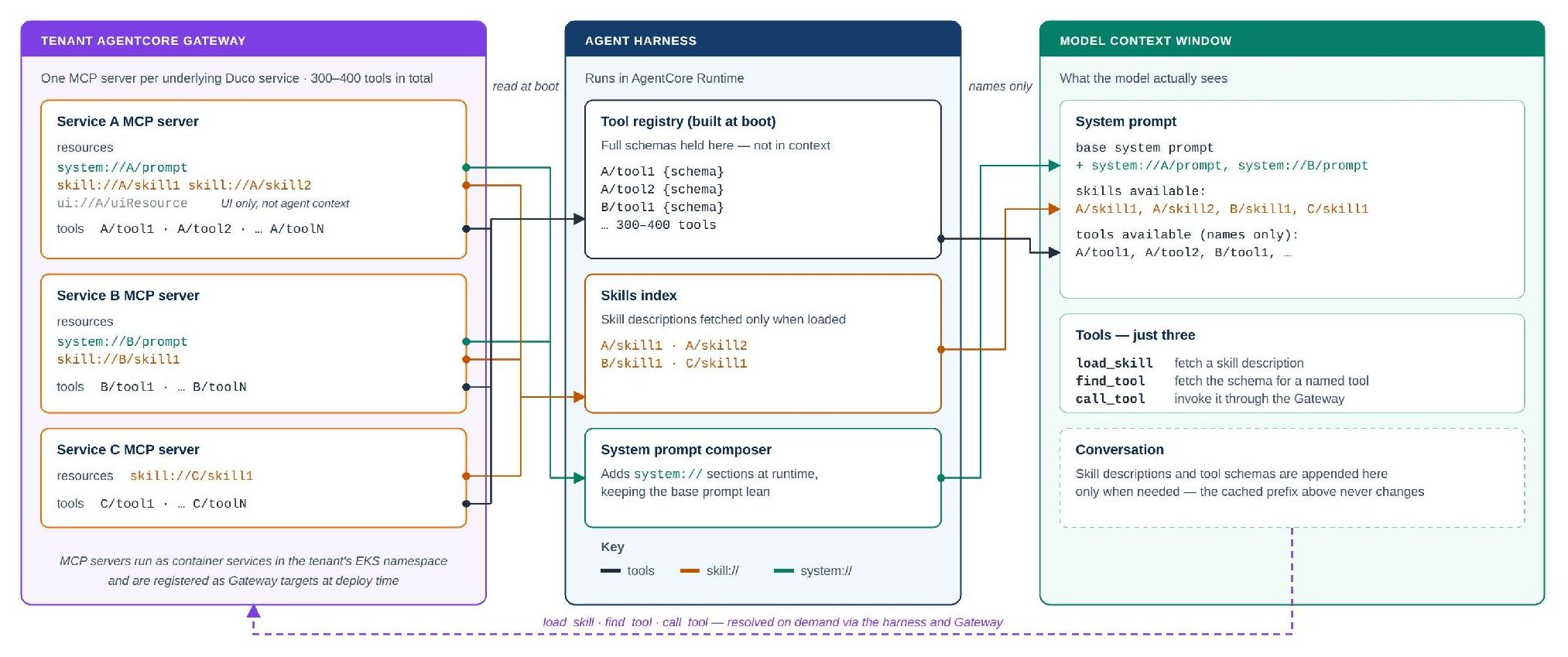
Figure 3: Context loading and MCP connectivity
The results
- 90% context reduction: Main context reduced from 200,000 tokens to approximately 20,000 tokens by moving tool descriptions out of static context and limiting the size of tool responses.
- Prompt caching preserved: the static prompt prefix (system prompt plus the three meta-tools) stays small and stable, and skills load into the conversation rather than the tool list, so loading a skill does not invalidate the cache.
- Measurably improved agent response quality: validated through a rigorous evaluation framework.
- Zero infrastructure changes required: same underlying models, same tools, and same tasks, with measurably better outcomes.
MCP tool discovery: Deploy a service, gain a capability
A key architectural decision was implementing MCP tool discovery at boot time. When a new service is deployed, its MCP server is registered as a target on the tenant’s AgentCore Gateway as part of the deployment. When an agent boots, the harness builds a registry of every tool the Gateway exposes and shares just the tool names. The agent then uses find_tool and invoke_tool to discover the details and invoke tools on demand. As a result, the agent automatically gains that capability with no redeployment or agent reconfiguration required. Access control is enforced by the underlying services themselves: because the user’s identity is passed through the Gateway, each tool call succeeds only if that user is permitted to perform the action.
This provides operational agility: the platform team can ship new capabilities to agents by deploying a new microservice, without touching the agent configuration or requiring downtime. For a platform that serves 200+ clients with diverse and evolving operational needs, this dynamic capability model is a significant competitive advantage.
Deploying agents at scale
Duco implemented Amazon Bedrock and Bedrock AgentCore to power two critical workflows that previously required extensive manual effort:
1. Intelligent onboarding
Previously, onboarding new reconciliation processes was a manual, time-intensive exercise requiring significant professional services resources. Banks would take years to migrate thousands of processes, moving at a pace of roughly one per week.
With Amazon Bedrock and Bedrock AgentCore, Duco can now:
- Automatically understand diverse file formats and data structures across legacy and modern systems.
- Translate legacy configurations from existing systems into structured Duco processes.
- Parse complex spreadsheet macros written decades ago that no one fully understands.
- Deploy new reconciliations 10× faster than before.
One global bank experienced a 70% decrease in onboarding costs for new reconciliations and achieved an increase of over 20% in straight-through processing through better match rates and allocation rules.
2. AI-driven exception investigation
Financial institutions run thousands of quality gates between systems, generating countless exceptions daily. Traditionally, armies of analysts manually investigate each break to determine if it’s worth worrying about, already being investigated, or represents a new risk.
Duco’s agents now handle the “first mile” of investigation:
- Triage new breaks as they arrive, grouping related exceptions that share a likely root cause.
- Check context, such as whether a break is already known, already being worked, or a timing difference expected to clear.
- Investigate by pulling evidence from source data and systems to trace the root cause of each inconsistency, whether a data quality issue, a missing or late record, a mapping or reference data problem, or a genuine mismatch, and explain why it happened.
- Recommend a decision-ready case: the likely cause, a proposed resolution such as an adjustment, a rule change, or an escalation, the alternatives considered, and the supporting evidence.
- Route each case to the right analyst, who reviews the evidence and makes the final call, with every decision recorded in the audit trail.
This agentic approach excels because financial workflows involve highly variable paths through information, exactly the kind of complex, context-heavy reasoning that foundation models handle well.
Operating in a regulated environment
Deploying AI agents in financial services requires more than technical capability. It demands rigorous compliance, auditability, and risk management. Duco’s implementation on Amazon Bedrock addresses these requirements through four core principles:
- Comprehensive observability: Every agent decision is logged in a complete audit trail. Reviewers can trace each decision to check it against regulatory requirements.
- Human-in-the-loop controls: High-risk actions require explicit authorization, with clear escalation pathways for complex scenarios that exceed agent confidence thresholds.
- Fail-safe architecture: Systems default to client protection over operational efficiency, supporting safety even when agents encounter edge cases or unexpected data.
- Regulatory alignment: The platform supports workloads subject to SOC 2 and DORA requirements, with data residency controls per institution.
Results that matter
Duco’s adoption of Amazon Bedrock has delivered measurable, auditable business impact across client deployments:
| 10× Faster reconciliation deployments |
70% Reduction in onboarding costs |
20%+ Increase in straight-through processing |
1000s Hours saved in manual investigation |
Perhaps most importantly, Duco now has a foundation for rapid innovation. Building new agentic capabilities no longer requires extensive machine learning engineering, so the team can focus on solving business problems rather than managing infrastructure.
Roadmap: The future of human–agent collaboration
Duco’s architecture is designed not to replace workers, but to elevate them. The platform envisions a clear progression in human roles as agentic capabilities mature:
Task Worker → Investigator → Decision Maker
Rather than humans performing repetitive tasks, the future sees operations teams orchestrating multiple agents in parallel with humans making final approval decisions based on agent-prepared analysis. The architecture is designed to support agent-to-agent communication, including cross-firm scenarios where agents at different financial institutions could coordinate.
Conclusion
For regulated financial institutions, Duco’s architecture shows that agentic AI isn’t only viable. It’s already delivering at production scale. Duco rebuilt its agentic AI stack on Amazon Bedrock and Amazon Bedrock AgentCore, combining strict per-tenant isolation, the right model for each job, and an MCP skills architecture that cut context overhead by 90%. The results include reconciliation deployments 10× faster and, for one global bank, onboarding costs down 70% and straight-through processing up by over 20%. To build a similar multi-tenant setup, start with the Amazon Bedrock AgentCore Developer Guide, then read Building multi-tenant agents with Amazon Bedrock AgentCore on the AWS Machine Learning Blog. For the operating model behind this work, see Duco’s Agentic Operations: a new operating model for post-trade.
About the authors

Rob Gates
Rob is Duco’s Chief Architect and Innovation Officer. He is responsible for designing, building, and running software and infrastructure empowering Duco’s users. At heart, Rob loves to build and create. He is the driving force behind Duco Breakthrough Labs, which stimulates innovation across the company. He has over 20 years of experience building high-performing teams and mission-critical systems across industries. Rob joined Duco in 2017 and has held a range of engineering leadership roles. Earlier in his career, he led engineering teams at BAE Systems Applied Intelligence.

Martin Reah
Martin is a Senior Technical Account Manager working with AWS EMEA ISV customers, who is passionate about helping customers maximize the value of cloud services and sharing their success stories with the broader AWS community.

Suraj Hinduja
Suraj is a Senior Strategic Account Executive at AWS, helping software companies across the UK and Ireland scale and grow on AWS. He works with customers in fintech and a range of other sectors, partnering closely with each one to turn cloud ambition into measurable business growth.

H Jafari
H Jafari is a Strategic Solutions Architect at AWS, specializing in AI/ML and agentic AI. He works with enterprise software companies across the UK and Ireland, helping them design, build, and deliver production-ready AI solutions across a range of sectors.
正文保留英文原文,标题与摘要由机器翻译。
原文发布于 AWS Machine Learning(How Duco transforms financial data automation with Amazon Bedrock AgentCore),标题、摘要与正文由机器翻译,术语按行业惯例统一,未经人工逐句校订。