Anthropic:Claude Mythos Preview 将 MI355X 适配从最长12个月缩至3天
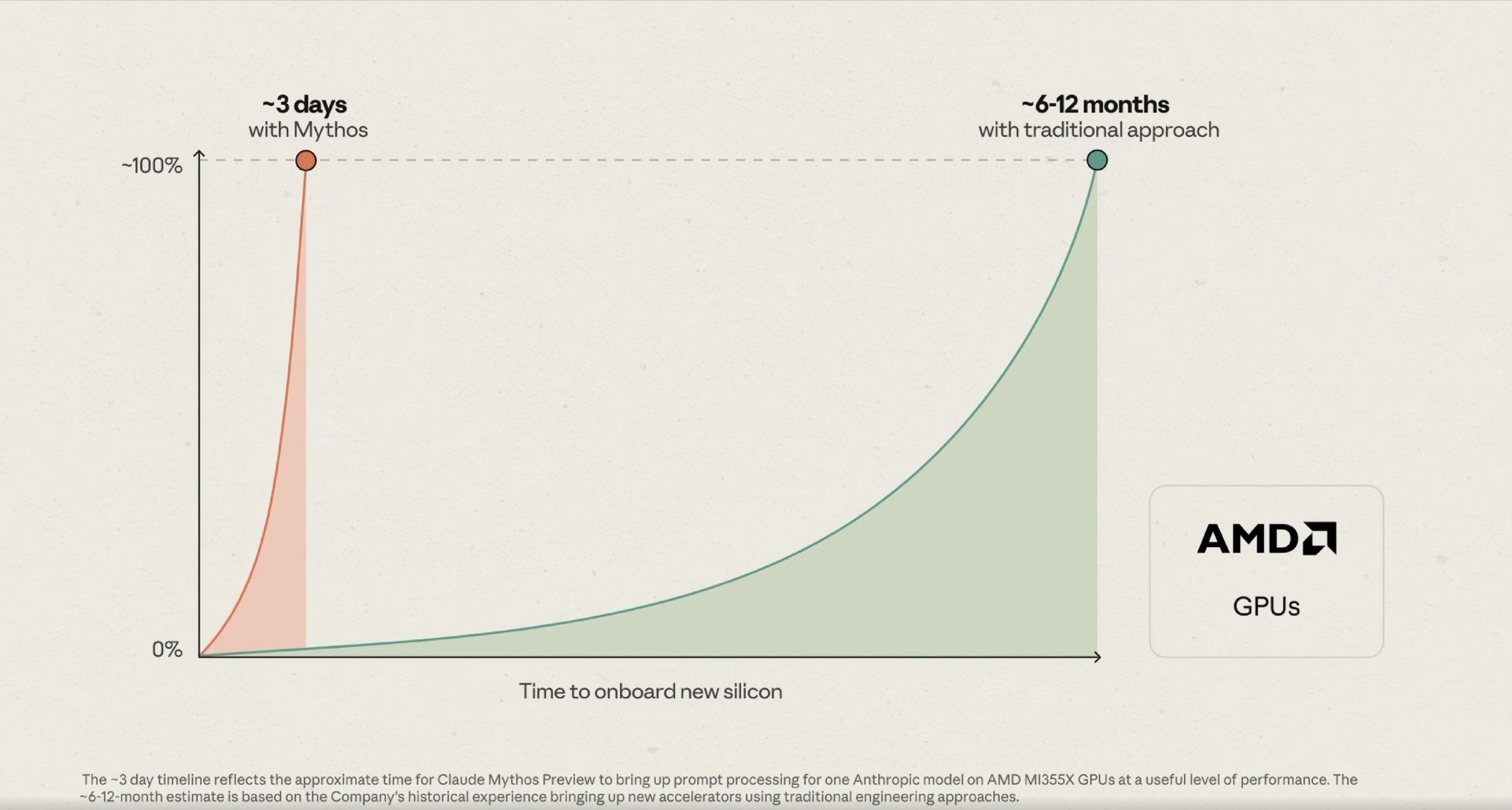
Anthropic 向 IPO 投资者表示,其 Claude Mythos Preview 模型用大约三天时间完成了让自家 AI 在 AMD GPU 上运行所需的软件工作,“基本上没有人工干预”,而这项工作过去据称需要 6 到 12 个月。这三天涵盖的是让 Anthropic 的一个模型在 AMD MI355X GPU 上“达到可用性能水平”的提示词处理,其中 Mythos 移植或编写了“几乎 100% 的内核”。这类把 AI 模型与某一家公司芯片绑定的底层代码,长期以来一直是 NVIDIA CUDA 护城河的一部分,而一个能在几天内写出这种代码的 AI,意味着这道护城河正在被侵蚀。
Anthropic 联合创始人兼首席算力官 Tom Brown 做出了这一时间对比,并向投资者指出,原先的工作意味着要动用一支“数十名工程师”的团队。该公司目前已在多种芯片上运行其模型——包括 NVIDIA 和 AMD 的 GPU、Google 的 TPU 以及 AWS Trainium——并将其算力资源作为“一个可互换的计算资源池”来管理。Brown 称早期押注多芯片是“一次非传统的赌注”。鉴于 Google 的 TPU 如今已能原生运行基于 PyTorch 构建的 AI 模型,且 Meta 已在生产中使用它们,这个赌注或许是明智的。
Anthropic 所称这项工作过去需要 6 到 12 个月,来自其以往的工作,即“采用传统工程方法引入新加速器的历史经验”,当时针对每个硬件平台定制代码是一大挑战。消除这一接入门槛后,这件事可能就简化为一个采购决策;Anthropic 今年首次开始与 AMD GPU 合作,目前已达成一项最高 2 吉瓦的协议。
CUDA 是 NVIDIA 的编程平台,问世已近二十年,非常成熟。AMD 有一个对等平台 ROCm,其编程层为 HIP。为 CUDA 编写的代码必须经过转换才能在其上运行,AMD 甚至为此打造了一款名为 HIPify 的工具。切换仍然存在转换成本,AMD 的 AI 软件副总裁 Anush Elangovan 在 4 月对 EE Times 表示:“Claude 比 HIPify 更好,因为它内置了网页搜索。”
自去年 8 月以来,AMD 一直在主张 AI 能够编写这类代码,当时它展示了一个研究智能体,其表现尚不及人类专家。同年 9 月,AMD CEO 苏姿丰(Lisa Su)在 Possible 播客上表示,许多 AI 软件都是用 CUDA 编写的,需要“翻译到 AMD”平台上,而“其中很大一部分现在都可以用软件来完成”。
到了今年 7 月,AMD 的 AI 高级副总裁 Vamsi Boppana 表示,其工程师正在使用 AI 模型生成 GPU 内核,苏姿丰说,当她询问自己的团队是否在帮助那位负责 MI355X 的 Anthropic 工程师时,得到的答复是他们不需要任何帮助。Boppana 表示,在某些情况下,生成的内核甚至“优于最精心手工调优的版本”。根据 7 月与 Anthropic 达成的协议,AMD 也在使用 Claude 为其 Instinct GPU 优化工作负载,并加速 ROCm 的开发。
在 7 月举行的 AMD Advancing AI 活动上,OpenAI 的 Philippe Tillet 表示,OpenAI 拿到其 Helios 机架后,仅凭一名工程师就在几天内确认一切都能正常运行,而且“从某种意义上说,智能体正在接管我们作为内核工程师的工作”。活动之前,AMD 企业副总裁兼数据中心 GPU 业务总经理 Andrew Dieckman 告诉记者,他几乎没有跟 AMD 的客户谈过 CUDA。
他们说了什么或展示了什么
AMD 研究人员
发布了 GEAK,一个编写 GPU 内核的 AI 智能体;面对 30 个由专家编写的内核,它正确完成了 19 个,平均速度是专家的 0.92 倍
AMD 的 ROCm 博客
苏姿丰(Lisa Su),AMD 董事长兼 CEO
被问及 AI 编程工具时表示,许多为 CUDA 编写的代码如今都可以通过软件转换到 AMD:“我们正在用软件大幅优化客户的代码,让他们能够在 AMD 上运行”
可能是播客
阿努什·埃兰戈万(Anush Elangovan),AMD AI 软件副总裁
他将 Claude 与 HIPify——AMD 用于转换 CUDA 代码的工具——作了比较:“Claude 比 HIPify 更好,因为它内置了网络搜索功能”
EE Times 采访
黄仁勋,NVIDIA CEO
“我们大量使用 AI 来生成我们所用的内核”;“没有人比我们更了解我们自己的架构”
Dwarkesh Patel 采访
安德鲁·迪克曼(Andrew Dieckman),AMD 企业副总裁兼数据中心 GPU 业务总经理
“目前这个时间点,我几乎不会和客户谈到 CUDA”
PC Gamer,来自 AMD 会前简报
Vamsi Boppana,AMD 人工智能高级副总裁
AI 辅助的 GPU 编程将“消除广泛普及所面临的任何剩余障碍”
AMD Advancing AI 主题演讲
Philippe Tillet,OpenAI
“从某种意义上说,智能体正在接管我们作为内核工程师的工作”
AMD Advancing AI 主题演讲
Tom Brown,Anthropic 联合创始人兼首席算力官
一名工程师让 Claude 启动一个 MI355X 机架,然后就让它"跑了一个周末"
AMD Advancing AI 主题演讲
Tom Brown,Anthropic 联合创始人兼首席算力官
Mythos"仅用三天就让 Claude 在 AMD 上跑了起来,基本没有人工干预";幻灯片脚注将这三天限定为针对某一个模型的提示处理
Anthropic 的 IPO 路演视频
不过,直到本周,所有这些说法都来自 AMD 或其演讲舞台,而不是 Anthropic 对自己的投资者所说。Anthropic 是芯片的买方而非卖方,且下周即将启动 IPO,因此其多芯片方案——如今至少有一些数据支撑——比芯片厂商的说法更有分量。它的招股说明书也以书面形式写明了这一点,只是没有给出具体数字:"我们接入新芯片平台所需的时间,只有过去的一小部分。"
Anthropic 在何处说过
是谁做的这项工作
它涵盖的内容
它所取代的内容
AMD 的 Advancing AI 主题演讲,7 月 23 日
一名工程师和 Claude
未说明;让其在“周末期间”保持运行
其“领先模型”在 MI355X 机架上,性能不断攀升
它所称的“一项巨大努力”
IPO 路演视频,旁白,11 月 10 日
Mythos,在“基本没有人工干预”的情况下
三天(“仅仅三天”)
让“Claude 在 AMD 上运行”;Claude“移植或编写了几乎 100% 的内核”
“耗费数十名工程师数月时间”的工作
IPO 路演视频,幻灯片脚注,11 月 10 日
Claude Mythos Preview
约三天(“约 3 天时间线”)
让某个 Anthropic 模型在 AMD MI355X GPU 上的提示处理达到可用的性能水平
6 到 12 个月(“约 6-12 个月的估计”),依据是“过去导入新加速器的历史经验”
招股说明书(S-1/A 第 2 号修订),11 月 10 日
其工程团队,“借助 Claude”
没有具体数字;“更快”
将“新的芯片平台投入生产”;未点名具体芯片
该公司所称的“持续数月的高强度工程投入”
工作负载中的提示处理(prefill)部分,是模型在开始回复之前读取并处理所收到内容的步骤,而 Anthropic 并未说明回复步骤(decode)是否也被包含在内。Anthropic 的图表横轴标注为“新芯片导入所需时间”,图中两条线都达到相同的“约 100%”标记,却没有说明这是什么的 100%。该公司也没有说明该模型在 AMD 的 GPU 上与在 Nvidia 的 GPU 上的运行速度分别是多少,而这正是我们想看到的对比,以判断 AMD 的芯片在运行 AI 编写的代码时能否与 Nvidia 的芯片匹敌。
另一方面,Nvidia CEO 黄仁勋在 4 月接受 Dwarkesh Patel 采访时表示,Nvidia 已经在其自家的内核上使用 AI,并且最了解自己的芯片——“没有人比我们更了解我们的架构”——能够将其性能发挥到极致。当被问及为何 Anthropic 等实验室使用其他加速器时,他称 Anthropic 是“一个特例,而非趋势”。Nvidia 和 AMD 等七家公司正以 IPO 价格购买 Anthropic 价值 260 亿美元的股票,因此 Nvidia 投资的正是黄仁勋称为例外的这家公司。
7月下旬,SemiAnalysis 发表了一篇题为《AMD 能打破 CUDA 的护城河吗?》的文章,其核心观点是:软件构建已不再是哪怕一年前那样的护城河。话虽如此,对 AMD 而言,问题在于:在智能体式编程中,“每个智能体都需要 GPU 来运行并测试其代码”,这意味着写代码的 AI 仍然需要硬件。在 AMD 内部,用于这类开发的 GPU 一直短缺,这拖累了 AMD,也可能成为一个新的瓶颈。
这让 CUDA 的护城河处于某种中间状态。让模型在新芯片上跑起来,曾经是最昂贵的环节,如今似乎正变得越来越便宜;而更强大的 AI 也可能削弱 Nvidia 所谓“最了解自家硬件”的说法。至于 Anthropic 的可互换算力池,其中的芯片并非完全可以互换——例如 Google 的 TPU 正变得越来越专用——而且要想充分发挥其中任何一款芯片的性能,仍然需要有硬件来做测试。护城河正在收窄,但并未消失。
原文较长,译文为节选;译文由英文原文机器翻译,术语按行业惯例统一,可在文末展开原文核对。
查看英文原文(Anthropic says Claude Mythos Preview cut AMD MI355X onboarding from up to 12 months to around three days)
Anthropic told IPO investors that its Claude Mythos Preview model did the software work required to get its AI running on AMD’s GPUs in about three days, with “basically no human intervention,” a job it says used to take six to 12 months. The three days cover prompt processing for one Anthropic model on AMD MI355X GPUs “at a useful level of performance,” with Mythos porting or writing “almost 100% of the kernels.” That kind of low-level code, which ties an AI model to one company’s chips, has long been part of Nvidia’s CUDA moat, and an AI that can write it in days would suggest that moat is eroding.
Tom Brown, Anthropic’s co-founder and chief compute officer, made the time comparison, noting to investors that the original meant using a team of “dozens of engineers.” The company already runs its models on multiple kinds of chips — on GPUs from Nvidia and AMD, Google’s TPUs, and AWS Trainium — and its fleet is managed as “one fungible pool of compute.” Brown called the early multi-chip decision “an unconventional bet.” It may have been a wise one, given that Google’s TPUs can now natively run AI models built in PyTorch, and Meta uses them in production.
Anthropic's claim that the job used to take six to 12 months comes from past work, from its “historical experience bringing up new accelerators using traditional engineering approaches,” where tailoring the code to each hardware platform was a challenge. Removing that onboarding barrier could reduce things to a purchase decision, and Anthropic started working with AMD GPUs for the first time this year, with an agreement for up to 2 gigawatts now in place.
CUDA, Nvidia’s programming platform, is very mature at nearly two decades old. AMD has an equivalent, ROCm, with HIP as its programming layer. Code written for CUDA has to be transformed to work there, and AMD even built a tool called HIPify for the process. There is still a conversion cost to switching, and AMD’s vice president of AI software, Anush Elangovan, told EE Times in April that “Claude is better than HIPify because it has web search built in.”
AMD has been making the argument that AI can write this type of code since August of last year, presenting a research agent that fell short of human experts at the time. In September of that year, AMD CEO Lisa Su said on the Possible podcast that much of AI software is written in CUDA, which needs to be “translated to AMD,” and “a ton of that can now be done in software.”
Moving forward to July earlier this year, AMD’s senior vice president of AI, Vamsi Boppana, said its engineers were using AI models to generate GPU kernels, and Su said that when she asked whether her team was helping the Anthropic engineer working on the MI355X, she was told they didn’t need any help. Boppana said that in some cases, the resulting kernels were even “better than the most manually tuned versions.” Under its July agreement with Anthropic, AMD is also using Claude to optimize workloads for its Instinct GPUs and to speed up ROCm development.
At AMD’s Advancing AI event in July, OpenAI’s Philippe Tillet said that once OpenAI got its Helios racks, a single engineer confirmed everything worked within a few days, and that “agents are taking over our jobs, in a sense, as kernel engineers.” Before the event, AMD’s Andrew Dieckman, corporate vice president and general manager of the company’s data center GPU business, told reporters that he has had practically zero conversations with AMD’s customers about CUDA.
Date | Who | What they said or showed | Where |
|---|---|---|---|
Aug. 1, 2025 | AMD researchers | Published GEAK, an AI agent that writes GPU kernels; against 30 expert-written kernels it got 19 right, at 0.92 times the experts’ speed on average | AMD’s ROCm blog |
Sept. 24, 2025 | Lisa Su, AMD chair and CEO | Asked about AI coding tools, said much of the code written for CUDA can now be translated to AMD in software: “We’re using software to significantly optimize our customers’ code so that they can run on AMD” | Possible podcast |
April 1, 2026 | Anush Elangovan, AMD vice president of AI software | Compared Claude with HIPify, AMD’s tool for converting CUDA code: “Claude is better than HIPify because it has web search built in” | EE Times interview |
April 15, 2026 | Jensen Huang, Nvidia CEO | “We use a ton of AI to create the kernels that we have”; “nobody knows our architecture better than we do” | Dwarkesh Patel interview |
July 23, 2026 | Andrew Dieckman, AMD corporate vice president and general manager, data center GPU business | “I have almost zero conversations with our customers about CUDA at this point in time” | PC Gamer, from a pre-event AMD briefing |
July 23, 2026 | Vamsi Boppana, AMD senior vice president of AI | AI-assisted GPU programming will “remove any remaining barriers to broad adoption” | AMD Advancing AI keynote |
July 23, 2026 | Philippe Tillet, OpenAI | “agents are taking over our jobs, in a sense, as kernel engineers” | AMD Advancing AI keynote |
July 23, 2026 | Tom Brown, Anthropic co-founder and chief compute officer | One engineer asked Claude to bring up an MI355X rack and left it running “over the weekend” | AMD Advancing AI keynote |
Nov. 10, 2026 | Tom Brown, Anthropic co-founder and chief compute officer | Mythos “got Claude running on AMD in just three days with basically no human intervention”; the slide footnote limits the three days to prompt processing for one model | Anthropic’s IPO roadshow video |
Until this week, though, all of this came from AMD or its stage, not from Anthropic to its own investors. Anthropic buys the chips rather than selling them, and it’s heading into its IPO next week, so its multi-chip approach — now with at least some numbers to back it up — carries more weight than a chipmaker’s claims. Its prospectus says it in writing, too, though without a number: “We can onboard new chip platforms in a fraction of the time it once took.”
Where Anthropic said it | Who did the work | How long | What it covered | What it replaced |
|---|---|---|---|---|
AMD’s Advancing AI keynote, July 23 | One engineer and Claude | Not stated; left running “over the weekend” | Its “leading model” on an MI355X rack, with performance climbing | What it called “a big effort” |
IPO roadshow video, narration, Nov. 10 | Mythos, with “basically no human intervention” | Three days (“in just three days”) | Getting “Claude running on AMD”; Claude “ported or wrote almost 100% of the kernels” | Work that “took dozens of engineers months” |
IPO roadshow video, slide footnote, Nov. 10 | Claude Mythos Preview | About three days (“~3 day timeline”) | Bringing up “prompt processing for one Anthropic model on AMD MI355X GPUs at a useful level of performance” | Six to 12 months (“~6-12-month estimate”), from “historical experience bringing up new accelerators” |
Prospectus (S-1/A No. 2), Nov. 10 | Its engineering teams, “leveraging Claude” | No figure; “more quickly” | Bringing “new chip platforms into production”; no chip named | What it calls “intense engineering effort over many months” |
The prompt processing (prefill) part of the workload is the step where a model reads and processes what it’s been given before it starts replying, and Anthropic hasn’t said whether the replying step (decode) was included as well. Anthropic’s chart, with its axis labeled “Time to onboard new silicon,” shows both lines reaching the same “~100%” mark without saying 100% of what. The company also hasn’t said how fast the model ran on AMD’s GPUs versus Nvidia’s, and that’s the comparison we want to see to show whether AMD’s chips, running AI-written code, can match Nvidia silicon.
On the other hand, Nvidia CEO Jensen Huang said in an April interview with Dwarkesh Patel that Nvidia already uses AI on its own kernels and knows its chips best — “nobody knows our architecture better than we do” — and can get the most out of them. Asked why labs like Anthropic use other accelerators, he called Anthropic “a unique instance, not a trend.” Nvidia and AMD, among seven companies, are buying $26.0 billion of Anthropic’s stock at the IPO price, so Nvidia is investing in the very company Huang called the exception.
In late July, SemiAnalysis published an article, “Can AMD break the CUDA Moat?,” which essentially said that software creation is not the same moat it was even a year ago. That said, the catch for AMD is that with agentic coding, “each agent requires GPUs to test their code against,” which means that the AI writing the code still needs the hardware. It has found a constant lack of GPUs inside AMD for this type of development, which has held AMD back and may be a new bottleneck.
That leaves CUDA’s moat somewhere in between. Getting a model running on a new chip, once the expensive part, appears to be getting cheaper, and better AI may wear down Nvidia’s claim that it knows its hardware best. As for Anthropic’s fungible pool, the chips in it aren’t fully interchangeable — Google’s TPUs are increasingly specialized, for example — and getting the most out of any of them still takes the hardware to test on. The moat is narrowing, but is not gone.
Anthropic’s first AMD MI450 chips, in Helios racks, are expected in the first half of 2027. That’s a new generation and an opportunity to see if the three-day bring-up can be repeated. Anthropic’s IPO comes sooner, after which it will report as a public company.
正文保留英文原文,标题与摘要由机器翻译。
原文发布于 Tom's Hardware(Anthropic says Claude Mythos Preview cut AMD MI355X onboarding from up to 12 months to around three days),标题、摘要与正文由机器翻译,术语按行业惯例统一,未经人工逐句校订。