推出 Gemini 4 Hydrogen

查看“产品与平台”中的全部内容
查看“创新与 AI”中的全部内容
查看“产品与平台”中的全部内容
推出 Gemini 4 Hydrogen
推出 Gemini 4 Hydrogen
Hydrogen 将前沿智能带给所有人。
Google DeepMind 高级副总裁、Google 首席 AI 架构师
您的浏览器不支持音频元素。
最后更新于 2026 年 11 月 13 日
今天,我们推出 Gemini 4 Hydrogen,将前沿智能带给每一个人——以速度和效率服务于日常编程和智能体式工作流。
我们的前沿模型 Gemini 4 Carbon 和 Gemini 4 Argon 擅长针对你最棘手的问题进行深度、长周期推理,而 Hydrogen 则是为在各类智能体式工作流中快速执行而打造。借助 Hydrogen,我们也把 Gemini 4 带给了所有人——覆盖 Google AI Studio 的所有层级、Gemini API、Gemini for business、Gemini 应用、Google Search,以及 Google Antigravity 中的付费 Google AI Pro 和 Ultra 订阅用户。
在 Artificial Analysis 智能指数上,Hydrogen 在其默认的 high 思考水平下超越了 Argon(51 对 50,并在最高的 xhigh 思考设置下达到 54),同时往往比同级别模型更快完成任务。Gemini 4 Hydrogen 在其完整的 100 万 Token 上下文窗口内实行统一价格:每百万输入 Token 1.50 美元,每百万输出 Token 7.50 美元。
释放多模型工作负载的效率
在真实的软件开发中,团队在设计系统或排查细微 bug 时会依赖 Carbon、Argon 这类前沿模型做出深入的架构判断,但他们仍然需要一个快速、严整的执行模型来编写代码、运行测试和验证改动。Hydrogen 既能作为日常工作的独立模型,也能与 Carbon 和 Argon 搭配,充当多模型工作流中的高效执行引擎。
为了让这种多模型协作实现自动化,我们在 Google Antigravity 中引入了 Orchestrator。它不再从头到尾只使用单一模型,而是在同一会话中动态地在 Carbon、Hydrogen 等模型之间切换。在 Terminal-Bench 4.0 上,Orchestrator 的任务成功率接近 Carbon,同时平均少消耗 24% 的配额、完成速度快 19%。对于需要并行智能体的工作流,Carbon 可以担任协调者,Hydrogen 则可驱动工作型与验证型智能体,在相互隔离的工作区中同时构建和测试变更——帮助团队更快交付复杂项目,而不会推高 Token 成本。
扩展开发者与企业工作流
除了多模型工作流之外,Hydrogen 对从 Gemini 3.8 Flash 迁移而来的团队来说也是一次重大的独立升级。它在速度与智能两方面都有显著跃升——在较高的默认设置下,任务完成速度快 2.5 倍,同时 Terminal-Bench 4.1 得分提升三倍以上(57% 对 18.2%),编造性陈述减少 5 倍以上,并且在工具调用失败或搜索返回为空时能够平稳适配。在其所属级别的核心开发者与企业工作流中,它也达到或超越了竞争模型:
迭代式代码仓库编程与调试:Hydrogen 能够处理问题修复、调试、快速迭代和代码库问答,进行聚焦且精准的修改——交付更简洁、可直接用于生产的代码,而不重写无关文件。在 SWE-sweep 上,它必须在不破坏现有代码的前提下发现并修复 bug,Hydrogen 的表现优于同级别模型。为高效探索大型代码仓库,该模型擅长原生并行批量执行文件读取与搜索调用,而非逐个查看文件;在针对复杂图结构、SQL 和数据密集型的企业工作流的早期测试中,我们的合作伙伴发现,与 3.8 Flash 相比,Hydrogen 的运行速度快 2 倍至 2.8 倍,同时 Token 用量减少 12% 至 23%。
开放式智能体式执行:在深度研究、数据分析和广泛的代码库导航等多步骤任务上,Hydrogen 在 arena.ai 的实时基准测试 Agent Arena 中排名第 5。在深度领域推理与分析方面,它在 HLE-Diamond 上领跑同类(58.8%),在 Vals Tax Agent Bench 上总排名第 1(52.3%),在 Vals Legal Research Bench 上并列第 1(55.8%),并在 AutomationBench-AA 上领跑同类。
多模态知识工作:Hydrogen 将原生 100 万 Token 输入与最高 100 万 Token 输出相结合,把密集的 PDF、电子表格、图表、音频和录制视频综合成精炼、带引用的报告和结构化交付成果。在面向复杂视觉文件端到端智能体式知识工作的新基准测试 Multimodal Knowledge Agent(MKA)上(53.4%),以及在面向端到端专业工作流的 Agents' Last Exam v1.1 上(71.6%),它的表现均优于其他模型。
Web 开发:在对开发者而言速度至关重要的任务上,例如实时 UI 原型设计、设计到代码的迭代以及交互式应用构建,Hydrogen 能用更少的提示生成功能更完整、特性更齐备的布局。
借助 Hydrogen 进行即时 3D 编码,Geminisland 让任何人都能通过一条提示向共享的体素岛屿中添加内容,在地图上实时生成自定义结构,玩家可以第一人称行走其中并探索。试试这个在线应用。
结合我们在 Google Antigravity 中新增的 Gemini 前端设计技能,Hydrogen 一次性构建出一个电商店面,包含 WebGL2 地形着色器、四阶段固定滚动叙事、温度分屏滑块、3D 线框规格卡片以及实时饰面配置器。试试这个在线应用和 Gemini 前端设计技能。
在 Google Antigravity 中,Hydrogen 将 Google Sheets 变成了动画像素画布:它把数千个单元格缩小,结合 Python、原生 =LET(...) 公式和条件格式,直接在实时电子表格中绘制并播放全动态画面。
从一个 YouTube 主题演讲视频和 Google Antigravity 中的一个设计模板出发,Hydrogen 直接在 Google Slides 中生成了一份多页演示文稿,随后运行自主审计与修复循环,找出重叠文本并清理每一页幻灯片的版式。
借助 Google Sheets 中的 Gemini,Hydrogen 可以帮助团队迅速把财务数据转化为交互式模型,这些模型能根据各种预测情景动态调整,在 Sheets canvas 中的生成速度比此前模型快 30% 以上。
四种思考层级带来可适应的速度与智能
我们打造 Gemini 4 Hydrogen 的目标是真实场景下的可用性。Hydrogen 的四档思考等级——low、medium、high(默认)以及新增的 xhigh 档——在质量、延迟和成本之间提供了广泛的选择,并以平滑、可预测的方式递进,让你只为任务所需的推理深度付出等待和费用。在各档思考等级下,Hydrogen 都能匹敌甚至超越同类竞品模型,同时往往更快完成任务、使用更少的输出 Token。
在 Gemini 应用和搜索中提供快速、日常的帮助
对消费者而言,Gemini 4 Hydrogen 让事情更容易办成,在多轮对话中更能保持正轨、更严格地遵循指令。
在 Gemini 应用中,Hydrogen 让你日常使用的助手更有帮助——它更善于遵循你的指引、调用正确的工具,并让你以更少的来回沟通得到可靠的结果。
开箱即用的写作、研究和日常工作:Hydrogen 严格贴合你的语气、格式和具体规则,因此邮件草稿、学习指南、改写内容和文档第一次尝试就能直接拿来用。当你比较产品或梳理密集材料时,它能把清晰的表格和可视化拆解汇总起来,而不会遗漏关键细节。
串联信息、完成更多任务:Hydrogen 将你的目标逐步拆解,从你上传的文件、Gmail 和 Google Drive 等 Google 应用,以及 Airtable 和 Dropbox 等 Connected Apps 中提取相关上下文。当你在 Gemini 中开始一项任务时,它也会更频繁地调用合适的工具和技能,帮你在勾选待办事项时节省时间。
日常原型设计与迭代:为了探索和测试想法,Hydrogen 能用更少的提示词生成干净、可运行的布局,让快速原型化和完善交互式项目变得轻松,例如将实时全球雷击数据合成为交互式 3D 地球。
从想法快速推进到可运行原型,Hydrogen 构建了一个由实时闪电驱动的交互式 3D 地球和 Web Audio 音乐引擎,并将世界各地的每一次闪电映射为视觉涟漪和实时氛围音乐。
当被要求创建一个 WebGL2 水和玻璃可视化器时,Hydrogen 仅用纯数学和 SDF 纹理就构建了它——模拟实时光的折射、反射、色散和吸收。
使用用于视频组装的定制技能,并遵循创意简报,Gemini 4 Hydrogen 制作了一段关于元素“氢”的档案式集锦片,从公共领域影像素材中取材,并将其剪辑成一段配有清晰旁白的连续成片。
Hydrogen 正在大幅升级 Search,为全球所有用户提供更有帮助、更直观的响应。
原文较长,译文为节选;译文由英文原文机器翻译,术语按行业惯例统一,可在文末展开原文核对。
查看英文原文(Introducing Gemini 4 Hydrogen)
See all in Products & platforms
See all in Innovation & AI
See all in Products & platforms
Introducing Gemini 4 Hydrogen
Introducing Gemini 4 Hydrogen
Hydrogen brings cutting-edge intelligence to everyone.
SVP, Google DeepMind and Chief AI Architect, Google
Your browser does not support the audio element.
Last updated November 13, 2026
Today, we’re introducing Gemini 4 Hydrogen, bringing cutting-edge intelligence to everyone — with speed and efficiency for everyday coding and agentic workflows.
While our frontier models, Gemini 4 Carbon and Gemini 4 Argon, excel at deep, long-horizon reasoning on your hardest problems, Hydrogen is built for rapid execution across diverse agentic workflows. With Hydrogen, we’re also bringing Gemini 4 to everyone — for all tiers of Google AI Studio, the Gemini API, Gemini for business, the Gemini app, Google Search, and paid Google AI Pro and Ultra subscribers in Google Antigravity.
Hydrogen surpasses Argon on the Artificial Analysis Intelligence Index at its default high thinking level (51 vs. 50, and reaching 54 at its highest xhigh thinking setting), while often completing tasks faster than models in its class. Gemini 4 Hydrogen is priced flat across its entire 1 million-token context window at $1.50 per million input tokens and $7.50 per million output tokens.
Unlocking efficiencies in multi-model workloads
In real-world software development, while teams rely on frontier models like Carbon and Argon for deep architectural judgment when designing systems or untangling subtle bugs, they still need a fast, disciplined execution model for writing code, running tests, and verifying changes. Hydrogen is built to stand on its own as a model for everyday work — or to pair with Carbon and Argon as the high-efficiency execution engine in multi-model workflows.
To help make this multi-model collaboration automatic, we’re introducing Orchestrator in Google Antigravity. Rather than using a single model from start to finish, Orchestrator dynamically switches between models like Carbon and Hydrogen within the same session. On Terminal-Bench 4.0, Orchestrator reached near-Carbon task success rates while, on average, consuming 24% less quota and completing 19% faster. For workflows that require parallel agents, Carbon can act as the coordinator while Hydrogen can power worker and verifier agents to build and test changes simultaneously across isolated workspaces — helping teams ship complex projects faster without driving up token costs.
Scaling developer and enterprise workflows
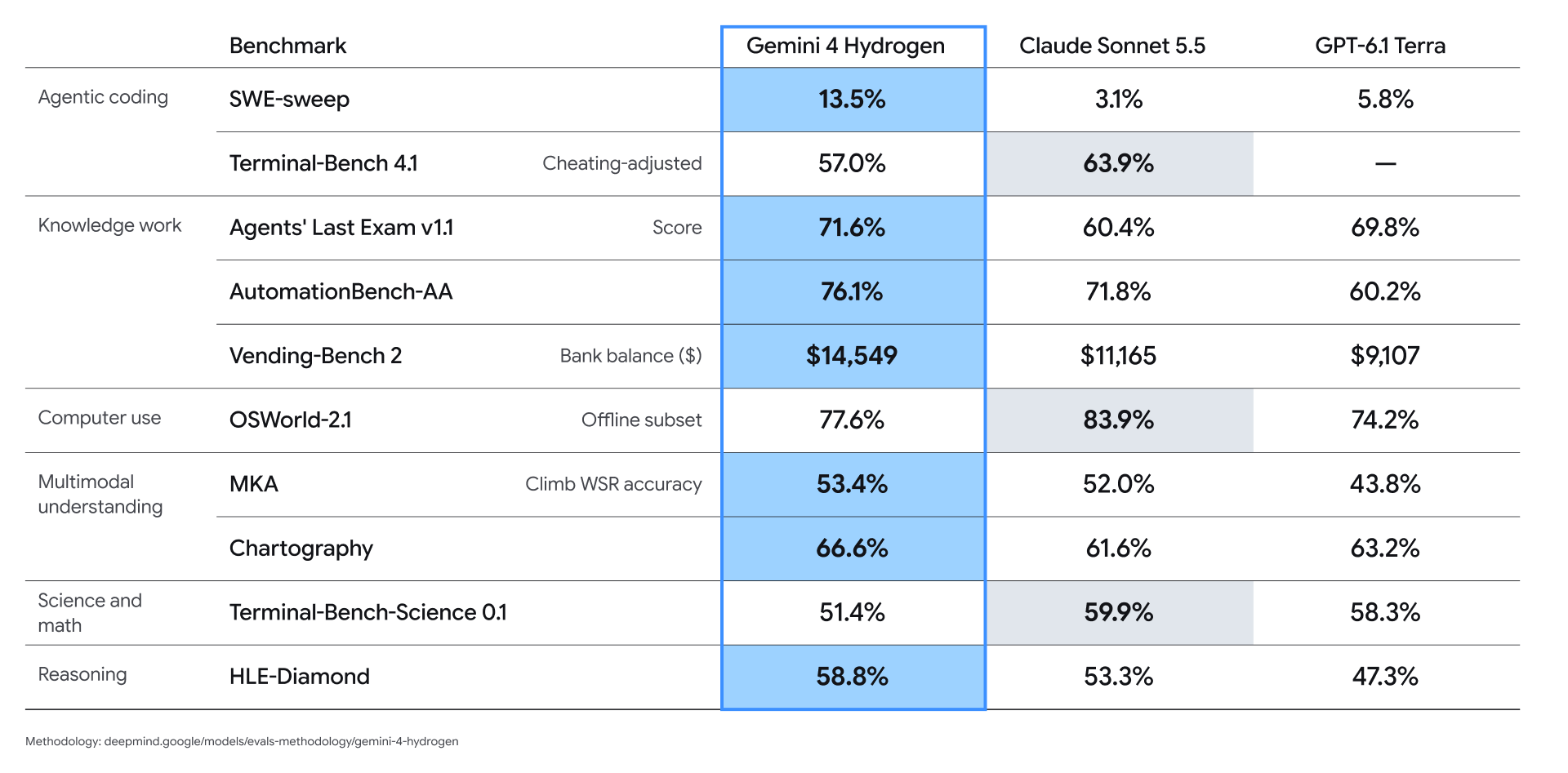
Beyond multi-model workflows, Hydrogen is a major standalone upgrade for teams migrating from Gemini 3.8 Flash. It delivers significant leaps in both speed and intelligence — finishing tasks 2.5 times faster at its high default setting while more than tripling Terminal-Bench 4.1 scores (57% vs. 18.2%), cutting fabricated claims by more than 5x, and adapting cleanly when a tool call fails or a search returns empty. It also matches or outperforms competing models in its class across core developer and enterprise workflows:
Iterative repository coding and debugging: Hydrogen handles issue resolution, debugging, rapid iteration, and codebase Q&A with focused, surgical edits — delivering cleaner, production-ready code without rewriting unrelated files. It outperforms similar-tier models on SWE-sweep where it has to discover and repair bugs without breaking existing code. To explore large repositories efficiently, the model excels at natively batching file-read and search calls in parallel rather than inspecting files one by one; in early testing across complex graphs, SQL, and data-heavy enterprise workflows, our partners have seen Hydrogen run 2x to 2.8x faster while reducing token usage by 12% to 23%, compared to 3.8 Flash.
Open-ended agentic execution: On multi-step tasks like deep research, data analysis, and broad codebase navigation, Hydrogen ranks #5 on Agent Arena, arena.ai’s live benchmark. For deep domain reasoning and analysis, it leads its class on HLE-Diamond (58.8%), ranks #1 overall on Vals Tax Agent Bench (52.3%), ties for #1 on the Vals Legal Research Bench (55.8%), and leads its class on AutomationBench-AA.
Multimodal knowledge work: Hydrogen pairs native 1 million-token input with up to 1 million output tokens to synthesize dense PDFs, spreadsheets, charts, audio, and recorded video into polished, cited reports and structured deliverables. It outperforms other models on the new Multimodal Knowledge Agent (MKA) benchmark (53.4%) for end-to-end agentic knowledge work over complex visual files, and on Agents’ Last Exam v1.1 (71.6%) for end-to-end professional workflows.
Web development: On tasks where speed matters to developers, like live UI prototyping, design-to-code iteration, and interactive app building, Hydrogen generates more functional, feature-complete layouts in fewer prompts.
Using Hydrogen for on-the-fly 3D coding, Geminisland lets anyone add to a shared voxel island from a single prompt to generate custom structures live on the map that players can walk around and explore in first person. Try the live app.
Paired with our new Gemini front end design skill in Google Antigravity, Hydrogen built an e-commerce storefront in one shot complete with a WebGL2 topographic shader, pinned four-stage scrollytelling, a thermal split-slider, a 3D wireframe spec card, and a live finish configurator. Try the live app and the Gemini front end design skill.
In Google Antigravity, Hydrogen turned Google Sheets into an animated pixel canvas by shrinking thousands of cells combining Python, native =LET(...) formulas, and conditional formatting to paint and animate full-motion scenes directly inside a live spreadsheet.
Starting from a YouTube keynote video and a design template in Google Antigravity, Hydrogen generated a multi-slide presentation directly in Google Slides, then ran an autonomous audit-and-fix loop to catch overlapping text and clean up every slide layout.
With Gemini in Google Sheets, Hydrogen can help teams rapidly turn financial data into interactive models that dynamically adjust based on various forecasting scenarios, generating outputs over 30% faster than previous models in Sheets canvas.
Adaptable speed and intelligence across four thinking levels
We built Gemini 4 Hydrogen for real-world usability. Hydrogen’s four thinking levels — low, medium, high (default), and a new xhigh tier — offer a wide range of options across quality, latency, and cost, scaling in a smooth, predictable progression so you only wait and pay for the reasoning depth a task requires. Across thinking levels, Hydrogen matches or outperforms some of the competing models in its class while often finishing tasks faster and using fewer output tokens.
Fast, everyday help in the Gemini app and Search
For consumers, Gemini 4 Hydrogen makes it easier to get things done, staying on track and following instructions more closely across multi-turn conversations.
In the Gemini app, Hydrogen makes your everyday assistant even more helpful — it’s better at following your guidance, calling the right tools, and getting you to a reliable output with less back-and-forth.
Ready-to-go writing, research, and everyday work: Hydrogen sticks closely to your tone, format, and specific rules, so email drafts, study guides, rewrites, and documents come back ready to use on the first try. When you are comparing products or synthesizing dense material, it pulls together clear tables and visual breakdowns without dropping key details.
Connects the dots and gets more tasks done: Hydrogen breaks down your goal step-by-step, pulling relevant context from your uploads, Google apps like Gmail and Google Drive, and Connected Apps like Airtable and Dropbox. When you start a task in Gemini, it also more frequently calls the right tools and skills for the job, helping save you time as you check things off your to-do list.
Everyday prototyping and iteration: For exploring and testing ideas, Hydrogen generates clean, working layouts in fewer prompts, making it easy to prototype and refine interactive projects quickly, like synthesizing real-time global lightning strike data into an interactive 3D globe.
Moving fast from idea to working prototype, Hydrogen built an interactive 3D globe and Web Audio music engine driven by real-time lightning strikes and mapped every bolt around the world into visual ripples and live ambient music.
When tasked to create a WebGL2 water and glass visualizer, Hydrogen built it from pure math and SDF textures — simulating real-time light refraction, reflection, dispersion, and absorption.
Using a custom skill for video assembly and adhering to a creative brief, Gemini 4 Hydrogen created an archival sizzle reel about the element ‘Hydrogen’, sourcing public-domain footage and cutting it into one continuous edit with clean narration.
Hydrogen is significantly upgrading Search, delivering more helpful, intuitive responses for all users globally.
Better understands your true intent: With Hydrogen, you can ask your question in your natural flow of thought — even if you have multiple parts to your query, hard-to-understand typos, or highly specific requests — and Search will intelligently comprehend what you’re looking for.
More visual responses: You’ll get highly adaptive, visual, and easy-to-scan responses that are uniquely relevant to your needs, at the speed you expect from Search.
Wider range of relevant links: With Hydrogen’s advanced reasoning, we’re also upgrading our query fan-out technique in Search, connecting you to a broader range of helpful links than before, helping you find sites you previously might not have discovered.
Designed for safe, dependable execution at scale
Gemini 4 Hydrogen brings improvements from our latest Gemini 4 safety and security stack to our broadest audience yet, combining built-in training with real-time surface safeguards to help mitigate both misalignment and misuse. Beyond foundational protections, we focused on two areas that matter most for a faster model that’s for everyday work:
Safe, aligned, and secure agentic workflows: While 3.8 Flash has strong alignment and safeguards, Hydrogen is a leap ahead. It reduces overreach in agentic tasks by up to 81% and under-service by up to 79%, and cuts misaligned actions and task shortcutting across tool-use and coding evaluations by 12x. When faced with impossible or blocked tasks, it is up to 2x less likely to bypass permission boundaries and achieves a 94% honesty rate on our internal agent honesty evaluation.
Building on our commitment to reasoning transparency, Hydrogen also preserves 99.9% chain-of-thought legibility with zero deceptive reasoning edits across more than 200,000 audited turns. Against indirect prompt injection attacks, Hydrogen is more than 2.3x more resilient on the Gray Swan IPI benchmark, while significantly improving robustness across tool use, computer use, and coding agents.
Helpful, reliable everyday interactions: Across our product surfaces, we tuned Hydrogen to make everyday conversations more reliable and safe. Our updated safeguards are also much more precise at distinguishing between real biosecurity risks and legitimate medical or scientific questions — keeping false refusals on HealthBench Pro under 0.4%.
For more details see the Gemini 4 Hydrogen model card.
Gemini 4 Hydrogen, available to everyone today
Starting today, Hydrogen is rolling out globally across our developer, enterprise, and consumer surfaces:
For developers: Build with the Gemini API in AI Studio and Android Studio, try it in AI Studio and if you’re a paid Google AI Pro or Ultra subscriber, you can try it in Google Antigravity.
For enterprises: Deploy it in Gemini for business via the API or model drop down, Google Antigravity, and in Gemini in Google Sheets for eligible business subscriptions.
For everyone: Start using it in the Gemini app model drop down 1 and in Google Search for all users, and in Gemini in Google Sheets starting with Google AI Pro and Ultra subscribers.
In the Gemini app, free users will get access to Gemini 4 Hydrogen via auto model selection when it’s the appropriate model for the prompt. Learn more here.
Koray is one of the world's foremost experts in artificial intelligence. As the SVP of Google DeepMind, he leads the development of Google DeepMind’s state-of-the art generative AI models and their integration into Google’s products at scale. Prior to his current role, he was VP of Research at Google DeepMind, where he founded the deep learning team and his team pioneered major research breakthroughs such as DQN (Deep Q-Network) and WaveNet.
Read more from Koray Kavukcuoglu
原文为英文,正文由自动抓取并保留原文。
原文发布于 Google Blog(Introducing Gemini 4 Hydrogen),标题、摘要与正文由机器翻译,术语按行业惯例统一,未经人工逐句校订。