6 种智能体式 GraphRAG 模式实践指南

第二代 RAG(标准 GraphRAG):将企业实体映射到知识图谱中,并执行静态的 Cypher 查询或全局社区摘要。这能让语言模型以结构化的基准事实为依据,但它是静态的、僵化的、被动的。在这一模式下,工程师精心编写提示词,一条单次执行的 Cypher 查询打到知识图谱上,拉取子图或相关文本块,再把检索到的上下文送入模型的上下文窗口。
静态 GraphRAG 在生产运营中有时会力不从心。以略微宽泛的条件查询一张稠密的企业图谱,会引发组合爆炸,让成千上万个无关节点塞满模型的上下文窗口。与此同时,指望 LLM 一次性生成复杂的多表连接 Cypher 查询又相当脆弱。查询往往会出现一处细微的 schema 不匹配,整个检索便一无所获。更糟的是,传统知识图谱只存储静态的领域事实,而不存储运营记忆。例如,它们或许能追踪到某位客户购买了某款产品,却几乎不记得过去的决策、委员会的豁免审批或用户偏好。这导致智能体在上下文不完整的情况下运行,无法从以往的工作流中学习,还常常把大量无关内容一并收集进来,从而推高 Token 成本。
为克服这一挑战,企业架构正转向智能体式 GraphRAG(Agentic GraphRAG)。
在智能体式 GraphRAG 中,知识图谱不再是等到提示词末尾才被查询的被动数据库。它变成了一张动态的组织知识地图,以及一张不断演进的上下文图谱(Context Graph):
智能体自主地沿着图谱一步步导航,评估关系类型,并动态决定在哪里分支或回溯。
图存储的不只是静态企业数据,还承载着企业的组织记忆与时间记忆,例如以往的业务决策、用户偏好、过往事件的解决记录以及例外情况。
智能体充当数据管家,主动监控运营遥测数据,在业务中断时计算拓扑影响范围(blast radius),并从传入文档中安全提取和添加新知识。
在我之前的文章中,我分别探讨过 GraphRAG 和 Context Layers,而本文要探讨的是如何将这些概念与自主智能体结合,构建图原生的企业智能。接下来我们看看构建企业级智能体式 GraphRAG 的六种高级架构模式。
智能体式图架构(Agentic Graph Fabric)的核心组件
要将被动的知识图谱转变为自主的、具备推理能力的智能体式图架构(Agentic Graph Fabric),需要将图操作解耦为六种功能模式:
运营记忆图(The Operational Memory Graph):一种图数据模型,将组织先例、已批准的政策豁免、委员会裁决以及历史业务例外情况捕获为一等的互联节点。
智能体式执行记忆引擎(Agentic Execution Memory Engine):一种图数据模型,捕获多轮工具调用、执行参数、错误码和经核实的执行轨迹,使智能体能够绕过已知的失败路径,执行最优的工具调用序列。
用户上下文图引擎(The User Context Graph Engine):一个不断演进的个人子图,对单个用户的组织角色、当前承担的项目任务以及过往的对话选择进行建模,提供无缝的跨会话连续性。
自我增强的拓扑与爆炸半径引擎:一张动态演进的运营图谱,将基线应用拓扑与持续采集的 ITSM 事件历史关联起来,把遥测症状与历史根因、为处置而调动的 IT 团队以及受影响的用户群体进行匹配。
分层多尺度引擎:一种多分辨率图结构,将稠密的企业拓扑组织为递归的社区簇(L0 至 L3),使自主智能体能够在高层管理摘要与细粒度原子事实之间垂直穿行。
自适应 ReAct 图谱导航器:一个增量式的横向图谱导航循环,将多跳问题求解拆解为经过验证的步骤(推理 → 行动 → 观察),沿横向实体关系推进,并在遇到死胡同时回溯。
模式 1:运营记忆图谱(组织先例与决策记忆)
在商业信贷审批、法律合同、监管合规、采购等企业领域,业务决策很少是孤立做出的,也并不总是基于预定义规则和确定性决策逻辑。它们往往受组织先例的约束。
为说明这一场景,设想一位商业信贷客户经理正在评估一家中型市场替代能源企业提出的 2500 万美元债务融资申请。借款方请求一项非标准让步,即 60 天付款期限和一项债务契约豁免。
标准的 RAG 或基础 Knowledge Graph 检索会去查阅正式政策手册:
“第 4.2 节:最长付款期限为 30 天。未经 C 级高管签字批准,严禁给予债务契约豁免。”
朴素系统建议拒绝该贷款,或触发高管升级流程,导致决策延迟两周,这可能使银行错失该机会。
然而,六个月前,该银行的高级信贷委员会曾为另一家同类公司批准了一项相同的豁免。该委员会还在这一过程中确立了一个具有约束力的先例,即如果借款人提供不可撤销的 ESG 政府补贴担保,并维持一定的偿债覆盖率(DSCR),则允许给予 60 天的豁免。
在传统架构中,该委员会的智慧要么记录在归档的 PDF 备忘录中,要么为做出决策的人所知。即使那份历史备忘录已在向量数据库中建立索引,传统搜索也常常失效。扁平语义检索无法调和严格政策规则与历史例外之间的冲突,也无法判断该委员会是否拥有可覆盖政策的治理权限,并且会在非结构化文本中产生幻觉或遗漏风险缓释因素。这种架构对企业决策而言不可靠。
运营记忆图模式(Operational Memory Graph Pattern)通过将智能体决策、工具执行和治理结果视为知识图谱(Knowledge Graph)中的相互连接节点来解决这一问题:
智能体图谱飞轮
将模糊的业务意图转化为图谱目标:借款人提交杂乱无章的 50 页信贷申请和带修订标记的合同,并附上一项让步请求,措辞为:“由于区域补贴发放周期,我们要求将付款延期至 Q3,并在债务偿付测试上给予灵活性”。智能体提取这一意图,并将其映射到标准化的图谱异常目标:(:ContractException {type: '60_DAY_COVENANT_WAIVER'})。
自主条件审计:在评估 Loan #902 时,智能体通过匹配行业板块和请求类型,检索出候选先例(Loan #881)。它检查该先例的结构性约束边(CONDITIONED_ON),该边指明这笔贷款是基于 1.25x 的 DSCR、由信贷委员会批准的。随后,这一信息作为上下文提供给决策引擎(LLM),由后者向客户关系经理呈现相应政策与例外情况。
通过记忆回写形成闭环:业务加速正发生在这里。这笔贷款不会被重新上报至高级信贷委员会。由于 Precedent #P-44 已被该委员会确立为经授权的机构先例,客户关系经理得以行使被授予的审批权限,几分钟内完成签署,而无需等待数周以排上委员会的日程。随后,智能体将执行记录写回图谱:
Loan #902 —APPROVED_UNDER→ Precedent #P-44,以及 Loan #902 —EXECUTED_BY→ RelationshipManager
Precedent #P-44 以及 Loan #902 EXECUTED_BY
这将该笔贷款接入公司的运营脉络,为全球各分支机构的未来信贷管理团队强化了先例轨迹。
用于先例检索的 Cypher 查询示例
当智能体评估 Loan #902 时,它并不只是检索静态的政策文档。它会遍历历史先例图谱:
原文较长,译文为节选;译文由英文原文机器翻译,术语按行业惯例统一,可在文末展开原文核对。
查看英文原文(A Practitioner's Guide to 6 Agentic GraphRAG Patterns)
Second-Generation RAG (Standard GraphRAG): Mapping enterprise entities into Knowledge Graphs and executing static Cypher queries or global community summaries. This grounds language models in structured ground truth, but is static, rigid, and passive. Here, an engineer crafts a prompt, a single-shot Cypher query executes against the KG, pulling subgraphs or related chunks and the retrieved context is provided to the model's context window.
Static GraphRAG sometimes falls short in production operations. Querying a dense enterprise graph with slightly broad criteria, triggers a combinatorial explosion that packs the model's context window with thousands of irrelevant nodes. At the same time, expecting an LLM to generate complex, multi-join Cypher queries in a single shot is quite fragile. Often, the query will have one subtle schema mismatch and the entire lookup will yield no result. Even worse is that traditional knowledge graphs only store static domain facts, not operational memory. For instance, they may track that a customer bought a product, but have little memory of past decisions, committee waivers, or user preferences. This results in agents operating with incomplete context, unable to learn from past workflows, often gathering large, irrelevant content thus inflating token costs.
To overcome this challenge, enterprise architectures are transitioning to Agentic GraphRAG.
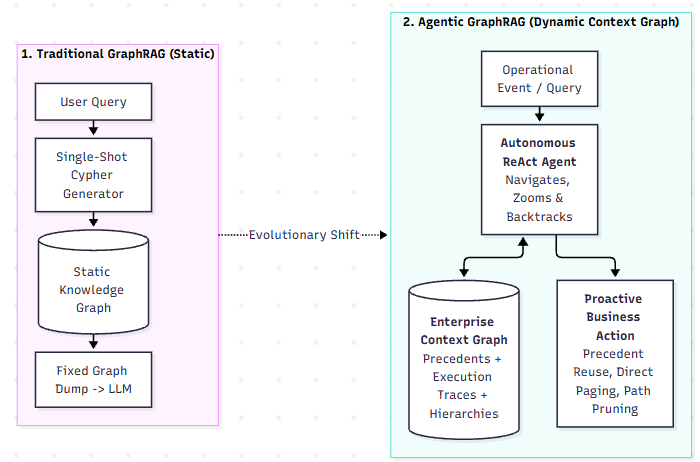
In Agentic GraphRAG, the Knowledge Graph is no longer a passive database queried at the end of a prompt. It becomes a dynamic institutional knowledge map and an evolving Context Graph:
The agent autonomously navigates the graph step-by-step, evaluating relationship types and dynamically deciding where to branch or backtrack.
The graph stores not just static enterprise data, but the firm's institutional and temporal memory, such as previous business decisions, user preferences, past incident resolutions, and exceptions.
The agent acts as a data steward, proactively monitoring operational telemetry, calculating topological blast radiuses during disruptions, and safely extracting and adding new knowledge from incoming documents.
While in my previous articles I have explored GraphRAG and Context Layers separately, here we explore how we can combine these concepts with autonomous agents to build graph-native enterprise intelligence. So let's look at six advanced architectural patterns for building enterprise-grade Agentic GraphRAG.
Core Components of the Agentic Graph Fabric
Transforming a passive Knowledge Graph into an autonomous, reasoning-ready Agentic Graph Fabric requires decoupling graph operations into six functional patterns:
The Operational Memory Graph: A graph data model that captures institutional precedents, approved policy waivers, committee rulings, and historical business exceptions as first-class connected nodes.
Agentic Execution Memory Engine: A graph data model that captures multi-turn tool invocations, execution parameters, error codes, and verified trajectories, enabling agents to bypass known failure paths and execute optimal tool sequences.
The User Context Graph Engine: An evolving personal subgraph modeling an individual user's organizational roles, ongoing project mandates, and past conversational choices, delivering seamless cross-session continuity.
The Self-Enriching Topology & Blast Radius Engine: A living operational graph that links baseline application topologies with continuously harvested ITSM incident histories, matching telemetry symptoms to historical root causes, IT teams activated for resolution, and affected user groups.
Hierarchical Multi-Scale Engine: A multi-resolution graph structure organizing dense enterprise topologies into recursive community clusters (L0 to L3), enabling autonomous agents to navigate vertically between high-level executive summaries and granular atomic facts.
Adaptive ReAct Graph Navigator: An incremental horizontal graph navigation loop that breaks multi-hop problem-solving into verified steps (Reason → Act → Observe), following lateral entity relationships and backtracking when encountering dead ends.
Pattern 1: The Operational Memory Graph (Institutional Precedent & Decision Memory)
In enterprise domains such as commercial credit underwriting, legal contracting, regulatory compliance, and procurement, business decisions are rarely made in isolation. Neither are the decisions always made based on predefined rules and deterministic decision logic. Often, they are governed by institutional precedent.
To illustrate the scenario, consider a commercial credit relationship manager evaluating a $25 million debt financing request for a mid-market alternative energy firm. The borrower requests a non-standard concession, which is a 60-day payment term and a debt covenant waiver.
A standard RAG or basic Knowledge Graph search would check the formal policy manual:
"Section 4.2: Maximum payment terms are 30 days. Debt covenant waivers are strictly prohibited without C-level sign-off."
The naive system recommends rejecting the loan or triggering an executive escalation leading to a two-week delay in decision making which might result in the loss of the opportunity for the bank.
However, six months prior, the bank's Senior Credit Committee approved an identical waiver for another such firm. The committee also established a binding precedent in the process, which is that a 60-day waiver is permitted if the borrower provides an irrevocable ESG government subsidy guarantee and maintains a certain debt-service coverage ratio (DSCR).
In traditional architectures, that committee wisdom is either recorded in an archived PDF memo or known to people who made the decision. Even if that historical memo is indexed in a vector database, traditional search often fails. Flat semantic retrieval cannot reconcile the conflict between the strict policy rule and the historical exception, or whether the committee held the governance authority to override policy, and hallucinates or drops risk mitigating factors in unstructured text. Such an architecture is unreliable for enterprise decision making.
The Operational Memory Graph Pattern solves this by treating agentic decisions, tool executions, and governance outcomes as connected nodes within the Knowledge Graph:
The Agentic Graph Flywheel
Translating Ambiguous Business Intent into Graph Targets: Borrowers submit messy 50-page credit applications and redlined contracts with a concession request as "Due to regional subsidy disbursement cycles, we require payment deferrals until Q3 and flexibility on our debt service test". The agent extracts this intent and maps it to standardized graph exception targets: (:ContractException {type: '60_DAY_COVENANT_WAIVER'}).
Autonomous Condition Auditing: When Loan #902 is evaluated, the agent retrieves candidate precedents (Loan #881) by matching the sector and request type. It inspects the precedent's structural constraint edges (CONDITIONED_ON), which specifies that the loan was approved based on a DSCR of 1.25x, by the Credit Committee. This is then provided as context to the decision engine (LLM) which presents the policy and exception to the relationship manager.
Closing the Loop via Memory Write-Back: This is where the business acceleration happens. The loan does not get re-escalated to the Senior Credit Committee. Because Precedent #P-44 was established by the committee as an authorized institutional precedent, the Relationship Manager exercises delegated approval authority, signing off in minutes rather than waiting weeks for a committee slot. The agent then writes the execution record back into the graph:
Loan #902→APPROVED_UNDERPrecedent #P-44andLoan #902→EXECUTED_BYRelationshipManager\text{Loan \#902} \xrightarrow{\text{APPROVED\_UNDER}} \text{Precedent \#P-44} \quad \text{and} \quad \text{Loan \#902} \xrightarrow{\text{EXECUTED\_BY}} \text{RelationshipManager}Loan #902APPROVED_UNDER
Precedent #P-44andLoan #902EXECUTED_BY
This links the loan into the firm's operational lineage, strengthening the precedent trail for future credit management teams across global branches.
Example Cypher Query for Precedent Retrieval
When an agent evaluates Loan #902, it does not just search for static policy documents. It traverses the historical precedent graph:
// Match historical loans in the same sector requesting the same covenant exceptionMATCH (sector:IndustrySector {name: "Renewable Energy"})<-[:OPERATES_IN]-(historicalLoan:CommercialLoan)MATCH (historicalLoan)-[:REQUESTED_EXCEPTION]->(exception:ContractException {type: "60_DAY_COVENANT_WAIVER"})MATCH (historicalLoanl)-[:RESOLVED_BY]->(precedent:DecisionPrecedent {status: "APPROVED"})MATCH (precedent)-[:CONDITIONED_ON]->(mitigant:RiskMitigant)MATCH (precedent)-[:APPROVED_BY]->(committee:GovernanceBody)RETURN historicalLoan.Loan_id AS ReferenceLoan, precedent.approval_date AS ApprovedDate, precedent.rationale AS ApprovalRationale, collect(mitigant.requirement) AS MandatoryConditions, committee.name AS ApproverORDER BY precedent.approval_date DESCLIMIT 1;
The agent resolves the historical rationale, notes the mandatory ESG guarantee mitigating factor, and formats an approval recommendation grounded in verified organizational precedent.
Business Value Proposition
Preserving Institutional Knowledge: Captures operational precedents, approved waivers, and edge-case exceptions as durable graph artifacts, preventing organizational know-how from being lost when key personnel leave the organisation.
Acceleration of Decision Cycles: Compresses edge-case approval cycles using grounded and automated precedent verification. Enforces uniform decision criteria across distributed business units, regional offices and departments.
Key Advantages & Trade-Offs
Pros: Transforms institutional precedent into queryable, deterministic reasoning assets, thereby ensuring uniform policy interpretation across distributed business units.
Cons & Risks: Requires converting organizational exception and sign-off events into structured graph schemas; necessitates rigorous lifecycle governance (TTL tagging and precedent expiration) to prevent outdated business practices from persisting.
When to Use: Recommended for complex policy enforcement, regulatory compliance reviews, contract exception handling, insurance claims adjudication, and high-value delegated operational approvals.
Pattern 2: Agentic Execution Memory (Tool Lineage, Trajectory Optimization & Error Avoidance)
Autonomous agents are dynamic reasoning systems. On every run, they formulate distinct paths to solve a problem, invoke enterprise tools with varying degrees of success, and iterate across multiple turns until they reach their objective or exhaust their iteration budget. However, enterprise autonomous agents suffer from execution amnesia, meaning each time the same problem category presents itself, they have no recollection of the optimal path and tools used before, blindly repeating the exploratory trial-and-error cycles, hitting the same bottlenecks and wasting tokens. What if we could store the agent execution history inside a graph to permanently eliminate redundant errors and prune failing paths? Consider the following scenario:
An agent assigned to reconcile cross-system financial records invokes LegacyERP.getLedger() with a 90-day time window.
The tool queries the legacy system, fails to handle the volume of records returned, and returns a 504 Gateway Timeout.
The agent reasons, plans, does four more round-trips testing alternative prompts, hits parameter validation errors, and eventually finds that calling LakehouseSync.queryLedger() is the right tool, which completes cleanly in a few milliseconds.
A little later, a different agent in the enterprise swarm receives a similar reconciliation request, and repeats the exact same failing tool invocation.
The Agentic Execution Memory Pattern avoids this by modeling tool invocations, parameter signatures, runtime errors, and execution trajectories as first-class connected graphs.
The Execution Memory Lifecycle
Graphing the Execution Footprint: Whenever an agent invokes an external tool or API, the runtime captures the execution event as a graph sequence:
TaskGoal→ATTEMPTEDTrajectory→HAS_STEPToolInvocation\text{TaskGoal} \xrightarrow{\text{ATTEMPTED}} \text{Trajectory} \xrightarrow{\text{HAS\_STEP}} \text{ToolInvocation}TaskGoalATTEMPTED
Each ToolInvocation node captures the tool signature, sanitized parameter schema, execution latency, and return status (SUCCESS, FAILED, RATE_LIMITED).
Plan Agent Failure Pruning: When an agent receives a new task, it queries the execution memory graph before generating its plan. The graph returns the negative constraints for the task, identifying tools and parameter ranges historically proven to timeout or fail on that task category, pruning those paths from the model's action space.
Optimal Path Adoption: If a proven trajectory with high success frequency exists, the agent adopts that sequence directly, bypassing trial-and-error reasoning loops.
Collective Fleet Learning: If an agent encounters an unfamiliar API failure and successfully invents a working fallback sequence, it writes that fallback edge back into the graph:
ToolInvocationfailed→RESOLVED_BY_FALLBACKToolInvocationsuccess\text{ToolInvocation}_{\text{failed}} \xrightarrow{\text{RESOLVED\_BY\_FALLBACK}} \text{ToolInvocation}_{\text{success}}ToolInvocationfailedRESOLVED_BY_FALLBACK
ToolInvocationsuccess
In this way, every agent's troubleshooting breakthrough upgrades the operational intelligence of every agent in the enterprise fleet.
Example Cypher Query for Trajectory Optimization
Before executing a data reconciliation task, the agent queries past execution lineages to discover known failure edges and surface the optimal tool sequence:
// Discover optimal tool sequence and failure paths for a specific task categoryMATCH (g:TaskGoal {category: "LedgerReconciliation"})-[:EXECUTED_TRAJECTORY]->(t:Trajectory)OPTIONAL MATCH (t)-[:HAS_STEP]->(failed:ToolInvocation {status: "FAILED"})OPTIONAL MATCH (t)-[:HAS_STEP]->(succ:ToolInvocation {status: "SUCCESS"})RETURN collect(DISTINCT {tool: failed.name, bad_params: failed.param_signature, error: failed.error_code}) AS KnownFailureEdges, succ.name AS RecommendedTool, succ.param_template AS OptimalParamTemplate, avg(succ.latency_ms) AS ExpectedLatencyMs, count(DISTINCT t) AS VerifiedSuccessCountORDER BY VerifiedSuccessCount DESCLIMIT 1;
Business Value Proposition
Optimizing Multi-Turn Execution Latency: On average, complex workflows can benefit by eliminating 2 to 4 exploratory trial-and-error API round-trips per task, cutting end-to-end task duration by over 50%.
Fleet-Wide Collective Intelligence: Transforms isolated agent failures into permanent enterprise organizational learning, ensuring no two agents in the organization repeat the same tool mistake.
Reduction in Token & Rate-Limit Waste: Greatly reduces repetitive loops to recover errors and runaway tool calling prompts, reducing inferencing token consumption and third-party API surcharge costs by over 50%.
Key Advantages & Trade-Offs
Pros: Self-optimizing tool trajectories; eliminates repetitive system failures; dramatically accelerates autonomous task execution across multi-agent swarms.
Cons & Risks: Requires graph storage to log execution traces; must distinguish between real tool failures and temporary network glitches, so healthy tools aren't blacklisted by mistake.
When to Use: Useful for multi-agent workflows, inconsistent legacy enterprise API integrations, high-frequency automated data pipelines, and complex tool-calling environments.
Pattern 3: The User Context Graph (Personalized Cross-Session Continuity)
A common problem with an AI assistant is maintaining long-term memory across sessions and more importantly, knowing what user specific domain, history and choices should hydrate the context window for a particular question in order to provide a true personalized experience. Consider the following scenario:
On Monday, an architect spends 30 minutes explaining their cloud migration guidelines: "Our division is migrating to AWS. We strictly mandate Python 3.12, containerized microservices on EKS, and zero open egress to the public internet."
On Tuesday, the architect opens a new session and asks: "Draft the architecture for our payment ingestion service."
The agent, not retaining sufficient cross-session memory, only gathers from the vector database that the architecture needs to be on AWS, and therefore, drafts a generic Node.js template deployed on serverless lambdas with public API gateways.
Standard architectures attempt to solve this using flat vector memories (e.g., embedding past conversation logs) or complex system prompts. But as described in Pattern 1, flat vector memories are temporal-blind. A preference stated three weeks ago ("We use Python") conflicts with a fresh update today ("We are migrating to Go"), returning conflicting text chunks that induce hallucinations. Also, vector search cannot capture complex relational structures, such as organizational hierarchies, current sprint initiatives, or project ownership boundaries.
How the User Graph Operates
The Identity, Role and Policy Boundary: The graph gets the user’s corporate persona (department, technical role, budget sign-off limits, and geographical jurisdiction).
Project & Ownership Scope: Connects the user to the specific projects they are currently assigned to (Project Titan), the applications they own (Core Ledger), and the teammates they collaborate with.
Use Generic Constraints to Manage Ontology Drift
Since users can discuss arbitrary topics, attempting to extract custom graph nodes for every conversational detail leads to uncontrolled ontology expansion. Instead, maintain a lean schema with generic relationships (e.g., (:User)-[:ESTABLISHES]->(:Constraint)-[:APPLIES_TO]->(:Project)). The specific architectural standards or user preferences are stored as text/JSON in the constraint node’s "details" property, which the agent retrieves at runtime via vector similarity matching against the user's active query.
Gather Conversation Relevant Context: When a user establishes an explicit architectural standard or policy preference in any session, a background worker extracts the entity triple:
User: Alex→MANDATESStandard: Mutual TLS→APPLIED_TOProject: Titan\text{User: Alex} \xrightarrow{\text{MANDATES}} \text{Standard: Mutual TLS} \xrightarrow{\text{APPLIED\_TO}} \text{Project: Titan} User: AlexMANDATES
Standard: Mutual TLSAPPLIED_TO
Query-Conditioned Context Extraction: The full personal subgraph is not dumped as a huge blob into the LLM context. For instance, when user Alex prompts the agent in a fresh session, the Context Layer dynamically traverses only the branch relevant to the active query:
If Alex asks about Project Titan: The retriever traverses the Project: Titan edge, extracting a 50-token constraint envelope specifying Mutual TLS and zero-trust networking.
If Alex shifts to a production incident in the Payment Gateway: The retriever ignores Project Titan entirely and extracts his L3 escalation role, on-call paging preferences, and triage runbooks for payment services.
Thus, instead of reading 50,000 tokens of raw chat transcripts and dumping the context window with irrelevant personal history, the model receives a refined, targeted Personalized Constraint Boundary specifically for the task at hand.
Example JSON-LD User Context Representation
{ "@context": "https://schema.enterprise.org/context/user", "@type": "UserContextSubgraph", "user_id": "usr_alex_vance", "active_mandates": [ { "project": "Project Titan", "runtime_standard": "Python 3.12", "infrastructure_target": "AWS EKS (Private VPC)", "auth_standard": "Mutual TLS (mTLS)", "established_in_session": "sess_204_20261018" } ], "governance_bounds": { "approval_limit_usd": 100000, "jurisdiction": "EU_GDPR" }}
Business Value Proposition
Cuts Prompt Overhead by Users: Eliminates hours of wasted operational time where users repeatedly re-explain project context, technical standards, and domain constraints across new sessions.
Enforcing Invariant Organizational Boundaries: When initiative leads establish project rules or governance bounds, every agent collaborating with relevant team members automatically inherits those constraints from the shared context graph.
Reducing Context Token Overhead: Replaces sprawling raw transcript searches with targeted personal constraint summaries, cutting prompt token consumption and daily inference costs by over 70%.
Key Advantages & Trade-Offs
Pros: Delivers persistent cross-session continuity without full conversational history; also dynamically scopes agent working memory to the user's active initiatives, role privileges, and organizational boundaries.
Cons & Risks: Requires asynchronous background pipelines to harvest personal context triples after a user session; demands strict access-control boundaries to prevent cross-user profile leakage of personal information; and requires chronological lifecycle management. Such as in our example, pruning or superseding outdated decision nodes when architectural standards change to prevent conflicting historical preferences from polluting the context.
When to Use: Essential for enterprise workflow agents, collaborative knowledge-worker assistants, multi-stakeholder operational swarms, and personalized executive decision support.
Pattern 4: Self-Enriching Topology & Autonomous Incident Triage (Living Operational Graph)
This is an interesting pattern because most automated IT operations and AIOps tools assume the enterprise possesses an accurate, static configuration management database (CMDB). They attempt to trace dependencies across a fixed application topology:
Component⟶Microservice⟶API⟶Client SLA\text{Component} \longrightarrow \text{Microservice} \longrightarrow \text{API} \longrightarrow \text{Client SLA}Component⟶Microservice⟶API⟶Client SLA
In production enterprise environments, this static assumption does not hold for various reasons:
Constant Drift & Stale Ownership: CI/CD cycles render static CMDBs obsolete, often pointing to outdated owners rather than the responders who actually resolve outages.
Topology Shows Connections, Not Behavior: A structural graph shows that API A calls Database B, but it has zero memory of why they fail. It does not hold any memory of a runtime failure (504 Gateway Timeout), historical root cause (Replica Thread Deadlock), teams involved, severity and so on.
The Self-Enriching Topology Pattern transforms the application graph into a dynamic operational graph. It begins with baseline application topology when an application goes live, but with every resolved incident in ITSM (ServiceNow, Jira Service Desk), the graph is continuously enriched with historical incident records, symptoms, confirmed root causes, resolving teams, and impacted user groups.
The Self-Enriching Autonomous Triage Cycle
Continuous ITSM Resolution Harvesting: Whenever an engineering squad resolves an incident and publishes analysis and resolution notes, an automated worker agent extracts the resolution subgraph and attaches it directly to the impacted application and API nodes.
API→RECORDED_INCIDENTIncident→EXHIBITEDSymptomPattern→CAUSED_BYRootCause\text{API} \xrightarrow{\text{RECORDED\_INCIDENT}} \text{Incident} \xrightarrow{\text{EXHIBITED}} \text{SymptomPattern} \xrightarrow{\text{CAUSED\_BY}} \text{RootCause}APIRECORDED_INCIDENT
SymptomPatternCAUSED_BY
Incident→RESOLVED_BYEngineeringSquadandIncident→DISRUPTEDUserGroup\text{Incident} \xrightarrow{\text{RESOLVED\_BY}} \text{EngineeringSquad} \quad \text{and} \quad \text{Incident} \xrightarrow{\text{DISRUPTED}} \text{UserGroup}IncidentRESOLVED_BY
EngineeringSquadandIncidentDISRUPTED
Symptom to Root Cause Pattern Matching: When a new incident occurs, such as when an event stream (Kafka or APM webhook) detects a new anomaly (e.g., latency spikes, 504 errors), the triage agent matches these error signatures against historical symptom patterns attached to that specific API topology.
Alerts the Right Teams: Instead of alerting the nominal API owner, the agent identifies the actual team(s) that resolved this symptom pattern in past incidents (Database Platform SRE) and alerts them. It also assesses and assigns severity based on past such incidents and takes additional steps if needed such as escalating to application owner for a high severity incident. This saves the application support team time on basic triage and expedites resolution.
Context-Aware Blast Radius: The agent traverses both technical dependencies (INTEGRATES_WITH) and historical business impact (DISRUPTED), accurately quantifying which end-user segments and partner SLAs may be impacted.
The Feedback Write-Back: Once the incident is triaged and resolved, the agent commits the new event and mitigation steps back to the topology, making future triage on that endpoint even faster and more accurate.
Example Cypher Query for Symptom-Guided Incident Triage
When a new 504 Gateway Timeout alert fires on the Payment Gateway API, the agent traverses historical incident clusters to pinpoint likely root causes and target responders:
// Match incoming 504 symptom signatures against historical incidents on this APIMATCH (api:APIEndpoint {name: "Payment Gateway API"})-[:RECORDED_INCIDENT]->(pastInc:Incident)MATCH (pastInc)-[:EXHIBITED_SYMPTOM]->(s:SymptomPattern)WHERE s.error_signature = "504_GATEWAY_TIMEOUT" AND s.latency_p99_ms > 5000MATCH (pastInc)-[:CAUSED_BY]->(rootCause:RootCause)MATCH (pastInc)-[:RESOLVED_BY]->(sreTeam:EngineeringSquad)MATCH (pastInc)-[:DISRUPTED]->(users:UserGroup)RETURN rootCause.description AS LikelyRootCause, rootCause.component AS SuspectComponent, sreTeam.pagerduty_escalation AS FastTrackPagingSquad, collect(DISTINCT users.name) AS HistoricallyImpactedUsers, count(pastInc) AS HistoricalPrecedentCount
Business Value Proposition
Optimising MTTR by Eliminating Misrouted Escalations: Rather than a protracted manual triage process where the incident gets reassigned between teams before resolution begins, the pattern accelerates triage cycle down to seconds by routing events directly to the specialized teams historically proven to resolve matching symptom patterns.
Institutionalizing Operational Diagnostic Memory: Embeds lessons learnt, troubleshooting and resolution logic directly into the topological graph, ensuring critical operational knowledge persists when personnel change.
Proactive SLA & Business Impact Protection: Correlates operational anomalies directly with customer, financial, and contractual dependencies, enabling proactive mitigation before breach thresholds are reached.
Key Advantages & Trade-Offs
Pros: Transforms static system topologies into living diagnostic knowledge base; continuously enhances triage precision using real and current operational incident history; eliminates costly misrouted escalations.
Cons & Risks: Requires continuous integration with incident resolution workflows and operational resolutions; necessitates robust telemetry to reliably filter noisy, high-volume anomaly streams.
When to Use: Critical for complex distributed IT infrastructure, industrial IoT and manufacturing operations, mission-critical logistics networks, and real-time transaction clearing platforms.
Pattern 5: Hierarchical Multi-Scale GraphRAG (Dynamic Abstraction Zooming & Macro-to-Micro Traversal)
Large graphs with millions of nodes and edges face a "Global vs. Local" retrieval dilemma. Although graphs are inherently built to perform multi-hop traversals across relevant entities and collect context, in a massive enterprise graph this produces subgraphs with thousands of relationships that overwhelm the LLM's context window. An immediate example is Pattern 4 (Self-Enriching Topology), where an application topology graph expands dramatically over time as years of incident records, symptoms, and resolution notes accumulate. To make this distinction clearer, consider the following queries:
Local Entity Queries:"Who is the supplier for Component X?" or "What is the latency on the Payment Gateway API?" (1–2 direct hops). Graph traversals and vector search excel at targeted, point-to-point lookups, resolving them effortlessly.
Global Systemic Queries:"What are our systemic supply-chain vulnerabilities in Europe?" or "Why did our operating margins degrade across regional logistics networks?" These are broad, thematic executive questions that require reasoning across an entire macro-region or deep subgraphs containing tens of thousands of nodes.
To resolve this, architectures pre-generate community summaries across dense regions of the graph. But static summaries alone lack the agentic agility to drill down and verify ground truth when anomalies appear.
The Hierarchical Multi-Scale Pattern resolves this by restructuring the knowledge graph into a multi-resolution community hierarchy navigated by an autonomous agent.
The Agentic Multi-Scale Lifecycle
Multi-Resolution Community Clustering: During offline graph indexing, hierarchical clustering algorithms (such as Leiden or Louvain) recursively partition the dense enterprise graph into communities:
Level 0: Global Enterprise ⟶ Level 1: Regional Domains ⟶ Level 2: Subsystems⟶ Level 3: Atomic Entities
A dedicated worker agent synthesizes a semantic summary node for each community cluster, detailing its high-level metrics, active relationships, and known risks.
Global Triage & Anomaly Isolation: When an executive asks a broad question, the agent begins at Level 1. Instead of querying thousands of entities, it inspects the compact summary nodes of regional clusters. In a few milliseconds, the agent observes that DACH and the Nordics are operating normally, which means 100% of the variance is attributable to the Iberia cluster.
Autonomous Zoom-In & Zoom-Out: The agent autonomously issues a tool call: zoom_in(cluster_id='iberia_logistics'). It drops down to Level 2 (Subsystems) to inspect the summaries of warehousing, rail, and trucking fleets, identifying that fleet fuel costs surged 45%.
Get Details at Atomic Scale: Since the reason for the cost escalation is narrowed down, the search space is small enough to issue a detailed Cypher query against the underlying Level 3 atomic nodes:
Subcontractor: 001→INVOICEDFuelSurcharge→GOVERNED_BYContract: #C-88\text{Subcontractor: 001} \xrightarrow{\text{INVOICED}} \text{FuelSurcharge} \xrightarrow{\text{GOVERNED\_BY}} \text{Contract: \#C-88}Subcontractor: 001INVOICED
FuelSurchargeGOVERNED_BY
It extracts the exact clause showing the contractual reason for the increase.
Backtracking and Dynamic Pruning: On the other hand, if a cluster inspection reveals that a metric variance was just a transient reporting lag rather than a true failure, the agent dynamically zooms out to Level 1 and restarts its search down an alternate regional branch.
Example Cypher Query for Hierarchical Zooming
The agent queries the pre-computed community summary at Level 1, identifies clusters exhibiting statistical anomalies, and retrieves the drill-down cluster IDs:
// Discover high-variance macro clusters and drill down into sub-clustersMATCH (c:CommunityCluster {level: 1, domain: "Logistics_EU"})WHERE c.variance_metric > 0.15RETURN c.cluster_id AS AnomalousClusterId, c.summary_text AS MacroDiagnosis, c.child_cluster_ids AS NextLevelZoomTargets, c.atomic_node_count AS ContainedEntityCountORDER BY c.variance_metric DESC;
Once the agent narrows the scope to child_cluster_ids = ['iberia_trucking'], it executes a targeted atomic Cypher query to retrieve contractual facts that can be verified:
// Drill down to Level 3 atomic ground truth within the isolated communityMATCH (s:Supplier)-[rel:BILLED]->(item:CostItem)WHERE s.community_id = "iberia_trucking" AND item.quarter = "Q3_2026" AND item.category = "SURCHARGE"RETURN s.name AS SupplierName, item.amount AS CostImpact, rel.contract_ref AS ContractId;
Business Value Proposition
Accelerated and Accurate Global Queries: Enables autonomous agents to answer enterprise-wide, thematic executive queries in seconds rather than triggering multi-minute timeouts or context overflows.
Grounded Verifiable Executive Trust: Eliminates the hallucination risk of high-level summaries by ensuring that every macro assertion is backed by an auditable vertical drill-down trail to atomic enterprise records.
Key Advantages & Trade-Offs
Pros: Grounds broad executive queries with atomic forensic proof; provides mathematical containment of prompt token overhead; supports dynamic backtracking across abstraction scales.
Cons & Risks: Requires periodic hierarchical community detection and summary synthesis pipelines; cluster summaries must be refreshed when underlying atomic entities change significantly.
When to Use: Great for corporate strategy assistants, enterprise risk assessments, supply-chain vulnerability audits, M&A portfolio due diligence, and executive business-intelligence copilots.
Pattern 6: Adaptive Multi-Hop Retrieval (The ReAct Graph Loop)
Whereas Pattern 5 executes Vertical Traversal (navigating up and down abstraction scales from macro community summaries to atomic facts), Pattern 6 performs Horizontal Traversal (hopping laterally across atomic entity nodes A→B→C within a flat graph to connect disjointed facts). This is needed because not every enterprise question can be resolved in a single step. Consider the following query:
"Which other enterprise customers were impacted by the same root error that disrupted XYZ Corp's billing run this morning?"
Attempting to solve this with a single, multi-join Cypher query is a brittle approach. Enterprise schemas are dense, and graph query generation is deterministic, with zero tolerance for error. If the LLM hallucinates a single relationship type, reverses an edge direction, or misinterprets an intermediate join, the entire query fails or worse, returns empty or incorrect results. The model has no way to inspect these intermediate findings to validate and course-correct.
The Adaptive Multi-Hop Retrieval Pattern models graph traversal as a dynamic ReAct loop (Reason → Act → Observe):
The ReAct Execution Trajectory
Instead of forming a single complex query, the agent breaks the investigation into incremental steps:
Turn 1 (Reason & Act): The agent reasons: "I need to find XYZ's ticket first." It executes a dense vector search across support tickets matching the description:
CALL db.index.vector.queryNodes('ticketEmbeddings', 1, $queryVector) YIELD node AS t RETURN t.id AS ticketId;
Turn 1 (Observe): The tool returns Ticket #104 ("XYZ Billing Run Timeout").
Turn 2 (Reason & Act): The agent reasons: "Now I must find the root technical error linked to Ticket #104." It executes a 1-hop traversal:
MATCH (t:Ticket {id: "104"})-[:REPORTS]->(e:TechnicalError) RETURN e.error_code, e.id;
Turn 2 (Observe): The tool returns ERR_AUTH_EXPIRED.
Turn 3 (Reason & Act): The agent reasons: "Now I can find all other enterprise clients whose tickets connect to ERR_AUTH_EXPIRED." It executes the final zoom-out query:
MATCH (e:TechnicalError {error_code: "ERR_AUTH_EXPIRED"})<-[:REPORTS]-(other:Ticket)<-[:FILED]-(c:Customer)RETURN c.name AS ClientName, other.id AS TicketID;
Turn 3 (Observe & Conclude): The tool returns FedEx, Maersk, and DHL. The agent synthesizes the final executive briefing with full, verifiable evidence for each hop.
Business Value Proposition
Investigation Fault Tolerance: If an intermediate traversal step yields no data or encounters ambiguity, the agent gracefully recovers within its reasoning loop, backtracking and exploring alternate relational paths rather than failing the entire query.
Multi-Hop Relational Accuracy: Replaces a complex multi-join Graph query based on guesswork with verified, deterministic entity traversals across complex enterprise domains.
Granular Token Budgeting: The agent retrieves only the specific nodes and edges needed for each step, preventing context-window bloat and minimizing unnecessary inference costs.
Key Advantages & Trade-Offs
Pros: Strong resilience on deep, multi-hop relational queries; gracefully handles intermediate missing data through adaptive backtracking; produces an inspectable reasoning trail at every traversal step.
Cons & Risks: Adds up sequential serving latency from iterative model reasoning and database execution round-trips; requires strict traversal upper limits and cycle-detection safeguards to prevent runaway loops.
When to Use: Valuable for complex forensic investigations, anti-fraud and anti-money laundering (AML) tracking, cross-system dependency discovery, and complex supply network failure diagnostics.
Agentic GraphRAG represents a paradigm shift in how we build enterprise AI systems. Traditional GraphRAG treats the Knowledge Graph as a passive, read-only database queried at the end of a prompt. Agentic GraphRAG transforms it into an active enterprise navigation map and a dynamic operational memory. Together, autonomous reasoning models and graph topologies complement each other. This allows agents to ground their answers not just in static enterprise facts, but actively navigate multi-scale hierarchies, retain personal preferences and domain/project metadata, learn from past tool execution failures and maintain a temporally aware history of the application landscape. The following diagram shows how Agentic GraphRAG acts as the glue that transforms streaming data into structured relational context so autonomous agents can safely execute business actions across production systems of record:
The objective of this guide has been to demonstrate that there is no single way to implement Agentic GraphRAG. Each of the architectural patterns here has its own merits and trade-offs. The question is no longer whether agents need graphs, but which pattern best fits your needs, balancing speed, risk, and governance for your specific use case.
These architectural patterns enable architects and data leaders to build systems where autonomous agents don't just limit themselves to finding similar documents or querying static schemas, but reason, learn from past failures, and navigate the connected dimensions of enterprise knowledge.
Connect with me and share your comments at www.linkedin.com/in/partha-sarkar-lets-talk-AI
Python tutorial for fine-tuning a Mistral Small 3.1 on an imbalanced training set to classify 15 emotions in social media communication
Explore the concepts behind the interpretability quest for LLMs
May 31, 202411 min read
Learn how to use Google's Gemini-1.5-pro-latest model to develop a generative AI app for calorie counting
August 21, 20248 min read
If you have both unique domain expertise and know how to make it usable to your AI systems, you’ll be hard to beat.
March 1, 202611 min read
Create your own models easily, no GPU required!
January 8, 202411 min read
Two techniques, two different problems, and why the question is not really "which one wins"
July 12, 20269 min read
Understanding the architecture, training pipeline and implementing TabPFN in practice
December 27, 20259 min read
In a simulated Risk environment, large language models from Anthropic, OpenAI, and Meta showcase distinct strategic behaviors, with Claude...
August 26, 202434 min read
Learn how to build production-ready systems using AI agents
September 9, 20258 min read
原文为英文,正文由自动抓取并保留原文。
原文发布于 Towards Data Science(A Practitioner's Guide to 6 Agentic GraphRAG Patterns),标题、摘要与正文由机器翻译,术语按行业惯例统一,未经人工逐句校订。