AMD 发布 EPYC Embedded 9006:Venice 提前切入嵌入式
上周,我们见证了 AMD EPYC 9006「Venice」系列服务器 CPU 的发布。作为 AMD 最新一代服务器芯片,Venice 的发布标志着 AMD 服务器 CPU 业务的一个重要转折点,原因有几点。它不仅是该公司首个 Zen 6 架构芯片家族,随之带来全部性能与功能上的优势,还标志着 AMD 业务的一次更大转变。至少对 Zen 6 这一代而言,服务器如今成了公司最先推出的产品——曾经是新架构下最后一批发布的产品之一,如今却排到了第一个。
这种向服务器优先的转变并不只体现在 AMD 的商业业务上。在标准 EPYC 9006 之外,AMD 还更进一步,同步推出了 EPYC Embedded 9006 芯片家族。作为 AMD 服务器芯片中经过严格验证、面向更基础角色的版本,它此前从未与传统商用芯片同步发布,这也凸显出过去几年 AMD 发生了多大的变化。
这也意味着我们还有另一整套 EPYC 产品线要谈,而且它还面向一个略有不同的细分市场。
不过,无论是商用 EPYC 还是 EPYC 嵌入式,AMD 的技术优势依然一致。Venice SP7 平台在核心数量、能效、I/O 带宽、内存带宽等方面都有显著提升。AMD 预计,其嵌入式客户与那些一直在抢购标准 EPYC 芯片的普通(以及 AI)客户一样,同样需要这些额外的性能。
AMD EPYC Embedded 9006 概览
如今,AMD 完整的 EPYC 嵌入式产品线从只有少数几个核心的芯片一直覆盖到 256 核,与 AMD 最顶尖的服务器芯片达到同等水平。高端芯片一直源自 AMD 的服务器和桌面平台,EPYC Embedded 9006 系列也没有改变这一点。
AMD EPYC Embedded 9006 — 嵌入式产品阵容
具体来说,9006 Venice 家族的嵌入式版本完整采用了 SP7 平台。这意味着它可以获得 16 通道 DDR5-8000/MRDIMM-12800 支持、96 条 PCIe Gen6/CXL 3.1 通道、Zen 6/Zen 6c 架构,以及 AMD 面向企业计算的一整套安全功能。
AMD EPYC Embedded:代际对比
16x DDR5-8000 / MRDIMM-12800
EPYC Embedded 9006 系列与 AMD 商用服务器业务的主要区别,在于芯片的供货情况和产品支持生命周期。AMD 将为 9006 嵌入式芯片提供至少 7 年的供应,且支持时间还会更长。
AMD EPYC Embedded 9006 — 长期支持
此外,升级到 SP7 平台意味着,与 SP5 平台相比,AMD 的嵌入式客户现在可以在可升级性方面重新开始计时。AMD 将在下一代芯片(代号 Florence)上继续沿用 SP7 平台,这意味着今天正在进行的设计,未来可以复用/升级以使用更新的芯片,而无需重新设计或重新验证整个平台。
对于 AMD 瞄准的嵌入式用户市场而言,这些都是重要特性——相比商用服务器客户,嵌入式用户在硬件设计与发布节奏上更为缓慢、审慎和保守。其典型目标是让一款设计沿用数年,而支持周期则更长。
目标市场:ATE、防火墙与企业存储
尽管 EPYC Embedded 9006 处理器面向 AMD 全部嵌入式客户群提供,但公司对这款新 EPYC 芯片最适合的产品类别已有一些具体设想。尤其随着 9006 系列顶配产品将总计算吞吐推至前所未有的水平,AMD(及其营销部门)关注的正是这些工作负载。
AMD EPYC Embedded 9006 – 目标市场
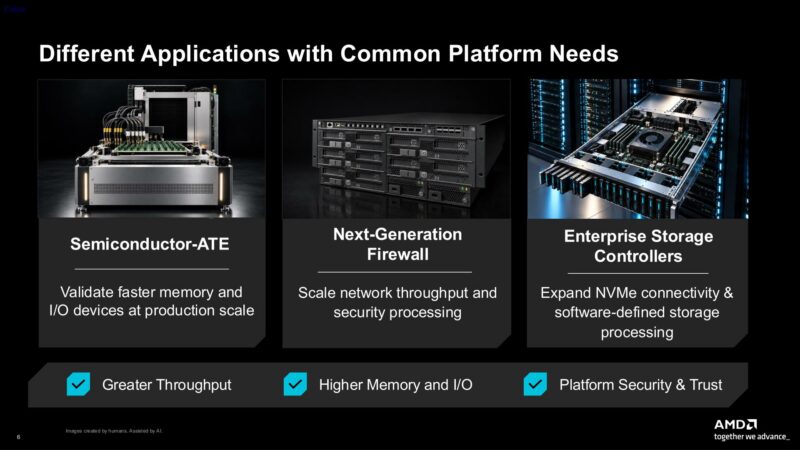
总体而言,AMD 以 EPYC Embedded 9006 主攻三个特定市场:用于半导体开发的自动测试设备(ATE)、高端防火墙和企业存储控制器。这些都属于长生命周期基础设施的范畴,同时也以某种形式与 AI 市场存在关联。
AMD EPYC Embedded 9006 – 防火墙
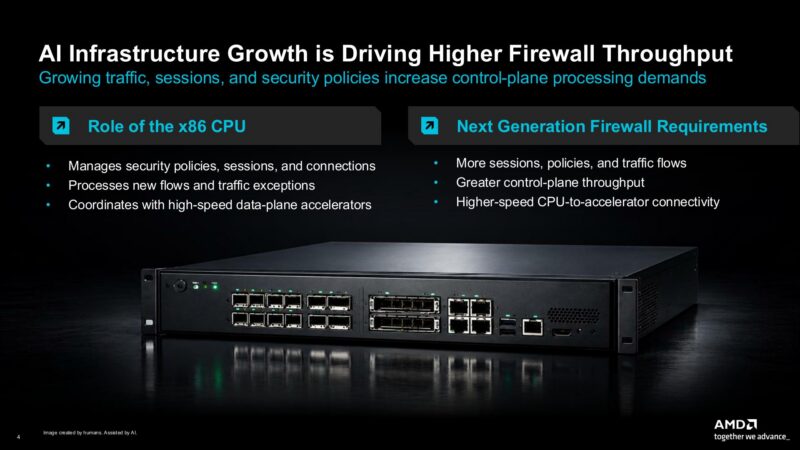
防火墙最为直接。随着智能体式 AI 系统处理的数据量前所未有,需要更快的防火墙来跟上,无论是处理更多数据,还是能够应对更复杂(因而更耗 CPU)的策略。即便防火墙设备已具备大量卸载加速能力,其 CPU 负载仍可能相当高。
AMD EPYC Embedded 9006 – 企业存储
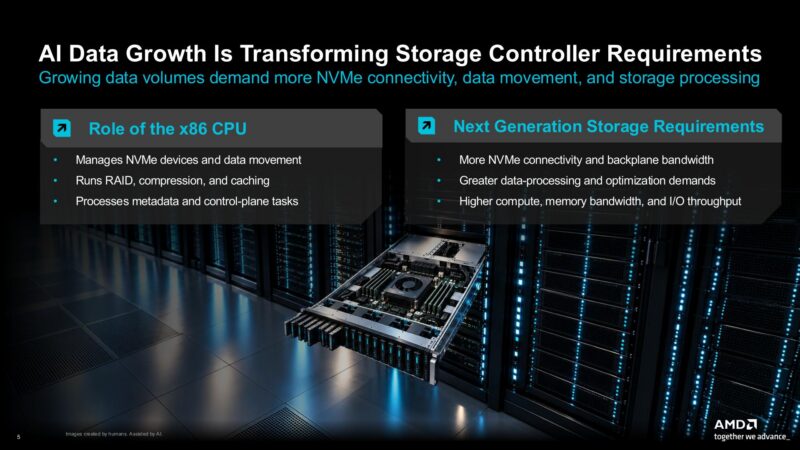
同样,AI 计算需求也在推高存储需求。机架级系统大量使用专用存储机箱,因此需要高速 CPU 来运行这些存储系统——而 AMD 希望这个 CPU 是自家的。与此同时,9006 系列标志着 AMD 的 EPYC Embedded 平台首次引入 PCIe Gen6 支持,因此对于没有使用某种 PCIe 交换机的存储系统,原生 PCIe Gen6 支持是充分释放第一代 PCIe Gen6 SSD 性能的关键。
AMD EPYC Embedded 9006 – 自动测试设备
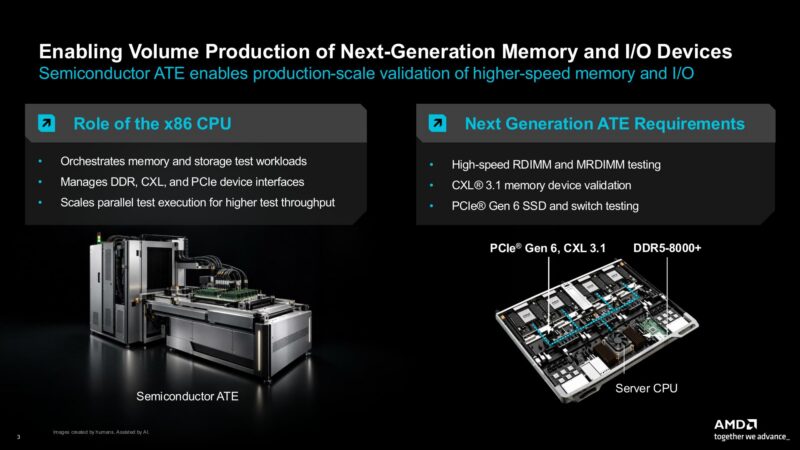
最后,在一个不那么常规的角色中,AMD 在这一代 EPYC Embedded 中瞄准了 ATE 市场。自动测试设备通常不是一个非常显眼的市场,因为对这类设备的需求集中在工程公司,而不是那些大规模部署硬件的超大规模云厂商、新型云厂商和其他数据中心。但据 AMD 称,由于这一代硬件所采用的所有新技术,他们预计这里的需求将出现新一轮跃升。更快的 DDR5 RDIMM、MRDIMM、PCIe Gen6/CXL 3.1 等。所有这些都将需要新的组件设计,随后还需要对这些设计进行大量验证。
最重要的是,这似乎是 AMD 在炫耀自己是最早一批让具备所有这些特性的服务器处理器广泛可用的厂商之一。Intel 还要等几个月,而各家基于 Arm 的业务仍在扩大自家硬件的规模。
AMD EPYC Embedded 9006 – 内存与带宽
不过,对于大量使用 PCIe 连接的 AMD Embedded 客户来说,他们不得不面对 PCIe 通道总数略有减少的情况。SP5 平台支持 128 条 PCIe Gen5 通道,而 SP7 平台仅支持 96 条 PCIe Gen6 通道——因此,虽然通道速度更快,但总体数量更少。
总结一下,随着本月 Venice 服务器芯片及相关 EPYC 产品线的发布,我们亲眼看到 AMD 的处理器发布节奏已发生显著转变。由于强调优先推出服务器处理器,新 CPU 微架构的首发产品已成为 EPYC 系列。而且不只是 AMD 的标准商用芯片,其 EPYC Embedded 芯片也是如此,这使后者从最晚发布的系列之一变为最早发布的系列之一。这是一项重大变化,足以说明 EPYC Embedded 产品线对 AMD 整体规划已变得多么重要。
AMD EPYC Embedded 9006 – 总结
至于 AMD 的嵌入式客户将如何充分利用这些新芯片及其全部新特性,等待时间也不会太长。AMD 本月已开始供货 128 核的 EPYC Embedded 9756。其余 5 款芯片将在 12 月下旬迅速跟进。
AMD EPYC Embedded 9006 SP7 SKU
译文由英文原文机器翻译,术语按行业惯例统一,可在文末展开原文核对。
查看英文原文(AMD Launches EPYC Embedded 9006: Venice Gets an Early Start in Embedded)
Last week we witnessed the launch of AMD’s EPYC 9006 “Venice” series of server CPUs. AMD’s latest generation of server chips, the Venice launch marked an important inflection point on AMD’s server CPU business for a few different reasons. Not only was it the company’s first Zen 6 architecture chip family with all of the performance and feature benefits that entails, but it also marked a larger shift in AMD’s business. For the Zen 6 generation, at least, servers are now coming first for the company – and what was once one of the last products to launch with a new architecture is now the first.
That shift towards prioritizing servers was not just for AMD’s commercial operations, either. Alongside the company’s standard EPYC 9006, AMD went one step further and launched their EPYC Embedded 9006 chip family as well. The highly validated variant of AMD’s server chips that is meant for more foundational roles has never before launched at the same time as the traditional commercial chips, underscoring just how much things have changed for AMD in the past couple of years.
It also means that we have a whole other EPYC product stack to talk about, and one that is aimed at a somewhat different market segment to boot.
Though whether it is commercial EPYC or EPYC embedded, AMD’s technical strengths remain the same. The Venice SP7 platform brings with it significant increases in core counts, energy efficiency, I/O bandwidth, memory bandwidth, and more. And AMD expects that its embedded customers are just as much in need of the extra performance as the rank and file (and AI) customers who have been scooping up standard EPYC chips.
AMD EPYC Embedded 9006 Overview
These days, AMD’s complete EPYC embedded portfolio stretches from chips with a handful of cores all the way up to 256 cores, reaching parity with AMD’s best server chips. The higher-end chips have always been derived from AMD’s server and desktop platforms, and that has not changed for the EPYC Embedded 9006 series.
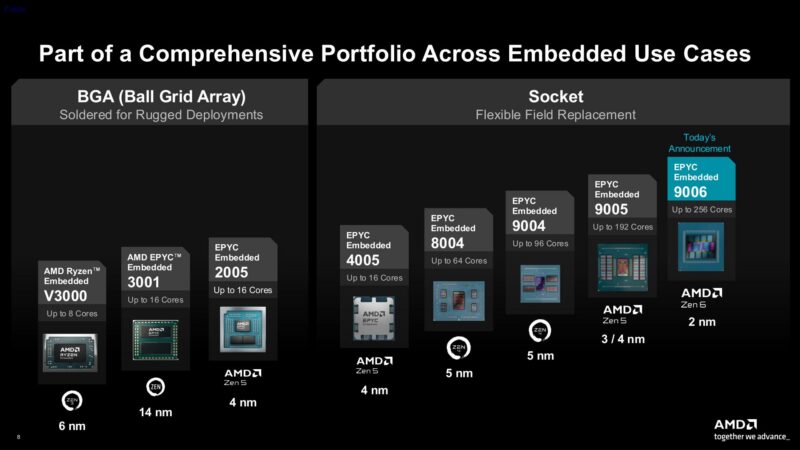 AMD EPYC Embedded 9006 – Embedded Lineup
In this case, the embedded version of the 9006 Venice family is adopting the SP7 platform wholesale. Which means it gets access to features such as 16 channel DDR5-8000/MRDRIMM-12800 support, 96 lanes of PCIe Gen6/CXL 3.1, the Zen 6/Zen 6c architectures, and AMD’s suite of security features for enterprise computing.
AMD EPYC Embedded: Generation on Generation
16x DDR5-8000 /
MRDIMM-12800
Where the EPYC Embedded 9006 lineup will chiefly differ from AMD’s commercial server operations is in regard to the chip availability and product support lifecycles. AMD will offer the 9006 embedded chips for at least 7 years, and they will be supporting the chips for longer.
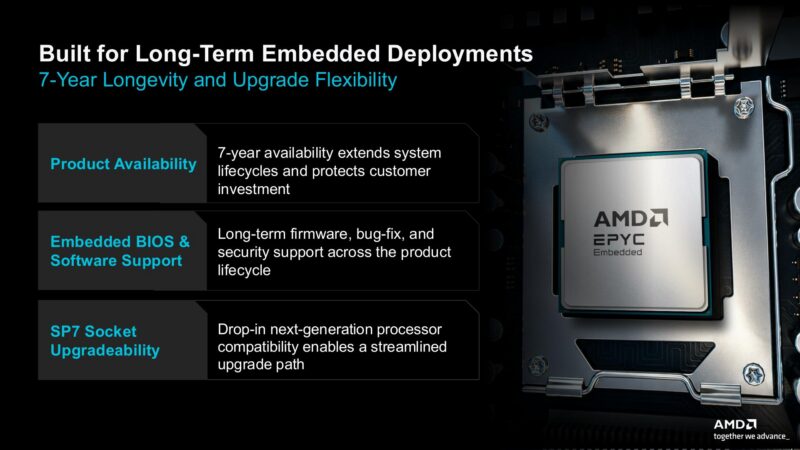 AMD EPYC Embedded 9006 – Long Term Support
As well, the upgrade to the SP7 platform means that AMD’s embedded customers now get to reset the clock in terms of upgradability as compared to the SP5 platform. AMD will be reusing the SP7 platform for the next generation of chips (codenamed Florence), which means that designs being created today can be reused/upgraded in the future to use the newer chips without having to redesign or revalidate the entire platform.
All of which are important features for AMD’s target market of embedded users, who, even more than commercial server customers, move at a slower, more deliberate and conservative pace with their hardware designs and release cadences. The typical goal being to release a design for years, and support it for even longer.
Target Markets: ATE, Firewalls, and Enterprise Storage
Though the EPYC Embedded 9006 processors are being made available to AMD’s entire embedded customer base, the company has a few specific ideas in mind for what the best classes of products are for the new EPYC chips. Especially with the top-end of the new 9006 stack pushing total compute throughput harder than ever, these are the workloads that AMD (and its marketing arm) have been looking at.
 AMD EPYC Embedded 9006 – Target Markets
Broadly speaking, AMD is chasing three particular markets with EPYC Embedded 9006: automatic test equipment (ATE) for semiconductor development, high-end firewalls, and enterprise storage controllers. All of which fall under the umbrella of long-lived infrastructure, and all of which are also tangential to the AI market in some form or another.
 AMD EPYC Embedded 9006 – Firewalls
Firewalls are the most straightforward. With agentic AI systems pushing around more data than ever, faster firewalls are needed to keep up, be it by processing more data or being able to handle more complex (and thus CPU-intensive) policies. Even with the significant amount of offload acceleration in firewall appliances, they can still be quite CPU-intensive.
 AMD EPYC Embedded 9006 – Enterprise Storage
Similarly, AI computing demand is driving up storage demand as well. With rackscale systems making heavy use of dedicated storage boxes, a fast CPU is needed to operate those storage systems – and AMD would like it to be theirs. Coupled with that, the 9006 family marks the introduction of PCIe Gen6 support on AMD’s EPYC Embedded platform, so for storage systems that are not using a PCIe switch of some kind, native PCIe Gen6 support is the key to getting the most out of the first generation of PCIe Gen6 SSDs.
 AMD EPYC Embedded 9006 – Automatic Test Equipment
Finally, in a less conventional role, AMD is targeting the ATE market in this generation of EPYC Embedded. Automatic test equipment is not normally a very visible market, as the need for equipment is clustered around engineering firms rather than the hyperscalers, neoclouds, and other data centers that are deploying hardware in large volumes. But according to AMD, they are expecting a fresh jump in demand here due to all of the new technologies in play with this generation of hardware. Faster DDR5 RDIMMs, MRDIMMs, PCIe Gen6/CXL 3.1, and more. All of which will require new component designs and then significant validation of those designs.
More than anything else, this one seems to be AMD flexing at being among the first vendors to make a server processor with all of these features widely available. Intel is months away, and the various Arm-based operations are still ramping up their own hardware.
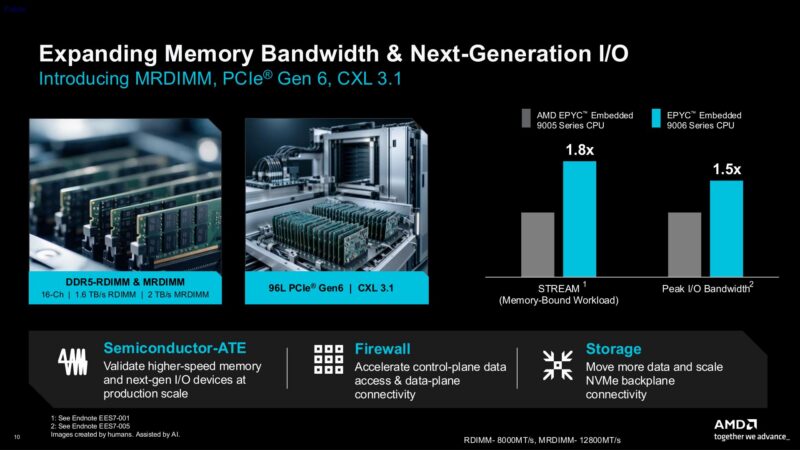 AMD EPYC Embedded 9006 – Memory and Bandwidth
Though for AMD Embedded customers who are making heavy use of PCIe connectivity, they will have to contend with a bit less of it overall. While the SP5 platform supported 128 lanes of PCIe Gen5, the SP7 platform only supports 96 lanes of PCIe Gen6 – so while the lanes are faster, there are fewer of them overall.
Wrapping things up, with this month’s launch of their Venice server chips and their related EPYC product lines, we are seeing first-hand how AMD’s processor releases cadences have shifted significantly. With an emphasis on getting server processors out the door first, the lead products for a new CPU microarchitecture have become the EPYC family. And not just AMD’s standard commercial chips, but their EPYC Embedded chips as well, bringing the latter line from one of the last to launch to one of the first. It is a major change that goes to show just how important the EPYC Embedded lineup has become to AMD’s overall plans.
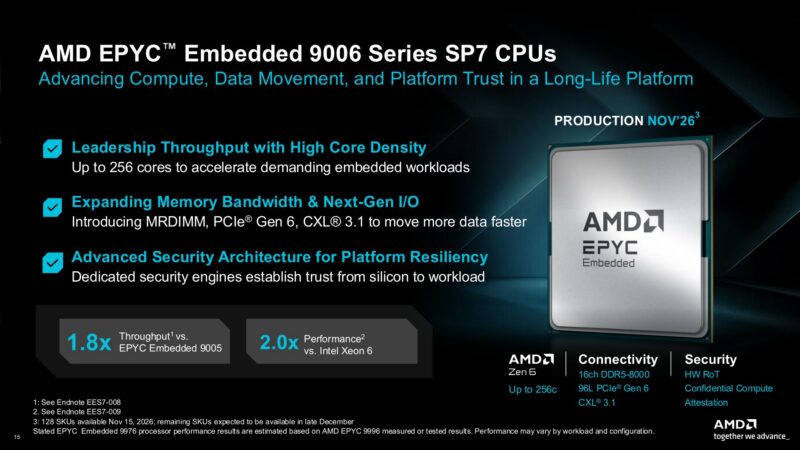 AMD EPYC Embedded 9006 – Summary
As for how AMD’s embedded customers will put the new chips and all of their new features to good use, the wait should not be very long, either. AMD is already making the 128 core EPYC Embedded 9756 available this month. The other 5 chips will quickly follow in late December.
AMD EPYC Embedded 9006 SP7 SKUs
原文为英文,正文由自动抓取并保留原文。
原文发布于 ServeTheHome(AMD Launches EPYC Embedded 9006: Venice Gets an Early Start in Embedded),标题、摘要与正文由机器翻译,术语按行业惯例统一,未经人工逐句校订。