夜间发出哔声之物:智能体式AI加入地外信号搜寻
虽然科幻传说告诉我们,人类将以小绿人的形象遇见外星生命,但这个万圣节真正该让人汗毛竖起的细节是:搜寻地外文明借助 AI 迈出了一大步,并且越来越聚焦于人类打造的 AI 智能体去监听外星人打造的 AI 智能体。
一些科学家提出,如果地外文明确实存在,它们可能比人类古老数十亿年。这类文明可能已发展出远超人类的技术,其中包括各种形式的 AI。
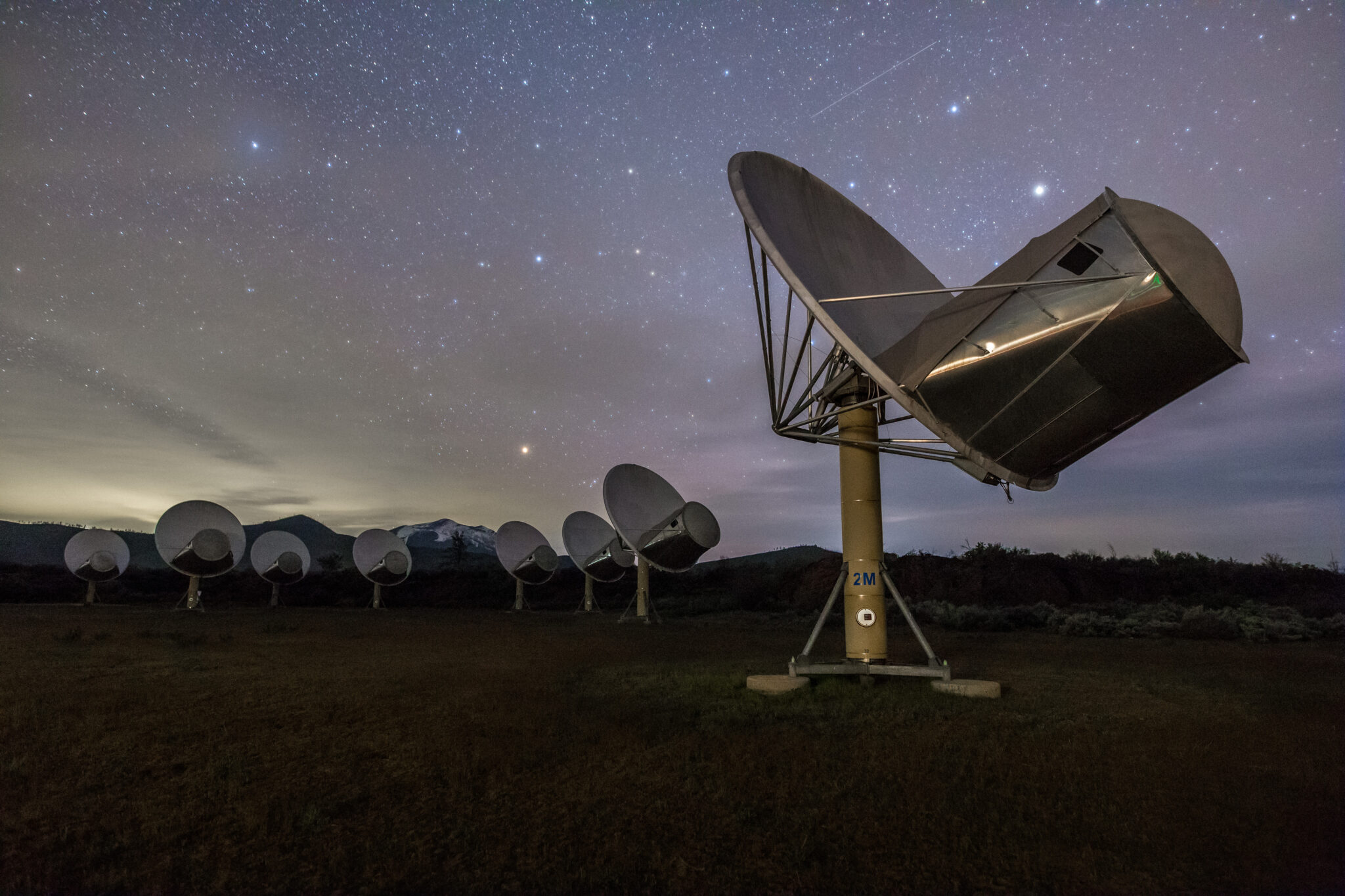
Breakthrough Listen 和 SETI Institute 正把智能体式 AI 引入日常的地外文明搜寻工作。在北加州的 Allen Telescope Array,智能体现已能够操控这台设备、增强并校正传入的数据,并把 AI 模型应用于实时数据流——这一切都只需一句自然语言指令。NVIDIA Holoscan 平台负责处理海量传感器数据流,为智能体提供可据以行动的实时数据。
其结果是更快、适应性更强的搜寻——寻找来自地外生命与技术的潜在信号。“随着我们这些全新的智能体天文台向宇宙伸出触角,它们所发现的东西,与它们自身的共同点可能远多于与创造它们的人类,”SETI Institute 的 Bernard M. Oliver SETI 讲席教授、Breakthrough Listen 首席研究员 Andrew Siemion 表示。“但这并不是什么值得恐惧的事。相反,这是翻译上的一次突破。”
射电望远镜会产生海量数据,这给需要在观测进行过程中识别潜在有趣信号的科学家带来了挑战。
在艾伦望远镜阵列(Allen Telescope Array),Holoscan 平台库 DAQIRI 让望远镜能将每秒数太比特的传感器数据直接拉入 GPU 内存,从而在数据流入的同时完成观测处理,而不是把硬盘写满。由 SETI 研究所开发的信号处理框架 CyberEther 则借助 NVIDIA CUDA-X 库(包括 cuFFT 和 cuBLAS)完成运算。
Nexus 是一个基于网页的观测站编排器,充当智能体的运行框架(agent harness)。它为智能体提供仪器状态、计算资源和流水线的单一事实来源,并让研究人员能够监控丢包、读取实时频谱图、重写信号处理模块——这一切只需用自然语言提示即可完成。该系统可在 NVIDIA RTX PRO 6000 Blackwell GPU 上处理每秒 2.4 太比特的数据,推理则在本地、紧邻仪器处运行。
把这些组合起来,该系统能让智能体操控望远镜天线、校准并调焦仪器以获得清晰信号、发现并修复数据错误,并绘制出结果。智能体能把原本需要人类花费数周甚至数年才能完成的工作压缩到数小时。
这条流水线已经证明了自身能力:在蟹状星云中实现了对脉冲星——一种快速自转、像宇宙灯塔一样发出脉冲的恒星遗迹——的首次实时 AI 探测。
接下来,团队正在评估包括 NVIDIA Nemotron 在内的开放模型,用于数据本地性和周转速度最为关键的场景,以及那些有朝一日可能在月球背面离线运行的观测站。
进一步了解 NVIDIA AI for science。
译文由英文原文机器翻译,术语按行业惯例统一,可在文末展开原文核对。
查看英文原文(Things That Go Beep in the Night: Agentic AI Joins the Search for Extraterrestrial Signals)
While science fiction lore tells us that humans will meet extraterrestrial life in the form of little green men, the detail that should raise hairs this Halloween is this: the search for extraterrestrial intelligence took a major leap forward with AI, and it increasingly focuses on AI agents built by humans listening for AI agents built by aliens.
Some scientists have suggested that extraterrestrial civilizations, if they exist, could be billions of years older than humanity. Such civilizations might have developed technologies far beyond humanity’s, including forms of AI.
Breakthrough Listen and the SETI Institute are bringing agentic AI into the daily search for extraterrestrial intelligence. At the Allen Telescope Array in Northern California, agents can now steer the instrument, enhance and correct incoming data, and apply AI models to the incoming stream — all from a single natural language request. The NVIDIA Holoscan platform processes the massive streams of sensor data, giving agents live data to act on.
The result is a faster, more adaptable search for potential signals from extraterrestrial life and technologies.
“As our new agentic observatories reach out into the universe, what they find may have much more in common with themselves than with the humans who created them,” said Andrew Siemion, Bernard M. Oliver chair for SETI at the SETI Institute and principal investigator of Breakthrough Listen. “But this isn’t something to fear. Rather, it’s a breakthrough in translation.”
Terabits a Second, Processed in Flight
Radio telescopes generate enormous volumes of data, creating a challenge for scientists who need to identify potentially interesting signals as observations unfold.
At the Allen Telescope Array, DAQIRI, a Holoscan platform library, enables the telescope to pull terabits per second of sensor data straight into GPU memory so observations are processed in flight rather than filling hard drives. CyberEther, a signal-processing framework developed at the SETI Institute, does the math using NVIDIA CUDA-X libraries including cuFFT and cuBLAS.
Nexus, a web-based observatory orchestrator, acts as the agent harness. It gives agents a single source of truth for instrument state, compute resources and pipelines and lets researchers monitor packet loss, read live spectrograms and rewrite signal-processing blocks — all by prompting in natural language. The system can handle 2.4 terabits per second on NVIDIA RTX PRO 6000 Blackwell GPUs, with inference running on premises, next to the instrument.
Put together, the system enables an agent to steer a telescope’s antennae, calibrate and focus the instrument for a clean signal, catch and fix data errors and plot the result. Agents compress what would take humans weeks or years into hours.
Science Fact, Not Fiction
The pipeline has already proven itself, achieving the first real-time AI detection of a pulsar — a rapidly spinning stellar remnant that pulses like a cosmic lighthouse — in the Crab Nebula.
Next, the team is evaluating open models including NVIDIA Nemotron for cases where data locality and turnaround matter most and for observatories that may someday run offline on the far side of the moon.
Learn more about NVIDIA AI for science.
正文保留英文原文,标题与摘要由机器翻译。
原文发布于 NVIDIA Blog(Things That Go Beep in the Night: Agentic AI Joins the Search for Extraterrestrial Signals),标题、摘要与正文由机器翻译,术语按行业惯例统一,未经人工逐句校订。