全球城市借NVIDIA物理AI与智能体式AI扩展AI服务
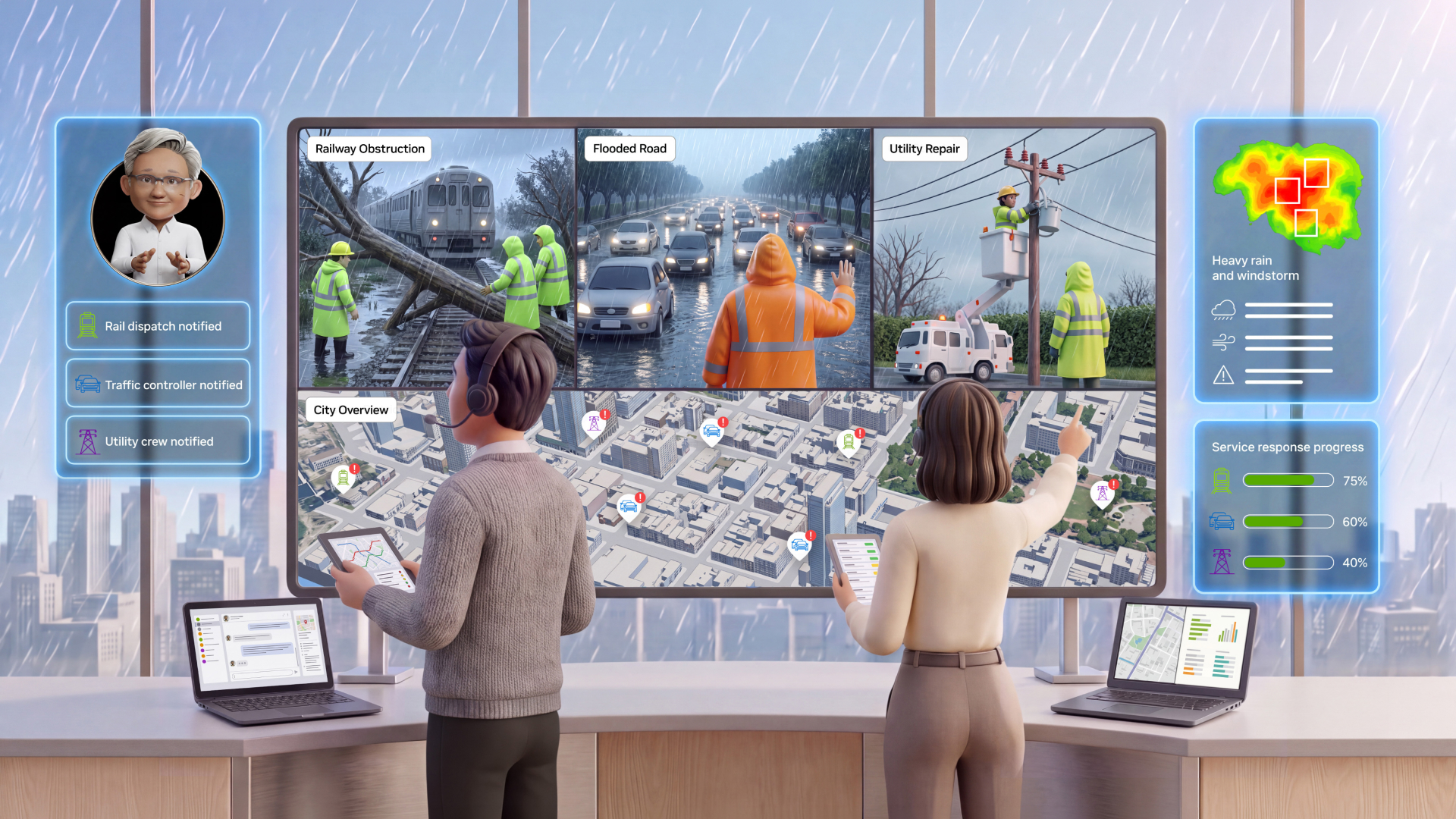
城市通过摄像头、传感器和运营系统产生海量数据,但要把这些数据转化为有用的行动——用于规划、维护和公共服务——仍然是一项挑战。
物理 AI 和智能体式 AI 提供了弥合这一差距的新途径,从用于基础设施规划的数字孪生,到视觉智能体和服务智能体,同时让地方政府始终掌握敏感数据的处理和使用方式。
在 GTC Berlin 上宣布的各项举措基础上,NVIDIA 及其合作伙伴正将物理 AI 和 AI 智能体推广到全球各地的城市。共享计算基础设施为城市各部门、周边市政当局和本地开发者提供了共同的基础——在扩展服务的同时,各机构无需自行采购和管理资源。
从居民服务到视觉智能体,城市正在采用 NVIDIA 智能体式 AI,以提供更快、响应更及时的公共服务。城市团队无需投入大规模基础设施即可开始构建这些 AI 服务:视工作负载而定,NVIDIA RTX 工作站或一套小型 GPU 系统可能就已足够。
在西班牙,1MillionBot 将巴塞罗那超级计算中心训练的 ALIA 开源模型与 NVIDIA Nemotron 及其他模型结合起来,用于 Madrid Digital(Comunidad de Madrid)、Administració Oberta de Catalunya 的居民服务智能体,以及西班牙全国 150 多个部署场景,处理市政办事流程、预约申请、城市规划事件和服务咨询。
在旧金山湾区,LiveX 正借助 NVIDIA Cosmos 世界模型、Nemotron 开放模型,以及基于 NVIDIA RTX PRO GPU 的 Omniverse 和 Metropolis 库,将其 AI City 愿景变为现实。这些可交互、可对话的 AI 接待员能理解人们的需求,给出答案并采取行动,还可针对机场、医院、本地活动及其他公共场所的本地语言和服务需求进行定制。
视觉 AI 智能体可以将城市现有的摄像头视频流转化为可操作的洞察,帮助团队识别交通出行与安全问题,并协调跨市政服务的应急响应。
在波兰弗罗茨瓦夫,K2K 正在利用 NVIDIA 加速计算、NVIDIA Cosmos 世界推理模型以及用于视频搜索与摘要(VSS)的 NVIDIA Metropolis Blueprint 构建共享 AI 基础设施,将现有摄像头视频流转化为可用于交通出行、安全和事件响应的可操作情报——并在多项城市功能中复用同一套基础设施。
在马来西亚,ITMAX 将基础设施与智能体式 AI 应用打包为面向城市的长期托管服务,其中包括交通管理。ITMAX 的 SamurAI V2 视觉智能体参考 Cosmos、Nemotron 和 Metropolis VSS blueprint 构建,正在 NVIDIA RTX PRO 6000 GPU 上扩展,以在 2027 年前支持 17,000 多路摄像头。ITMAX 还集成来自 Laplace Intelligence 的开源交通仿真平台 TeraSim,用于测试信号配时,使高峰时段走廊通行时间最多缩短 26%。
除了面向公众的服务,数字孪生还能帮助城市加快基础设施规划,最大限度减少对当地社区的干扰。城市数字孪生还可作为实时运营仿真,助力更快决策。
在尼日利亚 Dangote 的 Lekki 炼油厂,Honeywell Technologies 的 Forge Plant Cognition 利用由 Nemotron 驱动的 AI 智能体来理解运营数据。该公司还计划使用 Omniverse 库构建该工厂及其流程的数字孪生,以支持仿真与培训。该平台基于搭载 NVIDIA RTX PRO 加速器的 Dell PowerEdge 服务器构建,可帮助操作人员识别瓶颈、预判设备与工艺问题,并优化工厂运行表现。
在台湾,Linker Vision 与荷兰建筑事务所 MVRDV 正使用 NVIDIA Omniverse 和 Nemotron 构建环境、社会与治理(ESG)智能体,用于评估各类城市规划情景的环境影响,可在 10 分钟内模拟城市森林冠层 15 年的演变结果——将设计迭代速度从每轮两周提升至不到一小时。
城市可以依托既有基础设施并扩充容量,将 AI 扩展到更多服务中。共享资源与托管服务有助于把这些能力推广到各个部门和市政机构。
在摩洛哥的 Tanger Med 港,Cires Technologies 正在扩建一座主权 AI 工厂,用于工人安全、拥堵分析、货物路径规划和港口运营等计划中的应用。Cires Technologies 还在构建一个应用提供商生态,为港口和城市开发本地模型与应用。
除城市服务之外,巴塞罗那超级计算中心的 AI Factory 加速器计划为初创企业提供主权算力、技术支持和培训。BSC AI Factory 还支持初创企业的研究与创新——覆盖农业、医学影像、知识获取和语音服务等领域。
在 11 月 3 日至 5 日于巴塞罗那举行的世界智慧城市大会上,了解 NVIDIA 及其生态如何将物理 AI、智能体式 AI 和本地 AI 工厂带到全球各地城市。NVIDIA EMEA 区副总裁 Paolo Guglielmini 将发表主题演讲,随后由 NVIDIA EMEA 区智慧城市与空间业务总监 Charbel Aoun 主持一场专题讨论。
译文由英文原文机器翻译,术语按行业惯例统一,可在文末展开原文核对。
查看英文原文(Cities Worldwide Build and Scale AI Services With NVIDIA Physical and Agentic AI)
Cities generate enormous amounts of data from cameras, sensors and operational systems, but turning it into useful action — for planning, maintenance and public services — remains a challenge.
Physical and agentic AI offer new ways to close that gap, from digital twins for infrastructure planning to vision and service agents, while keeping local governments in control of how sensitive data is processed and used.
Building on initiatives announced at GTC Berlin, NVIDIA and its partners are expanding physical AI and AI agents to cities worldwide. Shared computing infrastructure gives city departments, neighboring municipalities and local developers a common foundation to build on — extending services without each organization having to acquire and manage resources of their own.
Agentic AI for Cities
From resident services to vision agents, cities are adopting NVIDIA agentic AI to deliver faster, more responsive public services. City teams don’t need a massive infrastructure investment to get started building these AI services: depending on the workload, NVIDIA RTX workstations or a small GPU system may be enough.
In Spain, 1MillionBot combines open source ALIA models trained at the Barcelona Supercomputing Center with NVIDIA Nemotron and other models in resident-service agents for Madrid Digital (Comunidad de Madrid), Administració Oberta de Catalunya and 150+ deployments across Spain, handling municipal procedures, appointment requests, urban-planning incidents and service inquiries.
In the San Francisco Bay Area, LiveX is bringing its AI City vision to life with NVIDIA Cosmos world models and Nemotron open models, and Omniverse and Metropolis libraries on NVIDIA RTX PRO GPUs. The interactive, conversational AI hosts understand people’s needs, provide answers and take action, and can be tailored to local languages and service needs in airports, hospitals, local events and other public spaces.
Vision AI agents can turn existing city camera feeds into operational insights, helping teams identify mobility and safety issues and coordinate emergency responses across city services.
In Wrocław, Poland, K2K is building shared AI infrastructure using NVIDIA accelerated computing, NVIDIA Cosmos world reasoning models, and NVIDIA Metropolis Blueprint for video search and summarization (VSS) to transform existing camera streams into actionable intelligence for mobility, safety and event response — using the same infrastructure across several city functions.
In Malaysia, ITMAX bundles infrastructure and agentic AI applications into long-term managed services for cities, including for traffic management. Built with reference to Cosmos, Nemotron and the Metropolis VSS blueprint, ITMAX’s SamurAI V2 vision agents are scaling on NVIDIA RTX PRO 6000 GPUs to support 17,000+ cameras by 2027. ITMAX integrates TeraSim, an open source traffic simulation platform from Laplace Intelligence, to test signal timing, reducing peak-hour corridor travel times by up to 26%.
Plan and Operate Critical Infrastructure With Digital Twins
Beyond public-facing services, digital twins can help cities expedite infrastructure planning, minimizing disruption to local communities. City digital twins can also serve as a real-time operational simulation to facilitate faster decision-making.
At Dangote’s Lekki refinery in Nigeria, Honeywell Technologies’ Forge Plant Cognition uses Nemotron-powered AI agents to understand operational data. A digital twin of the plant and its processes, built using Omniverse libraries, is also planned to support simulation and training. The platform, built on Dell PowerEdge servers with NVIDIA RTX PRO accelerators, helps operators identify bottlenecks, anticipate equipment and process issues, and optimize plant performance.
In Taiwan, Linker Vision and Dutch architecture firm MVRDV are using NVIDIA Omniverse and Nemotron to build environmental, social and governance agents that can assess the environmental impact of various urban planning scenarios, simulating 15-year outcomes of an urban forest canopy in 10 minutes — increasing design iteration speed from two weeks per iteration to less than an hour.
Build a Broader Local AI Ecosystem
Cities can extend AI to more services by building on infrastructure already in place and adding capacity. Shared resources and managed services can help extend those capabilities across departments and municipalities.
At Morocco’s Tanger Med port, Cires Technologies is expanding a sovereign AI factory for planned applications in worker safety, congestion analysis, cargo routing and port operations. Cires Technologies is also building an ecosystem of application providers to develop local models and applications for ports and cities.
Beyond city services, Barcelona Supercomputing Center’s AI Factory Accelerator Programme gives startups access to sovereign computing, technical support and training. BSC AI Factory also supports research and innovation for startups — spanning agriculture, medical imaging, knowledge access and speech services.
Learn how NVIDIA and its ecosystem are bringing physical AI, agentic AI and local AI factories to cities worldwide at Smart City Expo World Congress, running Nov. 3-5 in Barcelona, where NVIDIA Vice President of EMEA Paolo Guglielmini will deliver a keynote address followed by a panel moderated by Charbel Aoun, director of smart city and spaces for EMEA at NVIDIA.
正文保留英文原文,标题与摘要由机器翻译。
原文发布于 NVIDIA Blog(Cities Worldwide Build and Scale AI Services With NVIDIA Physical and Agentic AI),标题、摘要与正文由机器翻译,术语按行业惯例统一,未经人工逐句校订。