ArtCraft 克隆 Photoshop 欲重建一切
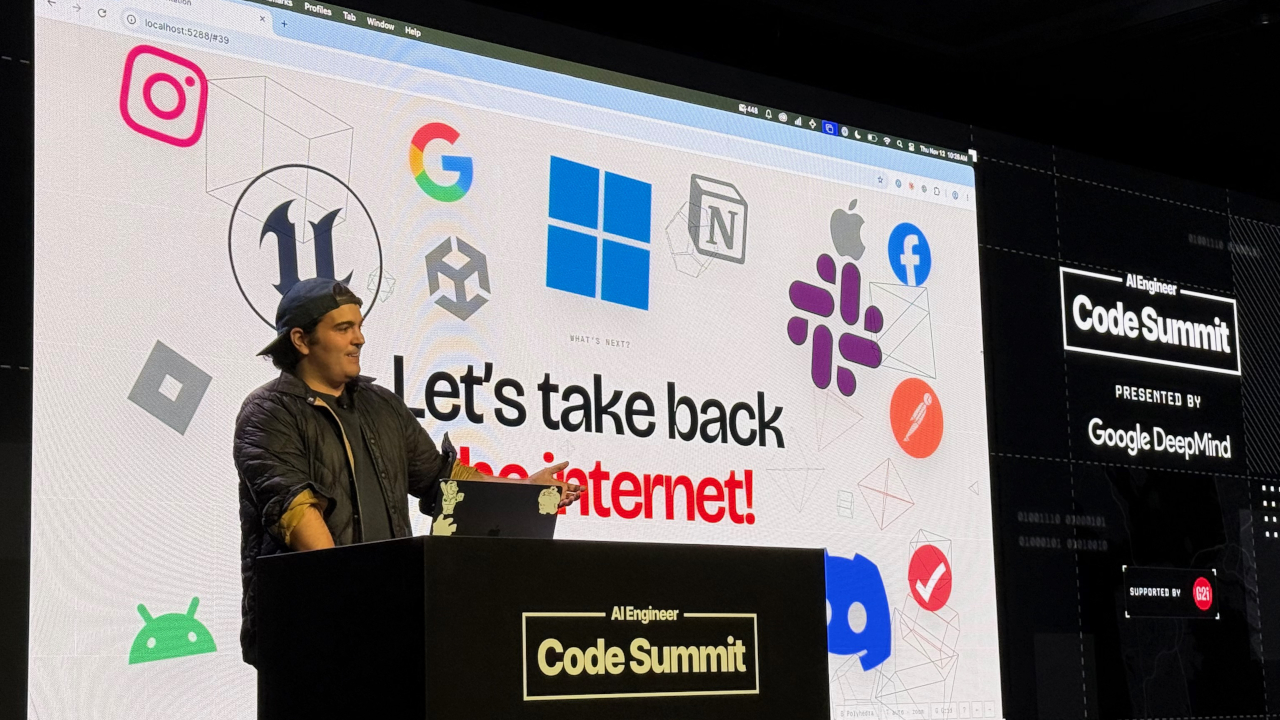
在旧金山举行的 AI Engineer Code Summit 第二天的主题是:用 AI 提升雄心。而在 AI 时代,很少有项目像 ArtCraft 这样雄心勃勃。迄今为止,这家羽翼未丰的公司已发布了 17 款热门软件工具的开源版本,第一个是用 Rust 从零构建的 Photoshop 替代品,名为 PhotoCraft。
今天上午,当 ArtCraft 创始人兼 CEO Brandon Thomas 在 AIE Code 上阐述一份关于基于 AI 的开源的宣言时,你能感受到现场的热烈气氛。当他提到 ArtCraft 已经克隆了 Adobe 的 Acrobat,推出了一款名为 PdfCraft 的产品时,观众报以一轮掌声。在收尾时,他喊出的“让我们夺回整个互联网”和“让我们重建一切”赢得了阵阵欢呼。
Thomas 以重温互联网的早期历史开场。在他看来,网络最初的初衷是正确的,但一旦 Web 2.0 成为主流,事情就搞砸了。
“我们有大量完全开放的聊天应用,”他在谈到 1990 年代的互联网时说。“IRC 就像 Discord,但你可以搭建自己真正拥有的服务器。你可以用任何程序来自动化操作和查询它们,不受任何规则限制。”
他的观点未必是当时一切皆开源,而是网络用户可以自由地创造东西。比如 Flash——一款最终被 Adobe 收购的商业动画工具——“孩子们用它做各种各样的动画。”
当 Web 2.0 伴随着更优越的宽带和智能手机到来时,“它把所有人都拉了进来。”Thomas 承认,这扩大了互联网软件的范畴,但代价是失去了用领先应用来自由创造的那种自由。
“那个分散、实验性的早期网络开始消失了,”他说。“API 被从我们手中夺走,接着我们开始看到分发被大厂把持。”
看来尤其是 Adobe 让 Thomas 很恼火。他描述了在取消月度订阅计划时被收取一笔意外费用的情况。
“真的很令人沮丧,网络——曾经非常、非常有前景、开放且自由——如今变成了这样一个榨取式的、被占有、寻租的世界。”
这促使他创办了 ArtCraft,“秉持着‘让我们把所有东西都做成开源’的理念”。据 Thomas 说,这甚至是一条连反 AI 人士都支持的诉求。
除了 PhotoCraft,他们还复刻了 Adobe 套件中的其他应用、克隆了 Figma,并做了一款类似 Microsoft 的文字处理器 WordCraft。此外还有一些独立应用,比如 SolidCraft——一个由社区主导的 CAD 项目,通过 ArtCraft 的启动器分发。
Thomas 重申,这些由 AI 构建的应用是 100% 开源的——“不仅是桌面应用,实际的基础设施也是如此。”
ArtCraft 从重写人们熟悉的工具入手。Thomas 更长远的愿景是让用户(比如以前使用 Photoshop 的艺术家)把软件定制成适合自己工作流的样子。
按他的说法,他们想“撤销 Web 2.0 时期发生的一切——那时一切都变得被占有、被整合、被设卡把关——把应用还给人们。”
他说,AI 是实现这一目标的手段。
但 Photoshop 不是已经有开源替代品了吗,比如 GIMP?
“GIMP 其实并没有多少艺术家在用,”Thomas 在演讲中表示。“我们实际上观察到,艺术家们在我们提供的软件之上,用 vibe coding 的方式搭出自己的工作流。”
为了开始创建 PhotoCraft,团队给 AI 模型输入了一段详细的提示词,其中说明了 Photoshop 的工具、数据结构和文件导入器。在那之后,他们“给出了一段非常、非常长的提示词,大意是:把这个应用做出来。”
作为这一过程的一部分,他们让所有内容都兼容 MCP 和 CLI。
Thomas 说,24 小时之内,“我们看到的已经是一个与 Photoshop 相当接近的近似版本——这让我们颇为震撼。”
Thomas 指出,PhotoCraft“仍未实现 100% 对等”——他说他们刚刚超过 60%——但团队已设定内部目标,尽可能接近 100%。(该项目在 GitHub 上声称,功能广度的对等度约为 76%,专业可用性约为 46%。)
“现在,我们希望复刻所有使用 Adobe 的艺术家已经形成的肌肉记忆。所以我们是直接对标 Adobe,对标他们的界面和‘外观与手感’。”
但在 ArtCraft 实现这一目标之后,他们计划“打造新的应用,这些应用拥有更具智能体特性的全新界面”。
Thomas 表示,他对 PhotoCraft 尤其受到的关注程度感到意外——从《纽约时报》请求采访,到其开源社区规模扩大到约 4000 名开发者。
“我至今仍难以消化所发生的一切。它触动了人们的神经。他们觉得自己在某种程度上被 Adobe 和其他科技公司亏待了。而我们做出来的东西确实引起了他们的共鸣。”
演讲结束后,Thomas 被 AIE Code 的参会者团团围住。
ArtCraft 的应用下载量约为每天 170 万次,Thomas 称这一速度仍在加快。
他补充说,除了 17 款官方应用外,还有约 300 款应用正由社区开发。
Thomas 表示,除了 AI 技术之外,Rust 是让这些应用具备高性能的关键——他举例称,PhotoCraft 的打开速度是 Photoshop 的十倍。
“Rust 可能是这款产品成功的关键,”他说。“我们之前见过有人用 Electron 来做,但对于高质量的创意应用,你确实需要原生方案。”
对于那些并非 Rust 专家的工程师,Thomas 有个好消息要告诉你。
“作为工程师,你今天想用 Rust,需要先懂 Rust 吗?完全不需要。[……]你的智能体就能把它用得挺好。”
不过,Thomas 承认并非一切都进展得一帆风顺。
“我们踩了不少坑——比如权限、GitHub、扩展、CI,”他说。“CI 撑不住了。我们一直在自己搭。我们找到了一个在托管服务器上搞到内存的好地方。”
但他们在智能体能做什么、哪些必须由人来处理之间,找到了一个平衡点。
“如果你做的是后端工作,或者需要 schema 迁移、API 设计的事情,那就让人来做。但对于桌面应用、游戏,以及任何基本上不需要改动的东西,尽管把智能体派上去,给它们十足的信心。”
而事实证明,在这方面甚至还有一个 ArtCraft 的解决方案。
“AutoCraft 是一个完全自主的软件工厂,我们将会把它开源。”
Brandon Thomas 和他的 ArtCraft 公司的雄心毋庸置疑。
“我们可以把整个世界开源,”他在演讲结尾宣称。“让我们拥有自己的应用、自己的基础设施、自己的协议、自己的模型——所有这一切。”
这是一个宏大的愿景,如果其当前的下载量增速持续下去,规模甚至可能比肩 Linux。但也许颇具讽刺意味的是,ArtCraft 最让我着迷的地方,是它人类贡献者社区的增长。毕竟,这恰恰是早期互联网做得最正确的一件事:大规模的人类协作。
与 1990 年代最大的不同在于,如今承担大部分开发工作的是智能体。
译文由英文原文机器翻译,术语按行业惯例统一,可在文末展开原文核对。
查看英文原文(AI Ambition: ArtCraft Cloned Photoshop and Now Wants to "Rebuild Everything")

The theme of day two of the AI Engineer Code Summit in San Francisco was increasing ambition using AI. And there have been few projects as ambitious as ArtCraft in the AI era. So far the fledgling company has released 17 open source versions of popular software tools, starting with a Photoshop alternative built from scratch in Rust called PhotoCraft.
You could feel the excitement in the room this morning when ArtCraft founder and CEO Brandon Thomas presented a kind of manifesto for AI-based open source at AIE Code. When he mentioned that ArtCraft had cloned Adobe’s Acrobat, with a product called PdfCraft, it got a round of applause from the audience. In wrapping up, his rallying cries of “let's take back the entire internet” and “let's rebuild everything” were greeted with whoops and cheers.
Thomas began his presentation by reliving the internet’s early history. In his view, the web started out with the right intentions, but things got screwed up once Web 2.0 hit the mainstream.

“We had a bunch of chat applications that were completely open,” he said, regarding the 1990s internet. “So, IRC is like Discord, but you can spin up your own servers that you actually own. You can use whatever programs to automate them and interrogate them without rules.”
His point wasn’t necessarily that everything was open source, but that web users could freely build things. With Flash, for example — a commercial animation tool eventually acquired by Adobe — “kids were making all kinds of animations.”
When Web 2.0 came along, with its superior broadband and smartphones, “it brought everybody into the fold.” Thomas acknowledged that this widened the scope of internet software, but at the cost of that freedom to build with leading apps.

“The diffuse, experimental, early web started to disappear,” he said. “The APIs got taken away from us, and then we started seeing distribution being gatekept by the big providers.”
It seems Adobe in particular annoyed Thomas. He described getting billed with an unexpected fee when he cancelled a monthly plan.
“It's really frustrating that the web — that was once really, really promising and open and free — has turned into this extractive, owned, rent-seeking world.”
This inspired him to start ArtCraft, “with the ethos of ‘let's build everything open source.’” A message even anti-AI people have gotten behind, according to Thomas.

In addition to PhotoCraft, they’ve copied other apps in the Adobe suite, cloned Figma, and created a Microsoft-like word processor called WordCraft. There are also independent apps such as SolidCraft, a community-led CAD project distributed through ArtCraft’s launcher.
Thomas reiterated that these AI-built applications are 100% open — “not only the desktop apps, but the actual infrastructure as well.”
PhotoCraft: The development process
ArtCraft is starting with rewriting familiar tools. Thomas’s longer-term vision is for users (such as artists who were previously using Photoshop) to tailor the software to their own workflows.
As he framed it, they want to “undo what had happened during Web 2.0, when everything became owned and consolidated and gatekept, and just give people back their applications.”
AI is the means to achieve that, he said.

But aren’t there already open source alternatives to Photoshop, like GIMP?
“GIMP isn't really used by artists,” said Thomas during his presentation. “We actually observed artists vibe coding their own workflows on top of the software that we gave them.”
To begin creating PhotoCraft, the team gave an AI model a detailed prompt outlining Photoshop’s tools, data structures and file importers. After that, they “laid out a large, large prompt to say, let's build out the application.”
As part of that process, they made everything MCP and CLI compatible.
Within 24 hours, said Thomas, “we were looking at a pretty good approximation of what Photoshop was — and it kind of blew our minds away.”

PhotoCraft interface; via ArtCraft website
Thomas noted that PhotoCraft is “still not at 100% parity” — he said they’ve just passed 60% — but the team has set an internal goal to reach as close to 100% as possible. (The project’s GitHub claims about 76% parity for feature breadth and about 46% for professional readiness.)
“Right now, we want to fill the muscle memory of all the artists that use Adobe. So we are going for Adobe, their interface and ‘look and feel’ directly.”
But after ArtCraft has achieved that, they plan to “build new apps that have new interfaces that are more agentic.”
A big reaction
Thomas said he was surprised by the amount of attention PhotoCraft, in particular, has gotten — ranging from the New York Times requesting an interview, to a swelling of its open source community to about 4,000 developers.
“I'm still struggling to bear with what has happened. It struck a nerve with people. They felt sort of maligned by Adobe and other tech companies. And what we built has really resonated with them.”

After his presentation, Thomas was mobbed by AIE Code attendees.
ArtCraft’s apps are being downloaded at the rate of about 1.7 million per day, which Thomas said is still accelerating.
In addition to the 17 official apps, there are around 300 being developed by the community, he added.
Rust is key, but there have been technical challenges
Other than the AI technology, Thomas said that Rust was a crucial part of making the apps performant — he claimed that PhotoCraft opens ten times faster than Photoshop, for example.
“Rust was probably essential in this product's success,” he said. “We've seen people do it in Electron before, but for high-quality creative apps, you really need something that's native.”
For those engineers who are not experts in Rust, Thomas has good news for you.
“Do you need to know Rust to start using Rust today as an engineer? Definitely not. [...] Your agents will drive it just fine.”

However, Thomas admitted that not everything has gone swimmingly.
“We've run into a lot of gotchas — like permissions, GitHub, scaling, CI,” he said. “CI is falling over. We've been spinning up our own. We found a good place to get RAM on co-located servers.”
But they have found an equilibrium on what agents can do and what needs to be handled by people.
“If you're doing backend work or things that require schema migrations [or] API design, let your humans do that. But for desktop apps and games and anything that's basically immutable, throw your agents at it and give them full confidence.”

And it turns out, there’s even an ArtCraft solution for you there.
“AutoCraft is a completely autonomous software factory that we're going to open source.”
AI open source FTW
There’s no doubting the ambition of Brandon Thomas and his ArtCraft company.
“We can open source the entire world,” he proclaimed at the end of his presentation. “Let's own our apps, our infra, our protocols, our models — all of it.”
It’s a big vision, potentially even on the scale of Linux if its current downloads growth rate continues. But, ironically perhaps, what intrigues me most about ArtCraft is the growth of its human contributor community. After all, that’s what the original web got most right: human collaboration at scale.
The big difference from the 1990s is that now it’s agents doing the bulk of the development work.
正文保留英文原文,标题与摘要由机器翻译。
原文发布于 Latent Space(AI Ambition: ArtCraft Cloned Photoshop and Now Wants to "Rebuild Everything"),标题、摘要与正文由机器翻译,术语按行业惯例统一,未经人工逐句校订。