Jev 革命:System One 模型在建什么
今天在 AI Engineer Code Summit 上,主旋律是系统一模型——即返回结构化选项、分数或概率的非生成式模型。它们通常也比推理型 LLM(又称系统二模型)快得多、便宜得多。
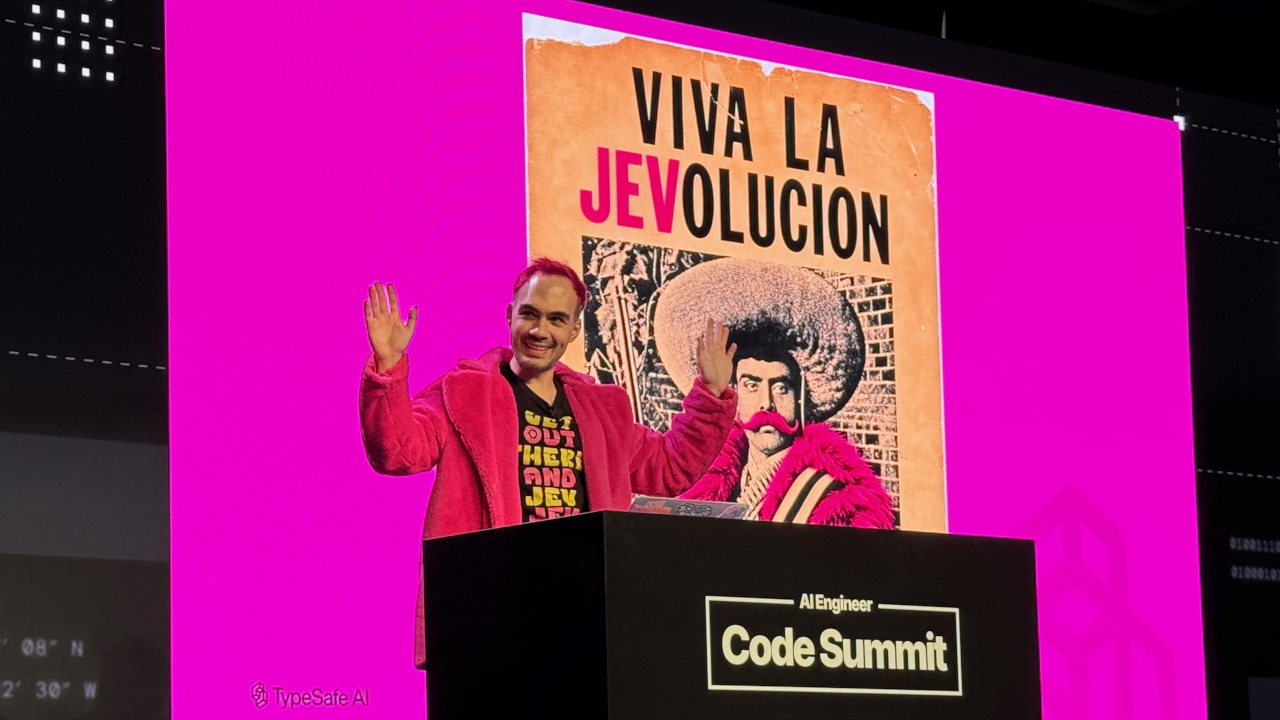
要为系统一模型发出振奋人心的号召,还有谁比 TypeSafe AI 联合创始人兼 CEO Diogo Almeida 更合适?Almeida 是 Jev 的首席创造者,这款产品在不到两个月前掀起了这股潮流。
Jev 在 9 月发布时,立刻让 AI 工程师们眼前一亮。在发布时与 Latent Space 录制的一期播客中(该期迅速成为我们今年最受欢迎的一集),Almeida 解释了把 LLM 作为软件核心的关键问题:可靠性。
在今天 AIE Code 的主题演讲中,他更进一步,声称 Jev 是“可靠的智能”,应该用于“把所有事情都自动化”。
AI 工程师尤其感兴趣的是 Almeida 的观点:系统一模型应当与代码集成。正如他在主题演讲中所说,“代码是自动化的语言,因此你需要与代码集成。”
Latent Space 创始人 swyx 将此解读为一种号召:“在应用程序代码内部到处‘大方地撒下’系统一模型调用,以打造更智能的软件,而不是越来越复杂纠结的‘把字符串拼接在一起,然后祈祷一切顺利’式的 AI 工程。”
“智能软件”这个词贯穿 Almeida 的整场演讲。它听起来像是 Web 2.0 时代 Microsoft 或 IBM 这类公司会用的说法,但在 AI 时代,它确实指向了 LLM 驱动软件的一个严酷现实:有时候它就是不太聪明。正如 Almeida 在演讲中打趣道:“95% 的时候你得到的是 Einstein,5% 的时候得到的是 Mr. Bean。”
“如果你连哪个是哪个都分不清,那他妈的还怎么去自动化任何东西,”他补充道。
Almeida 最后发出了一番慷慨激昂的呼吁——“把所有东西都自动化”。他像一个被 AI 改造过、染着粉发的史蒂夫·乔布斯,向“梦想家们,以及那些不愿被迄今为止发生的一切所限制的人”发出号召,并承诺 TypeSafe AI 想要“真正为你们而战,我们希望这东西能像第四种逻辑门一样可靠”。
紧接着 Almeida 上台演讲可不是件轻松的事,来自 Glean 的 Chinmay Goyal 随后登台,介绍了 Jev 一种更为平实的用法。他解释说,Glean 在使用 LLM 和其他类型分类器的同时,也使用 System 1 模型,而 Jev 尤其适合“零样本灵活性”。
“随着决策空间的分类体系发生变化,我们不必一遍又一遍地微调这些模型,”他说。
演讲结束后的简短采访中,Goyal 告诉 Latent Space,他们的客户实际上并不需要知道自己用的是哪一类模型。
“Jev 支撑着大量流程,但用户只需要有一个能用的产品;这一直是我们做任何东西的目标。所以我们希望把复杂性全部隐藏起来——无论我们用的是 Jev 还是一个完整的 LLM。”
在演讲的结尾,Goyal 给出了几条关于何时使用 Jev 的准则:
AIE Code 接下来的演讲者是来自业务编排与自动化平台 UiPath 的 Chibi Vikram 和 Kevin Bernstein。他们的一个示例展示了用 Jev 对文档分块进行排序的测试。他们搞了一场“锦标赛”:由 Jev 从各小组中挑出最相关的分块,胜出者再进入下一轮,如此往复。即便有数千次 Jev 调用,整个过程耗时也不到一秒。
“我们意识到,Jev 是一个我们可以调整的构建模块,”Vikram 在谈及这个以及其他实验时说,“我们必须找到这些新策略,让我们能够应用这个构建模块。它单独看起来可能没那么智能,但借助这些策略和模式,我们可以变得更智能——哪怕用的就是我们目前手上的 Jev 模型。”
Workday 的首席工程师 Scott Roberts 以他团队用 Jev 跑出的一些原型,为 AIE Code 的“系统一(system one)”环节收尾。
在其中一个原型中,用户还在输入时,界面就已经开始填写休假申请单。这有趣地展示了 Almeida 的观点:快速的模型调用可以改变软件本身的行为。Roberts 将其形容为“从预测你想说什么,转向预测你想做什么”。
今天从 System One 的几场展示中,我最大的收获是:像 Jev 这样的模型能开辟出令人意想不到的软件构建新方式。我当时坐在一位会议参会者旁边,他在自己公司负责 AI。他告诉我,他在业余时间用 Jev 做了一个网站,用来对梦幻橄榄球(fantasy football)的新闻进行归类和排序。
但最后发言的机会必须留给 Almeida,他把 system one 模型所开启的新机会比作早期互联网时期的种种试验。
“我认为软件的能力会迎来一次爆发,我们会希望人们去探索软件的这些边界。不一定是因为它有价值,而是因为他们有能力这么做,因为我们有新的前沿可以探索,而早期互联网正是这个样子。”
译文由英文原文机器翻译,术语按行业惯例统一,可在文末展开原文核对。
查看英文原文(The Jev Revolution: What Engineers Are Already Building with System One Models)

Today at the AI Engineer Code Summit, the main theme was system one models — non-generative models that return structured choices, scores, or probabilities. They’re also typically much faster and cheaper than reasoning LLMs (a.k.a. system two models).
And who better to give an inspirational rallying cry for system one models than Diogo Almeida, co-founder and CEO of TypeSafe AI. Almeida was lead creator of Jev, the product that kicked off this trend less than two months ago.
Jev was an instant revelation for AI engineers when it was released in September. In a podcast with Latent Space on launch (which quickly became our most popular episode of the year), Almeida explained the core problem with making LLMs the heart of software: reliability.
In his keynote at AIE Code today, he took it a step further by claiming that Jev is “reliable intelligence” that should be used for “just automating everything.”

Integrating system one models into code
Of particular interest to AI engineers is Almeida’s point that system one models should become integrated with code. As he put it in his keynote, “code is the language of automation, therefore you need to integrate with code.”
Latent Space founder swyx interprets this as a call to “liberally sprinkle ‘System One’ model calls everywhere INSIDE application code to make smarter software instead of increasingly convoluted forms of ‘concat strings together and hope for the best" AI engineering.’”

The term “smart software” was used throughout Almeida’s presentation. It sounds like the kind of term used by companies like Microsoft or IBM during Web 2.0, but in the AI era it does actually signify a harsh reality about LLM-driven software: sometimes it’s just not very smart. As Almeida quipped during his presentation, “you get Einstein 95% of the time, but Mr. Bean 5% of the time.”
“And if you can't tell which is which, how the fuck are you going to automate anything,” he added.
Almeida ended with an impassioned plea to “automate everything.” Like an AI-pilled, pink-haired Steve Jobs, he called out to “the dreamers and the people who don't want to be limited by everything that has happened so far,” promising that TypeSafe AI wants to “really fight for you, and we want this to be as reliable as a fourth logic gate.”

How Glean uses Jev
With the unenviable task of immediately following Almeida on stage, Chinmay Goyal from Glean presented a more prosaic version of Jev usage. He explained that system one models are used at Glean alongside LLMs and other types of classifiers, and that Jev is especially suited for “zero-shot flexibility.”
“As the taxonomy of the decision space changes, we don't have to fine-tune these models again and again,” he said.

In a short interview after his presentation, Goyal told Latent Space that their customers don’t actually need to know which type of model they’re using.
“Jev powers a significant number of flows [but] the user just needs to have a product that works; that is always our aim with building anything. So we want to hide away all the complexity of whether we are using Jev or we are using a full-blown LLM.”
In the conclusion of his presentation, Goyal offered some rules on when to use Jev:

Jev patterns and prototypes
Next up at AIE Code were Chibi Vikram and Kevin Bernstein from UiPath, a business orchestration and automation platform. One of their examples showed a test of Jev ranking document chunks. They held a “tournament” where Jev picked the most relevant chunks from small groups, then the winners advanced to another round, and so on. This whole process took under a second, even with thousands of Jev calls.
“We realized that Jev is a building block that we can adjust,” said Vikram about this and other experiments, “and we have to find these new strategies where we will be able to apply this building block. It might look less intelligent on its own, but with these strategies and patterns, we can get more intelligent — with even the current Jev model that we have.”

Scott Roberts, a Principal Engineer at Workday, finished the ‘system one’ session at AIE Code with some prototypes his team has run with Jev.
In one, an interface starts to fill in a time-off card while the user is still typing. It was an interesting showcase of Almeida’s idea that a fast model call can change what the software itself does. Roberts described it as going “from predicting what you want to say to predicting what you want to do.”

Like the early internet
The biggest learning I took from the System One presentations today is that a model like Jev can open up surprising new ways to build software. I was sitting next to a conference attendee who heads up AI at his company. He told me that in his spare time, he used Jev to create a website that sorts and ranks news about fantasy football.

But the final word has to go to Almeida, who likened the new opportunities opened up by system one models to the experimentation of the early internet.
“I think that there's going to be an explosion of what software can do, and we will want people to be exploring those boundaries of software. Not necessarily because it's valuable, but because they can, because we have new frontiers to explore, and this is what the early internet was like.”
正文保留英文原文,标题与摘要由机器翻译。
原文发布于 Latent Space(The Jev Revolution: What Engineers Are Already Building with System One Models),标题、摘要与正文由机器翻译,术语按行业惯例统一,未经人工逐句校订。