Google TPU 8tx 支持机密计算,8i Max 带宽翻倍
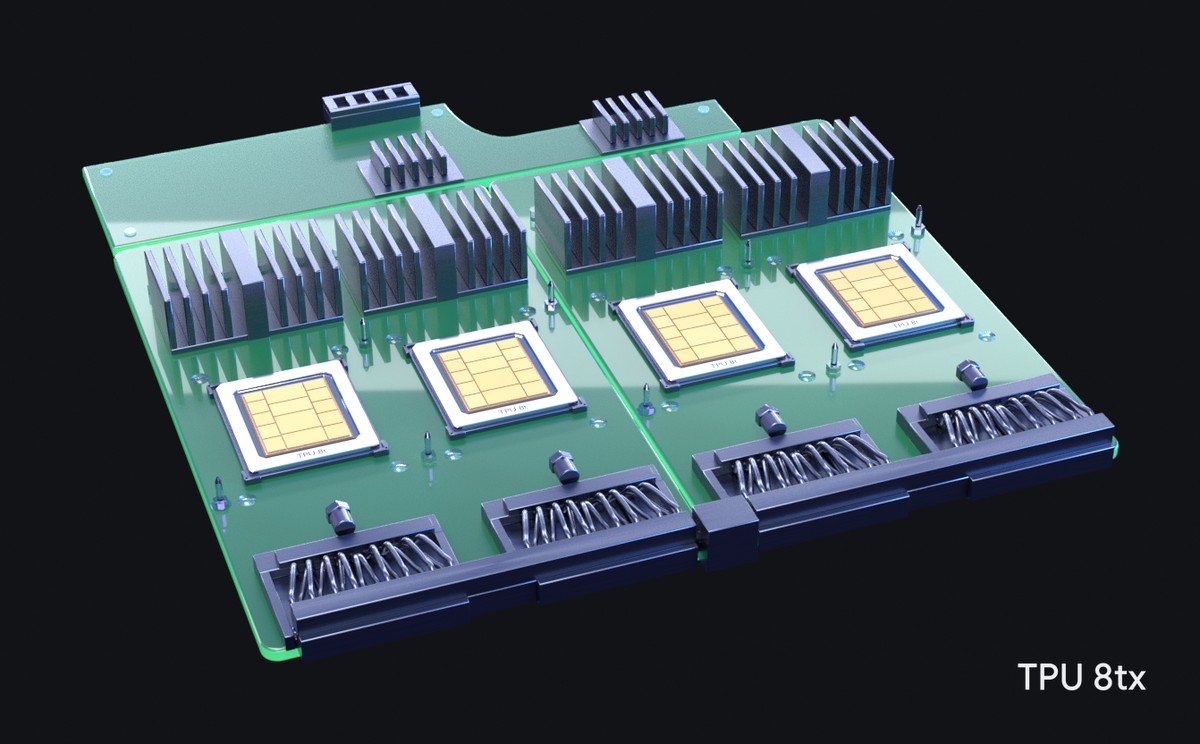
Google TPU 8tx 电路板示意图
Google 正在扩充其第八代 TPU 产品线,新增两款产品:TPU 8tx 与 TPU 8i Max。这是 Google 首次在单一年份内推出四种不同的系统配置,不过它们并非四款全新的芯片设计。8tx 基于现有芯片构建,面向机密计算,这标志着 AMD 的一次显著胜利;而 8i Max 则将两颗 8i 芯片集成到一个封装中,以应对超大规模上下文窗口。
我们在 Hot Chips 2026 上报道 TPU v8 系列时,曾重点介绍 Google 如何针对不同工作负载专门设计网络。面向推理的 TPU 8i 采用 Boardfly 拓扑,网络跳数直径最大为 7,而面向训练的 torus 设计则为 16 跳。这一结构差异降低了实时推理的延迟,也有助于解释为何 Google 持续定制互连,而非依赖单一网络架构。
Google TPUv8 Hot Chips 2026 TPU8i Boardfly 网络
TPU 8tx 是该代的第三款系统,面向那些在运行前沿模型或专有模型的同时处理敏感数据的受监管企业和政府机构。它采用与面向训练的 TPU 8t 相同的芯片,但 Google 为其搭配了定制的第五代 AMD EPYC“Turin”主机,将安全性直接构建在硬件层。通常情况下,数据在静态存储和传输过程中会被加密,但计算机处理数据时必须在内存中将其解密。8tx 通过机密计算让这些处于使用状态的数据持续受到保护,即在隔离的可信执行环境内对使用中的数据进行加密。
这是 Google 给出的 TPU 8tx 板卡渲染图。图中显示了四颗带有散热片的加速器芯片,以及沿着一侧边缘排列的连接端口,让人大致了解该托盘布局——它将这些加速器与配套的 Turin 主机 CPU 组合在一起。
Google TPU 8tx 板卡图示
在 8tx 的主机 CPU 方面,Google 选择了第五代 AMD EPYC Turin,以匹配 TPU 8t 的 PCIe Gen5 x16 接口。双路 Turin 配置可提供 128 条 Gen5 通道,确保四颗 TPU 与高速网卡之间不会出现 I/O 超配。Google 指出,像 AMD EPYC Venice 这样的 Gen6 主机平台(敬请期待更多相关消息)会降速至 Gen5 速率运行,且不会带来额外的加速器带宽,这与其 2027 年的硬件认证计划相符。
8tx 还采用了面向推理的 TPU 8i 所用的 Boardfly 网络,而非针对训练优化的环面(torus)拓扑。该拓扑减少了芯片之间的最大跳数,这对需要发起大量顺序推理调用的多步智能体而言至关重要。Google 声称,其延迟相比 TPU 8t 最多可降低 2 倍,而性能损失几乎为零。
Google TPU 8i Max 单封装集成两颗芯片并配备更多内存
第四个系统 TPU 8i Max 从另一个角度攻克内存墙。当众多智能体同时在整个代码库或数小时的视频上工作时,内存带宽会比算力更早成为瓶颈。Google 将两颗低延迟的 TPU 8i 芯片组合进一个多芯片封装。
这让 8i Max 的计算能力、SRAM 和高带宽内存(HBM)带宽都达到单个 TPU 8i 的两倍。具体来说,它提供 384 GB 高带宽内存,比 TPU 8i 多约三分之一,同时 HBM 带宽翻倍至 17.2TB/s,片上 SRAM 翻倍至 768 MB。TPU 8i Max 将 HBM 带宽翻倍至 17.2 TB/s,片上 SRAM 提升至 768 MB,直接应对制约大上下文智能体式工作负载的内存墙瓶颈。
Google TPU 8 硬件规格对比图
我们询问后,Google 告诉我们,如果数据必须留在机密计算域内,用户应继续使用 TPU 8tx 进行推理和服务。该系统保留了同样面向实时任务优化的低延迟 Boardfly 拓扑。
这里的关键信息大概是,Google 正在针对 AI 技术栈的不同环节、甚至不同客户来定制其 TPU 产品。TPU 8tx 更像是面向机密计算的定制化产品,而 TPU 8i Max 则是为推理而设计。对 AMD 而言,这大概不会一夜之间带来服务器 CPU 市场份额 10% 的提升。但它仍是一次重大胜利,因为 AMD 既在非 AMD 加速器系统中赢得了 EPYC 的订单,也通过在大型超大规模厂商中拿下一个插槽,展示了自己在机密计算方面的实力。
译文由英文原文机器翻译,术语按行业惯例统一,可在文末展开原文核对。
查看英文原文(Google TPU 8tx Pairs AMD EPYC Turin Hosts with Confidential Computing while TPU 8i Max Doubles Memory Bandwidth)
google tpu 8tx board illustration
Google is expanding its eighth-generation TPU portfolio with two new offerings, the TPU 8tx and the TPU 8i Max. This marks the first time Google has introduced four distinct system configurations in a single year, though it is not four new chip designs. The 8tx builds on existing silicon for confidential computing, marking a notable win for AMD, while the 8i Max combines two 8i chips into one package to tackle massive context windows.
When we covered the TPU v8s at Hot Chips 2026, we highlighted how Google specialized networking for different workloads. The inference-focused TPU 8i uses a Boardfly topology with a maximum network-hop diameter of seven, compared to sixteen hops in the training-oriented torus design. This structural difference reduces latency for real-time reasoning, helping explain why Google continues to tailor interconnects rather than rely on a single fabric.
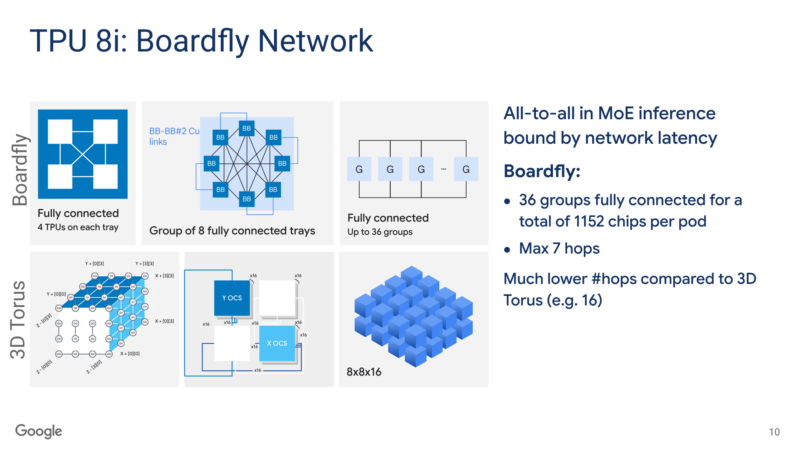 Google TPUv8 Hot Chips 2026 TPU8i Boardfly Network
The TPU 8tx is the third system in the generation and targets regulated enterprises and governments running frontier or proprietary models alongside sensitive data. It uses the same silicon as the training-focused TPU 8t, but Google has paired it with custom 5th Gen AMD EPYC “Turin” hosts to build security directly into the hardware layer. Normally, data is encrypted at rest and in transit but must be unlocked in memory while a computer processes it. The 8tx keeps that active data protected through confidential computing, which encrypts data in use inside an isolated trusted execution environment.
Here is Google’s rendering of the TPU 8tx board. The illustration shows four accelerator chips with heat sinks and connector ports along one edge, giving a sense of the tray layout that pairs these accelerators with their Turin host CPUs.
google tpu 8tx board illustration
For the 8tx host CPU, Google selected 5th Gen AMD EPYC Turin to match the TPU 8t’s PCIe Gen5 x16 interface. A dual-socket Turin configuration provides 128 Gen5 lanes, ensuring zero I/O oversubscription across four TPUs and high-speed NICs. Google noted that a Gen6 host like AMD EPYC Venice (stay tuned for more on that) would step down to Gen5 speeds without adding accelerator bandwidth, aligning with their 2027 hardware qualification schedule.
The 8tx also adopts the Boardfly network from the inference-oriented TPU 8i rather than the training-optimized torus. That topology reduces the maximum hops between chips, which matters for multi-step agents that make many sequential inference calls. Google claims up to 2x lower latency than TPU 8t with a near-zero performance penalty.
Google TPU 8i Max Packs Two Chips and More Memory
The fourth system, TPU 8i Max, attacks the memory wall from a different angle. When many agents work across an entire codebase or hours of video simultaneously, memory bandwidth becomes the bottleneck before compute does. Google combined two low-latency TPU 8i chips into a single multi-chip package.
That gives the 8i Max double the compute, double the SRAM, and double the HBM bandwidth of a single TPU 8i. Specifically, it offers 384 GB of high-bandwidth memory, about a third more than the TPU 8i, while HBM bandwidth doubles to 17.2TB/s and on-chip SRAM doubles to 768 MB. The TPU 8i Max doubles HBM bandwidth to 17.2 TB/s and on-chip SRAM to 768 MB, directly addressing the memory wall that bottlenecks large-context agentic workloads.
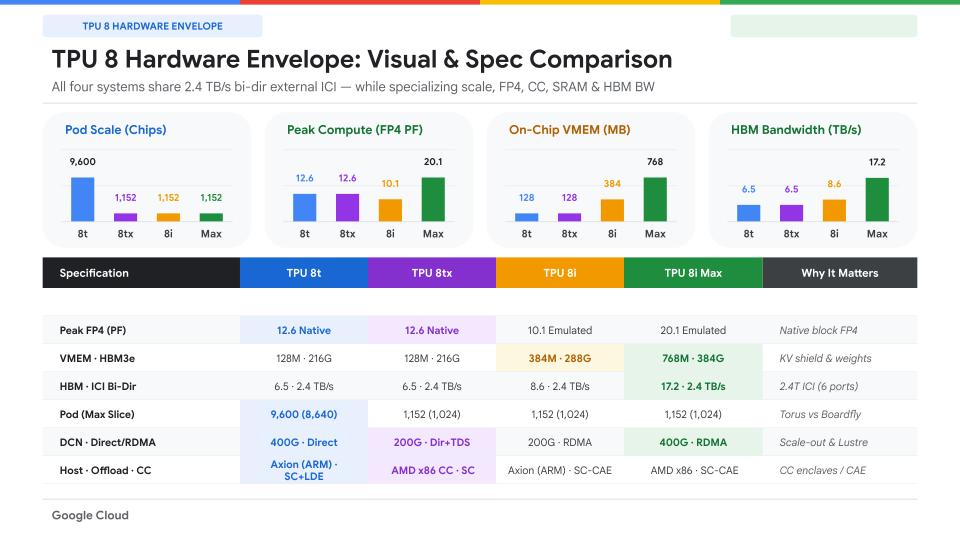 Google TPU 8 hardware spec comparison chart
We asked and Google told us that if data must remain within the confidential computing domain, users should stick with TPU 8tx for inference and serving. This system retains the same low-latency Boardfly topology optimized for real-time tasks.
Probably the key message here is that Google is tailoring its TPU offerings for different parts of the AI stack, and really even different customers. The TPU 8tx seems to be more of a customized product for confidential computing, while the TPU 8i Max is designed for inference. For AMD, this is probably not going to drive a 10% server CPU market share gain overnight. Instead, it is a big win because AMD is notching both a win for EPYC in a non-AMD accelerator system, and it is showing its confidential computing chops by winning a socket at a major hyperscaler.
原文为英文,正文由自动抓取并保留原文。
原文发布于 ServeTheHome(Google TPU 8tx Pairs AMD EPYC Turin Hosts with Confidential Computing while TPU 8i Max Doubles Memory Bandwidth),标题、摘要与正文由机器翻译,术语按行业惯例统一,未经人工逐句校订。