用可复用资产加速生成式 AI 交付
如果你正在构建生成式 AI 解决方案,可复用资产可以帮你不再重复重建已经存在的组件:检索增强生成(RAG)流水线、文档处理器、智能体脚手架等。这会带来累积成本:这些时间没有用于解决客户的实际问题。
本文将介绍如何访问 AWS Generative AI Innovation Center(现为 AWS Frontier AI Engineering & Services 的一部分)精选的 23 个生产就绪资产目录。这些资产可以将你的开发时间从数月缩短到数周,DoorDash、Lyft 和 Ricoh 等公司提供了佐证。
自 2023 年以来,AWS Generative AI Innovation Center 一直发布开源可复用资产。这些生产级构建块为你提供一个经过验证的基础,让你不必从空白文件开始。这些资产已为客户的解决方案提供支持,并带来可衡量的成果:测试能力提升 50 倍、工程工时减少 90%、部署时间线从数月压缩到数周。在本文中,你将了解为什么团队不断重复构建生成式 AI 组件、是什么让资产真正可复用、DoorDash 和 Ricoh 等公司如何通过使用这些资产取得可衡量的成果,以及如何访问和部署目录中的 23 个开源资产。有关所有可用资产的完整列表,请参阅本文末尾的资产目录。
三个根本原因导致生成式 AI 团队出现重复开发:
重复重建的成本会不断叠加。每一次冗余的构建都会消耗工程工时、延误客户交付,并带来维护负担。即便是 AI 生成的代码,也需要生产环境加固、安全审查、规模化测试以及持续维护。而这些资产在交付时已经过验证、安全审查并达到生产级标准,从而免去了这部分验证负担。当团队终于推进到生产阶段时,他们已经花了数周时间在做那些本不应重复的繁重基础工作——而这些工作本应从第一天起就可复用。AWS Frontier AI Engineering & Services 通过可复用资产解决了这一难题。
可复用资产不是代码片段,也不是示例。它是一个生产级、可组合的构建模块,实现了某项独立的生成式 AI 能力。可复用资产在发布前会经过质量与安全验证。它们附带清晰的部署指南以便于发现,并内置了监测机制以跟踪其在客户项目中的采用情况。这些资产在其整个生命周期内都受到维护。
该资产目录中的示例包括检索增强生成(RAG)流水线组件、文档摄取模块、智能体脚手架模板、评估框架以及提示词管理模式。这些资产在生产环境中经过测试,接受安全合规审查,并根据真实客户反馈持续优化。
这就是一次性产物与你可以信赖的构建模块之间的差别。
可复用资产的价值并非纸上谈兵。当团队基于经过验证的基础来构建,而不是从零开始时,情况是这样的。
根据 AWS 案例研究,DoorDash 利用 Contact Center GenAI Agent 资产构建了一套完全由语音操作的自助式生成式 AI 联络中心解决方案。据报道,该解决方案每天处理超过 10 万通电话,响应延迟为 2.5 秒,测试能力提升了 50 倍。使用 Amazon Bedrock 将开发时间缩短了 50%。团队在 2 个月内就达到了可进行实况测试的状态。
Lyft 使用同一套 Contact Center GenAI Agent 资产,为乘客和司机实现了智能体式 AI,展现出该资产在不同客户互动模式下的通用性。
Contact Center GenAI Agent 为文本和语音渠道提供自动问答能力。它采用检索增强生成(RAG)架构,在维持上下文的同时支持多轮对话。该解决方案与 Amazon Connect 集成,并使用 Amazon Bedrock Knowledge Bases——一项完全托管的 RAG 能力——来实现混合搜索和元数据过滤。
Ricoh 服务于大型健康保险付款方、管理式医疗组织和医疗服务提供方。这些客户每月处理数十万份关键文档,包括保险理赔、申诉、上诉和临床记录。随着 Ricoh 扩大规模以服务更多医疗客户,他们需要一种标准化的多租户文档处理方式。这种方式必须能够在无需为每个新部署单独开发和调优的情况下完成上线。
以 Accelerated Intelligent Document Processing on AWS 资产为基础,Ricoh 构建了一套标准化的多租户解决方案,用于自动化的文档分类与提取。这将其文档处理从定制工程的瓶颈转变为可扩展、可重复的服务。
结果:正如已发布的案例研究中所记录,Ricoh 实现了 7 倍的吞吐提升,从每月 10,000–70,000 份文档。每次部署的工程工时下降超过 90%(从 80 小时降至不足 5 小时)。上手时间从 4–6 周缩短至 2–3 天。该系统目前可在流量高峰期间于数分钟内处理 1,000 份文档,每年可节省超过 1,900 个潜在人时。
在这篇 2025 年博客文章中介绍的 GenAI IDP Accelerator,是一套可扩展的无服务器解决方案,利用 AWS 服务实现文档处理与信息提取的自动化。该系统将光学字符识别(OCR)与生成式 AI 相结合,可大规模地将非结构化文档转换为结构化数据。AWS Frontier AI Engineering & Services 也持续维护这些资产。
随着团队将重心从基础设施转向业务逻辑,可复用资产的价值愈发凸显。近期发布的两项资产展示了可复用构建模块如何加速下一代智能体式应用的开发。
Fullstack AgentCore Solution Template(FAST)是一个入门项目代码库。借助 FAST,你可以快速部署一个安全加固的 React 前端,并连接到 Amazon Bedrock AgentCore——这是一个可用任意框架或模型大规模构建、连接和优化智能体的平台。在此实现中,FAST 采用基于 React 的前端并依托 AgentCore 的托管基础设施,将全栈智能体式应用的构建周期从数周缩短至数天。
FAST 可在 30 分钟内完成部署,采用基础设施即代码(IaC),并内置了与 AgentCore memory(Amazon Bedrock AgentCore 的一项能力)的集成,以及 Gateway、Code Interpreter 和 Observability。身份验证使用 Amazon Cognito,并按企业安全最佳实践进行配置;该模板专为 AI 辅助开发而设计,配有详尽的文档和 steering 指导文档。
借助 FAST,你可以获得一套完整的参考架构,了解各部分如何集成,并配有一个可运行的全栈应用,供你学习并在此基础上继续构建。得益于模块化设计,随着需求演进,你可以替换主要组件(身份提供商、前端框架、托管解决方案或智能体框架)。
Agentic Chatbot Accelerator 是一个 Web 应用部署解决方案,使用 AWS Cloud Development Kit(AWS CDK)实现基础设施即代码,从而让你可以创建智能体式聊天机器人。该解决方案构建于 Strands Agents 和 Amazon Bedrock AgentCore 之上,简化了智能体式聊天机器人应用的开发。
该加速器借助 AWS CDK 实现快速部署,并通过 Strands Agents 和 Amazon Bedrock AgentCore 提供可扩展的智能体运行时管理。它可配置、可扩展,适用于多种聊天机器人用例,并针对身份验证、托管和扩展提供了预配置模式,已在客户部署中得到验证。
让我们通过一个具体示例,演示如何从开源目录中选择并使用 Contact Center GenAI Agent 资产。
要跟随本示例操作,你需要:
你正在构建一个客户支持解决方案,它需要同时处理语音和文本交互,使用公司的知识库回答问题,并将复杂问题升级给人工坐席。
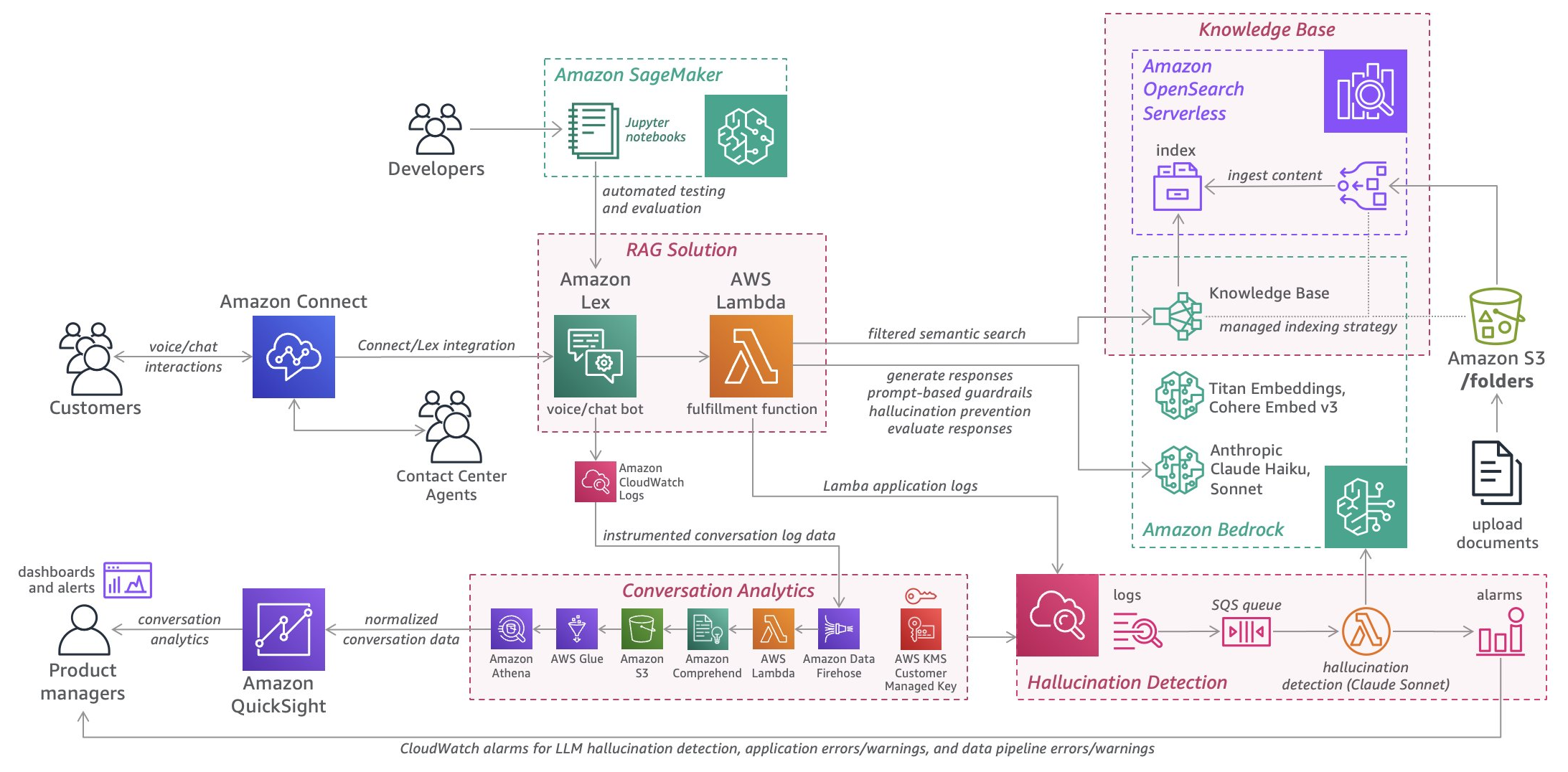
前往 GitHub 上的 Contact Center GenAI Agent。README 对其能力、架构和部署步骤做了清晰概述。下图展示了 Contact Center GenAI Agent 的解决方案架构。
图 1:Contact Center GenAI Agent 的解决方案架构
该资产包含经过安全审查的代码,采用 AWS CDK 基础设施即代码,集成了用于语音和聊天的 Amazon Connect,以及 Amazon Bedrock Knowledge Bases——一项全托管的检索增强生成(RAG)能力,用于问答。其中还内置了自动化测试框架和对话分析仪表板。
负责任 AI 控制是该架构的固有组成部分。Amazon Bedrock Guardrails 实施生产级安全控制,包括幻觉检测、内容过滤和主题级边界,确保智能体从第一天起就在既定的安全参数内运行。
原文较长,译文为节选;译文由英文原文机器翻译,术语按行业惯例统一,可在文末展开原文核对。
查看英文原文(Accelerating generative AI delivery with reusable assets)
If you’re building generative AI solutions, reusable assets can help you stop rebuilding components that already exist: Retrieval Augmented Generation (RAG) pipelines, document processors, agent scaffolding, and so on. This has a compounding cost: time not spent solving the customer’s actual problem.
This post shows you how to access a curated catalog of 23 production-ready assets from the AWS Generative AI Innovation Center, now part of AWS Frontier AI Engineering & Services. These assets can reduce your development time from months to weeks, with evidence from companies like DoorDash, Lyft, and Ricoh.
Since 2023, the AWS Generative AI Innovation Center has published open source reusable assets. These production-grade building blocks give you a validated foundation to start from instead of a blank file. These assets have powered customer solutions delivering measurable results: 50x increases in testing capacity, 90 percent reductions in engineering hours, and deployment timelines compressed from months to weeks. In this post, you will learn why teams keep rebuilding generative AI components, what makes an asset truly reusable, how companies like DoorDash and Ricoh achieved measurable results by using these assets, and how to access and deploy 23 open source assets from the catalog. For a complete list of all available assets, see the asset catalog at the end of this post.
The problem: Why teams keep rebuilding
Three root causes drive redundant development across generative AI teams:
- No single source of truth – Assets scatter across repositories, wikis, and drives. Builders can’t find what exists, so they rebuild from scratch.
- No quality signal – Without verification of production readiness, security reviews, or maintenance status, builders have no way to trust existing solutions and default to writing their own code.
- No reuse culture – Sharing remains informal and ungoverned. What one team builds stays with that team, and problems get solved repeatedly.
The cost of rebuilding compounds. Each redundant build consumes engineering hours, delays customer delivery, and creates maintenance burden. Even AI-generated code requires production hardening, security reviews, testing at scale, and ongoing maintenance. These assets arrive already validated, security-reviewed, and production-grade, avoiding that verification burden. When teams finally reach production, they’ve spent weeks on undifferentiated heavy lifting, work that should have been reusable from day one. The AWS Frontier AI Engineering & Services resolves this challenge through reusable assets.
What a reusable asset actually is
A reusable asset isn’t a code snippet or a sample. It’s a production-grade, composable building block that implements a discrete generative AI capability. Reusable assets are validated for quality and security before publication. They include clear deployment guides for discoverability and are instrumented to track adoption across customer engagements. These assets are maintained across their lifecycle.
Examples from the catalog include RAG pipeline components, document ingestion modules, agent scaffolding templates, evaluation frameworks, and prompt management patterns. The assets are tested in production environments, reviewed for security compliance, and refined based on real customer feedback.
This is the difference between a one-off artifact and a building block you can trust.
Real results: Customer success stories
The value of reusable assets isn’t theoretical. Here’s what happens when teams build on proven foundations instead of starting from scratch.
Contact Center GenAI Agent: DoorDash and Lyft
According to the AWS case study, DoorDash built a fully voice-operated self-service generative AI contact center solution using the Contact Center GenAI Agent asset. As reported, the solution handles over 100,000 calls per day with 2.5-second response latency, achieving a 50x increase in testing capacity. Using Amazon Bedrock reduced development time by 50 percent. The team reached live testing readiness in 2 months.
Lyft used the same Contact Center GenAI Agent asset to bring agentic AI to life for riders and drivers, demonstrating the asset’s versatility across different customer engagement models.
The Contact Center GenAI Agent provides automated question answering capabilities for both text and voice channels. It employs a RAG architecture to facilitate multi-turn conversations while maintaining context. The solution integrates with Amazon Connect and uses Amazon Bedrock Knowledge Bases, a fully managed RAG capability, for hybrid search and metadata filtering.
Learn more:
GenAI Intelligent Document Processing: Ricoh
Ricoh serves major health insurance payers, managed care organizations, and healthcare providers. These customers process hundreds of thousands of critical documents each month, including insurance claims, grievances, appeals, and clinical records. As Ricoh scaled to serve more healthcare customers, they needed a standardized, multi-tenant document processing approach. That approach had to onboard new implementations without requiring unique development and tuning for each one.
Using the Accelerated Intelligent Document Processing on AWS asset as a foundation, Ricoh built a standardized, multi-tenant solution for automated document classification and extraction. This transformed their document processing from a custom-engineering bottleneck into a scalable, repeatable service.
Results: As documented in the published case study, Ricoh achieved a 7-fold throughput increase, from 10,000–70,000 documents monthly. Engineering hours per deployment dropped by over 90 percent (80 hours to under 5). Onboarding time fell from 4–6 weeks to 2–3 days. The system now processes 1,000 documents in minutes during traffic spikes, delivering over 1,900 potential annual person-hours in savings.
The GenAI IDP Accelerator, introduced in this 2025 blog post, is a scalable, serverless solution for automated document processing and information extraction using AWS services. This system combines optical character recognition (OCR) with generative AI to convert unstructured documents into structured data at scale. The AWS Frontier AI Engineering & Services continuously maintains the assets as well.
Learn more:
- Blog post: AWS GenAI Intelligent Document Processing (IDP) Accelerator
- Blog post: How Ricoh built a scalable intelligent document processing solution on AWS.
- Source Code: accelerated-intelligent-document-processing-on-aws
New assets: Building the future of agentic AI
Reusable assets become more valuable as teams shift focus from infrastructure to business logic. Two recently launched assets demonstrate how reusable building blocks can accelerate the development of next-generation agentic applications.
Fullstack AgentCore Solution Template (FAST)
The Fullstack AgentCore Solution Template (FAST) is a starter project repository. With FAST, you can quickly deploy a secured React frontend connected to Amazon Bedrock AgentCore, a platform to build, connect, and optimize agents at scale with any framework or model. In this implementation, FAST uses a React-based frontend with the managed infrastructure of AgentCore to accelerate building full-stack agentic applications from weeks to days.
FAST deploys in under 30 minutes using infrastructure as code (IaC), with built-in integrations for AgentCore memory, a capability of Amazon Bedrock AgentCore, along with Gateway, Code Interpreter, and Observability. Authentication uses Amazon Cognito, configured with enterprise security best practices, and the template is designed for AI-assisted development with extensive documentation and steering docs.
With FAST, you can access a complete reference architecture that shows you how the pieces integrate, with a working full stack application that you can learn from and build upon. With the modular design, you can swap out major components (identity providers, frontend frameworks, hosting solutions, or agent frameworks) as your requirements evolve.
Learn more:
- FullStack AgentCore Solution Template
- Accelerate agentic application development with a full-stack starter template for Amazon Bedrock AgentCore
Agentic Chatbot Accelerator
The Agentic Chatbot Accelerator is a web application deployment solution that uses the AWS Cloud Development Kit (AWS CDK) for infrastructure as code so you can create agentic chatbots. Built on Strands Agents and Amazon Bedrock AgentCore, this solution streamlines the development of agentic chatbot applications.
The accelerator provides rapid deployment using AWS CDK, with scalable agent runtime management through Strands Agents and Amazon Bedrock AgentCore. It is configurable and extensible for diverse chatbot use cases, with pre-configured patterns for authentication, hosting, and scaling, validated across customer deployments.
Learn more:
Walkthrough: Using an asset from the library
Let’s walk through a concrete example of selecting and using the Contact Center GenAI Agent asset from the open source catalog.
Prerequisites
To follow this walkthrough, you need:
- An AWS account with permissions to create AWS CloudFormation stacks, Amazon Connect instances, Amazon Bedrock resources, and Amazon Quick Sight dashboards.
- AWS Command Line Interface (AWS CLI) installed and configured with appropriate credentials.
- An Amazon Connect instance (or permissions to create one).
- Access to Anthropic Claude Sonnet and Anthropic Claude Haiku on Amazon Bedrock.
- A Jupyter notebook environment for validation testing.
The scenario
You’re building a customer support solution that needs to handle both voice and text interactions, answer questions using your company’s knowledge base, and escalate complex issues to human agents.
Finding the asset
Navigate to Contact Center GenAI Agent on GitHub. The README provides a clear overview of capabilities, architecture, and deployment steps. The following figure shows the solution architecture for the Contact Center GenAI Agent.
Figure 1: Solution architecture for the Contact Center GenAI Agent
Evaluating the asset
The asset includes security-reviewed code with AWS CDK infrastructure as code, integration with Amazon Connect for voice and chat, and Amazon Bedrock Knowledge Bases, a fully managed RAG capability, for question answering. An automated testing framework and conversation analytics dashboard are built in.
Responsible-AI controls are integral to the architecture. Amazon Bedrock Guardrails enforces production-grade safety controls, including hallucination detection, content filtering, and topic-level boundaries, making sure agents operate within defined safety parameters from day one.
The repository shows active maintenance, comprehensive documentation, and links to customer success stories (DoorDash, Lyft) that validate production readiness.
Deploying the solution
Deployment follows four steps:
- Clone the repository and install dependencies.
- Deploy two AWS CloudFormation templates: one for the Knowledge Base stack and one for the RAG solution stack.
- Integrate with Amazon Connect using the pre-built contact flows included in the repository.
- Validate the deployment using the included Jupyter notebooks.
The full process takes under an hour. The solution also includes an Amazon Quick Sight dashboard for real-time conversation analytics.
For detailed deployment instructions and prerequisites, see the deployment guide.
Clean up
To avoid ongoing charges, delete the resources created during this walkthrough. The deployment uses two AWS CloudFormation stacks, so deletion follows the reverse order:
- Delete the RAG solution stack from the AWS CloudFormation console.
- Delete the Knowledge Base stack from the AWS CloudFormation console.
- Remove the Amazon Connect contact flows created during integration.
- Delete the Amazon Quick Sight dashboard and any associated SPICE datasets.
- For detailed cleanup instructions, see the deployment guide.
The outcome
Instead of spending weeks building a contact center solution from scratch, you can deploy a security-reviewed, tested foundation in days. Your team focuses on customizing the knowledge base, refining prompts for your domain, and integrating with your existing systems. This is the high-value work that differentiates your solution.
Potential time saved: 4–6 weeks of development time
What you focus on instead: Domain-specific customization, prompt engineering, business logic integration
Access to the AWS Generative AI Innovation Center open source assets
You can access 23 reusable assets as open source on GitHub and AWS Labs. Each asset includes deployment guides, sample code, and documentation to help you get started quickly.
Document processing and extraction
- GenAI Intelligent Document Processing (GenAIDP) – Scalable, serverless solution for automated document processing.
- Multi-lingual Document Processor (MDP) – Transforms complex multi-modal documents into structured text.
- Intelligent Document Processing with Generative AI – Extract information from custom documents.
- Extracting Information From Complex Documents – Hands-on workshop for document extraction.
- Semi-Structured Documents Automatic Pre-Labeling Tool – Automates pre-labeling for Amazon Comprehend.
Contact center and voice
- Contact Center GenAI Agent – Automated question answering for voice and text channels.
- Live Call Analytics with Agent Assist (LCA) – Real-time generative AI for customer and agent voice calls.
- Contact Center: Post Call Analytics (PCA) – Generative AI analysis of post-call recordings.
- Live Meeting Assistant (LMA) – Captures audio from browser-based meetings with transcription and insights.
- Recorded Voice Insight Extraction Webapp (ReVIEW) – Upload recordings and use generative AI to answer questions.
Agentic AI and chatbots
- Fullstack AgentCore Solution Template (FAST) – Deploy secured React frontend with AgentCore backend.
- Agentic Chatbot Accelerator – Web application deployment for agentic chatbots.
- Fashion Assistant Agent – Fashion assistant built with Amazon Titan on Amazon Bedrock AgentCore.
- Natural Language Database Agent – Query databases using natural language with LangGraph.
RAG and knowledge bases
- Deploy Amazon Bedrock Knowledge Bases using Terraform – Infrastructure as code for Knowledge Bases.
- Leveraging the User to Improve Agents in RAG Use Cases – Custom LangChain tool for conversational RAG.
- Reranker Fine-Tuning and Deployment – Fine-tune BAAI BGE Reranker for improved retrieval.
- Durable Semantic Caching in Amazon MemoryDB – Persistent semantic caching for GenAI applications.
Development and migration
- C to Java Code Conversion – Agentic workflow for legacy code migration.
- OpenAI Migration Framework – Systematic framework for large language model (LLM) migration.
- Fine-tuning ModernBERT for Intent Classification – Create smart LLM routing systems.
Infrastructure and operations
- Bedrock Logging Automation – Automate logging setup for Amazon Bedrock.
- Data Analyst BI – AI-powered business intelligence tool for non-experts.
To get started:
- Select one of the assets listed earlier.
- Review the README and deployment guides for assets relevant to your use case.
- Clone the repository and follow the deployment instructions.
- Customize the asset for your specific requirements.
- Reach out to the AWS Frontier AI Engineering & Services team for advisory support.
Conclusion
The cost of rebuilding is real, and it compounds. When teams rebuild RAG pipelines, recreate document processing logic, or start from scratch, those hours add up in engineering time that could have been spent solving actual customer problems.
A curated, validated asset catalog changes the economics of generative AI delivery. Not by doing the work for you, but by making sure you’re not doing work that’s already been done. The 23 open source assets published since 2023 represent thousands of engineering hours, dozens of customer engagements, and countless lessons learned. They’re packaged into building blocks you can deploy today.
The assets are open source. The deployment guides are comprehensive. The customer’s success stories are real. Start with one asset that matches your current challenge. For expert assistance, reach out to the AWS Generative AI Innovation Center.
About the authors

Sabine Khan
Sabine is a global tech lead for Generative AI Reusable Assets and Asset Governance in the AWS Frontier AI Engineering & Services. She supports AWS customers in scaling their generative AI strategies by delivering production-ready AI systems and driving agentic AI projects from concept to deployment. With over 20 years of experience in technology innovation, machine learning, and computer vision, she bridges advanced research with enterprise-grade production systems. Before AWS, she led cross-functional engineering organizations and large-scale digital transformation initiatives across Houston’s energy sector. Sabine holds a Master’s in Geoscience and an MBA in Information Technology.

Harshit Kumar Gupta
Harshit is a Machine Learning Engineer at Amazon with over 10+ years of experience spanning software development, generative AI, and natural language processing. He specializes in building Agentic and responsible AI systems that bridge the gap between advanced research and production-ready solutions. Throughout his career at Amazon, Intel Security, CognitiveScale, and Cadence, he has had the opportunity to work with deep learning, NLP, and large-scale distributed systems. He holds a Master of Technology from IIT Delhi. His work at AI Assets has provided AWS practitioners with insights from research to real-world impact.

Sanchita Basak
Sanchita is a Data Scientist at the AWS Frontier AI Engineering & Services, where she applies her expertise to the evolving landscape of agentic systems, physical AI, and large-scale machine learning. With a Master of Science from Vanderbilt University, she has spent several years building machine learning systems across natural language processing, predictive analytics, and forecasting applications. Her peer-reviewed research has been published across multiple international journals and conferences and was recognized with best paper awards. She focuses on translating AI research into production systems that solve business problems, helping enterprise customers implement ML solutions that drive operational efficiency and strategic outcomes.
正文保留英文原文,标题与摘要由机器翻译。
原文发布于 AWS Machine Learning(Accelerating generative AI delivery with reusable assets),标题、摘要与正文由机器翻译,术语按行业惯例统一,未经人工逐句校订。